Leaderboard



Popular Content
Showing content with the highest reputation on 10/21/2023 in all areas
-
1/2 ton trucks can be purchased that have more than enough power and brakes to handle virtually anything that North America can throw their way without adding "all sorts of accessories". The main issue that can cause people "problems" with 1/2 ton trucks is relative to how much "stuff" can be carried on or in these trucks. Owners who can be classified as "minimalists" have no problems and owners that generally travel alone should have no problems. But, if you add another person, plus a pet, plus a fire pit, plus bikes, plus, plus, plus, etc. the carrying capacity of a 1/2 ton can soon be reached and/or exceeded. Bill4 points
-
We have just returned from our month long trip out West and was beginning to put together a list of what I wanted to order to replace our Dometic Penguin II A/C with the Dometic Freshjet (see following article:) I pulled down the interior plastic air distribution panel to get a picture of the exact model number and verify that mine could be replaced before I put together a list to order. My son-in-law and I were going to do it. What I discovered was some flexible ducting that the jetstream of air was being routed through that had to be vibrating, rattling, creating all sorts of air disturbance. So I decided before ordering maybe it would be worth it to try and see if I could do anything to make a difference. The worst I could do would be to break something, then I would have another excuse to order the Freshjet. Anyway, I left the tubing in place and lined it with styrofoam blocks I cut out on my table saw and band saw (they work so much better than trying to cut with a box knife). My goal was to seal any cracks and make the path for the air to be as straight and clear as possible to prevent air turbulence. I included pictures of before and after below. So the results are not as great as what I expect you would get from the Freshjet, Houghton, or Truma, but I was surprised what a difference it made. Now I am at least going to wait another year and see how this works out. I forgot to get a picture of my phone of the sound before, but it was averaging between 74&75 dB. Afterwards under the same conditions (vent openings the same, phone in same location and orientation, and no background noise) the sound level had dropped to 67 dB which you could easily tell an audible difference. I am not sure how my phone app would compare to a real dB meter, but I suspect the 7 dB drop is not that far off. The other thing that was eliminated was the vibration the A/C seemed to have. If you have questions, feel free to ask, and if you have other suggestions, please do so. I am not a sound engineer and I started this just playing around so I am very open to other suggestions.
 2 points
 -
Nice "Halloween" touch to the Oliver Logo2 points
-
I have this one off amazon: https://www.amazon.com/dp/B0CCX4XGC8?psc=1&ref=ppx_yo2ov_dt_b_product_details it did require some modification and fitting but it works pretty good. Im 6'2" so it does make it a tight fit to stand in the shower, however i also have a "squatty potty" type stool in there and usually shower sitting on that. Im used to having to shower on a rocking ship so its usually easier for me to shower sitting down on the ship anyways so im used to it.2 points
-
GJ NOTE: This response is written for newer owners or those not well familiar with our OTT water systems. For the OTT Pros, it is overkill. The Freshwater Port (On the street side) is designed to flow water directly into the OTT 32-gallon water tank. My experience is that it can flow via gravity or a shore provided pressure system/pump. To flow via gravity, you need a several feet of pressure head. I.E. the tank on your TV needs to be a higher than the top of the OTT water storage tank. The higher the pressure head the faster water will flow. On occasion I have put a 25-gallon soft flexible tank on top of my bed cover to gravity flow water to the OTT freshwater tank. A friend puts that same tank on top of his ancient Chevy. NOTE: Not all bedcovers or cab roofs will take such loadings without damage. His is made from 1950 real steel, and my bed cover is rated for 500 pounds. If you can't get the head elevation on your rig, then a pump will be needed if you are sucking water from a non-pressurized source. I tried putting the flexible tank in the bed of my F-150, but it did not flow much water. I suspect that the pressure head was insufficient to overcome a check valve in the Freshwater Port line. It is possible to draw water out of the tank using you OTT pump and fill at the same time via gravity or under citywater pressure. The Citywater Port that is located adjacent to the Fresh Water Port. This port bypasses the OTT water storage tank and when connected to shore pressurized source will send water directly to the OTT faucets. Do not use your OTT pump as the pressure is provided from outside the trailer (Your pump or the City System). There are significant risks in using the Citywater port. I.E. the city or well may be pumping out water at a pressure that our plastic pipe will not handle. Personally, I own a pressure reducing valve and still very very rarely use this port. Freshwater and Citywater Ports Caution: Under very high shore water pressure or if you oversize your supplemental pump, there is a potential for over pressurization of the freshwater system. Be sure to check the flow rate/pressure at the fill point after it has been filtered by your blue filter. Also, as the freshwater tank fills, it is wise to also slow down the fill rate as you approach the capacity of the freshwater tank. No point in over pressurizing the systems and risk of damage as a result. The Boondocking Port is my primary go to when boondocking. I purchased a stiffer 6-foot garden hose that is cut near the middle to provide two hoses. The side with the female end stays in the TV. The side with the male hose bibb connection stays in Ollie. The one in Ollie is longer than the one in the TV. This allows me to elevate the 5-gallon water jugs to the tailgate of my TV for faster water transfer. WHY? To provide greater pressure head to the OTT pump when onboarding. To boondock onboard water you have to flip the valves and use your OTT pump. No, you cannot draw water from the faucets while using this Port. PS: Recommend you cut the 6' hose at a 45-degree angle. Helps prevent it from sucking down onto the sides of the water jugs. I hope that the above is useful. Geronimo John2 points
-
If we're not having fun, we're not doing it right.2 points
-
Thanks for all the advice!! Bit the bullet and bought a 2024 gmc 2500 diesel.2 points
-
I've towed my LEII with two different 1/2 ton trucks both here in the East and through out the Rockies out West. Absolutely no problems . However, you will need the Andersen weight distribution hitch AND you will need to pay particular attention to your payload capacity. Bill p.s. picking up a new Ollie in October is fantastic! You've got the better part of two months to do some serious camping and then you have the winter to do your mods plus get all those things you've learned that you want for that new baby. Welcome to the family!2 points
-
Hi all, We now have our deposit down!! - and are starting to look at minor customizations. So our first area to focus on is a rear table for the twin. Clearly Overland's approach to a flexible table is elegant, functional, and good looking, so I'm looking at using that as a foundation. I'm also interested in adding one more piece of functionality to literally support our two small (12lb) dogs. I'd like to use something similar for the support that Foy is using for his twin to king conversion. Something that brings enough vertical strength that would de-risk collapsing the Lagun arm or fracturing fiberglas from a wayward human. And once there is enough support we could use the same mattress material as those used in the beds, so that it would nearly be a functional king. If Foy sees this I would love to have that dialog. I know I can reach him directly, but it seemed better to launch it in the forum. - Thanks - Doug1 point
-
Hi, I am picking up my new Elite II in October and will be driving straight to Pigeon Forge to Camp Margaritaville for 5 nights and then back home to Greensboro NC. I have a 2017 Chevy Silverado 5.3 Z71 4 wheel Dr. with 3.42 axle. My question is do I have enough truck to keep me comfortable while towing in the mountains. I have 5 years before retirement and would probably jump to a 2500 then, we will be traveling the country after retirement but mostly weekends until then. Thank you, Mark1 point
-
Correct 14GA is the most common automotive wire gauge and would be fine for most OTT circuits. Sometimes they use lighter 16-18A for electronics. 12GA perhaps as a relay output, where you need higher amperage. All automotive/trailer wiring should be a stranded wire type. Only household wire is solid copper.1 point
-
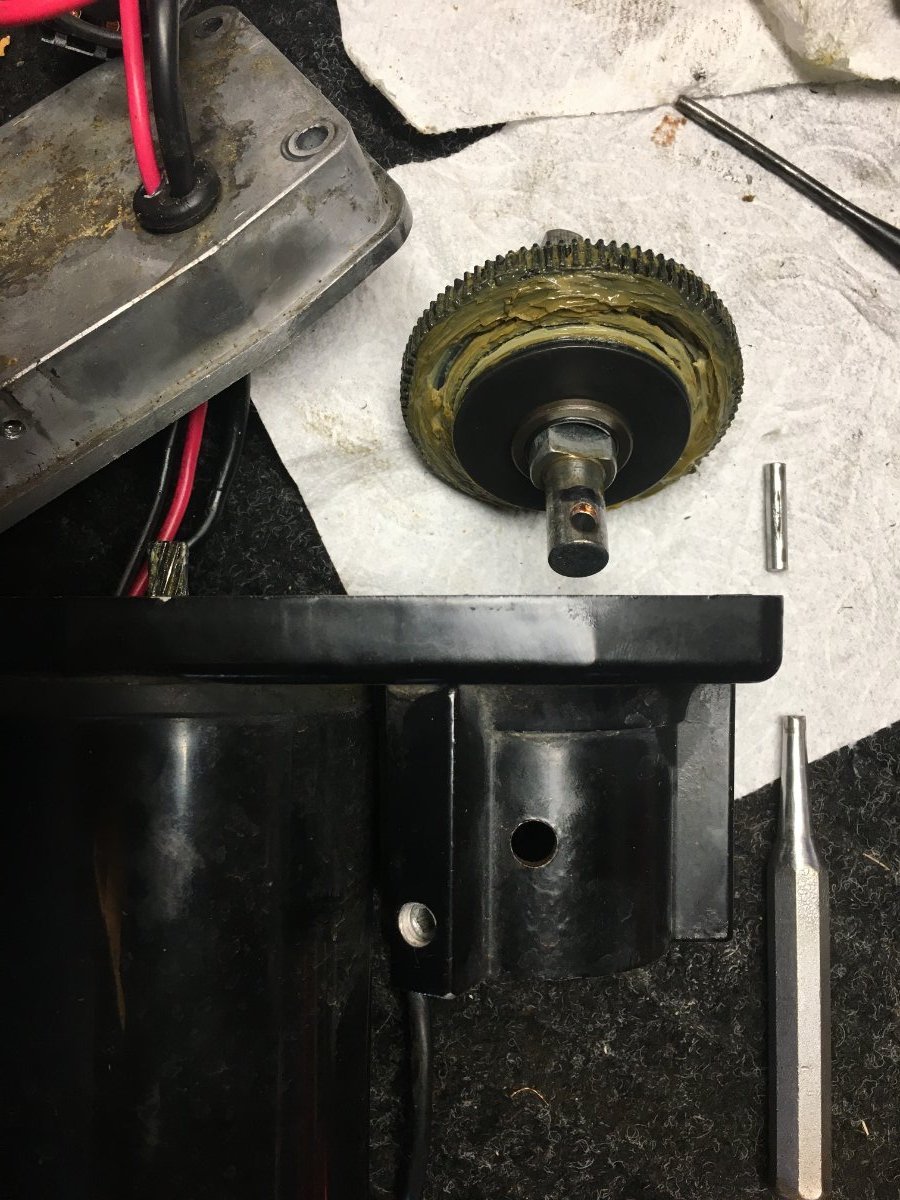
This OTT Service video is just about useless! If that's all you're going to do, don't bother, they would be better off sealed and left alone. @John E Davies wrote a how-to video. Then check page 2 where I added my update. I'm believe I'm the only one who worked the complete service, since where you really need new grease is under the gears and there is another step in removing them (see pic). What it looks like by merely removing the cover is insufficient, as you would not even see the worn grease underneath. Check out this link and when you're done, watch the service video again for grins. 🤣
1 point
-
Very true...we started out with many trips to the CAT scales before leaving on this year's trip. As full timers we carry everything we own with us and we have a topper on our truck bed. We found we have to transfer 150 lbs (3 tool bags and 2 buckets of liquids) from the truck to the trailer every time we move on to our next destination and transfer it back when we reach our campsite. A slight PITN, but necessary. That puts us at 6800 lbs on the trailer for travel and reduces the truck weight to 6770 lbs (our GVWR is 6800 for the truck) with 10% tongue weight, full propane tanks, full tank of gas in the truck, and fridge/supplies stocked up. So pretty much if we want to add anything, we have to get rid of something. On a better note, I think we've lost 20 lbs each from all of our hiking :) so a trim down on things we can get rid of in a couple of weeks when we get back to SC and we may be able to add that battery/solar powered portable refrigerator or maybe a second awning for our Oliver. All part of this wonderful deal :) John1 point
-
I don't specifically know the guage of wire that Oliver uses. But, I've always assumed that it is "standard automotive wire" that is normally 14 guage like THIS STUFF. A quick call to Oliver Service would confirm this though. Bill1 point
-
Absolutely! When and where allowed I will set up one of THESE TENTS for privacy along with a solar shower. Mossemi also designed an enclosure that is basically a three sided curtain and can be attached to the side of the Ollie near the outdoor shower. Either way, I always use unscented soap - particularly in bear country. Bill1 point
-
I bit the bullet as well. Bought a 2007 GMC Duramax LBZ with the Allison 6 speed. I know a lot of people use half tons to tow. And they use all sorts of accessories to just barely get the stability and control they need and they accept being marginally powered. I get it. Trade offs. Expense. Doing weight math ten different ways to make sure you are legal, safe, sane. But I have a million things in my mind on these journeys. I don't want to worry about whether I have just enough tow vehicle to be safe. I would prefer to have the confidence of a safety and convenience margin.1 point
-
I’ll save a place to note the outcome.1 point
-
this was something i had been thinking about laying in bed a few weeks ago listening to the AC. it really seems like the compressor itself doesnt make an unreasonable amount of noise at least to me with the soft start. the main issue is with the air blasting like a jet engine against the interior panel. my brother has a 3d printer and i have some CAD experience from college so i think im gonna try and design something to smooth out the airflow and hopefully quiet it down some.1 point
-
Wife of engineer, "apprentice" of many decades, totally gets it.1 point
-
Do use the saran wrap. It will smooth the edges. That's all you are really needing in a hidden locations. Best of luck. We love our Eite I , 2008.1 point
-
Too late now, but heat may have helped. Could have been epoxy, could have been a 3m product. You can "seal" that raw opening area with gelcoat (Ask over for the color number), or just use marine tex. It won't be a super close match, but it's under cushions anyway. Get the bright white if you go marine tex route. Use saran wrap to cover after application. Look up some youtubes. Lots of good ones out there. At the very least, cover with an adhesive patch, or even white duct tape, to keep moisture out, and save friction on the cushions.1 point
-
We changed from a suburban 6 gallon to a girard instantaneous. It required changing the door, as vent(s) are in a different place. 6 gallons take up a bit more space than the Truma or girard. When / If anything happens to our girard, we're going back to a standard 6 gallon .1 point
-
I remember telling someone my sad story about shower mats (see post above) and they suggested that I shower while sitting on the toilet. Somehow that suggestion struck me as being somewhere between taking a bath and being so sick that I could not stand. But, I still tried it out. Yep - somewhere between ......😁 Bill1 point
-
Very cool. FYI moving air doesn’t like squared corners at all. At the downstream side especially you get low pressure and turbulence, which decreases the flow rate and makes extra noise. Try putting nice smooth curves wherever possible, for example use a 1” or larger router bit, followed by hand sanding. Tape all seams and openings. Any reduction in area in a duct will reduce the airflow cfm, so it is important to have the shape be as aerodynamic as possible. John Davies Spokane WA1 point
-
Assuming that you are talking here about the BakFlip tonneau cover, your statement is not "totally" correct. These covers can still be opened with fairly simply tools even while the rest of the truck (to include the tailgate) is locked. Of course, this is good news AND bad news in that any would be thief that knows this can also use this information to get to your stuff. Bill1 point
-
Thanks, I really appreciate the offer. Actually I bought hole plugs, just haven’t installed them yet; I tend to save the easier things for last! Again thanks!1 point
-
Well, I tend to over-think and over-engineer everything, drives my wife nuts! Not that “serious”, but if I told someone my motto was “I strive for perfection to achieve satisfaction”, maybe they would understand! As for testing, I can only do so much in the driveway; need to travel and camp to see how all performs, or is that just an excuse to pack up and get away? This would be a ‘one trip wonder’ to see if I’m ‘there yet’. More to come, hopefully sooner than later.1 point
-
You guys are having too much fun!1 point
-
I have opened a Service Ticket. Awaiting a response.1 point
-
A potential source is that one or more of your ducts have come apart. This happens often in flex duct applications. GJ1 point
-
I don't plan to close off the main return air grill under the street side bed, because it serves two important functions in that location: (1) avoiding creation of low pressure in the area around the furnace, and (2) providing a supply of free-flowing air to the furnace intake. 1. Creating Low Pressure Around the Furnace A couple years ago, John Davies noted: "But if you relocate the furnace grill to the far side of the cabin, you are essentially creating a slight vacuum under the floor with the furnace fan, so air is going to be pulled inside through those [scupper] holes [in the bottom of the hull]. A little air infiltration isn’t bad, but on a really frigid day it will also suck in trickles of freezing cold outside air right where you don’t want it, under the tanks and plumbing. With the existing location there is no suction created under the floor, instead the cabin air enters directly. So maybe [the Oliver engineers] really did choose this spot for a good reason." See this thread: 2. Providing Free-Flowing Air Supply to the Furnace. I tried installing a homemade furnace filter over the air intake of our Truma Varioheat furnace a few months ago. The furnace began throwing error codes, I suspect because it sensed that the supply air intake was partially blocked by the filter. Removing the filter solved the problem. That furnace air intake sits directly behind that return air vent. It appears to me that the Varioheat furnace is designed to have the large, free-flowing air supply provided by that return vent directly in front of the air intake. I do not plan to block it.1 point
-
The answer to this question has a bunch of variables - the time the pump is run, how many times is the pump run, what is the pump being expected to "pull" and from how far, etc. I've never had a water pump fail under virtually any circumstances while others have had them fail after only a short period of time for a myriad of reasons. Having said all this - under the circumstances you describe, I think that you should do fine and that the standard water pump should serve you well for a number of years. But, if you are planning to really be way out in the boonies and/or don't want to take the chance on the pump failing, then simply by a "spare" to cover that base. I've virtually always used a 25 foot hose for the purpose you describe and the draw has usually been from the back of my tow vehicle or from a container located right at the inlet port. However, on two occasions I did draw from approximately 50 feet without difficulty. And, I've drawn from the back of my tow vehicle through a 25 foot hose while using a Camco water filter. If I understand your question correctly - the standard procedure is that the port draws water into your fresh water tank and you must configure the water valves in order to do this. Then you must reconfigure those water valves in order to pressurize the water lines inside the Oliver. I've never actually tried to draw directly from my tow vehicle and use that water inside the Oliver at the same time. My guess is that you can't do that. Bill1 point
-
I'm all about overkill, but a combination of two surge protectors (Surge/Only Portable at the pedestal and a Surge/EMS inside of your RV) will not interfere with each other, and will basically double your Joules of surge and spike voltage protection. And the inexpensive (under $100) portable Surge/Only protector on the pedestal becomes the sacrificial element that can be destroyed by a really big lightning hit in the area, or stolen by a thief looking to liberate you from your more expensive Surge/EMS protector.1 point
-
In 3 yrs of owning our Oliver I have not seen the need to double up with an EMS for added protection. The Olivers built in surge protection has performed flawlessly. Patriot🇺🇸1 point
-
Yes, I believe that doubling up is unnecessary. However, there have been other members here on this Forum that take the other view. In the eight years that I've owned my Oliver, the on-board Oliver installed EMS system has never let me down. Having said this though I should note that most of the time I'm not at commercial RV parks Bill1 point
-
Mark, First off welcome to the forum NC neighbor and congrats on your new Oliver. Yes, you presently have a truck that will tow an OLEll. As to whether you will be comfortable enough towing in the mountains only you can decide this. No questions, you will absolutely notice and feel a huge night and day difference when you bump up to a 3/4 or 1 ton TV. When we initially took delivery we started towing our 2020 OLEll with a 2014 5.7 Tundra Crewmax Platinum. It towed our Ollie ok but not great especially in the mountains. You will know you’re towing the Oliver. Based on our needs and what we carry and how we travel “ready to camp” our Tundra was not suitable for us. Our 1 ton F350 diesel has been a game changer in safety, long range driving comfort, cargo capacity, mpgs, and we really like the diesel engine brake. With an 3/4 or 1 ton you won’t need to use an Andersen weight distribution hitch which is highly suggested for most 1/2 ton trucks. No regrets bumping up to our Super Duty. Patriot🇺🇸1 point
-
5.3 with 3.42 on a 2019 LTZ 2wd that we got new in 2020 with 22 miles on it. We did extend the warranty to 100,000 and are looking to extend past that. Over 90,000 miles at the moment and are in Glacier NP now. No problems in the mountains and have been through Wolf Creek pass at 10,800 feet. Of course 40 mph up and 30 mph down in 3rd and 2nd gear, 3500-3800 rpm. Next truck will probably be a 3/4 ton as we are at 6800 lbs on the truck and 6800 lbs on the trailer (full timers). Andersen wdh and added air bags for us. Best of luck, John1 point
-
By the way....truck pricing is nuts right now!!!!1 point
-
Great, I was hoping I would be able to hold off getting a bigger vehicle until closer to retirement. I did order the anderson hitch and I just finished installing the Tekonsha P3 for added braking. Yes, we have become youtube watchers and seeing all the must haves, trying just to get those for now....watchdog ems, etc. Thanks for all the info...i'm sure I will have a tin more questions!! Mark1 point
-
Welcome to the forum from North Carolina and Congrats on your new Ollie! Many folks here have moved to 3/4 or 1 ton tow vehicles for the LE2 and love their rig's performance. We tow our LE2 with a 1/2 ton 2022 Tundra and very satisfied with the rig's performance.1 point
-
I had a 2016 Silverado 5.3 1500 with the tow package. Towing in mountains here on the east coast wasn’t a problem (Blue Ridge for me). I didn’t use it out west in the Rockies. I did use the Andersen WD / AS hitch and would recommend. You know the trailer is back there but the truck handled it no problem.1 point












-
Recent Achievements
-