Leaderboard

.thumb.jpg.e34bf01ef7f7d5e99ad31856d45afbeb.jpg)


Popular Content
Showing content with the highest reputation on 02/04/2025 in all areas
-
The quote below was prepared by the Franger Gas Company. Bill How often does a Propane Tank need to be recertified? Propane tanks are good for 12 years from the date of manufacture. After that, tanks typically need inspecting and recertification every five years. To check your tank’s status, look at the collar at the top of the tank. You’ll find the date of manufacture stamped into the collar using the typical month and year code. A tank stamped 08 18, for example, was manufactured in August 2018. When the tank is recertified, the company certifying it will either add a sticker to the tank with the inspection date on it or stamp its own mark into the top of the cylinder. A recertified date code consists of the letter A, B, C, or D as well as a two-digit number. The letter in the code indicates the quarter, and the number signals the year that the tank was recertified. A stamp that reads B 20 indicates certification during the second quarter (April, May, or June) of the year 2020. There are a few more things to note about the dates/tags listed on your propane tank, and how it indicates the propane inspection type performed on your tank: Date Only If your propane tank shows only a date, with no letter following it – this is typically the manufacturing date and indicates you will need to have your propane tank recertified within 12 years of the date on the tank. Date followed by a Letter An “S” on the tank after the date indicates an internal hydrostatic method was used for inspection. This means you have 7 years before needing your DOT propane tank checked again. An “E” following the date listed on your tank means the tank was inspected only visually and externally. This means you will need your propane tank inspected within five years of that date. The codes are meant to let you and any future technicians who examine the tank know when it was last checked and in which way. How to Recertify a Propane Tank Now that you understand the reason and timing behind recertification – we will explain the simple process of having your propane tank recertified. You can follow these quick and easy steps and you will be back to grilling or RVing in no time! Visit frangergas.com to find the nearest Franger Gas location. No appointment is necessary! Bring your tank to one of our refilling locations for recertification. We will inscribe your tank with the inspection date and recertification date. Note: There is a nominal fee for recertification. Once your tank has been recertified, it’s time to get grilling!5 points
-
I agree with new tanks at the 10 year mark. What could possibly go wrong? 😄3 points
-
X2 what John said! I love these friction hinges, they work wonderfully. I don’t have to use the latch = no pressure against that back stop. I can leave the door open when there is a breeze and the door stays where I put it and no more fly away door! 😊3 points
-
This truly makes sense! Our door would bang in the wind against that stop before you even got a chance to hook the door. Never since adding friction hinges. You must add these. Our door sits 90 degrees open, even in the wind, and never pushing on the stop. https://a.co/d/d1kftGz3 points
-
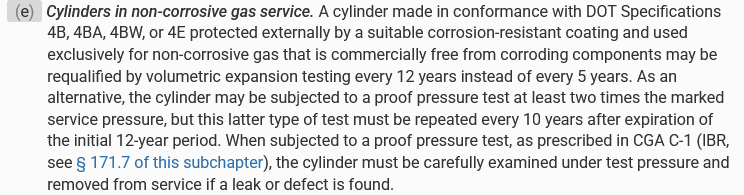
I knew I shouldn't have done it, but I decided to go down the rabbit hole of looking up the actual law in the CFR (Code of Federal Regulations) based on the DOT 4BA type tanks I have and found these recertification guidelines. Adds even more confusion, but I'm still having it done at 10 years anyway!
 2 points
 -
Just called a propane dealer in my area and they told me that there's a lot of confusion to the Federal law. It was originally 12 years, then changed to 10 a few years back at which point the propane industry made noise and DOT sent out an order to not enforce the new 10 year ruling. But 10 is what the Federal law actually says so better to get it done at ten, IMHO.2 points
-
We arrived Sunday night and immediately noticed a familiar face in Gary from Colorado! We met Gary at Lost Dutchman last November. We met Lance, also from Colorado, and his Hessie, who quickly became friends with our Charley. Later John and Wendy and there are a few others here that I had not known from this forum. Steve and Tali had to run an overnight to CA for a Starlink repair and after they returned yesterday we spent some quality time with Mr. Steve by our fire ring! If it wasn't for great people, this Dome Rock area is more the Casita class! 🤣 Our first morning somebody's car alarm went off 3 times, the first time it was still dark out. Minor generator noise late last night and a man screaming his lungs out to get them to turn it off. And the constant whine of I-40 a half mile away. Yesterday we looked for future boondocking locations, and found a great lunch spot along the way, at the north end of Q just west of Hwy 95. I strongly recommend the Meatloaf Sandwich!
2 points
-
Have you pulled the batteries, and had them checked? The 12v compressor fridge really doesn't draw that much power, nor, likely, your television. Our 12v dc draws about 20 to 26 ah overnight. We have run a compressor fridge on agm batteries for several years. We don't have an inverter, and dont use the television. Do you have the standard 6 gallon water heater? Since you normally camp with hookups, could it have inadvertently been left on 110 electric? That would definitely drag the batteries down, very quickly.2 points
-
I had the thought that adding the two friction hinges was the cause of our problem, because it took a lot more force to open the door....but I think our door had been flexed by wind events in the past and that may have started the problem and over time it just got worse. So my question and asking folks to vote: Do I put the door back on A) WITH" or B) WITHOUT.... the friction hinges.2 points
-
I am old as well and we both have memories of our roadster days. I once wore a new set of tires bald in 12,000 miles with my 68 Datsun 1600. Anyway, I live in the inner city (Portland OR.) and have a low height garage so a truck is just not practical for me and on street parking in my neighborhood is a challenge. My plan when I first purchased #657 was to limp along with the 4Runner just long enough until a tow capable EV SUV became available. The Rivian would work but according to my wife I can't afford one. And actually, the 4Runner is working out much better than I could have hoped. Of course, having driven nothing but manual transmission cars most of my life (like you probably), I am very comfortable manually shifting the automatic when towing to enhance performance and the transmission in my 4Runner is designed for maximum engine braking when descending. I am comfortable driving in the mountains and rarely have to use the brakes much to control speed, even on 6% downhill grades. I have found that the vehicle struggles with an OEM air filter but performance excels with a K&N air filter. I do have to be careful in loading my TV and have become accustomed to traveling light. If I travel with both my wife and dog, I have used up my cargo capacity and most everything else goes in the Ollie. I always keep the Ollie below 6,000 lbs. My 4Runner is a rare version called the V8 Limited that was factory set up for towing and was made in a Lexus factory in Japan. I am the original owner. I think it is almost identical to your GX470 but mine has the x-reas schocks and a self-leveling rear end which yours may not have. It is also factory rated to tow 7,000 lbs which I believe is a bit more than the GX470. Anyway, right before I drove 2,400 miles to pick up my new Ollie, I replaced the x-reas shocks and air springs at a cost of $5,600 and had a complete brake replacement with all OEM parts at a cost of $2,600. I now have over 20,00 miles of towing my Ollie and quite a bit of it has been on interstates in the mountains of Oregon, Washington and Utah. The car does struggle somewhat at high altitudes going uphill on windy two lane roads, but downhill is never a problem and I have never experienced any sway. That said I sure hope to upgrade to a more capable TV soon. Then we can start bringing a few toys along with us🤪2 points
-
Bulldog HD Shock Absorber Replaces 555001 For Trailer Leaf Spring Retro Kit 19-050000007 These are the shocks that I ordered based on other folks recommendations. They are pretty substantial shocks and I haven't installed yet as they didn't come until November, 2024. The guidance I received from this forum suggested that the top rubber cushions might need to be compressed a bit more than you would be inclined to do because of they are a bit larger than the originals. I paid $128.00 for 4 for our LEII.2 points
-
We don't have Alcans, but as information, replaced original Monroe shocks with Bulldog 1213-0656 shocks on our Dexter 5200lb axles with 5 leaf Dexter springs.2 points
-
I like how this is worded. After talking to @ScubaRx about this last night. He mentioned that across the country many locations have a 10 year policy. You may have to shop around for a location that will honor 12 years. I've heard 10 from our local Ford dealer who provides the wholesale price of $2.50/gal to their customers. We always leave home with two full 30# tanks. I may have to find the 12-year rule in legal writing from the AZ DOT after my tanks go over 10 years.1 point
-
If the new rubber is taller you must allow for that. You want the rubber to pillow out some to hold the mount tight. Overtightening will cause them to fail quickly. Also the used rubber will have been compressed for some time and will look smaller than when new.1 point
-
The Epoch Essentials 300 AH battery lists at $999 and several times a year it is 10% or 15% off. I got mine for $899 each, free shipping no sales tax.1 point
-
It's 12 years in my neck of the woods with a 5 year extension after recertification.1 point
-
I appreciate your thoughtful reply. You understand the physics better than most. Measure tongue weight, keep more trailer weight in front of the axles. Please forgive my sarcasm. Loved my ‘75 Alfa (drove it from ‘77 to ‘97). Your Datsun 1600 must have been fun. I got stuck with a girlfriend and her Datsun 610 needing work. Still can’t stand the name Nissan! Long, long ago I had to move out of the city for property and the 3-car garage, but I get it. But here 30-40 minutes from home in most directions is a 3,000 ft drop and it worries me during each descent, the Oliver behind us. Best wishes and I really like how you ended your post! 😂1 point
-
You could start a poll. You know my vote. Can’t wait to see your installation! Best wishes. JD1 point
-
We try to never have our AGM batteries discharged beyond 12.6V. This can be very challenging in cold weather as our Dometic Furnace squirrel cage can use a lot of Ah overnight. If you can keep your SOC over 80 percent at all times, we never go below 90 percent, you will double the life of your batteries otherwise you can expect only so many cycles. The advantage of Lithium is that they can be discharged more deeply and cycled many more times. The usual expectation for LiFePO batteries is about 3000 cycles. The best you can hope for AGMs are 750 cycles if you keep SOC above 90 percent.1 point
-
Ours has done this and we can recreate the issue, which is the door pressed into the black back stop puck. Even when using the door hook, constant wind pressure against that back stop has caused ours to crack on the inside, where the inset is hard and susceptible to cracking when under flex/pressure. Stand and push your door into the puck and you can see it flex. Thus when opening the door, if the wind grabs it causing good whack against the back stop, then the cracking begins. We bought our trailer used, and the door never closed smoothly or easily. There was a dent on the inside of the door, but we didn’t think that affected function. Turns out, that dent was probably something hard enough to bend the door frame and then, even when latched, there was play in the door allowing flex on the back stop, so here we are. We are ordering a new door from Oliver and having it installed. 2019 E2 hull #5501 point
-
My choice of propane tanks goes to (minimizing) weight being the highest priority. My tow vehicle (TV) has very little cargo capacity so minimizing tongue weight is very important to me. I am an outlier in that regard on this forum. To minimize weight I switched to composite propane tanks shortly after I acquired my LEII. When empty, they weigh about 1/2 of what a common steel tank weighs although the capacities are reduced somewhat. The 20 lb equivalent holds 17 lbs and the 30 lb equivalent holds 22 lbs of propane. Most people couldn't justify the cost because they are much more expensive than steel tanks. However, if lowering tongue weight is important for you as it is for me, you might want to check them out. They are way less expensive then a new TV🤑 I am pretty sure there are a few of you out there that would really appreciate the light weight and don't do extensive cold weather camping. Even if I get a new tow vehicle, I will probably continue to use the composite tanks because they are so much nicer for everyday use. In addition to being much lighter when full, they have a wide base and are extremely stable in the back of the vehicle without tie-downs. Also, they have no sharp edges whatsoever so it is much easier to carry around and pack in the Ollie when carrying a spare tank as I do for cold weather camping. I have never had any problems getting them refilled. They are made in Europe and imported by Viking Cylinders. https://www.vikingcylinders.com/online-shop/ Since they have a much larger diameter base, if you switch to them you will need to switch out your 2 tank mounting tray inside of the doghouse. Viking Cylinders sells a custom fit replacement tray for $40 and the old tray is easy to swap out for the new one and back again if necessary.1 point
-
Lithium batteries are the way to go. I spent 8 years in a truck camper with 2-12 volt AGM's and a 12v compressor fridge. I got 4.5 years out of the batteries before replacement. We also had only 100w solar on the roof, with an 80w portable panel and eventually a Honda 2200i. We did replace the 100w panel for 2-100w Zamp panel for the last 3 years, before purchasing the Oliver. Most of our camping was deep in the back country, so no Hook-ups. I can say this, we never got lower than 12.2. We managed our system very well. At night to save we used battery powered lights to see. It is so much better not having to be on "Battery Watch"1 point
-
Maybe we should start a thread on managing resources while boondocking. When we had AGM’s we did a lot of no hook up camping, mostly at National Parks, COE and FS areas, Harvest Hosts and of course Quartzsite. No 30a hookup meant fridge on propane, hot water on propane, boil water on propane stovetop for pour over coffee, etc. The only electrical load on the batteries was the furnace fan, lights and water pump. We seldom use the inverter, an occasional minute or two of microwave and maybe a blow dry after a shower. Keeping an eye on where the battery charge was happened frequently. If we weren’t back to near 100% by mid-afternoon the generator came out (happened at Glacier and Grand Teton, some dark cold days!). Our AGM’s lasted 5 years and got replaced because two were starting to leak. Now with Lithiums (just 300ah) we still camp the same when boondocking and rarely get down to 80% charge by morning. It’s a mistake to think that solar allows the same kind of camping off grid as with FHU. Mike1 point
-
Sorry let me clarify John. I always fill up the freshwater tank and use the water pump for everyday use, even when at full hookup campsites. Why I do this is a discussion for another day! 😊 In this mode, when the water pump starts sucking air, the SeeLevel shows still 13% left in the tank. On the other hand, when I drain the freshwater tank by opening the valve like in THIS video, it drains 100%, ie SeeLevel shows “0”. This is obviously because the drain point is at the bottom of the tank. So my thinking is the water pump suction tube is off the bottom of my water tank, ie when it starts sucking air there is still approx. 13% water sitting on the bottom, like a few others have noted as well. Hope this makes sense! 😊1 point
-
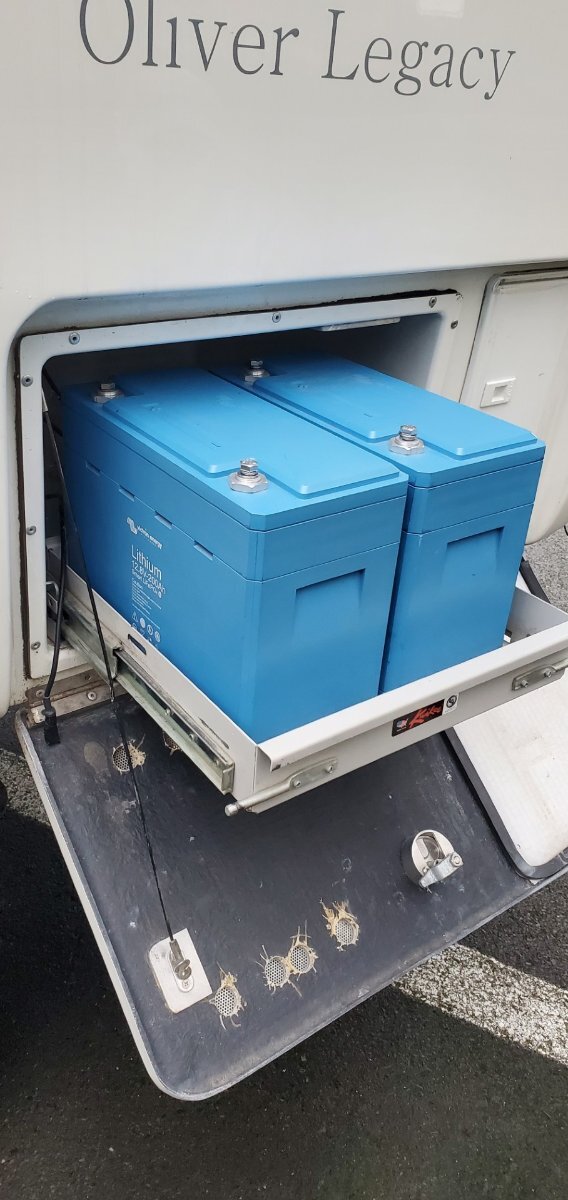
Here's a pic of a couple of "dummy" 200 amp/hr Victrons mocked up in my tray to see if they would fit. Dave
1 point
-
Well, plans change! After deciding this whole conversion project was above my pay grade, I spent some time talking with my local solar company reps about my system. I have run out of battery several times with my old AGM's when camping off grid where the sun was rarely seen. Rain and gray here in the PNW, especially in the shoulder seasons. For my current needs, the 400 amp/hr Victron will have more than 3 times the power available to me compared to my old AGM's. Maybe overkill. But looking to the future where I may be getting a compressor fridge (when my 3 way gives up the ghost) then things start to even out. As far as I know, this is the most power one can pack in to the Elite 1 while maintaining the OEM battery box and tray. I also changed my mind and am getting a Victron inverter/charger. Mostly for the better charging compatibility with the Victron batteries. We'll see how this all pans out. The components are expensive but I believe Victron makes a quality product with stellar representation. Pics will be forthcoming when this all gets completed for Elite 1 owners (and anyone else) who may be interested. Cheers, Dave1 point
-
Thanks @DavePhelps I will have to read-up on the Victron batteries... Looking forward to your report on this new configuration!1 point
-
My battery box tray is the same as your on my 2015 Legacy 1 trailer, 14.25" X 14.25" X 11" I was ready to go with the Epoch battery but pivoted after consulting with a local solar company. I am now getting 2 of the Victron 200 amp/hr batteries. They fit beautifully in my tray, and together will give me 400 amp/hrs of battery power ( well, almost). These batteries have a remote BMS, so the room in the battery where the BMS is normally located can be used for more Lithium cells and/or the batteries can be comparatively smaller with more available energy than other brands. Not cheap by any means. The batteries are expensive and then you also have to purchase the BMS module separately. For me and my needs however, it was worth it. I also elected to have this outfit do the install for me. The whole project just grew way beyond my comfort zone for a DIY job. After seeing their part list for the job, I'm really glad I'm going this way. My hat is off to all you folks who took this on yourself. You saved yourself a pile of money! When completed, I'll post a review with pics. Cheers, Dave1 point
-
As some may recall we've had 2 separate water heater fires in our 2019 EII. In the first case, the water heater was swapped out and the failing unit shipped to Germany for teardown by Truma. The second unit was also defective and had the same behavior after a year on the road. Oliver and the NHTSA have collaborated with Truma on a recall for Truma Water Heaters. Individual Notices to owners are going out in December and January, and I received a letter last week which explains the issue and repair strategy. Attached is the NHTSA Summary Report including the chronology of events. RCLRPT-24V876-7296.PDF The issue has been determined to be inadequate crimping of the burner assembly in manufacturing. This enables the burner tubes to rattle loose and eventually lead to fires in the firebox from tubes that are no longer contained. The manufacturing process has been changed to crimp all the tubes into place and new burner assemblies are being supplied for recall that meet the newer manufacturing process. The recall covers Truma SN less than DLE60C-33096055 (In my case the production patch SN was DLE60C-32123091) Here is the template letter from Oliver to consumers. The specifics of each trailer are unique so you may want to read this generic one to see the Serial Number range for recalled units and compare it to the Truma in your Hull. RCONL-24V876-1556.pdf Oliver will work with you on getting the repair completed. Craig Short Hull 505 - 2019 EII1 point
-
I think Tucker is right, but only with the assumption that the shocks have the dampening capability to do so. More detail follows: The dampers job is not only to control the rate of energy transfer to the spring, but also the rate at which it is released. The process takes the movement (Up and Down) and converts it to heat. Generally speaking stiffer springs require stronger damping to deal with the heat being generated by the stiffer springs. You can see this in many Asian suspension systems that use stiffer springs and are tuned with stiffer damping. Spring rates and damping are definitely connected. An increase in spring rate will require an increase in rebound damping to control it. This principle is in my opinion why I think that the Monroe shocks we are using do not have sufficient dampening capacity when used with the Alcon's. The net result I believe is that the Monroe's are being damaged by the heat generated by the Alcon's. For those wanting a deeper dive, here is a great web site to guide you through the math to do so: https://www.shimrestackor.com/Code/Sample_Applications/Spring_Change/spring-change.htm Just be aware that you'll get into some deep math pretty quickly. LOL! GJ GJ
0 points











-
Recent Achievements
-