Leaderboard



Popular Content
Showing content with the highest reputation on 01/05/2021 in Posts
-
TexasGuy - Many of us have wrestled with the same items as you are dealing with. To some degree I very much agree with SeaDawg - it depends on your camping style and where you tend to camp. Having said that - 1. I didn't have as many choices as you did on the subject of awnings, but, I chose to go simple. Even with wind sensors I would not trust that sensor to protect what could be a fairly expensive repair in the event the sensor was not fast enough or simply failed outright. Also, since I rarely camp in the desert I have not missed getting the streetside awning. 2. There is no question in my mind about solar since it gives me so much additional freedom and choice. However, that is not the question you asked. I chose the standard flooded wet cell batteries with the addition of the watering system. My thinking at the time was similar to yours - just how much time can it take to add water to those batteries - and I've found that indeed I was correct, it really doesn't take much time at all. Without the watering system I think that I'd have a different answer due to the sheer number of cells and the ability to reach those cells towards the back of the battery tray. I don't remember the numbers, but, with the addition of the watering system, the price difference was not as much as $500. But, even for a couple hundred I would have made the same decision as I did. Both AGM's and flooded wet cells should last 5 to 7 or 8 years with good maintenance. Hopefully at that time the price or alternatives will be even cheaper than they are today. You might also want to take a look at the "Lithium vs others" thread for a discussion about the long range costs of the various battery types in today's market (primarily this discussion only talks about the batteries themselves and not the associated costs of other "supporting" items that you will probably need to run or maintain lithium). 3. I got the standard water heater. That sure is a bunch of money to upgrade to the Truma. When I'm camping all I have to do is to remember to turn the water heater on ten minutes or so before I want hot water. If I forget, then all I have to do is wait the ten minutes. It really isn't like I'm rushing off somewhere and there is always something to do during that ten minutes - perhaps a glass of wine? Then, I simply turn it off - I NEVER just let it stay on since there is no reason to heat water just in case. 4. I also stayed with the standard toilet. Again, I simply could not justify the cost and already knew that emptying the grey and black tanks are no big deal. Add to this the fact that the Natures Head sits higher off the floor, it was a no brainer for me. Yes, from what I hear, composting toilets do save a bit of water. But, there are fairly easy ways around that issue too - portable tanks (heck, even the Nature's Head has a portable tank of sorts), "Double Duty" bags for instance. 5. Contrary to the "saving money" issues above, I did get the fiber granite option. I believe that this is a matter of taste and felt that the standard interior was simply not to my liking. This was a fairly simple way to give my Oliver a bit of decoration without having to tax my lack of decorating skills. Given that both the standard and optional surfaces are made of basically the same material I don't see where one would be "better" than the other. However, with the fiber granite, should you damage the surface below the pantry, or on top of the fridge, or on top of the night stand, these can easily be replaced. 6. I think that ctshort09's comments are good. Certainly do not get the WiFi option if you plan on using it in commercial campgrounds since these places simply do not have enough "bandwidth" to satisfy all campers demand. Since I do not have a cell phone, I rely heavily on email for communication while I'm on the road. I was/am surprised at a benefit of the WiFi booster that I had not considered prior to getting my Oliver - how much I use that booster while actually traveling from place to place. No longer do I have to cart my tablet or laptop into McDonalds, Starbucks, Wendy's, WalMart, Lowes, etc. I simply pull into the parking lot and with my WiFi booster I've got all the signal I need to send and download email and/or get to the internet. Good luck with your decisions. What is good for one is not good for all. Just take a hard look at what you intend to do with your Oliver and let that be your general guide. Bill5 points
-
Given the backlog of orders in the Oliver supply chain I would have to believe a new model is not in the forefront of the Oliver mindset. Increasing production and improving process throughput and improving initial quality seem much better targets. Quality is a very expensive thing to fix - after the fact. Incremental improvements in margins - especially in the additional options would be the smart move. From what I've seen, the service guys have turned the corner - from necessary product support, to profit center. Certainly nothing to complain about as a business decision. I could see a time when the Elite I is put on hold, or given specific order/production timing. Maximizing the higher margin Elite II, (my guess) developing new high margin add on options and product improvements just makes sense. Developing a new model- is very expensive, stresses engineering and design, and bottlenecks the already stressed production schedule. I am not optimistic on the idea of a new larger Oliver. However - how about some sort of new options offerings, after sale add on - improvement on OEM offering. Where is the Oliver online store? Where the additional cool stuff is available for purchase: Shower mats (yes, Oliver branded), Replacement table tops, counters , Oliver fitted bedding, fixtures, Oliver designed front end protection, rear wheel "mud flaps", and on.... This stuff would be high margin, easy to design, and have someone else manufacture- drop shipped on demand. Oh, right, When we catch up to orders, well think about it---- RB3 points
-
Interesting... I did the Yukon River Quest three times (450 mile canoe race) and the race officials tracked each of us with Spot devices each year. I have used InReach more recently and think it is a better device and service. There might be better devices that are designed for tracking stolen cars/RVs than the Spot or InReach which both offer rescue services. Mike2 points
-
Our Spot Trace has a battery backup (4 rechargeable AAA I think), but primarily it’s powered by a hardwired cable to the trailer. I think it will go for several days without power if thieves were clever enough to disconnect the batteries.2 points
-
tNo experience with that TV, but here are a few basic AV troubleshooting steps that may help if you haven't already tried these things (long ago I built and installed somewhat complicated interactive A/V systems in museums and at trade shows and got used this troubleshooting dance with A/V components, trying to isolate where problems lay). If there's more than one HDMI input on the TV, you could try moving the input cord from one to the other to try to sort out whether the problem is in the TV or in the cord or the device that's providing the source signal. You would of course have to select that second HDMI input on the TV menu. If you have a computer monitor in your house that takes an HDMI input (and has a speaker, which is not uncommon in later model LCD monitors) you could also bring that into the trailer and swap the HDMI input cable from your trailer's TV to the computer monitor to see whether that HDMI cable/plug is providing a good signal to the TV...2 points
-
TexasGuy, I highly suggest after market Lithium batteries. We went with Battle Born and have solar. The conversation is simple. All you need to start is a shut based battery monitor, one battery and you will have more usable power than any other two battery system and two Lithium batteies would be better than any other four battery system. For more information, check out Battle Born’s white paper on the subject and Morton On The Moves recent YouTube video. Andrew2 points
-
As usual - lots of experience backed replies. Oliver owners love to share. On awnings - I love the shade protection - but honestly, they are just not as usable in real time. The weather plays havoc on them - as long as your in camp - great - leave for 5 minutes (or retire for the evening) - and the wind sneaks up and tears them off....... I originally order port and starboard awnings, and cut that to just the one. Durability is not a strong point. Additional supports and tie downs are the hot ticket to keeping them healthy - at least where the wind likes to blow. I can't imagine trying to deal with two of them. The Truma - could go either way - I have the Truma- it does save me water and energy over time. Cost effective - ask me in 10 years... Bill is spot on with the counter upgrades. The composting toilet - my take is - its all about how you use the Oliver - stick to RV sites with full hook ups - not worth the change - like to boondock- stay off the beaten path - is a very nice thing to have .. I like my Natures head - it fits our camping profile. I have no use for the phone/WIFI/rear camera upgrades - Tech moves to quickly for me - I add as it improves. But I try to get away from that need in any case. Solar - for me - it is too early in the product/design cycle to do anything but the AGM's. Oliver does a good job with the actual install - adding LI later - as it improves seems the better decision. With my set up, AGM solar, compost, 30lb propane - we can stay off grid almost indefinably - water is transportable and easily pumped in, the toilet -similar - no need to move to empty, With no need for AC - don't need shore power - or get a small gen set. Propane is transportable. Honestly - this is why we enjoy our Oliver - it frees up possibility, we can go anywhere- within reason- and stay as long as we desire. Freedom. Good luck.2 points
-
1) Awning - I have 2 domestic awnings, (camp side electric), street side manual. I think the regular electrics now offered would be fine without upgrading. 2) Battery Choices: Here's an interesting article (and video) about Lead Acid, vs. AGM, vs Lithium Batteries to help you decide: https://mortonsonthemove.com/best-rv-battery-test-results/ For our use case we are trying to get the longest run time out of my battery for boondocking, so I'm planning to upgrade to Lithium, and added solar. 3) We have a truma. Pro - it sips fuel, weighs less as it's not a 6gal tank, Con - you still need to run out about a liter of water out to get to the HOT water but then it's continuous. We also take navy showers...I suppose the standard 6GAL water heater has some advantages...but I'll let owners with those chime in. 4) That change can be done later for sure. A lot depends on how you plan to camp. For the composter, there's no current way have it direct urine from the Composting Toilet into the Black Tank so you'll still need to dispose of urine on a timely basis. The weakness with a standard toilet comes if you plan to boondock for longer times. For two of us we can make it about 4-6 days before we are full on the black tank. If we had a composter we could likely go 2 weeks. 5) We have only seen one trailer with standard white and it looked great as well. 6) Again a lot depends upon your specific mobile data use case. Cell Boosters vs. WIFI Boosters The newer cell systems all use MIMO technology so your hot spot device (or phone) actually has multiple antennas built in and they have wider bandwidth because they use signal diversity to combine together the "best signal" possible. If the "cell booster" antenna is a single channel small whip, it may only be useful when the signal levels are extremely low...otherwise your device will have better BW running off it's internal MIMO Antenna. Here's a good article from "The internet resource center" on this topic. https://www.rvmobileinternet.com/guides/mobile-cellular-boosters/ The WIFI booster can also have a "modem" installed in it and that would make it also a CELL booster in function. If I had it to do over, I would simply buy the WIFI Booster, and put in the Modem for my carrier (AT&T)... That kills both the WIFI and cellular boost capability and it also provides a plug in for hotspot's via USB input. (So you can put your phone or hotspot into that wifi booster, and create a VPN for your campsite.) MUST Have - I wouldn't be without solar. There are so many things that solar can provide, one is the ability to charge your batteries while you are in transit. Most of today's 7 pin connectors only drive about 3-5 amps of current, so they can only KEEP your batteries charged, but they don't really recharge while you drive. (In the worst case, if you drive with your fridge on DC, you'll actually get to camp with batteries much lower than when you left. Solar helps a ton keep those house batteries charged. Another other option if you don't have solar is to add a dc to dc charger unit. that directly connects to cables your vehicles battery back to Dc to Dc charger which would be near your trailer batteries. Final take: If I were buying right now...I would 1) Buy standard awnings but put on both sides of the trailer (key to controlling heat in southern locations) 2) Buy as much solar and lithium as I could afford. 3) Buy the WIFI booster but add the modem inside In the long run those investments will pay back mightily improving your camping experience. Hull 505 - Galway Girl2 points
-
Legacy Elite II - NARV - I just now caught that JD. 😃 Not an RV - I'm curious- what do you call it- I guess I could come up with a few ideas - but I just call mine the Oliver. Haven't named it- or thought about a defining moniker - its just our $70k roving home on 4 wheels - one that does not get near enough use. I have an Oliver. I am just too simple. And to keep on point - an Oliver - towed 2500 miles is still better (In my opinion) than a "new" anything else. RB2 points
-
We have a cell based GPS as a backup, just because it was/is essentially free for us. We already had an LTE modem for the trailer, and Victron provides free geolocation via their VRM portal. All we needed extra was a $30 USB GPS dongle. We also have a Spot hidden away between the hulls, only because at the time it was the cheapest solution - not anymore. Which reminds me, I need to go grab it to update the firmware We have an InReach, but that stays with us in the truck or on hikes.2 points
-
There have been multiple threads on the FGRV forum concerning trailer security. Everyone has their own opinion and method and I agree that, depending on your personal beliefs, they could include simple diligence, locks, fences, chains, whips, guard dogs, guns, cameras, claymore mines, trunk monkeys and a moat. Those folks that are un-inclined to subscribe to any of the aforementioned tactics seem to just rely on good insurance. I employ some of these methods myself but if my trailer suddenly sprouts legs and walks off, I want to be able to find it and perhaps use some of the other methods on those folks that helped it along. I started investigating electronic counter measure devices to do just that. I looked at the SPOT Satellite Messenger. I didn’t find the initial cost of about $150.00 too bad. It uses your GPS location and sends it and preselected message to communication satellites which route your location and message to the appropriate network to get you help. It is obviously designed for and intended to be used by a person while traveling in remote regions and it does have good coverage. The best service plan will cost about $200.00 per year. For those folks that may only travel a few weeks of the year, that might be beyond what they are comfortable spending. I continued to look. There are several out there but none seemed to do what I wanted or cost more than I wanted to pay. I finally found what I thought would do everything I wanted at a reasonable price and I installed it in the Outlaw Oliver. I have it set up so that: When the trailer is unattended and sitting still (either here at home or anywhere else) and moves over 300 feet, it will send a text message to my iphone that includes a hyperlink to a Google Map page with an icon on it indicating where the trailer is. It will continue to send these until I tell it to stop. If the door is opened it will set off a local alarm and send a text message stating that the door has been breached and includes the same hyperlink. I can call it with my iphone and it will send the hyperlink. If the main power source is removed (trailer batteries) it will send the hyperlink. There are internal lithium batteries that power it if the external power fails and it will alert you if these become low. I can text it and tell it to switch between tracking and monitoring. In Monitor mode I can listen in on anything going on inside the trailer via a hidden microphone. I can authorize up to five phones that can access it. Family can always tell where we are. If we push the “panic” button it will send out a help message to all phones. All programing is done via text messages and in addition you can arm/disarm it with an included key fob remote. There are dozens of other functions that it will perform. You can set up multiple virtual GEO fences that will alert if the trailer is moved into or out of. You can have it text you if it is going over a MPH that you have pre-set as maximum. It has an internal SD slot that will log all this data. The list goes on and on. This piece of equipment is (I’m sure) made in China, as its manual is printed in Chinglish and thus has somewhat of a steep learning curve but it cost me less than $50.00 including the SIM card with 200 prepaid text messages. There are no monthly fees. When you’ve used your allotted text messages, you just reload it with another $10 worth. It operates in conjunction with the GPS and Cell phone systems. And it works just like it said it would. I tried to upload photos of the aluminum mast and mount that I made for my remote control GoLight and the two antennas for the tracker, but I could not get it to work. I will work on that another day. I believe both of these items might be being offered as options on the Oliver Elite II.1 point
-
So my build sheet will be due before I know it with a late March production date and starting to seriously look at options and hoping to hear from recent buyers as well as those with more experience in the Oliver. I am still deciding between Elite or Elite II. 1. Awning - From my understanding the upgrade gets you a wind sensor, remote and canvas material. The standard awning is still powered and a vinyl top. Based on my prior rentals I pulled in awning when out for the day and at night so wind sensor is not a big deal for me. If you did upgrade was the canvas material a better choice ? 2. On the Elite II it looks like you can get a solar option with wet batteries and save about $500 over AGM package. Is the AGM performance worth the difference? I appreciate you have less maintenance with AGM but is topping off wet cell batteries really that hard? Right now the lithium jump just isn’t worth it until I get more time in RV. 3. Truma water heater. So 70% of time will just be me and I always take a navy shower in RVs to save on water. Anyone with standard heater have issues with enough hot water? 4. While composting toilet is interesting not sure I want to take plunge yet. I will ask Oliver but this feels like upgrade that can be done later. Thoughts? 5. Countertops That seems like a lot of money to upgrade counters. Anyone with std white have regrets? 6. Wi-Fi/cell boosters- can these be sourced afterwards and not permanently mounted? With a mobile hotspot device are they even needed? Any specific options you have found to be must haves. I’m sure these have all been asked before and sorry to ask again but having in one place to reference is helpful to me Thanks!1 point
-
I know nothing about these gadgets (in case that isn’t obvious) but I’d like to find something good and hide it well in the Ollie. So IF a bad guy ever tries to make off with it I might at least be able to give the police something to start with. If that makes sense.1 point
-
I remember tracking a friend on Spot when we parted ways in the Yukon several years ago. Being able to follow our friend to "civilization " gave me tremendous comfort, as he was traveling solo, and not feeling well. My concern about battery power is for those concerned about trailer " in- storage" tracking solutions, as many people disconnect from the main batteries in the trailer. We don't, but we live in a mild climate, and solar recharges, even in shade . And, off season, at home, it would be ridiculously hard for someone to open the gates, first move the boat trailer out of the way, then move the Ollie, and steal our trailer out of the sideyard without our hearing it, or the alarm system notifying us. Or our neighbor seeing/hearing it, if we weren't home. Several days' battery is probably enough to know your trailer has moved, and where it's going, for recovery. That's good to know. But, in storage, how long do you think AAAs would last?1 point
-
I was just looking (again) at theft recovery gps devices a few days ago. The problem is battery power. I do think the inreach is a great idea for hikers. Next time our daughter goes on a hiking trip in Colorado, I really want her to carry one.1 point
-
Received a new battery tray from Oliver. New tray is over 6 pounds heavier than original unit. The battery straps connect in the same fashion on both trays. New unit on right: Old unit: New unit: Same footprint and bolt pattern on both units: New unit top has larger/stronger bearing/slide assemblies:1 point
-
I am in the market for an InReach, and just returned to this thread to see which model, etc., so thanks all. I am pickup up the Ollie 1 soon (!!) finally, and want something to track both the Ollie (if stolen) and me (if lost in the woods, not that I would actually go way out in the woods, but hey, better safe than sorry). 🙂1 point
-
nrvale0, Few years ago our Jensen TV did the same thing. Believe it was the HDMI outlet on our TV in our 2015 LE2. Ran RCA cables from TV to Furrion stereo/DVD player to fix the problem. Now have to choose AV (if I remember correctly) with TV remote instead of HDMI: TV: Furrion unit:1 point
-
1. Awning - I would go with two awnings so that you have shade on both sides. I think the electrical would be nice, but did hear that they sometimes close at the slightest wind. 2. I had the AGM batteries, but just replaced with two 150 amp hour Life Blue lithium for ~ $3000. I really like them, can go for days in the rain without worrying about running out of power (think I could go 7 days if need be, but if it is raining that much I am going home). And, they include a Battery Management System that connects to your cell phone via blue-tooth. 3. Truma water heater - we have the Truma, really like it. My wife and I can shower back to back without running out of hot water, and it doesn't take 6 gallons to fill it. 4. composting toilet - I agree, interesting, but I am not interested for a variety of reasons. 5. Countertops That seems like a lot of money to upgrade counters. Anyone with std white have regrets? --- Personal choice. 6. Wi-Fi/cell boosters- can these be sourced afterwards and not permanently mounted? With a mobile hotspot device are they even needed? --- I would go with sourcing afterwards. I tried one from Amazon and found it did very little for me. Plus, we tend to camp in places where there is absolutely no signal, nothing to boost. 7. Solar - I didn't buy the installed panels, instead I bought an 80 watt portable. It will recharge the batteries in one day of sunshine, plus, I have the lithium batteries that don't need to be charged every day anyway. The roof top solar doesn't work when you are under a tree, in the shade. Solar panels are also very sensitive to the angle of the sun. Difference from perpendicular to 45 degrees can be 1/2 the output. The portable was abut $350, much cheaper. Lastly, if you put a cover on your Oliver when not using it the solar panels tend to rip the cover. One plus for roof top is that if you store the camper outside where there is no power you do have a way to keep the batteries charged. Any specific options you have found to be must haves. I’m sure these have all been asked before and sorry to ask again but having in one place to reference is helpful to me. ----- One cheap one is the shower curtain in the bathroom. Allows you to shower and not get the entire bathroom wet.1 point
-
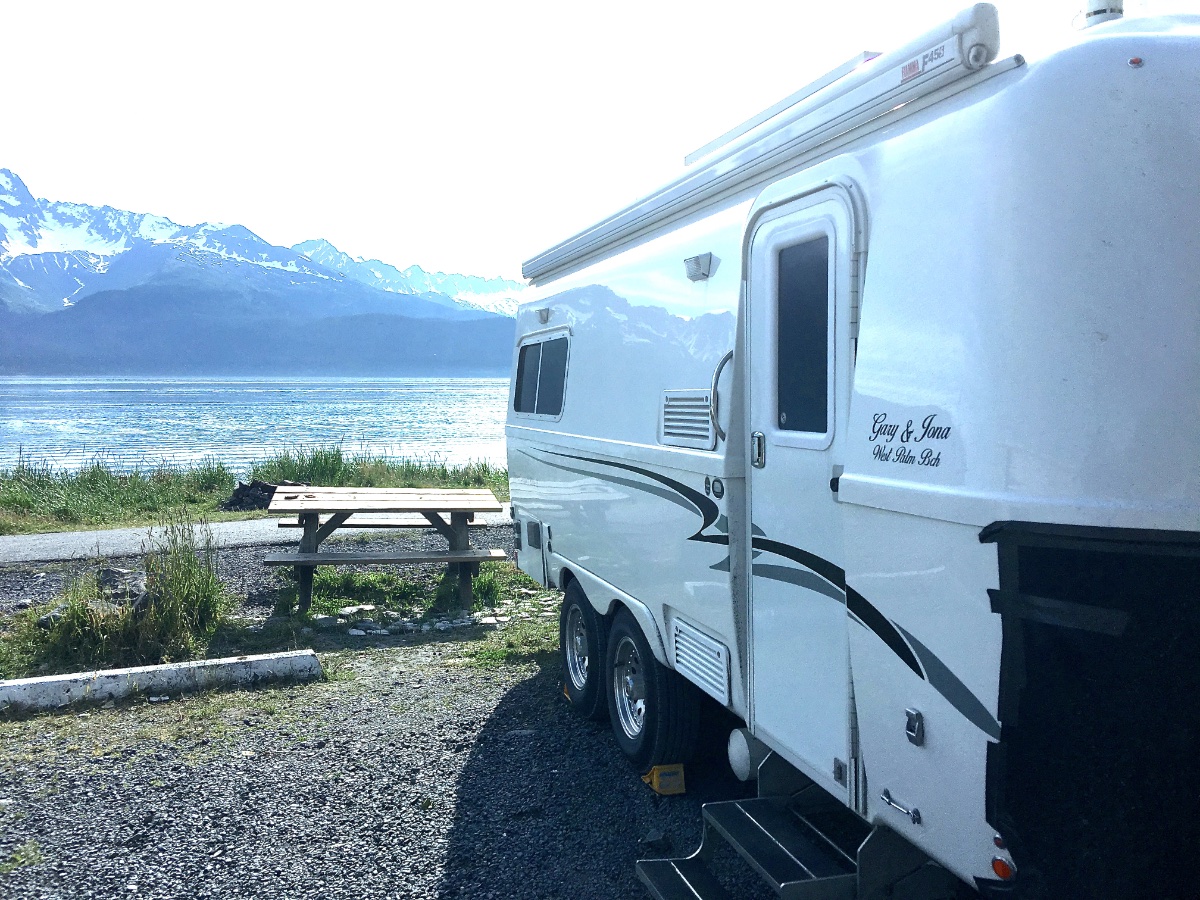
Yes, it is quite the special campground, and you get to put your mountain driving skills to the test as you first, climb a steeeeeep hill and descend the precipitous downhill approach to the lake. You really appreciate the relaxing views after your arrival!1 point
-
Appreciate insight. From what I can tell on spec sheet the $500 gets you 4 6V AGMs versus wet cell batteries. In both cases you get same solar setup on roof and 2000kw inverter.1 point
-
I think a larger Ollie (Elite III) is a great idea to make the Oliver travel trailer (superior quality and functionality) available to those that want/need extra space. We have only owned our Elite II for a month and a half now, and I've already made a bunch of modifications. While I enjoy doing modifications and have many of the tools and skills needed to pull some of them off (especially with help from forum members who have been there, done that), there are some that I'd just rather pay for. So... in addition to a new Oliver III, I'd like to see Oliver start offering upgrades (packaged) to new and current owners of the I's and II's. Some ideas that I'd have reached deeper into my wallet for... Deep winterization package (for extreme conditions such as Rocky mountain skiing), off-road package (with upgraded suspension, mud flaps, body protection), increased solar capacity, upgraded components like the refrigerator and/or A/C, options for using the available black tank when composting toilet option chosen. It would be great to have more access panels, ports, etc. located throughout the trailer to make troubleshooting, modifying and fixing things a lot easier. These would be nice additions, but all in all I wouldn't trade in my TT for anything else - I'm very happy with the Elite II!1 point
-
The west coast mountains were our biggest concern, as well; we were able to avoid mountain passes elsewhere. I'm glad our delivery was bumped up to the first part of December from the first part of February. We aren't snow people, but good to know we can still enjoy RV life pretty much year round; might have to stick to the coast for a couple of months out of the year, but heh . . . . what a great place to live!1 point
-
Thanks. Yeah, that is in the ballpark of what I'd estimated. And sure I got a "slightly used trailer" delivered to my driveway. Unlike JD I'm going to tow mine around the seasons as well. I've seen that discussion before and we each make our own tradeoffs in that regard eh? In any case having it here now is therefore also worth something to me versus waiting for maybe nicer weather later to go pick it up (at a time of year when I'd frankly rather be doing other things with or without the trailer). BTW I tracked the weather mine went through - bare and dry road until it was close to Snoqualmie Pass (about an hour from my house) at which point it got its first dose of some of our tropical winter weather. The grease fittings likely took a hit but it didn't get a bath of fresh icy road treatment (which I'll subject it to from time to time in any case frankly). I rinsed it a few days after arrival and it looks fine to me. I don't think there's a right or wrong here - just a set of tradeoffs JD and I make differently.1 point
-
It sounds like you found the perfect fit for you. I was offering a different perspective... someone interested in a larger rig with a different setup that might appeal to other types of buyers. I can be very comfortable with a smartly packed 75 liter pack that carries my tent, sleeping pad, sleeping bag, etc. It's all very functional, but that isn't everyone's cup of tea. I'm not trying to imply that there is anything wrong with the Elite II. I think a larger rig with different types of amenities / layouts might broaden the appeal of Oliver's high quality trailers.1 point
-
I totally agree. Our "new" BMW was delivered, more or less shrink wrapped, via train and then semi. It was fun to track it as it made it's way from Spartenburg, South Carolina to Medford Oregon. I did worry when it sat for a few days on the train (ironically just a few blocks from where I spent my first 5 years of life in Glendale, CA) waiting for the next train to Oxnard to be processed and turned over to the freight company for trucking to Oregon. All I could think of was "LA graffiti" lol. When it hit the ground at the dealer, it had 5 miles on the odometer and no graffiti! Sorry, I digress . . . . . . Has anyone investigated the cost to ship an Oliver from Hohenwald to anywhere, via flatbed truck? Seems like it would be comparable to the cost to tow. Our Leisure Travel Van delivery from Canada to Oregon was via two units to a flatbed truck, at a cost of $3,000. Flatbed transport would be my preference, though I would not want to forego the experience of the delivery inspection and walkthrough at the Oliver factory.1 point
-
FYI: our cost to drive to and home from Hohenwald, December 2020 (diesel, hotels, and RV sites), was just shy of $2,000. 8 days to Hohenwald (could have done it in 7 easy, with not too long of days); days home, towing was 6.1 point
-
TexasGuy - I have white counter tops and love them. I also have a composting toilet and am very happy with it. Solar is the same way..love it.1 point
-
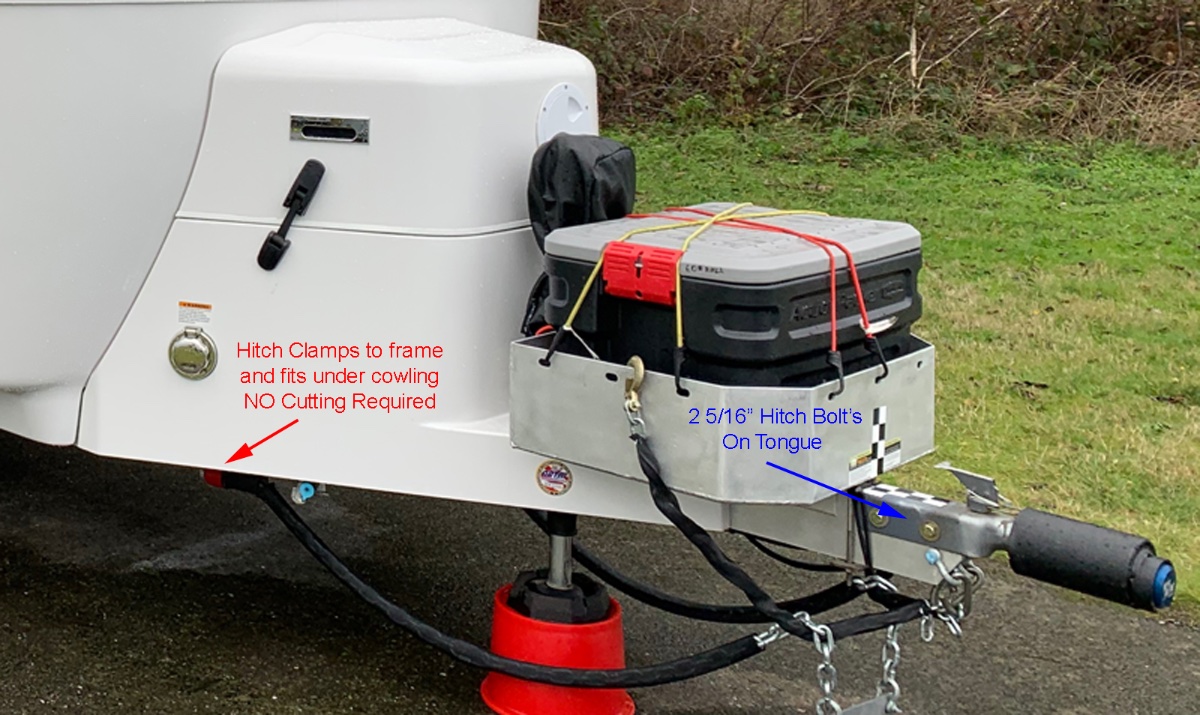
Xuxu Here's a pix of a 2 5/16" Coupler and how the Anderson Hitch Parts Fit on the Tongue. They fit perfectly under the fiberglass without cutting. I added chain shrouds to our Anderson Chain's to keep them from getting scratched up and preventing rust. Since we've upgraded to an F350, we won't be using the Anderson Hitch with 2 5/16" ball much longer so it's posted for sale in the classifieds section as is our "Towtector" rock guard system. Craig
 1 point
 -
Some of the answers will actually depend, at least somewhat, on which model you choose. And, your camping style. Can't comment on the awning, as we have had two manual Fiamma awnings. First vinyl top lasted almost ten years, with that brand. The battery compartment in the Elite is smaller, and tighter to work in than in the Elite II. I'm a big fan of AGM, for many reasons, but $500 is $500, and would almost pay for two Agm batteries, later. You're in Texas, so cold weather storage isn't a huge issue. We started with the included flooded batteries, and upgraded when they died. If you opt for the flooded, do set up a reminder on your phone calendar to check the fluids monthly. Do you get anything else in equipment with the $500 upgrade? In the Elite, you barely have any countertop in the kitchen, and the tabletop is actually quite nice in the leathered black. Our original white still looks nice, 13 years in. The Elite II has more countertop showing, so that's a matter of personal aesthetics. When we lost our original water heater, we replaced it with a Girard instantaneous. It's really nice , but I don't know if I'd do it again. Boondocking, you can fire up the standard water heater for say, 10 minutes, get the water to a comfy temp, and just shower without the mixer. In an electric site, you can use the free power and save your gas with the standard water heater. It's a pricey coin flip, especially if you typically camp solo. You do have the anode in the standard to attend to annually, so a tiny bit more attention. But, not a big deal. We've never had a cell booster, though I tried a highly-rated mobile one, and returned it. Problem is, you have to have some kind of a signal to boost. We carry two cell phones, instead. One gsm, one CDMA, and if there is a signal, one of us gets it, and shares it via Hotspot. It sounds like you're leaning toward solar, and that's really my one and only must have. It allows us so much more freedom in site choices, and we almost never opt for sites with power, preferring the quiet of out if the way places. We've not yet had a composting toilet. Be prepared. You'll get lots if opinions.1 point
-
My personal feeling is that a new trailer towed 2500 miles to your home is not a new trailer, it is now used. You never know what road damage might occur after nearly a week on our highways, especially during winter months when some are covered in sand and corrosive chemicals. One that is shrink wrapped at the factory, winched onto a truck bed and delivered that way is still new. Trailers do not age while sitting, unless by harsh weather. They age and deteriorate through accumulating towing miles. I am sure many disagree with this viewpoint, but would you consider a brand new car driven 2500 miles to your home to still be “new”? At the very least wait until April or later to have it delivered by towing. John Davies Spokane WA1 point
-
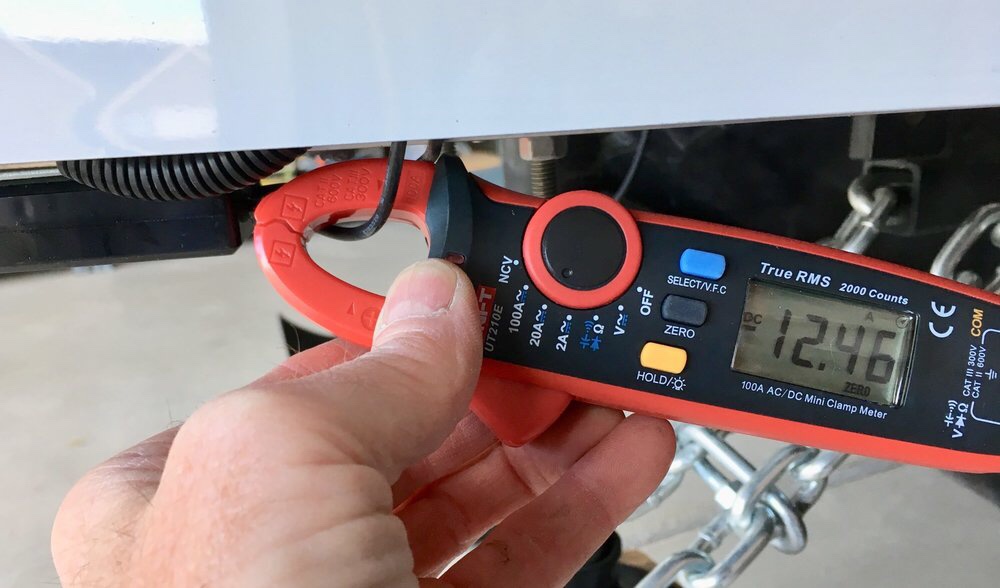
For RV use I recommend this one. https://www.amazon.com/Uni-T-B4Q094-UT210E-Current-Capacitance/dp/B00O1Q2HOQ/ref=sr_1_1?dchild=1&keywords=Uni-T+B4Q094+UT210E+True+RMS+AC%2FDC+Current+Mini+Clamp+M+W+Capacitance+Tester&qid=1609729532&s=industrial&sr=1-1i It does most common measurements like voltage and resistance, but the most useful feature is the clamp on ammeter. You can use it to measure current without disassembling any wires, though they do need to be separated from each other, not inside a loom or harness cover. For checking your electric trailer brakes it is WONDERFUL. I liked mine so much I left my regular multimeter at home, and gave one of these inductive ones to my son for Christmas. Look through this page to get an idea of how it is used for measuring amps. https://olivertraveltrailers.com/forums/topic/2685-how-to-brake-wiring-is-undersized-some-answers-and-partial-solution/ You can use it at home, but really a plug in outlet/ gfci (ground fault) tester with LED lights might be more useful, and it would also be very good for checking a campground electrical post before plugging in.... John Davies Spokane WA
1 point
-
Love it. Bet it would sell in the Oliver Owners Store. Nice to look at, and take Home, after touring the plant and placing an order. Something to "Show and Tell" while waiting. A buy with the hat, mug, and vest...1 point
-
Well - Bill you have much to look forward towards - Have a great 20211 point
-
On the bay in Seward Waterfront Park , Alaska. life is good but I could go on to on the ocean along the 101 in Washington state again Life is good. Enjoy them all.
1 point
-
One gas station trick, when the lanes face the building, is to drive around and pull through facing out. That way you can get a sense if the trailer can make the turn before you’ve committed yourself, and you’ll be less likely to get pinned in later by other traffic. Just be sure when you pick a pump that you can pull through to the farthest one so that you don’t leave your trailer in the traffic lane.1 point
-
If you have (quite) a bit of time on your hands, some lengthy but informative (somewhat repetitive) info on the various Garmin inreach units. Some good photos and insights into operation, features, and benefits. https://hikingguy.com/hiking-gear/in-depth-garmin-inreach-mini-review/ Costco had the inteach mini bundle on the shelf last month. Sherry1 point
-
Mine is an inReach SE+ (no maps). I have so many other nav options I did not feel the need for them in this device. If I were a back country hiker I would have got the map version... https://www.outdoorgearlab.com/reviews/camping-and-hiking/personal-locator-beacon/garmin-inreach-explorer-plus John Davies Spokane WA
1 point
-
Do you really want to rely on a cell based design? There are lots of places out West where it will be completely dis-functional. A satellite based locator will work anywhere that it has a reasonably clear view of the sky. It may not work if your stolen trailer is stashed in a steel roofed barn, but normal buildings and moderate tree cover is not a problem. If a satellite is not in view, it keeps trying until one comes along. Normally it takes a couple of minutes, very rarely as long as ten minutes. My inReach works flawlessly through the roof of the Ollie. I guess the Oyster 2 would be great in an urban area, but not in the boonies (OTH the odds of theft there are greatly reduced). John Davies Spokane WA1 point
-
SPOT annual (prepaid) subscription services are overpriced. In some cases grossly so. And very punitive; if you have to cancel - they keep it all... That is the primary reason why I bought an inReach for $350 and dropped my $50 (on sale, rebate) SPOT Satellite Tracker. Their web interface, at the time I cancelled, was clunky and awkward to use. Garmin’s is not great, but it is better. I would never recommend any SPOT. I don’t know if any theft devices offer a monthly subscription. My inReach monthly plan can be “paused” by going online. At the end of that month it stops until I restart it. No penalties or limitations. I don’t need it for camping five months per year, but I do travel in the winter, so I keep it active all year long, for that purpose. John Davies Spokane WA1 point
-
Reviving an old topic..... There have some recent posts on both FGRV forum and Airforums of travel trailers being stolen. Yesterday it was an Airstream stolen from a storage area, a week or two ago there was a fiberglass (Scamp, I think) stolen from a repair facility. So, I’ve started thinking again about GPS trackers. There seem to be a number to choose from. I know some Oliver owners have been using the Spot Trace and am wondering if you all are still happy with it? It gets mixed reviews online mainly due to the billing and subscription price increases each year. Does anyone use a different brand? Any recommendations? Mike1 point
-
After a year in my Oliver I wouldn't change a thing.1 point
-
John, I've had my Gen1 Spot Locator for about 7 years and it has been helpful for family and friends to know where I camped. To overcome the shortcomings you mentioned, I now also have the Spot Trace, which connects to a hidden 12v connection in a cabinet and has backup batteries in case of 12v outage. Small, easily hidden, family can even track me as I head down the road during the day. It does not, however, have the 911 feature. Because of that, I've kept the Gen 1 Locator as cheap insurance. Steve, What is the name of the gizmo you are now using? It sounds interesting.1 point
-
Thanks for the informative post. You left out one crucial fact .... The name of the unit you bought! Can you post a link? FYI the SPOT is a very nifty device, but the website interface where you store your profile and and emergency info and text messages is very clunky and not at all user friendly. The device itself is simple and can run 12 hrs per day in Tracking Mode up to two weeks on a set of lithium batteries. It has no external power connection, and you cannot use cheap AA batteries, so it would get costly for long term trailer security. Also, all the features are manually operated, you cannot set up any sort of automatic transmissions. Because it has no external antenna connection, it must be placed with the SPOT logo facing the sky. Ideally at a window location facing south, but in a fiberglass enclosure just about anywhere would work, just not directly under a piece of dense equipment like the A/C unit. It is also unreliable under dense tree cover or in steep terrain, it requires a decent view of the heavens. If you use it for hiking and want the tracking to work, it should be carried high up on a backpack facing the sky. Here is an article I wrote when this was brand new technology.... http://www.spokanister.net/ktm_SPOT.html I've used a Gen 1 SPOT for many years and recommend the optional emergency rescue (SAR) insurance, which could save you tens of thousands of dollars in the event you actually have an emergency in the boonies. Even if you don't use it for trailer security, I recommend a SPOT for anyone who travels away from _reliable_ cell coverage. John Davies Spokane WA USA1 point

.thumb.JPG.dd838cdb3df463dab6a16861fa23a319.JPG)















-
Recent Achievements
-