Leaderboard



Popular Content
Showing content with the highest reputation on 08/04/2021 in Posts
-
So I’ve got 2021 F150 and still learning features. In the FordPass app there is feature that runs a light check for you. Nice to avoid getting in and out of truck to check when you are solo so thought I’d share.
 3 points
 -
That can be a nice time of year to be here too and far less crowded parks and campgrounds. As you may have already experienced weather can change in a heartbeat too so be prepared for that.2 points
-
I was always happy with the performance of my AGMs in cold weather. They did fine down to mid teens on many occasions. I haven’t subjected my Battle Borns to that yet, but that’s going to happen at some point. Heck, we went through Bozeman a couple of years ago and swore we’d return! Mike2 points
-
As my jr. high math teacher would say, show your work or it doesn't count. 😜2 points
-
Thanks John and Mike and Carol for clarifying the issues with usage vs re-charge at cold temps. FWIW I got the idea of lead acid batteries performing at cold temps based upon my own experience. Granted I don't take off in the middle of a Montana winter when its sub zero but on more than one occasion have been caught out in low teens and our batteries did just fine. I was also referring to the storage of them as well. As long as there is NO phantom draw on power a fully charged lead acid wet cell battery is supposed to be good at extreme below zero temps. Not sure you can do this with lithium and AGM's. Regarding Long Way Up, agreed the program was fairly lame other than the magnificent scenery. While they may have been driving prototypes the batteries were anything but though, unless you know something I don't and it certainly did not speak well for that battery technology to my way of thinking. Our area has lots of Tesla's now a few Audi E-vehicles as well but suspect these are all housed in garages with some temp control and easy access to a charging station. Charging stations are few and far between in this neck of the woods, heck even gas stations can be depending on where you're going. Have not heard the Dust to Glory film but thanks2 points
-
Doesn't matter if you do or not - (4 x 6) + (10 x 6) = 14 x 6, if I understand what Steve is saying. The 'trick', I think, is that the bottom trailer is drawn slightly differently, telling you to break out the components from the start. So the bottom trailer isn't the same 30 points as the top ones.2 points
-
I see two potential answers, depending on how you want to interpret it. First, at face value, trailer = 30, tire = 5, window = 6, so the answer would be 5 + 30 x 6 = 185. Probably not the right answer. Second, since the top and bottom row trailers are drawn differently, you'd consider the window and tire values separate from the base trailer. So to get the base trailer value, subtract 4 tires (20) and one window (6) from 30 = 4. That gives a value for the bottom trailer of 14, since there's only two tires and no window ( 4 + 10 + 0 ). The final answer would be 5 + 14 x 6 = 89.2 points
-
No, You have to consider the trailer in the final row as being an equation inside parentheses.2 points
-
If you're talking about this one on Amazon, you may want to watch this video from Will Prowse.2 points
-
I've never owned a truck camper, but my uncle had one for a number of years. He eventually bought a Scamp to replace it. I love the concept of a truck camper, but dislike the climbing in and out part. (Today's trucks are so high.) We see a lot of truck campers on 4 x 4 trucks up in Canada and Alaska, both rentals and privately owned. But we see campers of all types, as well. Northern Lite makes beautiful products.2 points
-
I watched his whole series on Alaska/Canada and he definitely took some roads I’d never consider but also saw a lot of other highways with amazing scenery that looked decent and something I’d tackle. My Alaska trip is 5+ years out as I can’t take that much time off work now. I do wonder when it is time if a truck camper is a better option. I’ll admit I did heavily think about a Northern Lite before getting my Ollie. There is a trade with every RV but wonder if easier not having to tow on those roads.2 points
-
So I can’t store at home as there just isn’t space and not allowed by HOA . I live in DFW area. I have a spot that is covered with open front. Space is 50 feet long so the Oliver tucks back nicely and well protected from weather even in front. I am able to trickle charge battery and storage place has a dump station and will fill propane tanks which is nice. I could pay less for uncovered but then I’d need a cover and we get some wicked spring storms here so covered is a big plus. Eventually I’d a place where I can have enclosed garage that can be climate controlled but need to figure out first where I want to be long term.2 points
-
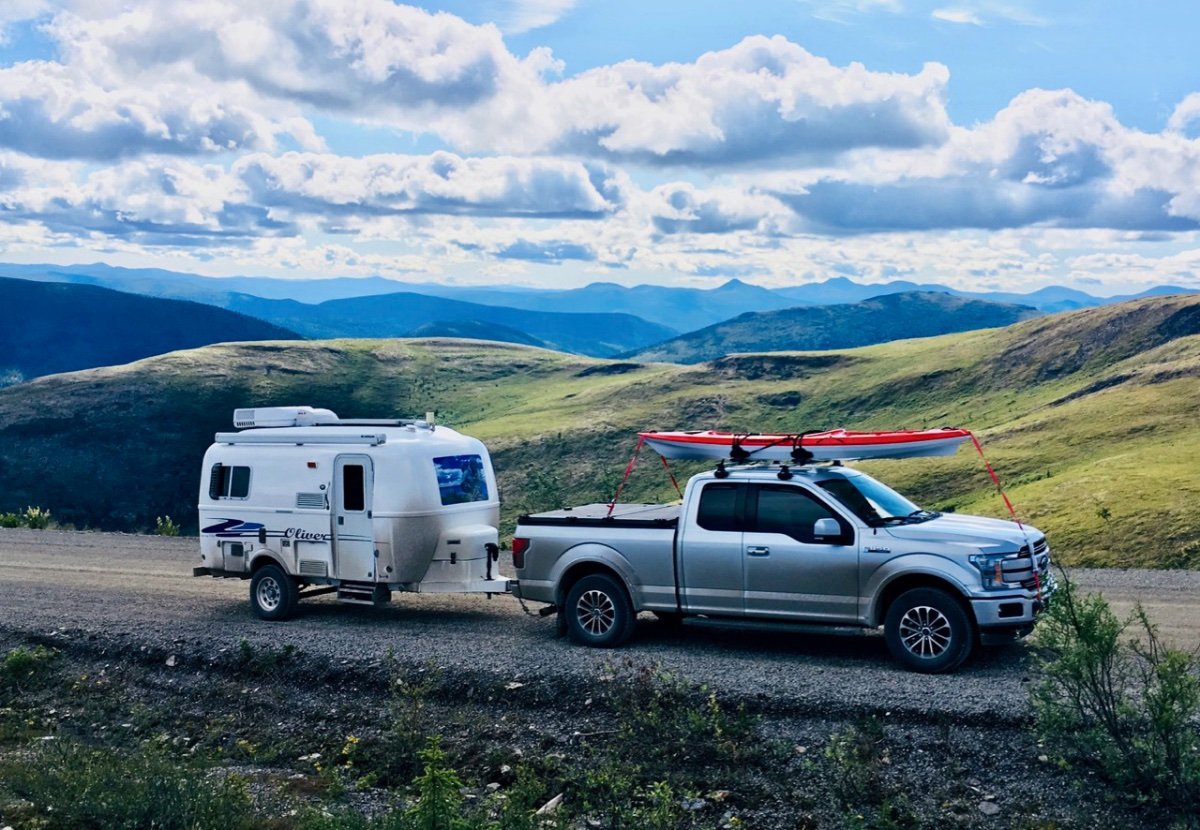
My Alaska trip was in 2018. I was very intrigued, and tempted, to take the Dempster Highway, but when I arrived at the turnoff to Inuvik, there were barriers across the road stating it was closed due to inclement weather and road conditions. Sooooo, the decision was made for me. Ha! As Sherry said, the Top of the World Highway has soft shoulders and wicked drop-offs, so be careful. I only saw one old set of skid marks going over the side. Definitely time your crossing to avoid wet, muddy conditions. There is a campground on the western side of the Yukon River where you can hang out a few days if the weather is bad. The views are spectacular. Don't hesitate to stop along the way and take your trailer's "hero" picture for your scrapbook. Enjoy a chicken-pot-pie in Chicken, AK! The wash station at TOK was very useful.
2 points
-
We store Ollie in an airplane hangar. This hangar has an open front:2 points
-
Lifepo4 batteries can be heated to above 32 fairly efficiently, with small mat heaters in a small compartment, like the Ollie compartment . Some batteries are sold with an integrated heater . Important to note, the batteries can still discharge, (can supply power to the trailer) at temperatures somewhere below 32, though perhaps not as as efficiently, they are just limited in charging. I could probably live with that, as we don't love winter camping and I can't remember a day when we didn't get above 32, daytime, even in Alaska, for at least 10 hours . (We don't camp in cold weather, intentionally. ) But, for a very few others (true cold weather campers), not so great. They'd need the warming mats, and they'd deal with the energy drain, accordingly.2 points
-
Then how do you catch your 🪰 for fishing? Mossey2 points
-
Your charging rates and current are dependent on specific batteries. My deep cycle marine 105 ah agms can charge at a higher rate than Chukarhunter references. I would say that generally, lithium is a terrific, very light, and very expensive, option, that can benefit many people. I, too, am not convinced that I will ever "need" lithium. We may do it anyway, but we'll see. For us, it's a want, not a need. A small generator, that we carry anyway, for cloudy days, can easily make up the difference. It's not as eco friendly or quiet as the solar we love, but it works, when we need it. I usually suggest that people new to camping get flooded or agm, and wait to see if they actually "need" lithium . @Chukarhunter's suggestion of a smaller lithium package is an excellent one, imo. A number of members here have diy'd smaller lithium battery banks, and are very happy.2 points
-
It was great. The actual trip started and ended in Greensboro, NC and covered over 10,000 miles in 30 days. We had covered most of the continental US a few years before. So we only stopped only briefly for sleep when crossing the US. Not many people made the trip to Alaska in those days so we saw very few cars on the Alaskan Highway and the Milepost was invaluable tool back then. The sign forest at Watson Lake was only a single row of signs. There was still a lot of devastation in Anchorage from the 9.2 earthquake in 1964. So, so many memories. We traveled to Mexico City in a Winnebago motor home 4 years later.2 points
-
The advantages of lithium-ion batteries over flooded/AGM batteries are numerous, although the relative importance of each benefit to some extent depends on how you plan to use your trailer. I have owned my 2020 LEII for one year now and almost always boondock. Oliver didn’t start offering a lithium package until one month after I placed my order and the first thing I did after arriving home from Hohenwald was to swap out the 4 lead acid batteries it came with for four 105 amp-hour Group 24 Lithium-Ions. Since I already had the 340 watts of solar and 2000-watt inverter/charger, it was a simple swap to make as Galway Girl points out. No changes in cabling required or anything else. For me, the greatest benefit is the much higher rate at which the lithium-ion batteries will accept a charge. If you go with AGM batteries and solar, Oliver will require you to use four 110-amp hour AGM batteries weighing over 200 pounds, even if you don’t want or need that much battery storage. I was told that this is so Oliver can test the performance of the solar system before it leaves the factory and that explanation makes sense. This is because the maximum charging rate of an AGM battery roughly 150 watts (12 amps) up to 80% charge and only about 60 watts (5 amps) between 80% and 100% charge. A single lithium-ion battery, on the other hand, can accept a charging rate of over 1,000 watts (100 amps) all the way to 100 percent charge. The 2000-watt inverter/charger Oliver installs can deliver about 1,000 watts (80 amps) to the batteries and the 3000 watt inverter/charger can deliver about 1200 watts (100 amps) to the batteries. This can all be confusing so I will explain what this means in the field. If you remember one simple rule, it becomes much easier to understand this. The rule is: volts x amps = watts. My Oliver solar panels are capable of 340 watts on a sunny day. At an average charging voltage of 13.5 volts (controlled by the solar charge controller), the panels are capable of delivering roughly 25 amps to the batteries, ignoring losses (340 watts / 13.5 volts = 25 amps). If you have 4 AGM batteries, once they reach 80 percent charge, they can only accept about 20 amps of charge current (4 batteries times 5 amps each) which means the solar panels are throttled back to only produce about 270 watts (13.5 volts *20 amps = 270 watts) to protect your AGM batteries. This slow charging between 80% and 100% means you are wasting potential solar energy and your batteries will likely never recover to full charge after you have started your trip, (this is true even if you use a generator unless you want to run the generator for 6 hours/day). With my lithium-ion batteries, my solar panels always deliver their full capability, unless and until my batteries reach 100% charge. I am a high desert bird-hunter and so I boondock in the fall/winter. The solar panels are not always adequate for longer trips in the winter due to shorter daylight hours, sun much lower in the sky, and cloudy weather. For winter trips more than 3 days I reluctantly take a generator and hope I don’t need to use it. If I do need to use a generator though, I only need to run it for an hour to put 80 amp-hours into my lithium-ion batteries. One would need to run a generator for 2-4 hours to put 80 amp-hours into four AGM batteries. A bigger generator doesn’t make a difference since the limitation is in the batteries and not the capacity of the generator. In fact, I can put 70-80 amp hours into my lithium ion batteries in one hour using the smallest/quietest /lightest inverter generator made (Honda EUI 1000 at 28 lbs). The newest LEII has a 3000 watt inverter/charger that can put 100 amp hours into lithium-ion batteries in one hour, but will still only put 20 -40 amp hours into AGM batteries in the same hour. One other consideration is that with lithium-ion batteries, you can get by with fewer than 4 batteries and still have more usable battery storage than you get with 4 AGMs. When you factor in the difficulty of charging the AGM’s above 80 percent with solar in the field, you really only have 40% of usable storage with AGM’s (50% to 90%) whereas the lithium ions give you up to 85% usable storage (15% to 100%). Translated to amp hours, the AGM’s give you about 170 usable amp-hours/day before charging is mandatory (40% of 420 amp-hours), whereas the lithium ion’s give you over 350 usable amp-hours/day before charging is mandatory (85% of 420 amp-hours). My understanding is that the Oliver lithium-ion package comes standard with two 220 amp-hour lithium batteries at roughly $3,000 more than AGM’s. For those that don’t need 420 amp-hours but still want all the benefits of lithium, I think Oliver should also offer a lithium package with only one 220 amp-hour lithium-ion battery at a savings of about $2,000. This would mean the upgrade to lithium-ion would only be about $1,000 above the four AGMs instead of $3,000, while still providing more usable battery storage than four AGM’s. Hope the above makes sense. I am no expert and welcome corrections/clarifications from other forum members.2 points
-
The settings inside the inverter are dependent on the type of batteries, number of batteries, incoming AC power, and how it is used. Below is a link to the Xantrex Inverter Settings article for best setup. You may find that some settings require a change as not everyone uses their camper in the same way but we have reviewed these settings and set them based on majority rule and least amount of callbacks for issues. You may have to change some of the settings based on your current location, current shore power connection, or if you make a change to your battery bank. https://support.olivertraveltrailers.com/portal/en/kb/articles/xantrex-inverter-settings If you need assistance changing your settings please contact the Oliver service department. If you are able to download the Xantrex App and Bluetooth connect to the inverter remote it is much easier to change the settings. How to connect via Bluetooth is included in the article link above.2 points
-
Tonight I was watching “Traveling Robert” on his YouTube channel. (He has some interesting trips on his show IMHO.) In this episode he took delivery of his new Winnebago TT, “Minitini III.” I suspect Winnebago may be supplying the trailer gratis for marketing purposes; however, that is totally unsubstantiated. The exciting thing to me about this program is that he had Truma representatives inside the new RV showcasing their new Aventa eco RV air conditioner. Robert was video recording the show while standing right next to the unit as it was running, and AC noise was not noticeable in the recording! The Truma Aventa eco is a 13,500 btu unit, according to the Truma website. They are available only on select coaches now, but it appears they will be made available as an after market item at some point. I want one!1 point
-
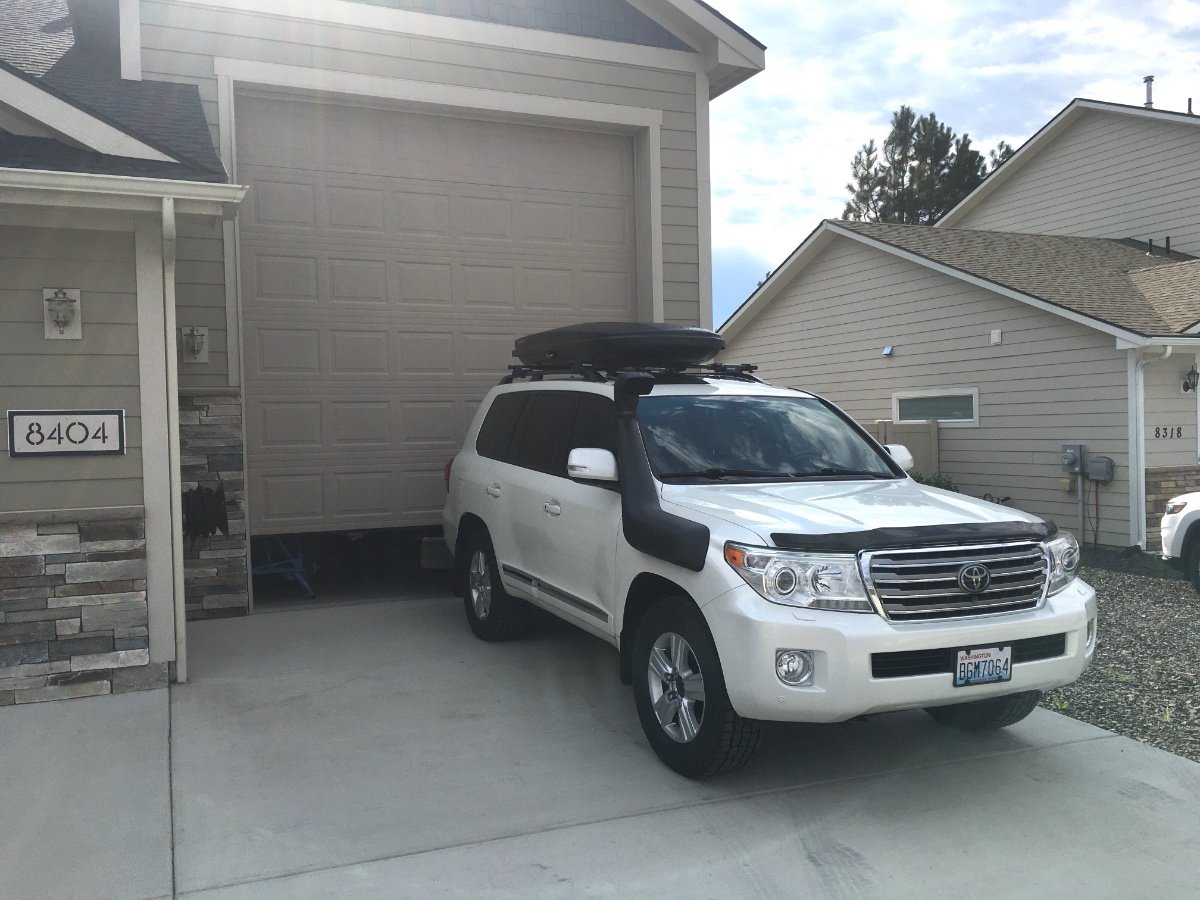
I love snorkels, I put one on my 200 last year, not so much to go fording 5 foot deep rivers, but to disguise the big crease my wife put in that fender at the grocery store .... But it gets the air intake completely up and out of the dust, and lowers the inlet air temp by a few degrees. The one on my Series 80 dropped it by up to 60 degrees, an amount you could actually feel. In the 200, it is more like 20 degrees.... Mainly it helps us find the Big White SUV in a sea of other big white SUVs in the box store parking lot... It does generate a whole lot of What The Hell Is That Thing questions. John Davies Spokane WA
1 point
-
Darn, I missed the missing wheels on the last row but did account for the missing window. Astute powers of observation @FrankC1 point
-
Our thought over the years have been, get a big motor 4 x 4 van, and tow the Ollie. Leave the Ollie, and explore in the 4 x 4. (Paul really, really wants a big van, with a snorkel. 😄) As you can see by our signature, that hasn't happened. Maybe Santa will bring him one. I doubt it, though.1 point
-
The answer is 89 because of the subtle little details of the Ollie in the last equation and also because of standard math rules. From the first equation, a complete Ollie Elite II is equal to 30. From the second equation a single wheel equals 5. And from the third equation a window equals 6. The Ollie in the last equation is missing the window on the door (so subtract 6 for that) and only has 2 wheels showing, not 4 (look really closely). So that means the Ollie in the last equation is 30-6-10=14. Then you have to follow the established math rules for how you sequence the equation. The memory trick is PEMDAS. Please Excuse My Dear Aunt Sally. Meaning you do any operations in parentheses first, then any exponents, then multiplication, then division, then addition and subtraction. So the final equation (doing multiplication first per the PEMDAS rules) is the de-featured Ollie trailer of 14 x 6 for the window which equals 84, then add the 5 for the single wheel in the equation which gives 89.1 point
-
If that's the case then as someone else said the answer would 174 then.1 point
-
Why, I don't see any parentheses. Granted I'm not a mathematician. This is an assumption I don't understand.1 point
-
Yep, the 200 amp version of this caught my eye because it was so cheap. Looks like the build and cell quality was quite good. If they have added a low temp sensor it just might work for my uses. Thanks!1 point
-
Good catch, though I don't know if it's irrelevant to the math. I don't think anyone has noticed, before.1 point
-
114 Assuming the last trailer isn’t also missing the kitchen sink, toilet etc…. PS- I’m terrible at math…… (5+14x6=114) revised answer: 14x6=84 + 5 = 891 point
-
210 3 Ollies = 90 for 30 each 3 windows = 18 for 6 each 5 wheels = 25 for 5 each so 5 + 25 = 30 X 6 = 2101 point
-
Up until this past month I have stored our Ollie in an open bay but covered shelter which did have plenty of room, but no power. The new owners of this faculty raised rents twice within a year for a total of 60% increase. I told them to take a hike and moved out. We live in Montana and during winter months turn off all switches to power including the solar panels eliminating any phantom power draws. Our 4 lead acid batteries maintain their full charge during the approximate 5 months ± of storage and will normally be 12.84 volts ± a fraction when I pick up. In the meantime we are keeping ours in the driveway at home which is not ideal due to small lots, small driveways in the downtown historical area of our town. I truly envy John Davies setup. There are no HOA codes in the area we live, at least for now, regardless its sort of a PITA to keep even a small RV like the Ollie parked here all summer. Looking at other completely enclosed storage facilities now will raise the price of admission another $15 or $20 per month with no power or temp control. My CAB (cheap a** ba*t*rd) factor starts to kick in. I have also flirted with the idea of hauling ours to the SW for the winter months for storage which would make it much easier to get away on an adventure down there, then bringing back to Montana for the summer to enjoy camping in smoked filled skies. 🥵1 point
-
Here's a link to the video @IL_Travelers discussed. Robert's minitini has some equipment that may not be available yet on Winnebago. The US version Aventa eco ac is not listed on Truma North America's website, yet. To save you the time of watching Robert's entirely too long video, skip over to 38:00 to see and hear the Truma ac in action. It is very quiet, at least as quiet as my RecPro, maybe moreso. Robert's running his on a 320 ah lithium battery (lithionics.), along with a 10 cubic ft 12v fridge. I'll look forward to its release here in the US. Since Oliver already partners with Truma on the water heater, this could be a good match. (Though it will likely be quite expensive.)1 point
-
Some storage facilities prohibit working on your trailer, you have to haul it away to do any maintenance or cleaning. It would be smart to study the contract. And decent inside lighting would be a big plus. One of the Ollies we looked at before buying was located inside a large UNLIT warehouse, We had to use flashlights to study the outside features, I can’t imagine doing anything constructive in those conditions…. My RV bay has bright white sheet-rocked walls and ceiling (they reflect the ambient light) , three decent sized windows facing south , and excellent LED daylight spectrum lighting. Even with the big entry door closed, it is EVENLY illuminated. My aging eyes appreciate the lack of shadows. I had a Sea Ray 250 Sundancer years ago, I stored it under an exposed but roofed RV unit with 15 amp power. That worked OK but the driveway was gravel, so it was always filthy, and I worried about collisions….. It looked great parked in front of my house but I could not store it there. John Davies Spokane WA1 point
-
We are renting a completely enclosed bay without climate control. Three sides abut other bays, and only the front with garage door is exposed. When we were evaluating, it was 90 degrees and about 1PM when we walked inside and didn't feel any temperature difference from the outside, making me wonder if the roof is insulated. It has 15a electrical access, but it is a 4-gang outlet just outside the bay, so it can be shared with up to 4 bays, meaning it's probably unreliable (time will tell; they said it's only there for charging batteries). Haven't actually stored the Ollie there yet. Will be soon, and will be checking at least weekly at first. We've had it at home for the last week (against covenants) so I can work through the tickets I have open without having to travel the 20 miles too often. We'd love to hear opinions on this solution if others have this experience. It's "by the month" so we can change our minds at any time.1 point
-
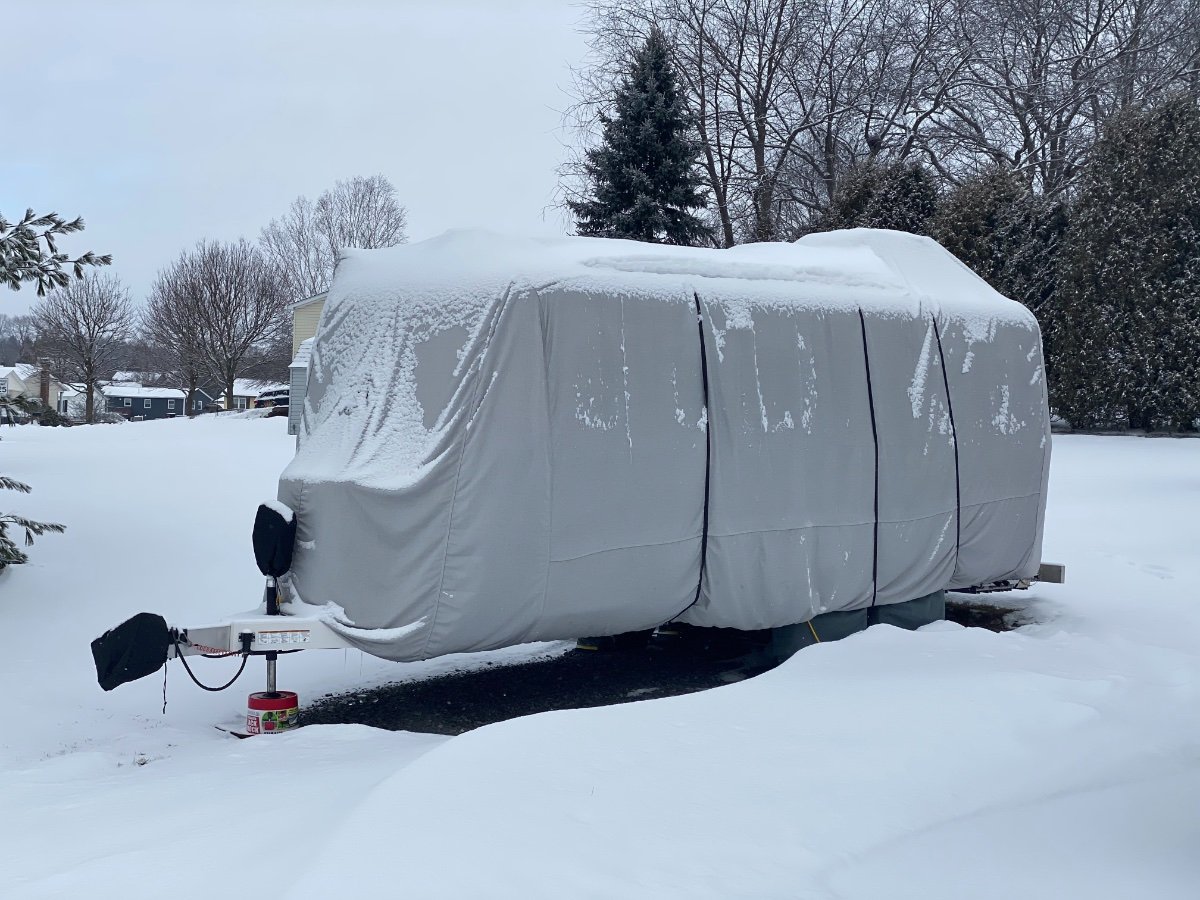
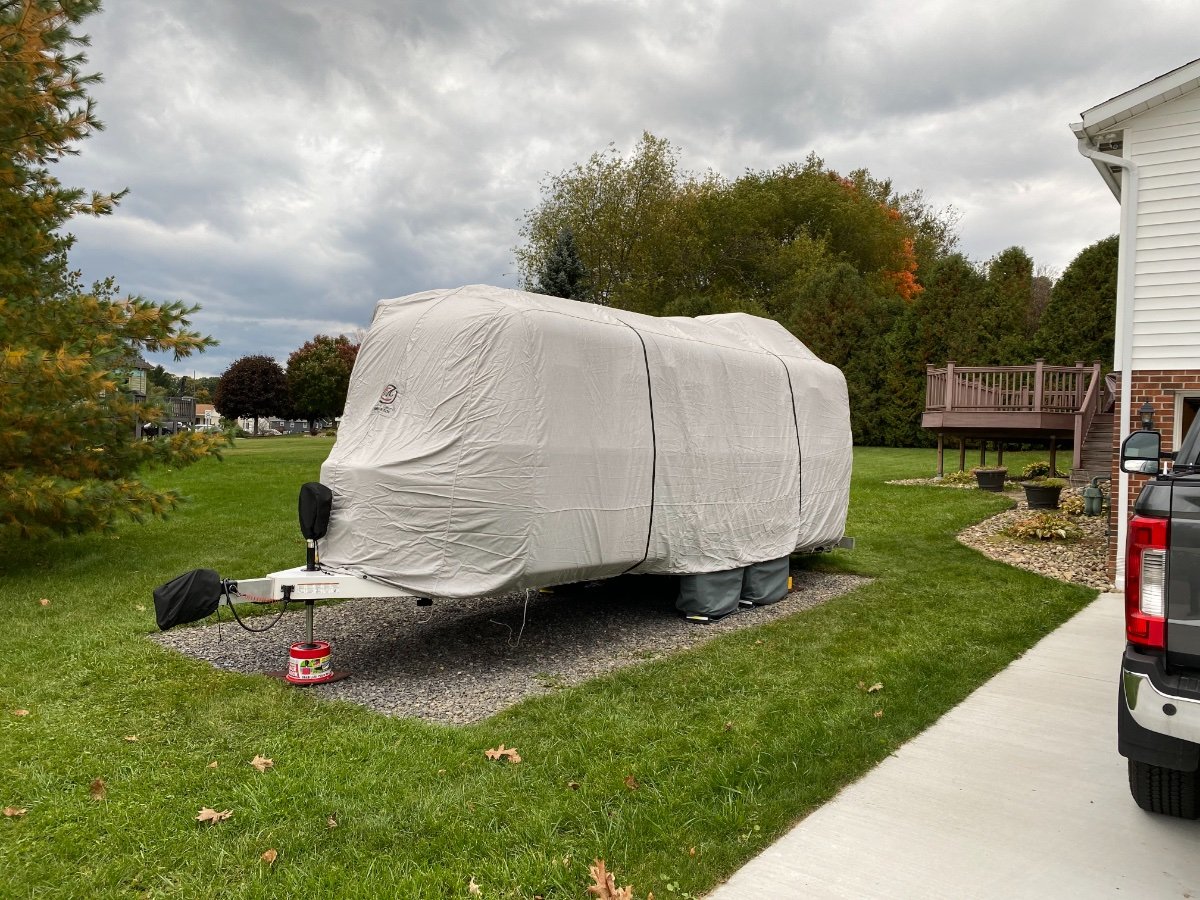
We store ours at our house when not in use using the Calmark cover. Our local borough zoning laws allow a trailer or boat up to 25’ to be kept on the property. Having it right at the house is great. Very convenient so I can check on it anytime I want, or work on it. And can plug it in to keep the batteries charged.
1 point
-
There are countless Web articles on “RV winter storage”, Google that term, watch some videos. Bottom line is, how much time (and money) are you willing to dedicate to keeping track of your Ollie? An uncovered commercial parking spot will require frequent visits to clear off snow, ice, or leaf accumulation and make sure everything is OK. An open but covered one with power is lots better, a fully enclosed one is WAY better (and the risk of collision damage or theft drops to near zero). A fabric cover offers protection but has its own risks and major hassles, such as making sure it and the hull are clean before use. You have to balance convenience, cost, location, drive time and security against your own preferences and worries. We had an owner here who had to drive six hours round trip to visit his trailer! It can be a tough and potentially very expensive conundrum, depending on your climate and home location. I feel sorry for owners who cannot store their Ollie at home, things are a lot tougher when it is far away... I live in a private development; of the thirty houses here, about 12 have attached, fully enclosed RV bays. Which is the main reason we picked this spot….. being able to use your Ollie as an emergency shelter during a power outage, or as a guest bedroom, or even walk naked out to your Ollie in a blizzard - if you wanted to 😳- is priceless. I don’t even bother to winterize, the temp there has never dropped below 38 degrees. Plus it saves many thousands of $ in storage and travel costs. Where are you located? It helps us to give better recommendations if you will add that info, and your tow vehicle, to a signature. John Davies Spokane WA1 point
-
And just for the sake of discussion, after making my last post I found this replay (pasted below) to a question on the Battle Born website. Seriously how on earth can someone expect to do fall & winter camping if you can't charge a battery in 25º weather? This past winter my wife and I watched a TV series via the Apple TV+ programming called, Long Road Up, or something along those lines. The actor Ewan McGregor and his buddy were riding battery powered motorcylces from Tierra del Fuego all the way to Los Angeles. Immediately they could not charge their bikes due to the cold weather and worse still the Rivian Trucks that were to be used as sag wagons and support also had serious issues in the cold weather all the way through Argentina and Chile. My lead acid batteries don't give a rats behind what the weather is like and can hold a charge all winter long in Montana. I would love to loose the weight of lead acid, but i just don't see how LI-ION in its current state is the panacea of energy storage. Thanks Hi Bob, thanks for reaching out. At 25° F, a Battle Born battery will no longer accept a charge. This is to preserve the cells in the battery, and the internal BMS will allow a recharge when the temperature is above 32° F. Every single battery that we assemble has an internal BMS. If you’re interested in getting more information, check out our white paper study here. https://battlebornbatteries.com/lead-is-dead-white-paper-study/1 point
-
I hope you'll get to do that trip again, someday, and share your story, along with the differences from your memories, with us . The sign forest has certainly grown. And, the roads and services are significantly better. Again, lucky you, to have experienced the road, not long after Alaska's statehood. Such a great experience !1 point
-
I agree. We drove into Banff, drove back out. Great for townie shopping tourists, not for us. Jasper is a great park, and Jasper town is a lovely spot to walk around, do laundry, get groceries, eat, catch a movie, or catch the train.(we've done all the above.) Jasper town is very walkable, clean, and pretty. Not the massive crowds of Banff. We caught a first nation festival one time. Very interesting. We've found the people of Jasper town to be very warm, inviting, and helpful. It's small, but has just about every service you may need. We've not been to Waterton yet. We'll try to do that, another trip. Thanks.1 point
-
Thanks for the video and reminding me how much we love the Canadian Rockies. We have toured them by car and motorcycle but never by RV. We really like Jasper, Banff not so much. I have never gotten used to commercial areas in the middle of Canadian National Parks. And now to completely contradict myself, we really enjoy the hiking around Waterton Park in Waterton Lakes National Park. Mossey1 point
-
Back when I installed my Victron inverter, I talked with Oliver about how they should offer it, and one reason they didn't want to touch it was because it was too complicated. Things change. One nice thing about the Victron is that Oliver could potentially diagnose and change software settings remotely. This seems similar to a problem that I ran into with my Victron when installing it. When the inverter was plugged into a separate controller/display, then it would wait for the controller to tell it to power up. That was normally fine, but if you were starting everything up cold, then the controller wouldn't see that you had an inverter to turn on, since it hadn't been powered up. So the inverter was waiting for a signal to turn itself on that could only be sent if it had already turned on and announced itself to the controller. The solution was to unplug the controller so that the inverter would default back to its internal controls and turn itself on. Then you could plug the controller back in and everything would be fine from then on. They've since fixed that with software, but it definitely gave me a scare when after installing everything, the big moment came to turn it all on and... nothing.1 point
-
I went to elementary school in Starkville when my dad was a student at Mississippi State. Long time ago. Mike1 point
-
What a sweet setup! Very nice and congratulations! Someday... someday we'll be out there with y'all!1 point
-
Hello John, I recently had to commit to my own build sheet and, like you, I am unsure of how serious I will get about boondocking until I get out on the road and see where the wind blows me. I decided to go with the 6V AGM, 2000 Watt Inverter and the easy start AC but no solar for now. I also invested in a Honda 2200 with the LP conversion kit so that I have my own power solution while I learn what my long term needs will, or will not be, relative to Solar. Not trying to sway you in either direction this is just where I landed, my build sheet is set in stone, check written and I pick up my Ollie the end of Oct. Your question is AGM VS Lithium so I may not be of much help 😉 in my case it was more commit or not commit to solar right now.... and the batteries I chose were the result of that decision. I am used to 6V AGM from my past campers and never had any issues with them. Good Luck with your choice and Happy Trails. Dan1 point
-
Agree with comments above. Ventilation is the main preventer of condensation. We keep a vent open almost all the time and have had very few issues with condensation. We shower, boil water for coffee, cook and even breathe inside our trailer. Mike1 point
-
Congratulations! You are going to love your Oliver. Wishing you many happy adventures in the coming years. Cindy1 point
-
Congrats on your Ollie. We took delivery of Hull 802 on May 14. They do pull great. We also had a great orientation by Hannah, who took the time to answer all our questions. Just wondering if you had any contact from Oliver after delivery? I am disappointed that we have not heard from anyone at Oliver just to check in. Enjoy the Oliver. We are enjoying ours! Jeff Simone1 point
-
I only use the Generator for batteries when solar isn't enough, like winter in WA with tall tries and gloomy/snowy skies. During much of the year, we'd be better with solar panels mounted on the side of the trailer. We don't have an inverter: USB-C laptops charge off of DC power, DC TV, and DC conversion on the apple TV. So all we lose are the Microwave/Convection, AC, and dehumidifer. The dehumidifier is the one thing I want back for snow camping - followed by the micro/convection for some cookies.1 point
-
You cannot find a more satisfying product than Rejex. Read the reviews. It is amazing stuff, and a single coating will make your Ollie glow. Two coats will make your jaw drop. (Great for dark colored cars with paint in good condition.) https://www.amazon.com/Rejex-High-Gloss-Protective-Finish/dp/B00GM6NF0I You must remove all existing wax from the surfaces before applying. Dawn dish detergent will strip off wax, and a followup with a paint prep solvent like this ... https://www.amazon.com/3M-General-Purpose-Adhesive-Cleaner/dp/B00Y957GWC/ref=sr_1_2?s=industrial&ie=UTF8&qid=1534521368&sr=1-2&keywords=3M+adhesive+cleaner .... will remove tar, tree sap, etc etc. You can get it locally from an auto paint supply store for as little as $15 per quart (and no shipping). At NAPA it is close to $30. You need about half a quart to do an Elite II, including the roof, if it isn't too dirty/ spotty. I suggest that you buy two quarts to be safe, and for future use. Good stuff... use with gloves and adequate ventilation. It smells a little but it does not knock your head off like MEK or acetone. I use square cotton rags folded twice to apply, flipping when they start to turn black. That gives you eight clean sides to work with. I only need half a bottle of Rejex to do "Mouse". Dried three week old bug carcasses on the front wall do not "rinse off" but they do come off completely with absolutely minimal pressure. It is very satisfying compared to the old routine of multiple hard scrubbings, which is hard on you and also hard on the gelcoat. John Davies Spokane WA
1 point


















-
Recent Achievements
-