Leaderboard



Popular Content
Showing content with the highest reputation on 04/14/2022 in Posts
-
Just a quick note for those interested in the lithium platinum package, which we have on our 2022 Ollie. We took our maiden voyage in VellOllie this week, about 4.5-5 hours from home. Because I knew we would have an electrical hookup at our campsite, I decided to run the regrigerator on DC for the entire trip down. We started at 100% battery, according to the Lithionics app, and ended at.....99% battery on one, 100% on the other. It was sunny the entire trip, which helps of course. On the return, we ended at 99% and 98%, and were in cloudy conditions for the entire drive. I'd say that's pretty good performance, and have confidence in running the fridge on DC while traveling, even when I know we won't have electrical hookups at our final destination. Pretty cool...and part of why we went with the biggest solar/battery package we could get.8 points
-
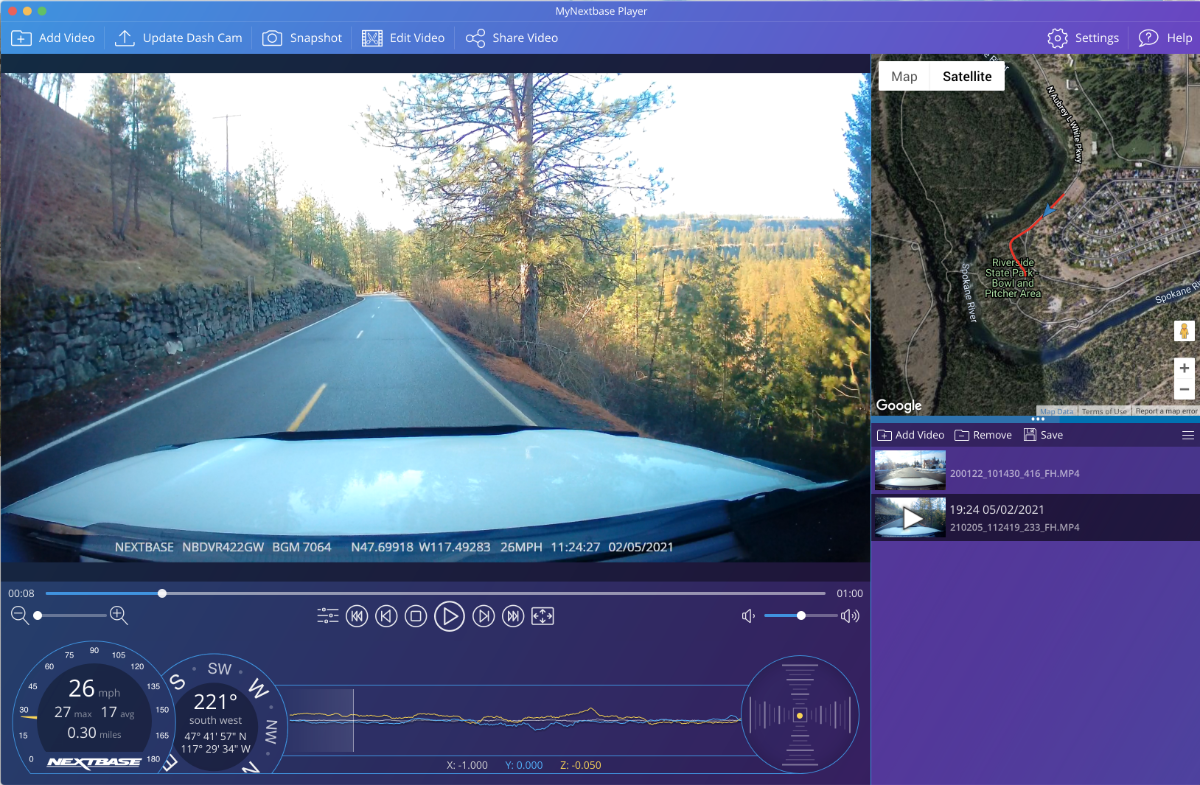
You need to read some dash cam comparison reviews, and decide how much you want to spend and what features you would like. Where and how you park your car is important too! This would be a good choice, I have had one on my TV for three years and just bought a hard wire kit for my wife's new Acura RDX, so I can swap it easily to her car. I will probably buy another cam for that car when they are on sale. https://www.amazon.com/Nextbase-522GW-Dash-Cam-Kit/dp/B07PV2RX57?th=1 Nextbase 522GW price history You need enough image quality to read license plates at NIGHT, and a polarizing filter to cut glare in sunlight. Everything else, like rear view cams, are optional features. I really like how this cam captures all the speed, location and G force info, and can overlay it onto a Google map. This is a screen cap of a video using their desktop application. I have to admit that I feel naked and unprotected driving without one. 😉 John Davies Spokane WA
 6 points
 -
I bought this Garmin Mini 2 and a 256GB data card. Forward view only, but very compact and some nice features like voice recognition. Hides nicely between the windshield and the rear view mirror. Garmin Dash Cam Mini 2, Tiny Size, 1080p and 140-degree FOV, Monitor Your Vehicle While Away w/ New Connected Features, Voice Control https://www.amazon.com/dp/B0931YZ82P/ref=cm_sw_r_cp_api_i_Z5M0YW178SD5J3MD7JTY?_encoding=UTF8&psc=14 points
-
We recently had our new F350 Super Duty completely covered in XPEL 8 mil PPF (paint protection film) and had XPEL’s Ceramic Fusion Plus applied over the PPF. The results are amazing with regard to an amazing shine that pops, shedding water and ease of washing the truck. We have had XPEL PPF installed on all of our cars and trucks over the last decade It’s held up extremely well. We even had areas of the front of our Ollie covered in 10 mil PPF. It’s all about the install. https://www.xpel.com/ceramic-coating-fusion-plus3 points
-
Not with the lithium packages.3 points
-
The NextBase cams use a suite of Mac MyNextbase software and apps. You can view and transfer files to an iPhone by wifi, email them (in low resolution) or connect your iPhone to a Mac computer with a cable and use their program to import, view and edit files. You can remove the memory card and insert it into a card reader and copy them. You can upload them to Cloud storage. Or you can use the built in settings in the cam to do a lot of stuff rom the rear screen. I am not a big fan of the software, it could use some refinement, but it works well enough. Go here to the MyNextbase box part way down, click Learn More. https://nextbase.com/dash-cam-features/ It can get quite complicated, it is best to just watch a whole lot of videos for different brands, to see what appeals to you. It is really important that you use a very fast memory suitable for HD video, or the camera will freeze and crash. This is what I have, the Class 10 V30 (or higher) symbol is what you look for. It depends some on if you have a 1080p cam or a 4k cam….. John Davies Spokane WA
3 points
-
Garmin makes a nice small one that easily connects to the mirror in late model Fords (and other vehicle brands too). A couple of years ago after doing a bunch of reviews (as JD suggests) and watching a bunch more YouTube videos, I bought a front and rear dash cam that went by the trade name of Apeman. As a friend of mine suggested - perhaps that alone is why I bought it? However, I'd like to think that it had a ton of features, allowed for about a 320 degree view, all at 1080p and the price (on sale) was under $140. Since this camera will give me a warning if it has recorded something that I should see - it does this automatically in the event of an accident, movement or noise even if the vehicle is not on (parked) and/or I'm not in it. Of course it also records constantly while I'm driving. Whatever you decide to buy, be sure to get a large data card for it (I've got a 128 gig card and some newer cameras will take an even larger card). Virtually all of these cameras record to the data card until they are full and then simply start to overwrite the oldest data. My camera does this except that it will not overwrite anything that has been saved due to an "event" - either identified on its own or by me. Happy shopping! Bill3 points
-
When I pulled into Vinnies there were about 8 Airstreams all lined up for their turn getting the coating. No other campers but Airstreams...and mine was the only Oliver..LOL2 points
-
Correct. It's disconnected because the lithiums can absorb power way faster than the vehicle alternator can handle. (My probably over-simplistic understanding of the engineering.)2 points
-
We’ve never run our fridge on DC, when we had the AGM’s I felt more comfortable with propane. It’s good to know the performance of the lithiums and it gives us another option. I’ll probably stick with propane since it’s worked so well over the years. Mike2 points
-
Most - if not all - the current models of dashcams have multiple ways of getting to the video files. This has never been an issue with any of the cameras I've been interested in. Also, I too have a TPMS, Garmin 890 (and the truck's navigation system), cell phone, dashcam, rearview camera screen, radar detector, and laptop - all in that central area of the truck. I have never experienced ANY issues with any of these devices interfering with anything. Bill2 points
-
I have only 5 years and 25,000 trailer miles with the same system. No issues at all.2 points
-
I recently installed the TireMinder i10 TPMS system. The instruction manual says the following of page 28: Can Rubber Valve Stems Be Used with The TireMinder Transmitters? Yes, TireMinder Transmitters may be used on high quality, high pressure rubber valve sterns. However, we highly recommend brass or stainless steel valve sterns. Due to the fact that rubber valve sterns deteriorate fairly quickly, e.g. they should be replaced when replacing your tires, an external TPMS sensor can exacerbate the deteriorating by adding weight to the valve stern. Additional rubber valve stems issues are based on age, length and physical location (i.e. exposure to road salt, high heat, sun, etc). If using rubber valve sterns, it is recommended that you check the condition of you rubber valve sterns on a regular basis. Failing to do so will result in a tire failure.2 points
-
One of the reasons I changed to metal stems. Bill2 points
-
I drove to Tallahassee yesterday and left the Oliver at Vinnies Northbay. They are going to put the ceramic coating on it and I will pick it up after working the tornado relief in Dawson City, Kentucky next week. The process takes about 3 days.1 point
-
Note: This information is specifically related to the Xantrex Freedom 2000w or 3000w Inverter/Chargers. Inverter - What is it and how does it work? An inverter produces 120V AC power from a 12V DC power source. The easiest way to think about this is 12v power x 10 = 120v. This is not exactly accurate as it takes slightly more power but this is the easiest way to do a quick conversion. For instance, a laptop might be rated to use 3 amps when plugged into 120VAC but when used through the inverter it would equate to 3a x 10 = 30 amps. The importance of this is because while on shore power your energy is endless. When using the inverter, you are limited to the battery’s capacity. Battery capacity varies from battery to battery. Charger - What is it and how does it work? The charger uses incoming 120VAC power and steps it down to 12VDC power. The charger is setup with a specific charge profile based on the type of batteries and the number of batteries that you have. Each and every battery has a charge profile set by the battery manufacturer. The charger has 3 stages of charging: Bulk Charge, Absorption Charge & Float. In Bulk charge it will supply a set amount of voltage, typically 14.0 - 14.6 volts and a large amount of amperage to replenish your battery charge quickly. The length of this stage depends on the battery type, number of batteries, charge profile and *incoming power. Absorption charge is a timed charge cycle. It keeps the voltage high but lowers the amperage going into the batteries. Once in Float charge mode it drops the voltage right above the batteries resting voltage to top them off & maintain them. Note: When in Bulk Charge rate it is passing the max amount of energy allowed to the batteries. With Lithium batteries this is a large amount of amperage which generates a tremendous amount of heat. During this stage it is normal for the fan to run at a high speed which causes it to produce a lot of noise. *Amps setting based on battery type & number of batteries. Shore Power *Incoming Power The camper is designed for 30 amps however smaller power sources can be connected using adapters. It is important to understand that the camper and the inverter/charger are setup for 30 amps and when using a power source smaller than 30, it may result in poor performance or failure. House: When you are connected to a regular home receptacle, you are connected to a 20a or 15a circuit, unless you had a dedicated 30a receptacle installed. You also have to consider that the circuit most likely is not dedicated to the camper which means other appliances inside your house are running on that same circuit. When connected to a house circuit you may also experience failure at the circuit breaker in your hose. If this occurs, you have overloaded your house circuit meaning you are requesting more power than what it is rated to provide. You would need to locate a dedicated circuit, a circuit that is not being used, or turn off some of the appliances to lighten the load. Generator: When you are connected to a generator the incoming power depends on the size of the generator. We recommend at least a 3000w generator which will provide about 25 amps of power. You can use a smaller generator however you will again be limited to how much power it can provide. Note: When using a generator, because it is not grounded, it is recommended to use a Neutral Ground Plug. Without the plug you would be required to turn off the surge protector, which we DO NOT recommend. WARNING: Using an undersized or long extension cord may result in poor performance and failure. When using an extension cord it is important that you use the appropriate size & length. A 100ft extension cord will have voltage loss resulting in heat buildup at the power inlet which can cause the inlet & cord to melt. We recommend using a 10ga/25ft max extension cord. Flow of Power Solar & Shore power have their own path to the batteries for charging and they work independently of each other. The battery is just the storage device for the energy whether that energy comes from Solar or the Charger via shore connection. See pic below for path of power The red arrows indicate the direction of power with both stopping at the battery bank. NOTE: The Inverter/Charger has two connections to the AC Panel as shown above. One connection comes from the Main power supply to the input side of the inverter. The Input side is what supplies 120vac power to the inverter/charger. Once the inverter/charger has the incoming power it passes it through the output side back to the AC Panel on a split bar to allow AC power to any breaker located on that side of the panel. The inverter/charger also uses this same power to charge the batteries. When not connected to 120vac power and the inverter is turned on it pulls 12vdc power from the battery bank and converts it to 120vac power, sending it down the same output connection in order to supply power to the AC panel on the split bar. Caution: We do not recommend leaving the inverter on. The inverter will pick up the AC load within seconds if something happens to the incoming 120vac power but this will start to pull from your batteries which will cause the batteries to drain without your knowledge. Solar vs Charger Solar collects and charges at 12vdc whereas the Charger uses 120vac incoming power to charge at 12vdc. The difference is in the amount of amps supplied to the battery. The max amp output that the solar panels can provide is 18.8a per hour however this is dependent on the sun, while the charger can put out up to 150a per hour depending on the charge rate setting in the charger. Bottom line is that a shore power connection whether it be at a camp ground, your house or a generator will always charge faster than the solar. Areas highlighted in light blue below are the primary settings to review. Please make sure you locate the appropriate battery column for your camper build. Below are some links to the Service Knowledge Base articles. *These links may require login credentials as some of the articles are posted for Oliver owners only and cannot be viewed without an account. Xantrex Inverter Settings Inverter/Charger - Battery Charge Profiles Xantrex Inverter - Error 20
1 point
-
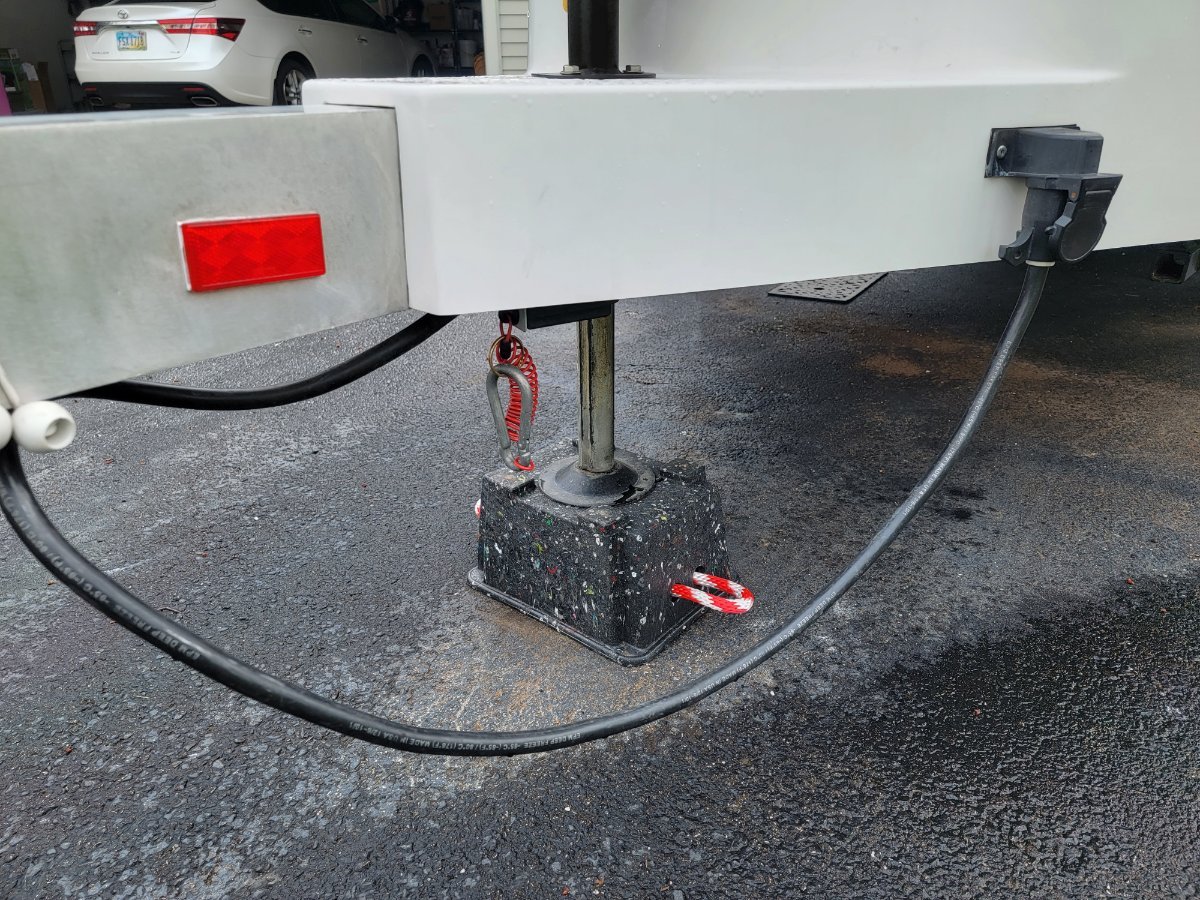
Just wanted to share an item that I've found recently that I'm pretty impressed with. I have used various pieces of treated lumber in the past and will still carry a few for sloped sites where I need to lower the bow more, but I recently was looking for a better (and safer) option for the front jack post while parked in my driveway or at level sites. It's called an Ox Blox. They can be purchased in a pack (4) for the rear stabilizers as well. I only ordered one for now to test it out as it's a little pricey for a hunk of 9# plastic, but so far, I really like it. It can support up to 10K pounds. I added the knotted red rope handles for ease of use. I know there are other options like Andersen but I'm liking it's low profile and the recycled plastic. https://www.amazon.com/Trailer-Camper-Blocks-stabilizer-Supports/dp/B09DMM51FP/ref=sr_1_1_sspa?crid=2QDUHSRGXH4DQ&keywords=Ox+blox&qid=1649865895&sprefix=ox+blox%2Caps%2C178&sr=8-1-spons&psc=1&smid=A2VI3MSVP5BC79&spLa=ZW5jcnlwdGVkUXVhbGlmaWVyPUEzR0dXVTcwMUFBVFJDJmVuY3J5cHRlZElkPUEwNzg3NTkzMjk4MVVISThCUE1WRCZlbmNyeXB0ZWRBZElkPUEwNDgwODAwMklGNEtXWTNDVzRLTSZ3aWRnZXROYW1lPXNwX2F0ZiZhY3Rpb249Y2xpY2tSZWRpcmVjdCZkb05vdExvZ0NsaWNrPXRydWU=
1 point
-
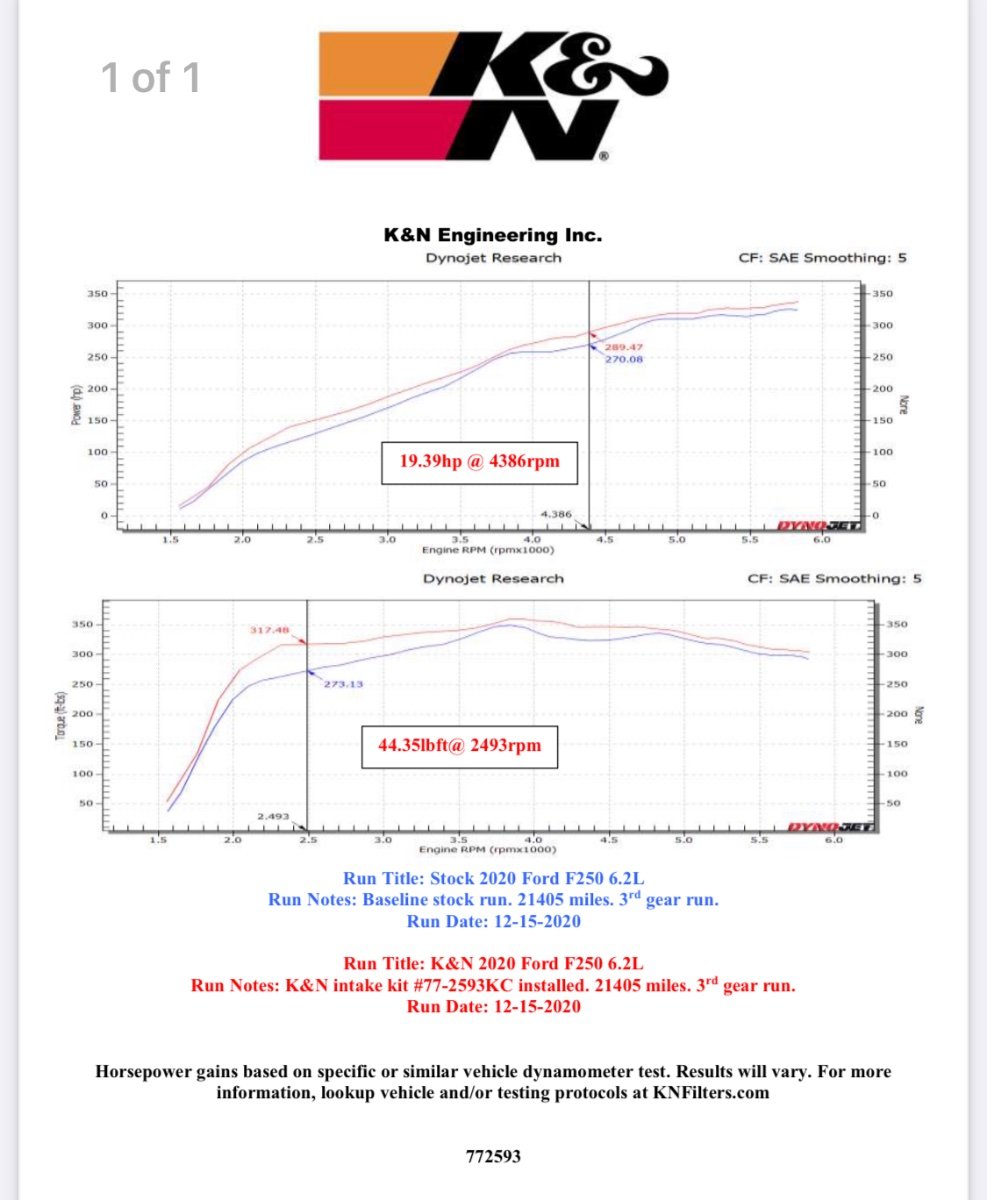
K&N does publish actual dyno run data for their products that shows a performance increase. I was actually surprised to see the significant increase in torque for the test on an F-250 6.2 liter gas engine, especially in the lower part of the RPM range. But the dyno runs always seem to be in a single gear (3rd gear run in this case). So I’m sure K&N is cherry picking their data a bit to show the best results, and this test is for a complete K&N cold air intake, not just the filter.
1 point
-
On the older trailers the Dometic is the high point. 9’ 7” I believe. I use 10’ as my safe number. Our cell booster antenna is well below the top of the AC. I can’t speak to the Cradlepoint. Mike1 point
-
Oiled filters do NOT provide nearly as much protection as a quality pleated paper one. This has been proven with oil analysis tests. I use OEM Toyota paper engine air filters only, and change them often. I can’t comment on your performance claims, but I can state that with some vehicles a properly calibrated cold air intake (with ECU tuning) or a snorkel will noticeably improve power. My LC200 has a snorkel, I do not see any improvements at all and it is noisy and whips road spray onto the passenger side glass at highway speeds. My 1996 Series 80 had a snorkel, and it really woke up that engine, probably because there was an up to 40 degree drop in intake temperature (recorded with an OBD2 monitor). One great thing about a snorkel, it makes it really easy to find your white SUV in a sea of white vehicles at the box store…. Do you intend to keep towing with your 4.7 Toyota? That is a very marginal power plant for a 6000 pound Ollie.. It is a tough little truck but IMHO that is definitely abusing it. John Davies Spokane WA1 point
-
This can happen sometimes - if an IP address changes, for example you move around a lot or on cell vs wifi - many reasons. It also happens to me and it's most likely nothing to be concerned about.1 point
-
I saw Beacon on I-95 in Wells Maine heading south yesterday around 4:00 p.m.1 point
-
That’s even farther away, but I could include a trip to Napa!1 point
-
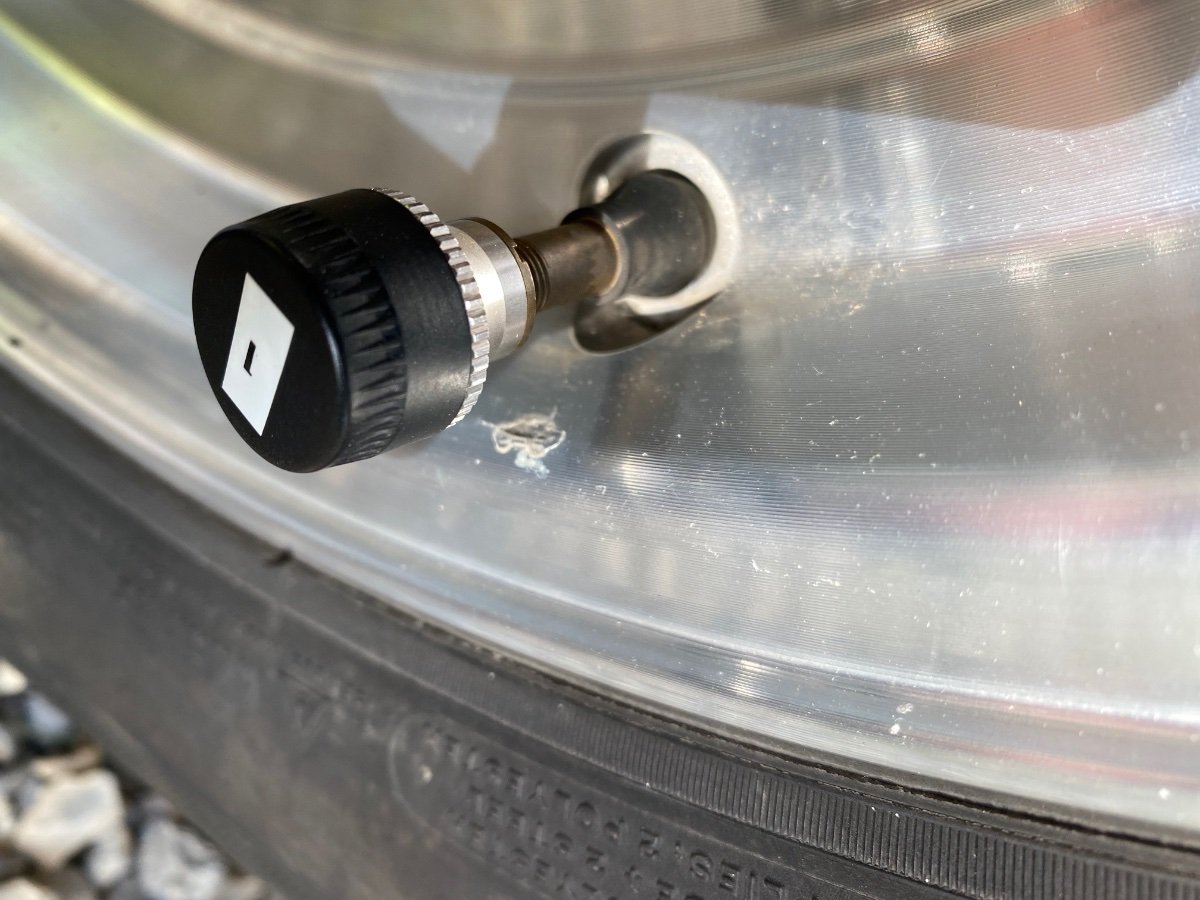
I have the TireTraker TPMS with the external sensors that thread onto the valve stem in place of the normal valve caps. While doing my spring cleaning on the Ollie, I noticed that all 4 aluminum rims have a wear mark on the rim directly adjacent to the valve stem (see picture). In researching this a bit, I found some comments on other forums about the weight of the external TPMS sensor causing the valve stem to deflect when the tire is rotating at highway speeds, and in some cases even causing the valve stem to fail. Anyone else observed this? Has anyone ever experienced a rubber valve stem failure while using the external sensors?
1 point
-
We went with metal stems when we got the TST system 5 years ago. Local tire shop mounted the stems and balanced each wheel with the TST sensors mounted. If I recall it took about 45 minutes and was not expensive. No issues so far after around 60K miles with them mounted. Mike1 point
-
For sure the microwave plate is on our arrival/departure list. We use a large fluffy towel and wrap it well, and put it back into the microwave. Best place for it. Never had even a second thought about it there.1 point
-
What if you slip on a rubber grommet to help support the valve stem from the centrifugal force of the spinning tire. Just a thought.1 point
-
John, I need to be able to connect to an iPhone or my MacBook to down load files. Can you take the SD drive out of these and play the files on a computer or do you need a special app to play them? I have figured out that the phones need a special app to view/ down load. I just do not know how well they work with the iPhone. The thought about using a 256gb card for storage. So there would be less chance of over writing a file I wanted before I could get it downloaded. I’m assuming I could get 25 to 30 hours of time on a 256gb card with HD. thanks everyone for the info, keep it coming. I’m sure I’m not the only one that is taking it seriously after the wreck. Bob and Dawn1 point
-
I can't recall where I found this, or I would post a link, Here are some screen captures. I have been using these stainless crimp rings for years, and removal was always a pain, though less so than for the copper ones, but when I saw this tool, I had to have one. Picked up at Lowes for $30: Here is the full pdf. John Davies Spokane WA 1082707744_ApolloPEXInstallationManual0422.pdf
1 point
-
I certainly now see the advantage of a dash cam after reading about Questionmark's accident. But I do have some concern with all the gadgets I now have and adding a dash cam all with their monitoring display near each other in the TV cab. The devices will include: (1) Garmin 890 RV GPS, (2) Ollie's rear view camera monitoring display, (3) TPMS monitoring display, (4) cell phone and (5) now a dash cam. I remember reading in the TTPS manual about interferance of their monitoring display if near other similiar devices. Will they all work properly in the cab together? Do they need to be located in seperate areas of the cab? I would appreciate others opinions and experience with multiple system running concurrently. Thanks1 point
-
Tst recommended them when we bought ours, over a decade ago . We installed metal stems. No issues. If you continue with original rubber stems, just check regularly. I think it's a personal choice. Weigh the weighted sensors, vs stems, vs camping habitat and roads .1 point
-
Thanks so much for sharing this. I've been wondering how much of a drain running the fridge would be on the lithium batteries. Very helpful!1 point
-
Thanks John. Good to know your long term experience with them has been trouble free.1 point
-
Going on six years, and no issues with my TireTraker sensors, they do hit the rims, just like that top picture, it never bothered me any. I worry a whole lot more about busting off a steel TPMS stem on my Land Cruiser. John Davies Spokane WA1 point
-
Nan, Can't wait to hear about the results!1 point
-
We have used a VAVA dash cam with 1080P for years, but you'd need to be more specific in what you expect beyond resolution before others can answer wisely. Charlie.1 point
-
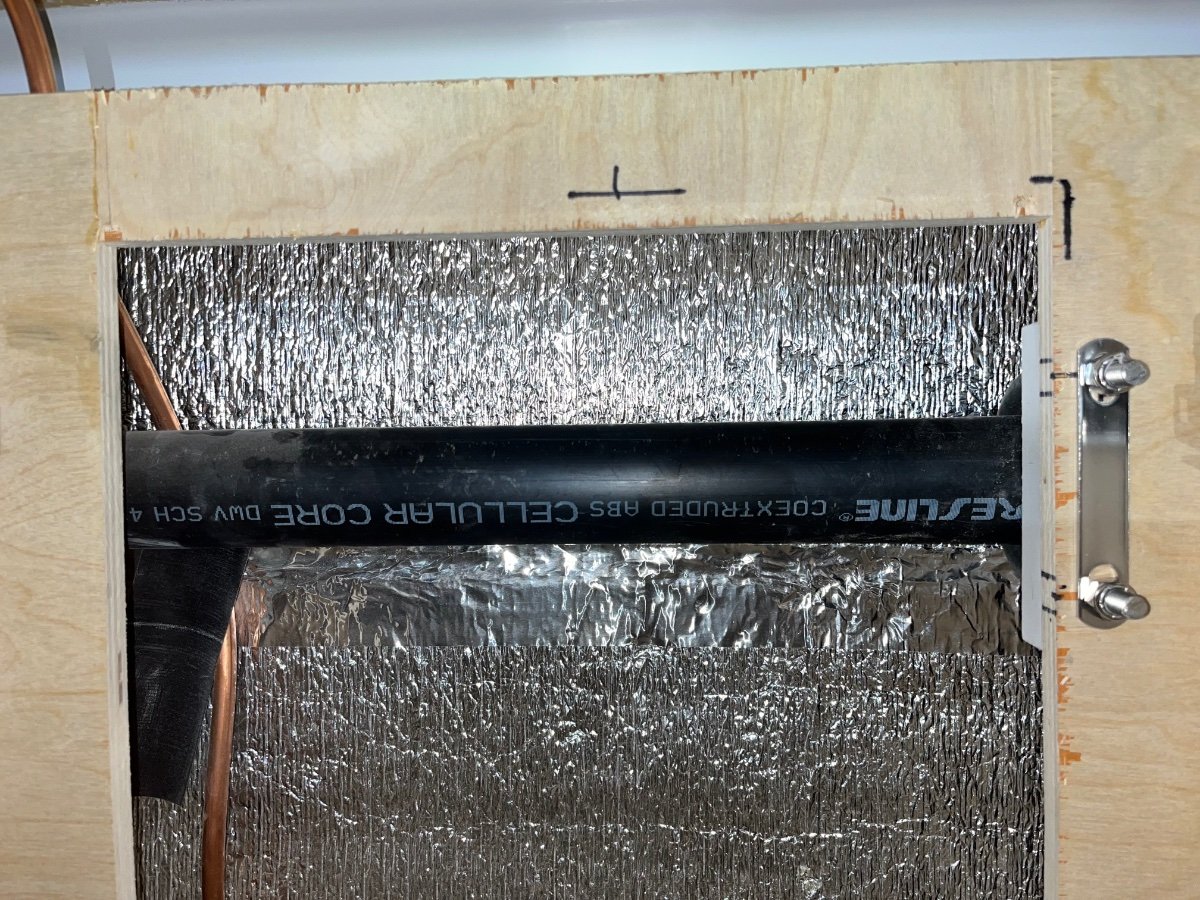
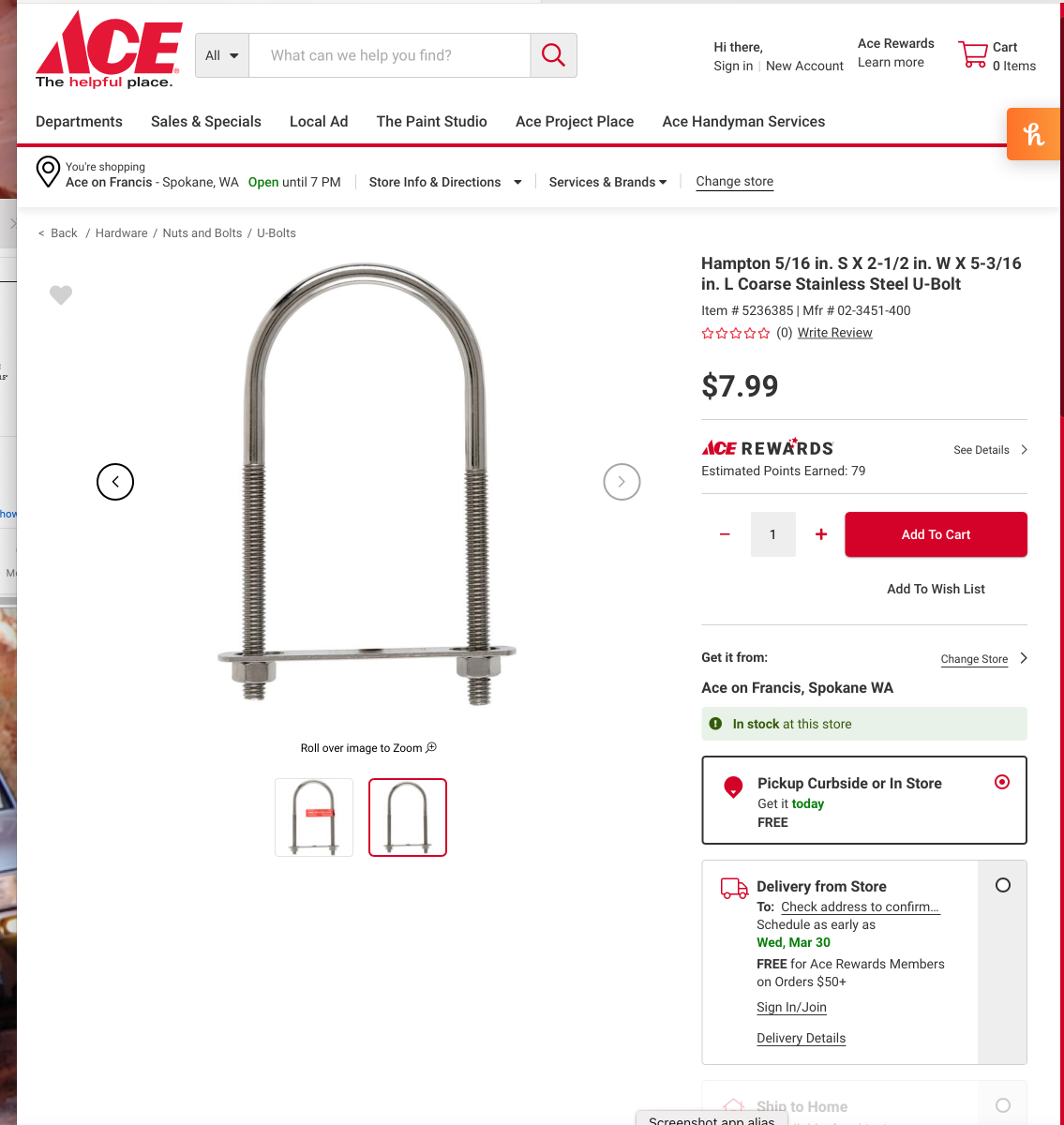
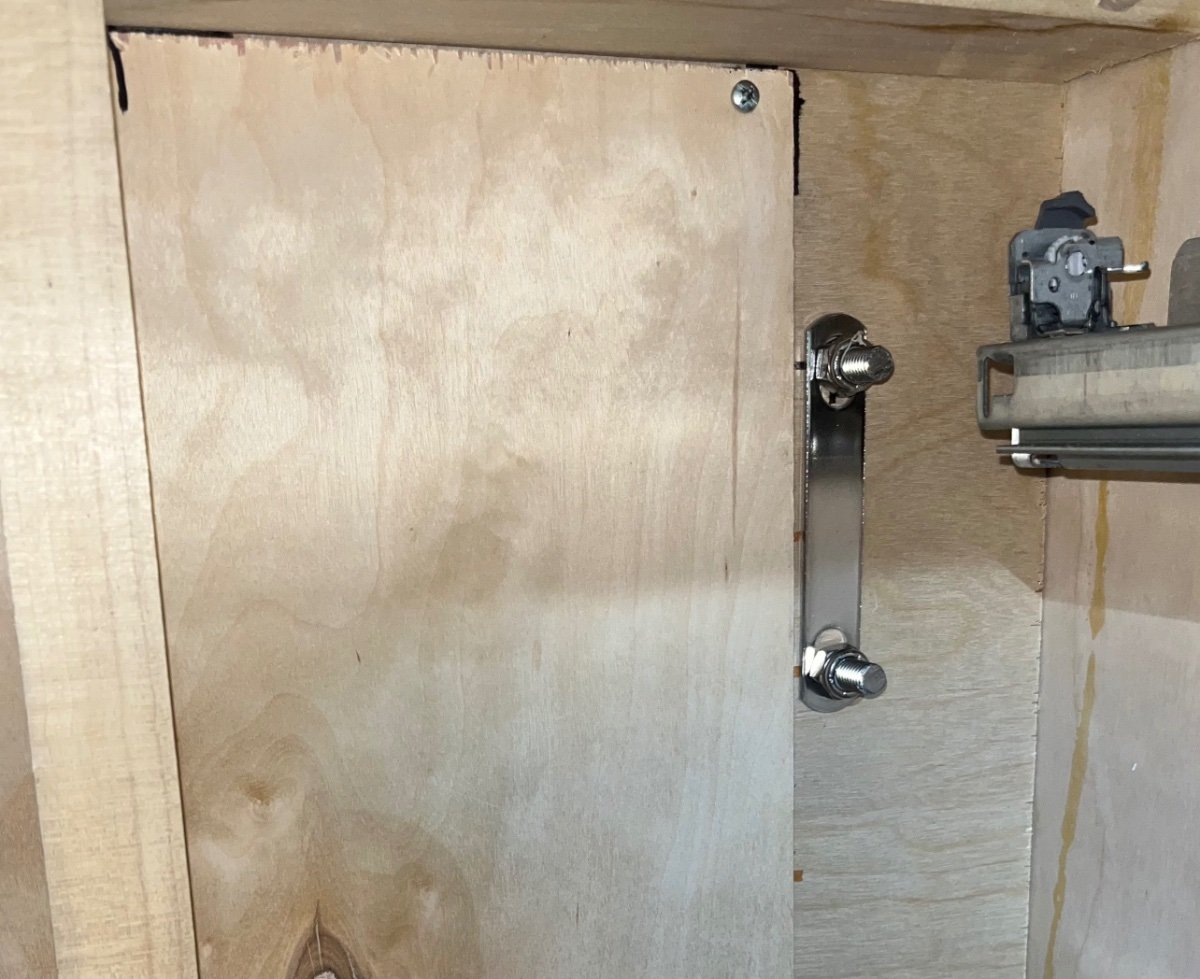
I opened up my sink access panels for the first time in five years (Yeah, I know!) and found the black pipes just flopping around, there was zero support between the sink bottom and the grey tank itself, many feet away. Video: Oliver Legacy Elite 2 Sink grey pipe With that much possible movement, it really stresses the glue joints. I decided to use a ubolt and a 1 inch spacer, to remove all motion and also to keep the down angle so water would flow properly toward the tank. (If I moved the pipe hard up against the back of the cabinet, the angle was UP..) I slid 3/8" automotive fuel line over the ubolt as padding, and a 1" thick piece of HDPE material, the same stuff Oliver uses throughout their trailers. I also replaced the plain nuts with self- locking ones. SORRY, some of these pics are coming through rotated...! This shows the tee piece and the 1/8" plywood access panel removed. This shows how it goes together, using a scrap of pipe. Use the legs to locate the holes in the wood: Use a 90 degree square to draw the center of those lines. The legs need to be cut off, anything longer than this will mean you don't have enough room to install it into the holes. Finished, the pipe is drawn up tight against the wood, no movement! This shows the slight down angle of the pipe, in reference to the wood cross piece. John Davies Spokane WA
1 point
-
Followup, here is the access panel in place. And yes, the drawers still close 😉 John Davies Spokane WA
1 point
-
Hello Oll, I’ve been working in the marine industry for 40 years. gelcoat is very similar to paint in it’s required care. CUT, POLISH, WAX !! A heavily oxidized gelcoat will require cutting with sponge abrasive wheels. If you have not had experience with this , it would be best to learn from someone experienced. There are excellent YouTube tutorials on this if you are feeling too cheap to pay someone or, honestly want to learn yourself . Most important are cutting implement abrasive grades, polisher speed adjustment during passes and pressure applied to surface as you go. Polishing a new paint/gelcoat or an old weather/industrial impurity/sun damaged finish is an acquired, hands on skill. The most forgiving victim would be an auto/boat that is moderately oxidized. Find an old car that needs a polish and go to it. It can only look better, so you won’t have to worry too much about barking up an $80,000 trailer. After all of these years polishing boats and cars, I have come to be unimpressed with highly specialized products. Any product that promises high gloss without your flesh as a toll, is packed with disproportionate amounts of petroleum products like oil or grease (most likely salad oil from the local grocer). While some amount of these two ingredients are normal and desired, too much is harmful when left on and especially when activated by U.V. Influence. (Think Amorall after two weeks in the sun) I recently bought an Ollie elite used (02/10/2022) from a guy that neglected to clean and care for the exterior finish (gel coat) and had it stored outside in Albuquerque N.M. The finish had a good bit of oxidation on the upper end sections. The gel coat was slightly yellow and not reflective at all (moderate oxidation). I chose to do a 4 stage polish restoration on these two areas , 3 stage on the upper sides and a 2 stage on the lower tub portion of ol’ Boondock. I use a dual action orbital polisher from Harbor freight (@$100) combined with the foam polishing pads in the specified cutting abrasives and the Maguire cut, polish and wax in their respected levels of abrasion for cut and polish. It is important to match the pad and polish cut levels. All of these items can be purchased at Harbor freight. The complete works for a 4 stage polish will cost about $300.00 . A 1 time detail (polish and wax, no cutting) for your Ollie by a competent detailer will run you $400-800 if they are any good and experienced. A 4 stage polish on an 18’ trailer takes 2 full days, a 2 stage ,1 full day. Ask yourself how much you would charge for your two days of experienced, dirty, manual labor. I’m only stating my experience here. If you disagree, tell your life mate, not me. Maintaining expensive, shiny things is expensive and time consuming. The maintenance part of acquiring and maintaining these things “comes with the dinner”. have a great day, B1 point
-
The tow vehicle is a 1998 GMC 3500 single wheel 4x4 5 speed with a 6.5 Detroit. The bed is heavy duty custom made and the cap is heavy duty aluminum with 4 large side compartments and a large 4x8 interior space for 2 bikes gear and a 75 litre fridge. The truck is used as the exploration vehicle and the Oliver is our base camp. Pics to follow as we are still on our way home from the Oliver Hanger Cheers, PerryG1 point
-
I am very intrigued by your tow vehicle. Would you tell us about it and post some pics of the storage bed? TIA... Scotty1 point
-
MOST Ollie owners do not participate in this forum, you should use the See an Ollie link to request a referral from the Sales department. Though there are many owners who do not participate in that program. This is a good first step, there are definitely some trailers in the SFC area. The red symbols are the LE2s.. https://olivertraveltrailers.com/see-an-ollie/field-visit-request/ John Davies Spokane WA
1 point
-
Update on our SR5 CrewMax 2WD Tundra. One of the features I really like is the electric rear cab (complete) window. Letting the rear window down is a nice feature for fresh air circulation without as much noise as open side windows. The Ollie/Tundra rig is very stable with plenty of power with the 3.5L twin turbo. Some (less than 1%) new Tundra owners have had issues with passenger side turbo actuators, but we have not had any issues with our Tundra. The latest reported Turbo warranty replacement requires removing the passenger side wheel/tire for access to the turbo through the fender well. With 1500 miles on our 2WD Tundra yielded 14MPG in central NC/SC areas towing Ollie at 60 to 65MPH in 8th gear turning 1750 to 1900 RPM. When not towing Ollie getting 22MPG in 10th gear mostly highway driving same region at 65MPH at 1500RPM with over 2000 miles on the Tundra so far. Fuel economy towing Ollie with our 2016 Tundra was 12MPG. I am very easy on the throttle during take off and don't use cruise control while towing. Our Ollie weighs in ready to camp as per CAT scales from 4900 to 4950lbs with empty tanks except for full hot water heater. This Tundra's GVW is 6990 pounds, lower than our 2016 5.7L Tundra's 7100 pound GVW. Tundra's operators manual states a WDH is required for any trailer over 5,000 pounds, since our Ollie weighs in under 5,000 pounds ready to camp, towed Ollie without a WDH and the rig was very stable. Believe 99% of LE2 Ollies weigh in at least 5,000 to 6,000 pounds. We are camping minimalist and reduce gear taken on trips to a minimum. The Tundra's operators manual indicates a sway device is required with trailer weights above 2,000 pounds, so I have an electronic device that activates trailer brakes in a sway event, but honestly the Ollie has such fine towing manners, don't believe we have ever encountered any sway events. The Anderson WDH is also a sway device. Here's CAT scale results of the Tundra/Ollie rig with Ollie's water tanks empty including hot water heater was empty. After following CAT scale results still needed to load 50 pounds of gear in the Tundra and 50 pounds of gear in the front of Ollie before a camping trip in February. The Tundra had two people on board, 30 gallons of fuel, and camping gear loaded, except for what I mentioned earlier in this paragraph. Additional 50lbs of weight in the front of the trailer will put the tongue weight within 9% to 11% of Tundra's recommended trailer tongue weight. With Ollie connected. Our Tundra does not have OEM airbags or any rear suspension enhancement installed, yet. OEM airbags would be a nice option to have.1 point
-
I watched the video removing the triangle plate on an angle. Couldn't you simply just remove it while tow vehicle and trailer are straight upon checking in to the campground? While one person is checking in at the office, the other raises the jack on the Ollie, removes the plate and secures it with a bungee cord or something...then drive on to your Site and park. If the Site is on an angle, you are all set, the plate is already off. If tow vehicle and Anderson lines up at the Site, then when re-hooking the triangle plate won't be an issue.1 point
-
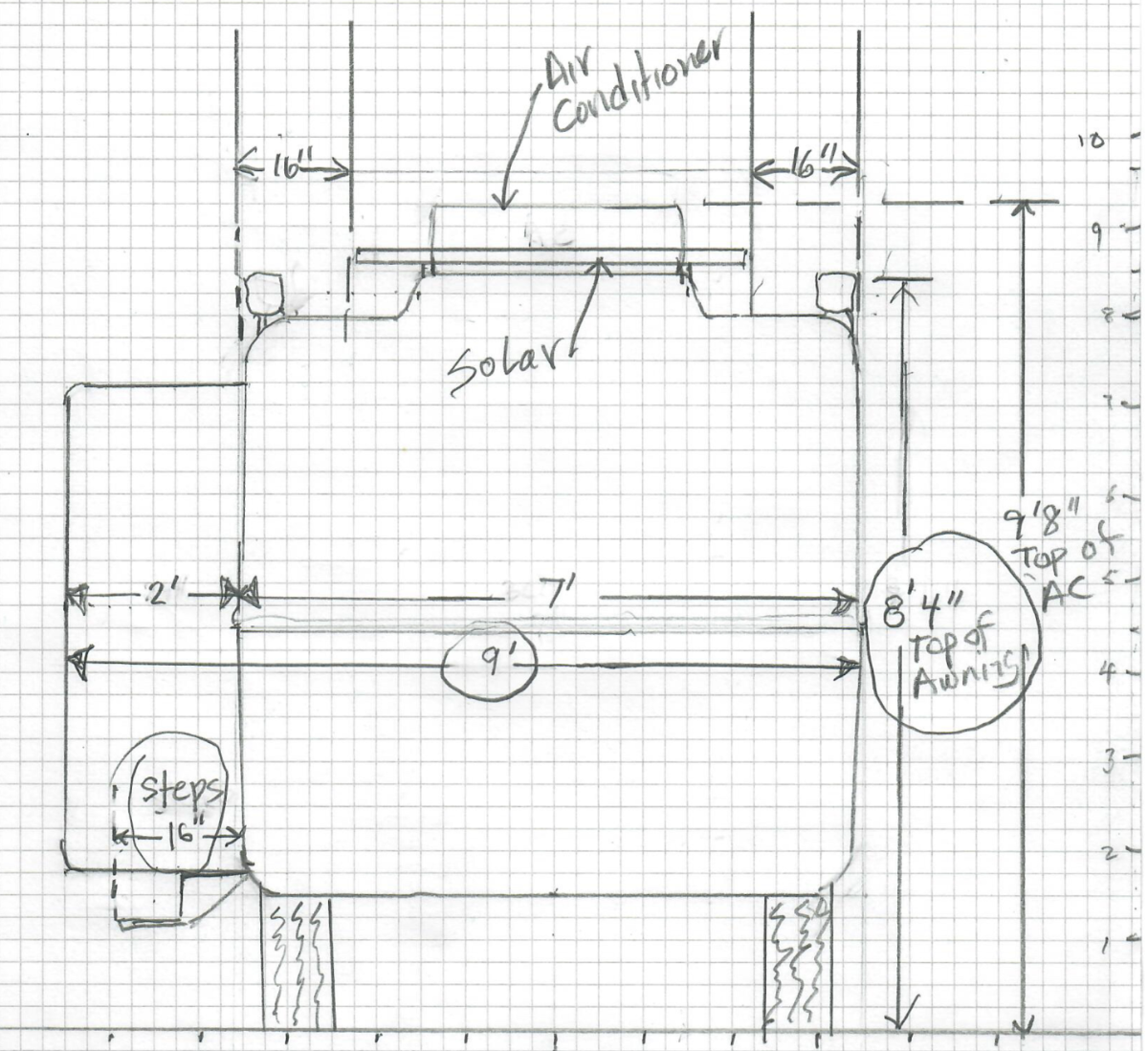
We showed our trailer last week and the party wanted some quick measurements after the visit to make sure the EII would fit beside his garage. What he asked for prompted me to do this extremely rough sketch for him...and I thought dropping it here might be useful. It looks at the EII from the FRONTAL view, with the door and steps open. Text that went along with the sketch: Here are the measurements you asked for and a bit more on the front view sketch with Steps and Door Open. The drawing is at a scale of 3” per square, or 4 squares / 1 foot. Height: (To see if it will fit under your overhang area.) Height from Top of Awning to Ground - 8’ 4” (102”) Height to Top of Solar Panels - 9’ 1” Height to Top of AC - 9’ 8” Width: (To see if it will fit between the house and the hedgerow.) Trailer Width Door Closed - 7' Trailer Width with Door Open - 9’ (Door sticks out 24” from belly band.) Steps - Stick out 16” from trailer when fully open). Solar Panels are 16” from edges of trailer on either side. Hope that helps you plan your parking spot. If anyone has an actual 2d drawing of the Oliver from Side , Front and Top Down profile (which is the floor plan I guess) it would be nice to have. Craig - Hull 505
1 point
-
That is very cool, my wife depends on reliable data access for her work, unfortunately they still don't have any sats in polar orbit, so if you want to go the Alaska (the big part) you will still be out of range: "SpaceX Service's ESIMs will communicate only with those SpaceX satellites that are visible on the horizon above a minimum elevation angle of 25 degrees." The RV antenna will have to be prorfessionally installed, and will it be as big as the home ones? That might be a problem on the limited and curved roof space of an Ollie. Maybe use a telescoping mast coming off the rear frame extension.? I'm guessing it won't be usable when driving.... John Davies Spokane WA1 point
-
I almost signed up for Starlink a few weeks ago when they finally opened up their beta to anyone, but it was quickly made clear that it wouldn't work at all for mobile use. That is, they specifically prevent you from doing so by tying your dish to a specific region. I wondered if that was a limit of the technology, but apparently it's just a temporary restriction due to the limited number of satellites in orbit right now. And it looks like that's changing already, with the announcement yesterday of a dedicated mobile product in the works - https://arstechnica.com/information-technology/2021/03/spacex-plans-starlink-broadband-for-cars-boats-and-planes/ Very cool. Also, the download speeds are looking pretty darned good. About 150mbs now, and they'll up that limit to 300 later this year. I'm lucky enough to get fiber where we live, so it's usually above 900, but I could get by with a third of that even at home, and certainly for the trailer. Pretty neat how quickly this is moving. Just a couple of years ago, this was a 'someday in the future...' thing that got mentioned every now and then here, then in just October it became a real product, and now it's looking like within a year it will be a true option for us - cost aside, probably the best one.1 point
-
This is the sketchiest character I have seen this far. I am reporting him to the rangers. APB issued. Outstanding warrants. Bad egg. Prison tats, too.
1 point
-
The benefit to us would be for emergency use and trip planning. We usually just plan a few days at a time, sometimes hour by hour, and it's nice to be able to bring up a map, look something up, etc. Plus we both still work, so the ability to take care of something without having to drive out of the way to find service would be welcome.1 point
-
I have a couple of personal reasons to really dislike this new technology, though it is a game changer for rural folks and especially for emergency response teams moving into devastated regions. The possibility of space junk from collisions - they weigh nearly 600 pounds each, with over 4000 satellites planned, and there has been a very near miss already - and night-sky light pollution. This is what happens when a ground telescope takes a long exposure picture while a string of these satellites is passing overhead: These can probably be reduced, but not eliminated, by tech improvement. Starlink is planning to do this at other locations too, specifically our moon and Mars: ...https://www.tesmanian.com/blogs/tesmanian-blog/starlink-on-mars As a long time sci-fi fan, the idea of surfing the Web from Olympus Mons or Valles Marineris simply boggles my mind... And FYI Season 5 of "The Expanse" starts in a six weeks John Davies Spokane WA
1 point






















.jpeg.d6e61b473ac28225d828f6918a7fb595.jpeg)
.jpeg.bca5ad26b7a62f7dee543fa252fb605a.jpeg)
.jpeg.5e41a2798b252f2cbec92c4af37418f5.jpeg)









-
Recent Achievements
-