Leaderboard



Popular Content
Showing content with the highest reputation on 01/24/2024 in all areas
-
Love this. Growing pains are just that, but I know the folks that run Oliver will not change. Like you point out, they are actually responding to our demands in most of this. And they are doing what it takes to add strength and longevity to the company and brand. Down the road we'll have conversations around the camp fire about the old way and newer owners will tell about their experience. And life will go on.5 points
-
I absolutely agree with this. And, I too wish that more people could get a chance to have the experience that we did when dealing with Oliver in Hohenwald in the "old" days. Unfortunately, Oliver simply could not find any other way that made sense to try to satisfy all of the "demands" that were being made. In this regard, when "we" were demanding better quality control, Oliver had to take steps that many of us didn't like and even some of us predicted doom. What I'm talking about here is the move away from custom/semi-custom trailers to a more restricted list of options and choices without the ability for the customer to add on "stuff" that was not normally offered by Oliver. As it turned out it appears as though there was reasonably little effect on sales due to this decision. In the more recent past, "we" have been lamenting the lack of service centers (particularly in the west) and even some customers have made note that there were no "fairly easy" way to get to see an Oliver. Yes, Oliver could have developed their own set of service centers but we must remember that Oliver is not some large far flung corporation. Establishing and controlling these types of centers with renting buildings, adding inventory, training full and part time staff, etc. would be very costly. So, Oliver decided to take the path that we are now talking about. Our "cost" for this is the lament that others will (possibly) now not have the chance to have that same wonderful experience that we did. Oliver has stated that it is their intent for those in Hohenwald and the chosen dealers to be up front with customers about pricing. No, I do not know exactly what that means. But, given now over eight years of dealing and getting to know the owners and personnel at Oliver I have faith that they will do (or at least try very hard to do) exactly what they say they are going to do. Now, "I rest my case"! Bill5 points
-
...... which is exactly what I said in the following sentence. : "Cost is important to us, but value of product and quality of customer experience is more important to us." It's all well and good to like haggling, but most of us chose the Oliver route knowing we would get our money's worth without the haggle, and we're glad for that, as indicated in the previous comment by @Rivernerd. I too am very glad I didn't have to go in to a dealership and haggle for a fair price and hope I was going to get treated in a respectable way. My only hope it that in the process of developing their dealerships, Oliver management puts a heavy emphasis on maintaining that level of honesty and respect for the customer. Honestly I have faith that's been the plan from the beginning. I'm sure customer surveys will follow the purchase process after the dealer experience to help maintain that reputation.4 points
-
As a retired attorney, "I rest my case." We were attracted to the "old" Oliver business model precisely because we didn't have to have hours of our time wasted, and our patience sorely tried, by the "barracuda" dealer's efforts to extract every last penny of profit from the deal. We did not dread the old Oliver purchase process, as we have every time we needed to buy a new vehicle. We are glad we already have our Hull #1291.4 points
-
Unfortunately this situation is NOT the "fault" of either Oliver or the dealers involved - blame it if you wish on the bankers involved. As is customary in the automobile industry, the RV industry, truck, farm implement, etc. industries all have a "problem" in how to finance the inventory they carry in order to have product to show customers in their showrooms. So, the bankers step in to help. The general rule of thumb is that the bankers will finance up to 80% of the MSRP for the dealers. In turn, this is what caused most of the recent increase in the price of Olivers and the difference between the MSRP price and the "real" price out the door by any dealer (to include Oliver) will be somewhere between the MSRP and the price that Oliver would have sold the RV prior to using a dealer network. This is absolutely nothing different than the situation of when we venture into a car/truck dealership looking to purchase a new vehicle. Oliver has said that they intend to do whatever they can to make sure that there is little to no difference in the price paid by any customer regardless of where that customer decides to purchase the Oliver of their choice. However, in the real world that is full of legalities I suspect that this will be a bit difficult to do. Hopefully, the process of buying an Oliver will never become as distasteful a process as it normally is for buying a car/truck. But, in any case, you can "blame" it (yet again) on the bankers - not Oliver or the dealers. Bill4 points
-
There is another side to this. Part of the dealer pricing game is driven by the customer desire to "work out a bargain deal". This is only a percentage of buyers, but we all know folks that like to brag about the deal they worked on XYZ. Dealers love this mentality also as they love to play the money game to make a buyer feel like they pulled one over on the dealer, and reeling them into to purchase. It's not all just about pulling the wool over on the customer, but also making them feel they are getting a bargain at that moment and locking in the sale. What I'm saying is there's a percentage of folks that prefer the haggle and wheel and deal process over the fixed price, no haggle method. And dealerships are just used to working this way. I think an interesting characteristic about this topic is that before the dealer option, Oliver sales attracted a certain kind of customer base that made us very relatable. We liked the direct factory purchase arrangement, and for many that was a driving force in our attraction to Oliver. We are the kind of folks that have no interest in the haggle game. We are straight shooters and we perceive Oliver as being very honest, straight shooters as well. Cost is important to us, but value of product and quality of customer experience is more important to us. Buyers that prefer the dealer purchase process and working their deal will choose that route for their own reasons. In many ways it is customer driven.3 points
-
Apologies for the duplicate. I’m glad we found our Ollie when we did.3 points
-
https://www.theautopian.com/the-oliver-travel-trailer-is-a-luxury-fiberglass-camper-that-isnt-built-like-crap/2 points
-
To my knowledge, Escape is still factory direct only. Bigfoot has dealers (they call them "outlets" ) scattered all over the US, including Alaska, and most of the provinces bordering the US. (Nothing in Saskatchewan or Manitoba, nor northern provinces and territories, probably because of smaller populations?) Northern Lite has probably twice as many dealers, both in Canada and US. A few dealers west of the Rockies would be a big boon for Ollie owners, I'm sure.2 points
-
That would be great, not just for those who live in the West, but also for those traveling there. I suppose it depends on the growth generated by the east coast dealers. I think Bigfoot and maybe Escape keep their dealers geographically close to their factories. Maybe logistics are easier that way?2 points
-
I just went through a nightmare using a third party to do Oliver warranty work. No way will I do that again.2 points
-
Amazing isn't it that the percentage is very close to the percentage "caused" by what is called "floor plan financing"? My comment of blame it on the bankers was a bit tongue in cheek. Without the bankers being involved we (the consumer) would certainly not have as many RV's on dealer's lots to look at and compare. Yes, this does make things a bit more complicated - for ALL involved (the consumer, the dealer and Oliver). But, if we (the consumer) want more and better service centers around the USA and Oliver wants more exposure for the purpose of sales, and Oliver wants to help us have more service centers, and dealers want more product to show to those that have never seen and Oliver and ..... I too reasonably enjoyed my purchasing experience back some 8 years ago. But, I still wish Oliver well in at least trying to help satisfy both its customer base, potential customers and its need to grow. As has been said before - hopefully this new way of selling Olivers will be a success. Remember, as has been said before, a customer can still chose to purchase a new Oliver in Hohenwald and all of us can still chose to have our Olivers serviced in Hohenwald. HDRider - I really don't know to what, if any degree, Oliver is participating in floor financing. However, since Oliver never got into the business of financing for the individual customer and since financing is not related to any of their businesses, I doubt very seriously that they would get into the business of floor financing. I think that this is particularly so given the vast array of "finance types" that are already offering these services. Bill2 points
-
It is possible that the factory sells to the dealer at a wholesale price. Both the dealer and the factory sell to us at a retail price. It might be the factory policy to not haggle. The new channel is called "dealers" for a reason.2 points
-
So are we.2 points
-
Consider it done! Bill2 points
-
Just read that. A fairly balanced review.2 points
-
I am using a MicroAir thermostat and I don’t remember if it or the Dometic display the set and actual temps. I am old school, if the AC in running I just assume that it has not reached the set point or if Krunch says it too hot or cold, I can change it with an app, but usually just change it manually. Mossey And this is the Bluetooth adapter that I am using in the Cerbo GX, instead of the onboard Bluetooth adapter.
 2 points
 -
We have similar issues with our late 2018 Elite I, with two differences from most of the Elite II configurations being discussed on the forum: There is very little clearance between the 2 hulls of the Elite I to route flex or solid ducting The furnace is under the forward side dinette seat, with one outlet blowing directly into the aisle (towards the refrigerator & entrance door) and the second outlet going through the adjacent wall into the bathroom low and to the left of the toilet. The return vent to the furnace is on the face of the forward dinette seat facing the space under the dinette table. I have read most of the referenced threads and have a tentative game plan that I will begin to implement over the winter: Install remote temp sensors in both rear corners near the water pump and the outside shower plumbing, and also low in the vanity area under the bathroom sink. My current temp monitoring system only has 3 remotes, but I might try to find & place a 4th of some kind under the sink near the kitchen plumbing. Add some vents with 12v fans on each side of the aisle under the rear dinette/bed, pushing some heated cabin air into these two plumbing spaces Add a return air vent (shielded against spray intrusion) from the bathroom into the space under the sink (which, with the bathroom door closed, should funnel some heated air from the bathroom into the space under the sink) Maybe add a return air vent from the space under the bathroom sink into the adjacent closet Add 2 vents to the closet, one high and one low as referenced elsewhere. Consider partially opening one of the kitchen drawers to allow some return air flow out from the space under the sink. We do have a small electric space heater, which helps save propane when we have shore power available, but the airflow is a little different from when the propane furnace is running. We are from upstate NY and don't usually camp in the winter any more (we used to do so in a tent), but we do encounter sub-freezing temps in the western states in the spring and fall "shoulder" seasons; especially at altitude. It seems like a little fine tuning of the airflow (which is almost non-existent now) should make a difference 🙂2 points
-
Your observations on the inferior design of the HVAC (furnace) "system" is spot on. I think Oliver has maybe not given this issue sufficient design attention because a large proportion of Oliver Owners probably winterize their trailers and don't care much about the furnace. I use my Oliver throughout the year, store outside, and do not winterize. My primary concern is the ability to keep the plumbing from freezing even when the cabin is warm. I have placed internet connected thermometers in the basement by the outside shower hoses and other spots, and found that the basement temperatures can fall to 30 degrees or more below the cabin temperatures when outside air temps drop into the low 20's or teens. I found that if the outside temperatures go very much below freezing, I have to keep the cabin at least 65 degrees to keep most of the basement areas (except for right around the furnace itself) above freezing. I determined the problem is insufficient warm air circulation through the basement (i.e., no return air vents in the front of the trailer (bathroom). Oliver did add a small return air vent in the bathroom in more recent models. I have resisted running new ductwork or cutting holes in the trailer to address this while I studied the issue in the field. Finally, and just recently, I tried a non-invasive hack that appears upon initial testing to work quite well. The outside temperatures last week dipped into the mid-teens for several days, yet my basement temps stayed within 15 degrees of the cabin temps (the Oliver was in outside storage). I am heading out next week and will test the cabin and bathroom comfort in temperatures expected to be just below freezing, and I expect to find a much warmer bathroom and more comfortable trailer, as well as the warmer basement temps. What I finally did was easy. I removed the "front bottle plate" from the bathroom vanity and disconnected the flex duct from the bathroom vent, creating a 3'' (or 4") return air vent in the bathroom. I then left the disconnected air duct loose under the sink to put extra heat into the front of the basement. Combined with the new return air vent in the bathroom, the warm cabin air flows forward into the bathroom and the warm air bathroom air is pulled under the bathroom and shower to be slowly circulated from front of the basement to the back of the basement when the furnace fan is running, more effectively heating all the plumbing and battery box. I do need to keep the bathroom door cracked (but not open) for this to work, unless or until I install a vent between the bathroom and main cabin. I am not sure if a functional return vent like this would cause problems in Olivers with the composting toilet. I have the standard toilet.2 points
-
I was thinking of doing exactly that, then I saw the recommended duct lengths in the Truma manual (attached) just recently! It might still work, but I haven’t sat down yet to really mull it over! Truma furnace duct length.pdf.pdf1 point
-
I worked at a manufacture that sold exclusively through dealers. We carried floor inventory for the dealers. Like a bank, we charged them for it. We also did cooperative advertising that helped the dealer promote our product, and their sales.1 point
-
Not me. I am haggle man extraordinaire. I simply saw Oliver as the best value.1 point
-
Hopefully, I’m not lighting another flame… but, I’d still like to see Oliver build their own maintenance (this is my concern) and sales center west of the Rocky Mountains. To date, I’ve only found one dealer RV tech that I truly trust to perform the maintenance that I don’t feel confident of doing myself.1 point
-
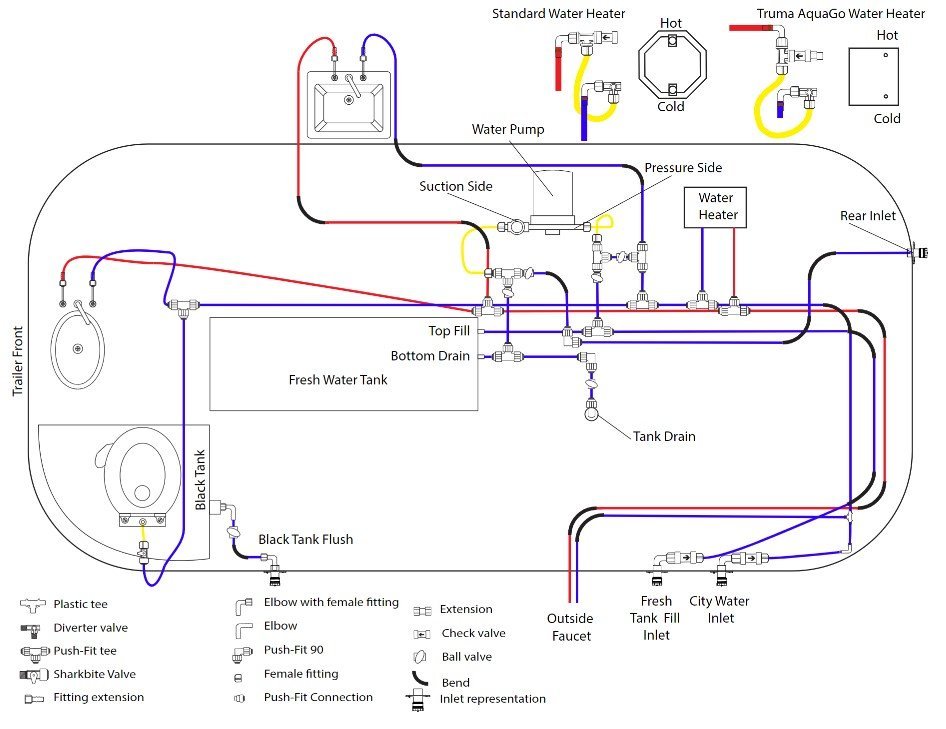
I've been told these are in our Owners Manuals, but mine is a 2016 and I do not see any schematic drawings in the manual for 2016. You have a 2023 and perhaps they would be in the PDF version of your manual online. What I've done is collect drawings other members have posted in this forum, every time I see one! When I copy a drawing of a newer OTT, I'm never sure the systems in my Oliver will be exactly the same, but they help. Hopefully others in the know will chime in.1 point
-
I can't see how this can be avoided. The dealers will have other manufacturers` RVs on their lots, too, and those RVs will have "RV Show" sale prices, "Summer Blowout" sale prices, "End of Year" sale prices, etc., etc. The customer will want the same kind of "deals" on the Oliver or they'll think they`re getting a better value on the "sale" units. Pre-COVID the rule of thumb was never pay more than 70-80% of MSRP for any RV because we all knew the MSRP was wildly inflated. Fair enough, but those manufacturers weren't also trying to sell factory-direct at those stated MSRPs. This will be a challenge for OTT. Don`t some of the other fiberglass manufacturers (Bigfoot, Escape) have this mixed factory/dealer sales arrangement? How do they handle it? Are the trailers bought at the factory more expensive than the ones you can get at a dealer? It will be interesting to see how this plays out.1 point
-
So, here we go with "MSRP," "sale price," etc. One of the things I liked about our purchase experience was the fixed/no haggle price. I'd be interested to know which of those two prices matched the factory price for that trailer, if either. They can't have the factory charging less than the dealers and undercutting them. OTOH, I can't see the dealer charging less than the factory and still making an acceptable profit margin.1 point
-
Neat article, thanks for posting. Our local dealer Bumgarner Camping Center has (2) 2024 LE2’s listed for $106k marked down to $95K. As an owner, I am glad we purchased our LE2 - “XPLOR” in 2020. @topgun2 could you merge these posts please? It’s a duplicate.1 point
-
Thanks for that plumbing drawing. What manual is it in?1 point
-
From your link - There are companies out there with quality on their minds. Oliver, a producer of fiberglass trailers, is one of them. These campers are far more expensive than many of the fiberglass trailers I’ve written about, but they’re also several steps above in build quality than most trailers. I toured a couple of Olivers at the 2024 Florida RV SuperShow and left feeling like these were the fiberglass trailer equivalent of an ’80s Mercedes.1 point
-
https://www.theautopian.com/the-oliver-travel-trailer-is-a-luxury-fiberglass-camper-that-isnt-built-like-crap/1 point
-
The links don’t go to anything anymore.1 point
-
Nor do I want to drag a "home" behind me. We bought the Ollie to camp. We did not want to drive or drag a rolling "billboard" through the winds. It's definitely not fun. Been there, done that, and done with it, 16 years ago. It's actually kind of amazing, but we spend close to six months, some years, in the space of my walk-in closet. Well, not actually. The outdoors is huge, where we really live.1 point
-
Bigger is not always better, especially when you get older and maintaining a massive trailer or Class A gets to be a chore. I bought the OTT to get outdoors. I go home to be in a big house. Nothing beats the size, beauty and luxury of a brick and mortar home. I certainly don’t want wheels on it.1 point
-
Yes, there are check valves at the water inlets as shown, but there is also a check valve at (or inside) the pump. If the pump didn't have a check valve, pressurized water in the lines while connected to a city water supply would backflow through the pump and fill the water tank. This is actually how most people find out their pump check valve has failed: the water tank keeps filling up on its own. Also, when using your pump, without an integral pump check valve, your system would lose all pressure as soon as the pump shut off, because the water would push back into the tank.1 point
-
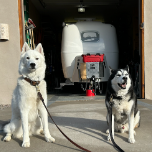
Our Jolli Olli is our first travel trailer. 2 year anniversary is approaching and we couldn't be happier. Came from a pop-up truck camper, and the Olli interior is perfect for us and our lab1 point
-
The following information applies to Hull 193. SeeLevel monitors fresh, grey and black water levels and the battery voltage. In order to display that information on my Cerbo GX Touch display, a new SeeLevel display and a modified comm cable from the SeeLevel display to the Cerbo GX was required. Mopeka monitors the propane level of the propane tanks and required a Mopeka Pro Check Universal for steel tanks for each tank to be monitored. RuuviTag's monitor the temperature, humidity, air pressure and motion. I have 3 of this model in Hull 193. The RuuviTag Pro is available in IP67 or IP68/ IP69 versions for wet and rough conditions. I have one IP67 model in the propane box. Mopeka and RuuviTag sensors communicate with the Cerbo GX via bluetooth. I am including some resources that may be of help. Mossey Victron Cerbo GX Links.pdf1 point
-
The check valves are shown in the OTT drawing to be directly inside the hulls at the City and Freshwater inlets. I found them to be along the back wall which can be seen in what I call the Oliver's trunk (see pics, btw a bad place for these lines to be and will freeze more quicky with these large brass valves, a strong conductor will release internal heat more quickly). When you blow out the lines, you are pushing compressed air in the proper direction of the backflow preventer (aka check valve), so no associated issue. There is not another check valve at the water pump. The backflow preventer has several purposes, but in an RV without one the water pump would continue to cycle continuously. The backflow preventer creates a necessary close system to build require pressure in the plumbing system. I have a thread on using compressed air to winterize. I have a thing about using chemicals when working, done 20+ brake jobs w/o Brakleen and the like, even when THEY claim to be environmentally safe, yeah right! We blow our tanks dry and refill several times each winter, since we camp from fall to spring and not during the summer. It's too hot down here! We use and need a good furnace and could care less about the Dometic cooling albatross sitting on the roof! I might remove it one day (fill a 14x14" hole) and mount 2 more solar panels! Glad it was your thread we hijacked! 🤣
1 point
-
That's what's we do. The first vent under the curb bed is closed.1 point
-
The absence of return air vents in Olivers before 2022 also impedes air circulation, and, therefore, distribution of warm air to the front of the cabin. For your Oliver, I recommend the ductwork upgrade detailed by Minnesota Oli. My Hull #1291 came new with upgraded ductwork. Yet, I have also added more 4" round return air vents to the closet and under the front dinette seat. See this thread: As noted in that thread, our Hull #1291 came with a return air vent (as well as a supply air vent) in the bathroom. In your earlier model, I would add such a 4" return air vent for the bathroom as well. With these return air vents in the bath, closet and under the front dinette seat, the flow of heated air in our 2022 Elite II is much improved. The front of the trailer is no longer cold. Good luck!1 point
-
I agree with “dewdev” on the grill dampers. I removed the damper from behind the grill at the kitchen and the one from behind the grill in the bath. I typically have the one under the bed mostly closed allowing the heat to flow mostly towards the front of the camper so that the furnace return will draw the warm air back towards the rear. Seems that the rear stays pretty warm compared to the front so hopefully this helps balance out the heat distribution some. Remember that the outer hull is insulated so even if the basement is heated, the floor will be warm.1 point
-
jd1923: It sounds like you found the vent in the bathroom under the toilet paper holder, which is good. In my 2018 Oliver Elite II, we had a similiar low amount of air coming out of the vent covers. After talking to Oliver service, we ended up temporarily popping off the vent covers at each vent and removing the plastic diverters behind the cover and then reinstalled the vent cover back on. These plastic diverters were restricting the air flow. You might want to considering removing the plastic diveters, if they are still installed, as their removal greatly improved our air flow. Also, place you hand in front of the bathroom vent to feel if you are getting air coming out of that vent. If you have no air flow at the bathroom vent. (I have seen on this forum where some people have found that the vent piping was not connected to the vent outlet.) If this is the case, you can remove the front bottle plate (4 screws) in front of the bathroom vanity so you can reconnect the vent piping to the vent cover.1 point
-
There have been a few posts regarding this issue here on the Forum over the years. The easiest attempt to get more heat in the bath involves adjusting the vents - fully open the bath vent and close down/adjust the main cabin vents - in order to better "balance" the heat flow. Next is to make sure that the bath door remains open or find a way (mod) that allows air flow both into and out of the bath area. Next is to modify the duct work - more insulation, improve the kind and length of duct, make sure it is attached properly. Good luck. Bill1 point
-
Our 2022 E2 doesn't put out much noticeable heat in the bathroom. I had to go under the sink for something else and found no kinks. I think the lack of airflow (heat) is related to the long distance from furnace to bathroom vent. We have the same thing in a bedroom and bathroom furthest from the furnace at home.1 point
-
That would be a "sucker" bet in that hull #117 also has the vent in the bath and heat does come out of it. Bill1 point
-
Thanks @AlbertNTerri I found it and thank you @Minnesota Oli. Wow what an extensive upgrade, very well done! Yep, the only way to the bathroom is the long way around. And yes, our hull #113 is from 2016 and unless I overlooked one, I only see two curbside ducts in the back half of the cabin. If we lived in Minnesota, first I'd move to Arizona (we lived our first 45 years in Northern IL) but kidding aside, this extensive mod would be necessary up north. Great ideas here. Love the new furnace plate with the added 2" outlet and I had no idea they made 2" duct hose. Food for thought and yes will always share mods. Thanks again!1 point
-
"Red sky at night - sailor's delight?" I'm thinking those adages don't apply to this particular geographic region - the nearest major body of water is about 360 miles west of here. They call it the, "Pacific Ocean." HA!1 point
-
"Red sky in the morning, sailor take warning"?1 point
-
So we moved to a campsite about 4.5 miles south of The Q to BLM land that outside of LTVA fee-areas. We're closer to the QuartzFest HAM Radio campout which starts tomorrow. The boys and I volunteered to help out the organizers by hauling their registration tents and accessories from their storage location in downtown Q. The QF started officially in '96 or '97 and draws north of 800 rigs from all over the US and Canada. It will likely start getting a bit crowded around here by this weekend! FYI: Here's the latest sun rise from the Sonoran Desert taken a few minutes ago: Cheers!
1 point
-
Thanks, Steve @ScubaRx - The dogs and I arrived at the Q Saturday... Camping on west side at La Posa and walking distance to the RV show area. Planning on a 24JAN departure. We'll definitely need to link up.1 point
-
I don't plan to close off the main return air grill under the street side bed, because it serves two important functions in that location: (1) avoiding creation of low pressure in the area around the furnace, and (2) providing a supply of free-flowing air to the furnace intake. 1. Creating Low Pressure Around the Furnace A couple years ago, John Davies noted: "But if you relocate the furnace grill to the far side of the cabin, you are essentially creating a slight vacuum under the floor with the furnace fan, so air is going to be pulled inside through those [scupper] holes [in the bottom of the hull]. A little air infiltration isn’t bad, but on a really frigid day it will also suck in trickles of freezing cold outside air right where you don’t want it, under the tanks and plumbing. With the existing location there is no suction created under the floor, instead the cabin air enters directly. So maybe [the Oliver engineers] really did choose this spot for a good reason." See this thread: 2. Providing Free-Flowing Air Supply to the Furnace. I tried installing a homemade furnace filter over the air intake of our Truma Varioheat furnace a few months ago. The furnace began throwing error codes, I suspect because it sensed that the supply air intake was partially blocked by the filter. Removing the filter solved the problem. That furnace air intake sits directly behind that return air vent. It appears to me that the Varioheat furnace is designed to have the large, free-flowing air supply provided by that return vent directly in front of the air intake. I do not plan to block it.1 point














-
Recent Achievements
-