Leaderboard

.thumb.jpg.e34bf01ef7f7d5e99ad31856d45afbeb.jpg)


Popular Content
Showing content with the highest reputation on 10/29/2025 in all areas
-
Least we not forget - virtually all of our Olivers still have the Oliver name at the "third brake light " position. As this discussion lingers on I would hope that everyone would re-read my post in this very thread from this past Saturday at 2:38pm. We are working on finding the real and complete story on the situation with decals. I will post back here when I have answers. Again, please be patient during this process. Bill5 points
-
Finally got around to picking up a Greenland Turbro Inverter AC/heat pump to replace the original Coleman that came with Hull 45 back in 2009. Been wanting to do this for a while now and couldn't resist once @jd1923 posted the about the anniversary sale going on that knocked the price down from a list of 1,499 to 1,099 with free shipping. Install was a breeze. The hardest part of the job was cleaning the gunk off the roof after the Coleman was removed. The seal for the Turbro is preinstalled so it's just a matter of getting the unit centered over the opening and bolting it down through the inside mounting plate. Since it doesn't have a wired thermostat, electrical connections were simple too. Just the 120v power and connecting the wiring between the rooftop unit and the inside cover panel was all that was needed. I have separate thermostats for AC and heat which made it easy but if you have a single thermostat for both AC and heat additional steps may be required. The Turbro comes with a remote with a wall mount and it also has a phone app available. Once fully installed, I connected our power cord to a voltage/amps/watts meter and used an adapter to plug into a standard 15amp outlet. I also turned off all other breakers to insure I was getting only the draw from the Turbro during startup and running. There were two main reasons I purchased the Turbro unit- One, because it uses the same extremely efficient "inverter" compressor technology used in mini-split systems and two, because of this technology the system is able to "ramp down" once set temp is reached and continue to run at a lower capacity instead of powering down and cycling like a standard single speed compressor does. Running in this manner reduces or eliminates the humidity spikes common with standard compressor systems and is very important to those of us who live and travel in hot/humid locations. Added benefit is that no soft start reuired and it can be easily run off the Honda EU2000 that we have as a backup. Since my brother is using our Ollie for temp housing while his house is being finished I didn't have much time for testing after the install, but here are some of my finding and opinions for the short time I had. The good- Power efficiency is right about what I expected, which is excellent. The unit slowly ramps up starting around 120 watts and peaks just under 1000 watts. As it gets closer to setpoint, it begins ramping down and settles in around the 500-700 watt range. At set temp I was seeing watts in the 120-200 range but couldn't tell if the compressor was running or not at those watts. The compressor is so quiet that it was impossible for me to tell. The air output continued to be cool so I assume the compressor was still running. Cooling and humidity control were both excellent too. Cabin cooled quickly after which I changed the setting on the remote to "dry" mode which locks the fan on low speed with compressor running. No humidity spikes seen at all. Outside sound level is about the best I've encountered. You will not annoy anyone around you running this unit at night, even if they're in a tent right next to you. LED strips built into the inside panel can be left off or set to white, blue or yellow. I think this feature will come in handy for us at night when getting up to go the bathroom. The not so good- While not close to Dometic level loud, and quieter than our old Coleman, it's not the quietest unit out there. Quiet enough for us for sure, but if sound level is the most important feature you're looking for then you should probably look somewhere else. On the bright side, I think the sound issue could be improved with an updated interior cover panel alone. I loosened the cover and dropped it a couple of inches down and the sound dropped dramatically. Another issue that makes me think the cover panel is the problem is that the airflow only can be felt across about 1/3 of the vent openings on both front and back vents. The ability to adjust the airflow between front and back vents with a damper would be another nice feature... Temperature control... Wasn't happy here. It seems to be about 4-5 degrees off from actual cabin temp. Hoping that this can be solved with the addition of the external Cielo wireless thermostat that @Ronbrinkturned us on to and has had great success with. I wish I had more time to test and give better feedback, but I most certainly will update this post once I'm able to. I want to see how it performs in different environments, how the phone app works, and how it interfaces with the Cielo thermostat before I make a final judgement. For now I'll give it an overall rating of A-. On power efficiency alone, an A++
 3 points
 -
Congratulations @CRM, I know you have been wanting this for a while and I'm happy for you! 😂 And you didn't have to wait 'til Thanksgiving! Every time I've read an Oliver A/C installation thread, I've always thought this and you're the first to mention it. When I removed the Winegard dish from our roof it was a mesh underneath and I expect under the Dometic to be the same or worse. I'm hiring a guy to shine up the Oliver and hope to get him up top first after I've pulled the old unit and temporarily plug up the 14x14 opening to keep buffing compound out of the interior! The solar panels will come off too so most of the roof can be addressed. One of the Greenland YouTubers talked to this, re the interior airflow being noisy too. Given your description, I'm wondering, could a foam insert between the Oliver ceiling and the A/C interior panel help here? Did you have fan set to high or low? This is why you insisted on the Inverter A/C! BTW, I purchased one on sale too a few days after you! It just arrived. With help of the FedEx guy, we put it in the back of our GX for lack of a better place to put the huge heavy box! It's still in the box. I have to finish up some current projects and line up the guy to buff the roof. We'll both have new Greenland Inverter A/Cs before Thanksgiving and perhaps we can work together on modifying the interior air exchange for quieter operation. I'm looking forward to running this inverter A/C on batteries. Already thinking about where to put a 3rd battery for total 1060Ah (maybe an Epoch 460 in the doghouse)! 😎 Bummer is the extra battery would cost more than the Greenland Inverter A/C!3 points
-
Sorry for the tire issue but at least you had a level spot and help when you needed it. I have steel valves and have never had a problem with them. However, for anyone considering a change to these valves it should be done with the knowledge that the steel valves are simply not as "forgiving" as the rubber valves are when they are bent or hit with something hard. I certainly had to consider this fact when I changed to the steel because I travel over a bunch of dirt and/or two track roads every summer. Even a sage brush could possibly be enough to bend or break one of these valves let alone a rock. Of course, that same brush or rock could possibly damage a rubber valve but .... Bill3 points
-
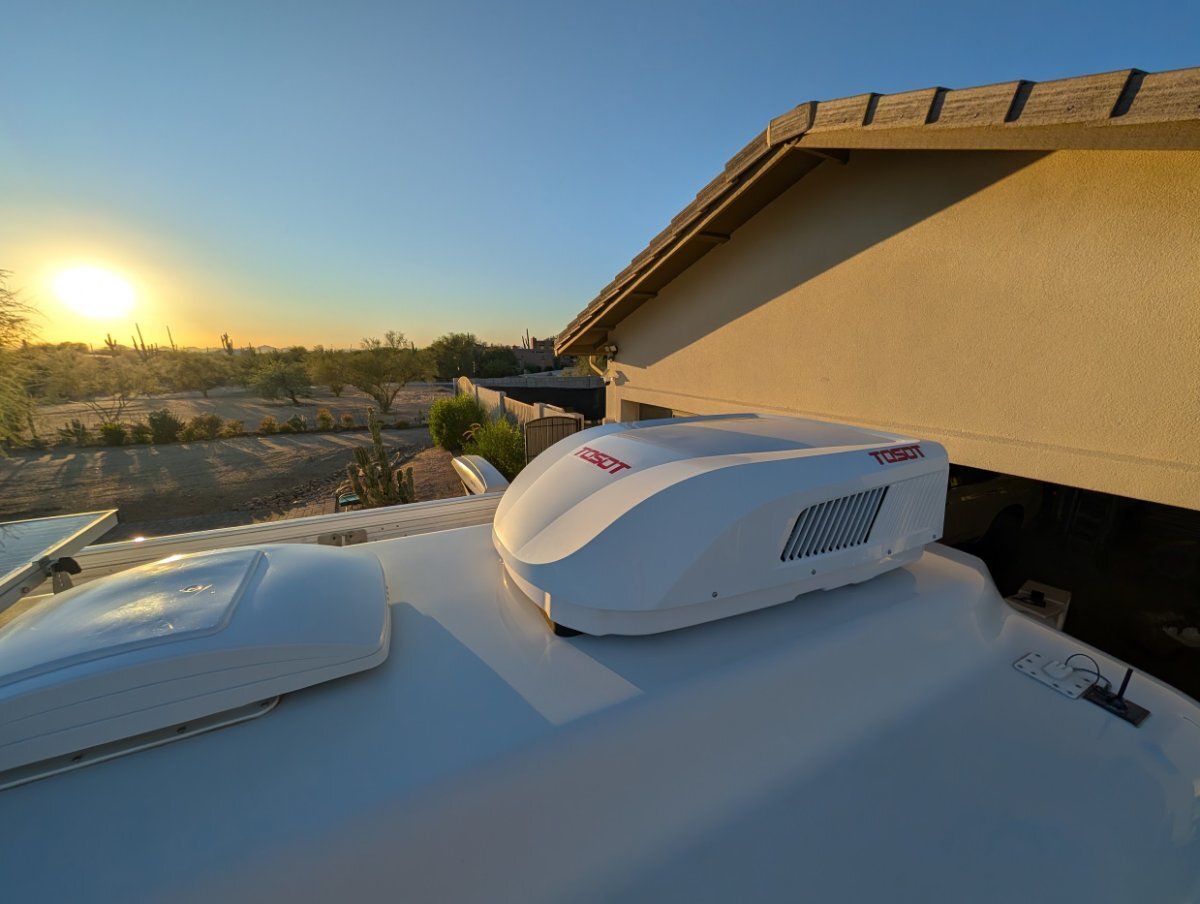
Congrats CRM on the install. Looks like a nice unit. My Tosot install was very similar with just the power wires, but with mine the gasket removal was much cleaner. I think whomever put that old Coleman on accidently flipped that seal on install. The sticky side is supposed to be on the AC unit. Makes a mess for you when swapping out the way they did it. This was mine right after I removed the Dometic. Hopefully, John's is like this. I just sprayed it off, then gave it a quick buff to clean it.
2 points
-
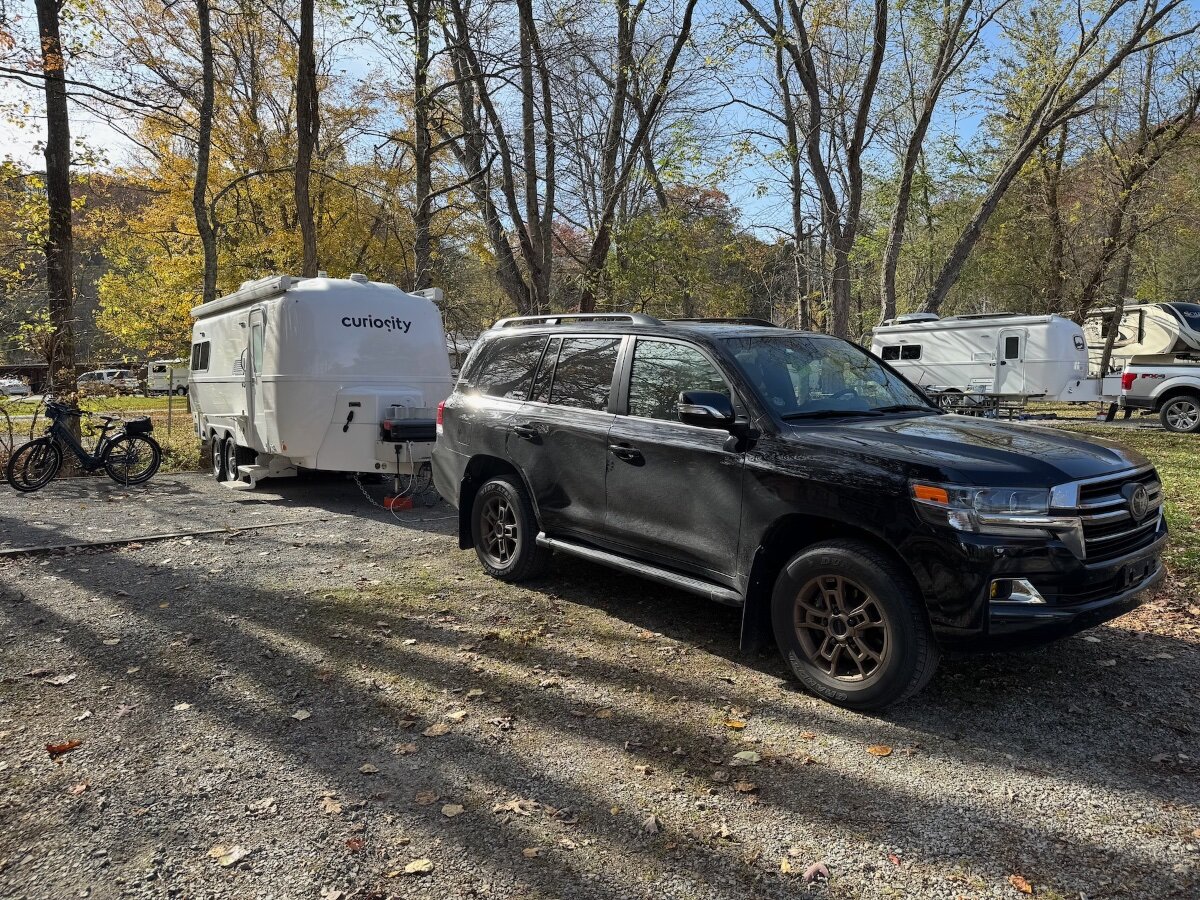
No Oliver logo on the nose would look really strange! We ordered our 2023 naked, and added our own graphic. We've had a lot of people ask what a "Curiosity" trailer was. We've heard "Is that some kind of Casita?", or the guy in Florida who looked it over rally well walking by, but wasn't inclined to chat. He returned the next day to tell me that he'd looked up Curiosity trailers, and that it was a really expensive trailer! No Oliver logo on the nose would certainly seem to cut down on random inquiries and potential sales! Here's a Curiosity brand trailer next to an Oliver at the Hungry Mother Fiberglass Rally. You can barely tell the difference! 🤣
2 points
-
I've not acted on advice to switch to steel valve stems while using our TST tire pressure monitor. Yesterday, that procrastination bit me in the ass on my way home from the Hungry Mother Fiberglass Rally in Virginia. Rapid Pressure Loss" or similar wording was what the monitor said with a constant loud beeping. A quick look in my mirror showed the front left trailer tire was indeed low. Stopped to check, and with 28 PSI showing, I elected to slowly drive to the next exit, and found a flat spot in a gas station lot. The rubber valve stem was partially separated from the rubber base, and if flexed, dumped out pressurized air. No fixing that on the spot! Time to change tires. I have all the tools needed, and it was a cool sunny day, so that was a bit of luck. It had been raining a few hours earlier. I didn't have my impact driver with me, but I do have an 18" breaker bar, so I could loosen the lug nuts. Before jacking up and removing the tire, though, it was time to get the spare. Two heavy e-bikes made this a chore, but fortunately, that's when a large fellow stopped and offered to help. (Oddly enough, the local deputy sheriff who was using the facilities at the station never even checked to see if we needed anything on his way out of the parking lot.) With his help, we slid the rack and mount out far enough to get to the spare. His impact driver made for a faster swap than my breaker bar, and his torque wrench was easier to get to than mine buried in the trailer's basement. All in all, about an hour and a bit delay, and the kind gentleman who stopped to help refused any remuneration. - I usually only carry the impact driver with me on long trips. And while this was about an eight hour drive, I'd elected not to bring it with me. It will now be included in every trip. - I'll be removing the bike rack mount and cleaning those surfaces and applying a dry lube to make it easier to slide the rack in and out. After we were done, I was really re-thinking John Davies choice to not use the fiberglass tire cover while toting bicycles! - I will be changing to all steel valve stems before we leave on our next trip!2 points
-
Just about every owner's location can impact the winterized trailer. In addition to studying your battery Owner's Manual, I suggest that you contact your battery MFG and state the conditions you will be storing your Ollie, for how long, and if power is always available there during the winter. GJ1 point
-
Restricting airflow creates noise. Just like when you restrict the nozzle of a hose it creates noise. We'll have to look at a way to open up the air handler to increase airflow across the register! Good news is, it's just the air handler! Outside sound is likely much quieter than standard compressor models, and inside & out no compressor ONs and OFFs. And when the manufacturer redesigns the air handler, it's a low cost part with little effort to replace.1 point
-
2016 Legacy Elite II, Twin Beds, Hull #124 It's likely time for you to replace both tanks anyway. If the propane pressure regulator is OEM, I would replace it as well! GJ1 point
-
I agree with both of the above. We are incontact with the bumpers and frame typically at the dump station and when hitching up. Maybe a few times during our stop. BUT the steps are the one that could get most of us.... many times a day. Not just casually, but when one foot is on the step and the other contacts the earth. GJ That said, I'll not be changing our PI Power Mgt System any time soon. Two other things that I do keep top of mind when working electricl are: Situations where "The Step Potential" could be in play Forgetting to keep one hand in my pocket when working a open hot panel or device.1 point
-
Yep, it would have saved me more than an hour if it were installed correctly.1 point
-
That's another thing I should have added to the "not so good" list- the fan speed noise doesn't seem to change much between the low-med-hi settings. Maybe it was something I was doing wrong? I'll look closer at this when I'm using it over Thanksgiving. Also, I don't think adding foam between the two who do much since it's not vibration causing the noise, but who knows? I really think the air channels in the cover need a redesign to fix it, especially since airflow is only coming from a 1/3 of the register openings. That alone has to be creating some extra noise. Will definitely be experimenting! In the end, it's not horribly loud, but Just a little quieter would be icing on the cake!1 point
-
I’m one of those where sound level matters, being a lite sleeper! Before installing a soft start on the DPll, I was constantly awakened with each load thud of the compressor cycling. The soft start made a huge difference regarding that issue, but the noisy fan was still an extreme annoyance. While reorganizing a storage bin recently I found these lurking in the shadows, made the hair on my neck stand up! Hard to believe I didn’t think to purge them from the Oliver a long time ago; oh well …… out of sight, out of mind.
1 point
-
The URL shown in John's first post results in a 404 error. The new URL is: https://olivertraveltrailers.com/forums/topic/2504-how-to-stone-stomper-gravel-guard/1 point
-
I was lucky, we had a slow leak so we could fill and get home. We went to a truck tire place and they vacuumed out balance beads and installed metal valve stems.1 point
-
Wish we had that much flat ground, let alone a garage large enough for the Oliver and much more! First thing I would do is trench some power to that garage, install a sub-panel, add a 30A outlet and a few lights and regular outlets to start. Our home has 200A service and I've run cable and added 4 sub-panels for many needs. The last one was to our TuffShed next to where we park the Oliver, with a 30A outlet there. Electrical work is the easiest upgrade, though everything costs $$$. Do the doors later. It's not like it's going to snow down there! 🤣1 point
-
Slight update. I'm waiting for a thermostat, but I also found the Dometic control box that Ron posted a bit cheaper on https://thervsurplus.com/search?q=Dometic™+OEM+3316230.700+(9600024570)&options[prefix]=last so I ordered one. We're going on a weekend trip and I don't think I'll have either of them hooked up, so maybe next week. Buttoned up the AC unit for now. Works great and it's quiet. I tried to power it with my Honda EU2000 generator, but it didn't turn on. Thought it might, but no bueno. PXL_20251028_001654190.mp4
1 point
-
I'd be looking into the possible reasons for this "getting stuck" issue. The way these things work is not all that complicated and most likely something is not aligned properly or it needs a touch of lube or there is something getting "caught" in there, or something is bent, etc. Bill1 point
-
As with anything else, I'm sure that there are some zerks that are better made (materials, craftsmanship, etc.) than others. However, given the relatively simple design and purpose of these things, I've never given the cost of a zerk or where or how its made much thought. Heck, you can buy as many of these little things as you most likely could ever use for much less than $50. Having said this - I would strongly suggest that for any new zerks and/or even old zerks, the usage of protective caps over the zerks helps keep them cleaner and less likely to get "plugged" by keep most dirt out of that little spring loaded ball that is in the end of the zerk. Bill1 point
-
Since we typically watch the TV while "seated" in bed (we have the twins), I thought that was a FEATURE not a BUG. 🤣1 point
-
"Dexter offers a limited five-year warranty on its E-Z Flex equalizers and suspension systems. The warranty is valid for the original purchaser and covers defects in material and workmanship from the date of the trailer's original purchase." "Five-year limited warranty coverage" "The five-year warranty on equalizers and suspension components applies to all Dexter trailer axles, suspensions, and brake control systems manufactured on or after September 1, 2016."1 point
-
Assume that you realize that this is a relatively expensive option versus simply tapping new threads and replacing the "cheap" zerks?1 point
-
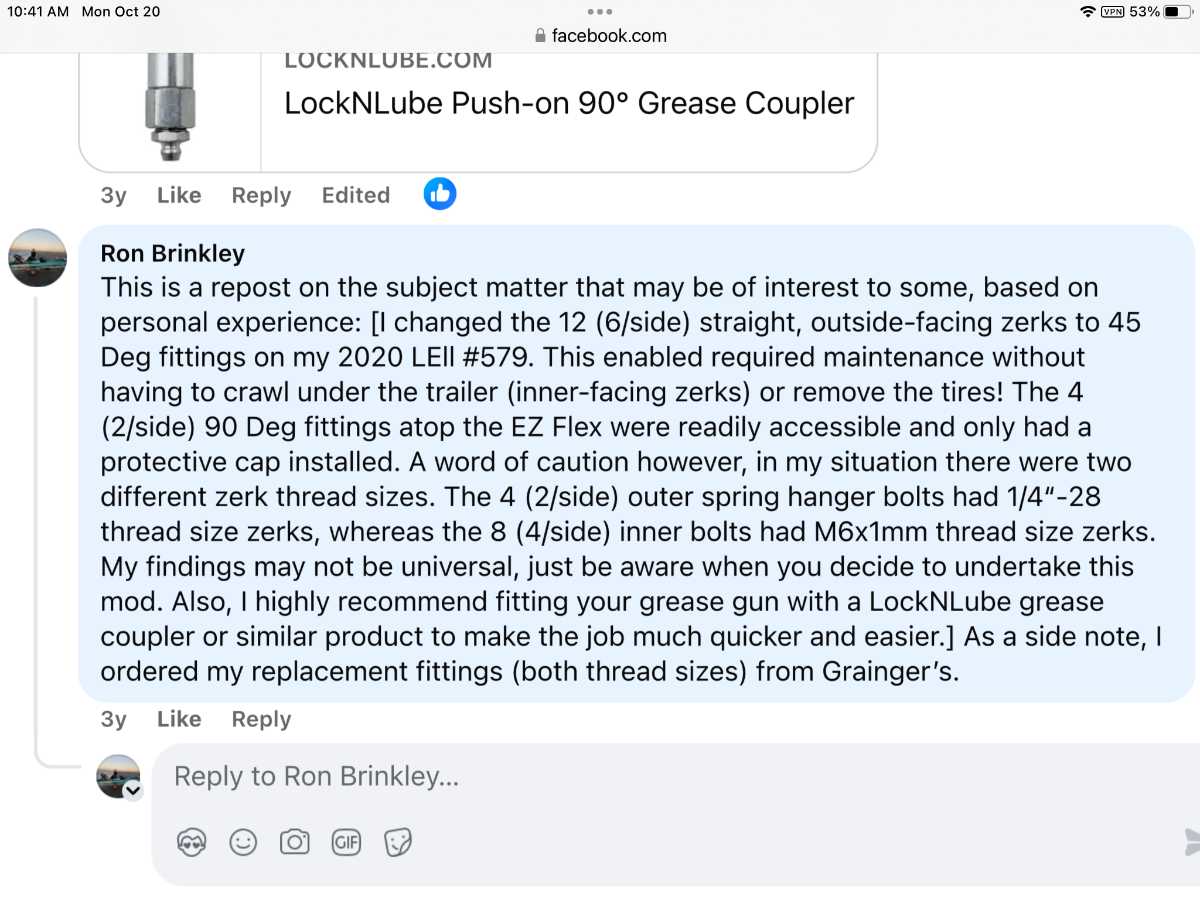
In response to a question by @Gliddenwoods, I answered with the above statement based on mental recall; but in finding a comment made on FB from several years ago I can honestly say “it ain’t what it used to be”! I stand corrected in the following:
1 point
-
When we are traveling together, my wife calls it our little Cannellini Bean. When I’m solo, I call it my MFC (mobile fishin’ cabin)1 point
-
I joined this thread Nov 2019 looking for a solution to protect our trailer's fiberglass from rock chips/pitting. We have remained fustrated for a solution that met our needs. John Davies rock stompers were more than we want futz with while hitching/unhitching and bugeyed driver's Vortex appeared to be very good but very expensive based on his report and was available only 800 miles from my home. Six years later, even more frustrated dealing with rock pitting our fiberglass. I called the Vortex company and asked if they had experienced dealers near me. I was given two options: one in Sacramento and the other in Redmond Ore (near Bend). Both within a 5-6 hour drive. I spoke with Calvin, the owner of Interstate Coatings and Linings of Redmond Oregon. Clavin was very knowlgable and gained my confidences to spray our trailer with Vortex + an automotive UV stabilizer color match paint. Having solved finding an experienced Vortex services within shouting distances of home, price was the next Hurdle. Interstate Coating's quoted fee was $10 per sq foot + $65 per hour for disassembly / re-assembly of the propane nose and various hardware. One week later the job was done. The total cost was $695. We are pleased with the work and color match. We are ready put the Vortex to the test. Calvin and Alex (shop manager) are good guys and offer a what we think is a great service/product that let us roam the outback gravel roads stress free. We will let you know how Vortex preforms for gravel protection. For now we are happy campers. Thank you Bugeyeddriver for taking the time on the phone and sharing your experience with Vortex. You gave us the confidences to go forward with the Vortex process.
1 point
-
If the ground is bonded to neutral at the pedestal, instead of a separate direct run back to main panel ground as it should be, the ground conductor will become the neutral if the neutral connection is lost inside the trailer.1 point
-
I think this scenario occurs when connecting to a generator without a bonding plug. Mossey1 point
-
Spoke with a friend today who is very knowledgeable on the subject and he said that none of the EMS products on the market right now satisfy the requirements of the upcoming code for Grounding Monitor Interrupter's in RV's. He said while they might cut power when a ground is missing they will not protect in other rare scenario's where power is on the ground wire.1 point
-
Have you tried having someone physically pull out on the awning while you crank it? I Have a Fiamma also but when I had alignment issues it would not come out until I pulled out on it while cranking. Something might have been damaged or knocked out of adjustment when the wind got hold of it.1 point
-
Right tighty, lefty loosey. You'll get some little bit of gas when everything is closed, but just a tiny bit. If you get more than a bit, you have a faulty valve, or didn't actually close it.1 point
-
Residual gas in the trailer LP plumbing would NOT be enough to start a flame on the stovetop at all, or if it did so it would burn out in seconds. I believe one/or both of your tank valves is/are either open or bad. If you can truly run the cooktop for any length of time, the tank valve is OPEN. We always run gas through the cooktop for a few seconds (lit or not) before turning the fridge to LP, turning on the HWH, or furnace, to bleed the lines with pure gas up to that point. However, for gas to flow from an LP tank, both the internal valve has to be open and the LP line with the correct connector needs to be attached. Both the valve open AND the line connected is necessary for LP gas to be released from the tank (redundancy for safety). Either it's something as simple as your tanks valve(s) are NOT closed (righty-tighty), or you valve is bad, failed in an open position and it's not apparent until the line is connected that the valve is actually open. Hope this helps! This Q&A on this website explains: https://www.propane101.com/valveopennopropane.htm1 point
-
No, they can retroactively enforce this. Though anyone who doesn't have this sort of protection is crazy not to have it added to their RV. And have it hard wired inside the RV... If you rely on pedestal protection you're not protected from an open ground if the power cord or it's connections are damaged beyond it.1 point
-
Sounds like Oliver was ahead of the curve again!1 point
-
The Progressive industries EMS that Oliver supplies does check for an open ground, Error #2 as does the Watchdog; We use both devices.1 point
-
For any Oliver owners that have an interest in rear mud flaps. I sent David Hess at Sea Biscuit the info on this thread about rear mud flaps for Olivers. I would not be surprised if Sea Biscuit starts fabricating and selling a nice set of rear mud flaps for our Olivers. @connor77 has also been instrumental working with Sea Biscuit to possibly get this mod into production. 👍🏻 Stay tuned! 🇺🇸1 point
-
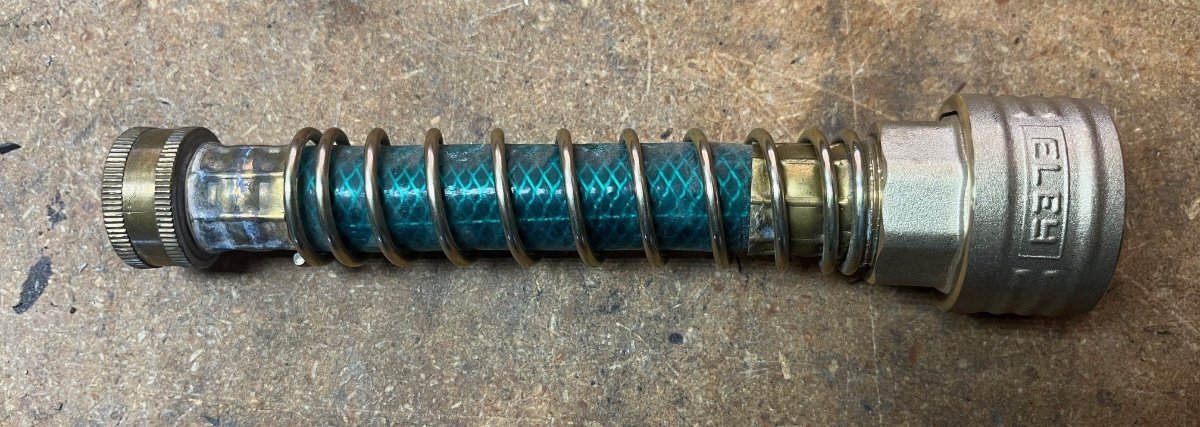
I made this fitting for quick campground connections. It should work well.
1 point

















-
Recent Achievements
-