Leaderboard



Popular Content
Showing content with the highest reputation on 10/23/2023 in all areas
-
On an Ollie, back flushing inwards (forward) from the rear main outlet connection risks pushing our enemies E. coli up into the grey tank. Not a good result. Not recommended. Don’t do it, there is a very good reason Oliver put the black flush fitting up at the tank itself. On an SOB RV with completely separated dump valves it will work safely. If you have a NH toilet, you can rinse out the big pipes easily with a garden hose nozzle by directing the stream forward a few times. That will act to rinse the back sides of the grey and black dump valves, where crud will accumulate unseen and untreated. I wouldn’t try this with a regular toilet. Yech. John Davies Spokane WA3 points
-
A bag of ice dropped in the tank on the last trip home works, or at least it worked in 1988 when I last owned a trailer with a conventional crapper. John Davies Spokane WA3 points
-
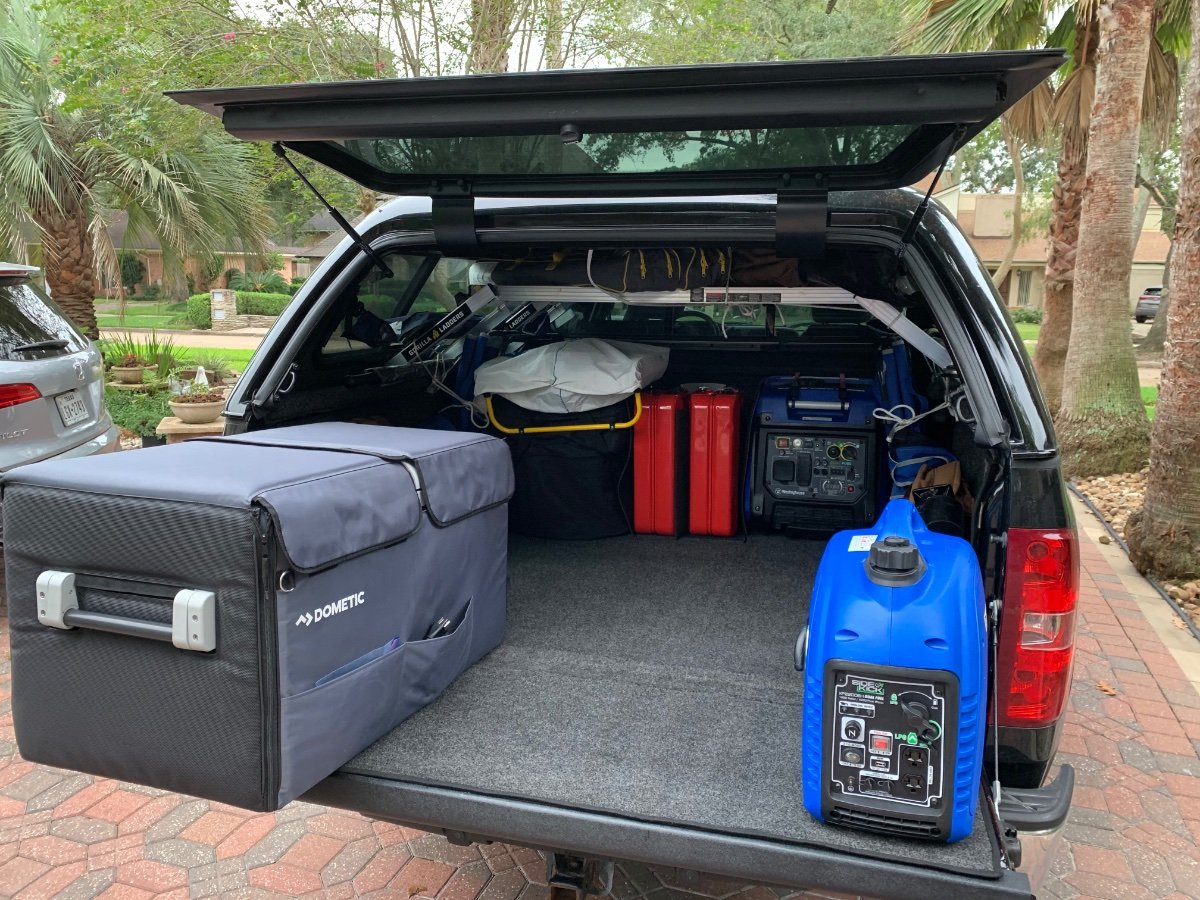
As Sherry points out, a 5 cubic foot freezer is a ton of frozen meat storage. A rule of thumb is one cubic foot of freezer space will store 35-40 pounds. So it's actually only about 175 pounds, but still. I know you are looking at an Oliver to buy, but unless you're planning to travel with a fully grown timber wolf, it's going to be hard for you to consume that much meat in a reasonable time. I'm all about overkill and no one will ever accuse me of being a minimalist, but while I think your idea is sound it may be perhaps a bit unrealistic about what you really need. We travel with a 75 Liter Dometic dual zone freezer/fridge combo. Either or both sides can be fridge or freezer. It equates to about 2.6 cubic feet of storage. The great thing about going in this direction is that it will run off either 12 VDC or 120 VAC. It lives in the bed of our truck with its own Lithium battery and solar panels set up on the roof of the camper top. It will easily store enough fresh meat to keep that wolf happy for a couple of weeks.3 points
-
Definitely correct. Should have been more accurate in the previous discussion - my bad. We use the OTT-provided black tank flush to fill the tank 3 or 4 times until viewed clear effluent is observed in the plexiglas port. We don't use the back flush hose adapter on the unit for exactly what JD is describing above... We use the device when dumping at home because of the long run from the trailer to the dump head - just makes it more convenient and easy having it closer to the valves.2 points
-
Today I learned that some people have "liked" some of my posts. (OK, I'm not the sharpest knife in the drawer, I guess. 🙂 ) So, I went back and mindlessly, belatedly clicked TY for each of the replies I've received. Believe me, every word is very much appreciated as we prepare to take this leap.2 points
-
Hello David, I'm sorry I'm just seeing this now and wasn't involved while you still had your old batteries. I had four T-105's in my sailboat for years. I suspect premature cell failure and usually it's on a single cell. That's the beauty of using 6V (3-cell) instead of 12V (6-cell), you can better pinpoint the problem cell and only need to replace one of four batteries. I would have told you to do what I eventually did and was very surprised by: Run some kind of decent load like 10-20 amps, then go into the battery compartment and measure each individual battery's voltage AT THE TERMINALS, not the cable clamp/connector. The loaded batteries should show around 6.1, 6.2 Volts. I was amazed when one of mine was like 5.3 Volts, all the others ok. And I bet even within that battery it's only one of the three cells that's bad, but our resolution is 3 cells. And replacing with a single new T-105 everything was like new. The reason you need to measure at the terminals themselves is the other likely problem would have been a high resistance connection; if you measure two batteries 6.2V and 6.2V then when you measure across all the wiring you better see 12.4V. If not it's then easy to make a few more measurements to narrow down where the bad connection = voltage drop is.2 points
-
@Cameron, I have both. "Composting" in the barn, and traditional in the Ollie. Perfectly happy, 16 seasons in, with the traditional dump system in our Ollie. Not very happy with the composter/dry toilet, in the barn. Pick your poison, imo. No poop pyramids in decades of ownership. Plenty of liquids in. Rinse within reason. Some campground dump stations are vault, vs septic.2 points
-
Well, I just couldn’t stand it and had to give it a try. The access method described above worked as expected. The new thermistor, not so much. I’m disappointed, for sure. For testing, I just dangled the new thermistor directly down from the air distribution box which is centrally located in my RV. The thermistor was about waist level. In AC mode, it seemed to be a pretty good solution although I did not spend much time in this mode. The compressor did come on as expected and seemed to turn off much closer to the set point when measured by an external inexpensive indoor/outdoor thermometer at countertop level. In heat mode, the fan would never come on. I could hear the compressor turn on as well as the fan in the rooftop unit, but the interior fan that blows the warm air never came on. Heat was occurring in the coils because when I switched it from heat to fan-only mode, the fan did come on and the residual heat from the heat mode allowed for some warm air to come out. This puzzles me and I can’t help but wonder if the prior fan modification is in the equation somehow. That mod is described upstream in this thread. Prior to the new thermistor, I did notice a change in the fan behavior between AC and Heat modes: In AC mode, the fan cycles with the compressor only when the fan is in Auto mode. It remains on all the time if the fan is switched to medium or high mode (can’t recall about low speed). However, in Heat mode, the fan will cycle with the compressor no matter what speed the fan is set to, including auto. After the new thermistor, the fan would not come on at all no matter what fan setting I used. I returned the setup to what it was before I tinkered with it today and it’s back to running as expected in both AC and Heat modes. HVAC and resistors are by no means my area of expertise. I’d be interested to hear from those who know more on these subjects. For the record, the replacement thermistor I bought is a 10K NTC thermistor. That means absolutely nothing to me but there are gobs of these on Amazon with this specification and advertised as being suitable for mini-split systems which do both AC and heat. So I figured I’d start there. I can’t find any specs on the one Houghton uses.
 2 points
 -
ugh. so glad i have the composting toilet.2 points
-
I'd have to imagine that it is quieter on the outside too - quieter is quieter - unless you are simply sealing off the "noise" from one area and not the other. From what Ray is telling us it would seem that the reduced noise level he is sensing is the result of cleaner air flow (i.e. not the compressor and/or associated parts). Can't wait to hear more! Bil2 points
-
I’m a carnivore, well more like an omnivore, but I can’t imagine wanting to share my Ollie with a freezer of those proportions. Have you considered something like an Engel or National Luna that resides in the tow vehicle?2 points
-
Very cool. FYI moving air doesn’t like squared corners at all. At the downstream side especially you get low pressure and turbulence, which decreases the flow rate and makes extra noise. Try putting nice smooth curves wherever possible, for example use a 1” or larger router bit, followed by hand sanding. Tape all seams and openings. Any reduction in area in a duct will reduce the airflow cfm, so it is important to have the shape be as aerodynamic as possible. John Davies Spokane WA2 points
-
Assuming that you are talking here about the BakFlip tonneau cover, your statement is not "totally" correct. These covers can still be opened with fairly simply tools even while the rest of the truck (to include the tailgate) is locked. Of course, this is good news AND bad news in that any would be thief that knows this can also use this information to get to your stuff. Bill2 points
-
We have a Diamondback cover on our truck. It's secure and you can strap things on top of it (you can walk around up there). We added racks to carry our bikes or whatever (tank tote, firewood, etc.).
2 points
-
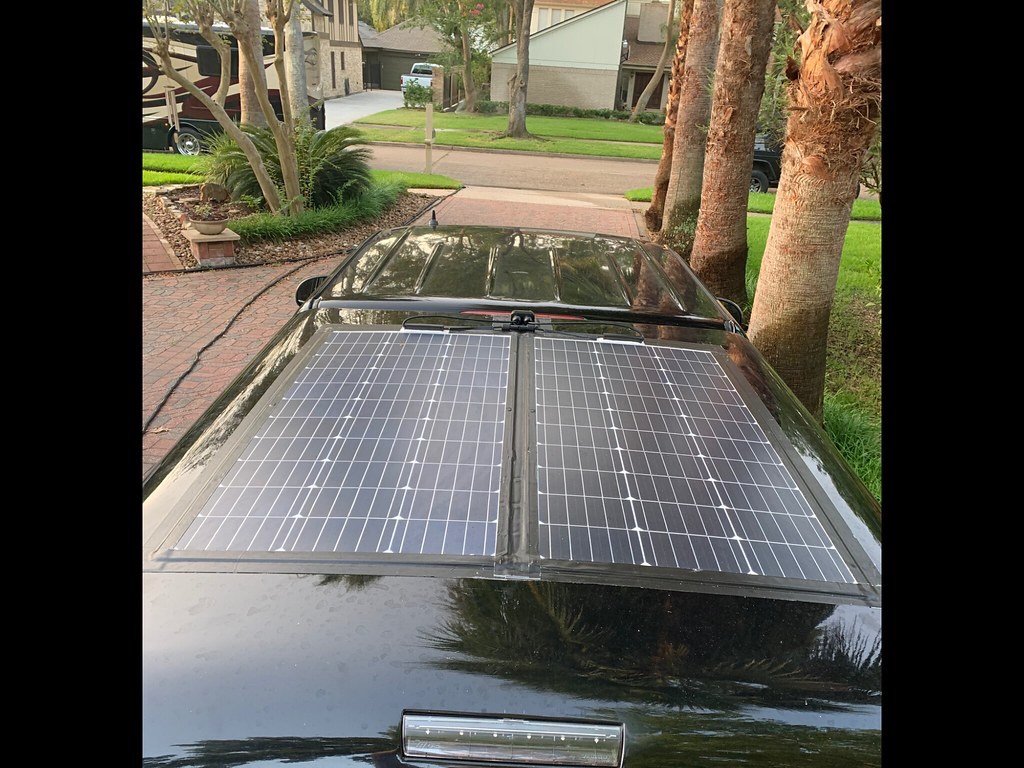
I too have the BedRug with bottom, sides and tailgate coverage in my 2012 short bed TV, as well as an A.R.E. cap lined with the same carpet material. As some mentioned, easy on the knees, as well as an insulating factor and sound reduction. 11 years and counting with little signs of wear or staining. I have furniture carpet slides on the bottom of a large frig/freezer that work great in handling it. Although a cap will add significant weight, it provides protection and security, as well as added space, especially for bikes and even a loft. I also installed a 200W solar array atop the cap.
2 points
-
We started with the Bakflip @topgun2 mentioned...also got a spray in liner. The bed-rug is also a great ideas (ask my knees!). We ended up with an ARE truck topper which we prefer - but there are loads of pros and cons between toppers and tonneau covers. We were happy with the quality of the Bakflip, Need to consider all uses of your two vechicle for a decision that works best for you all.2 points
-
Thought I would share my latest projects… We enjoy boondocking mostly. While we enjoy the utility of our Ollie inverter, I’m trying to convert as many appliances to operate on twelve volt as possible. 12 Volt Television Conversation We sometimes enjoy streaming video or playing a downloaded movie at the end of our day. I looked into 12 volt televisions but good ones like the Jensen are expensive and besides, the Oliver installed Vizio works satisfactorily. So, I found a way to convert the Vizio to operate directly from the Ollie battery. Opening the [TV] case I located a Tiny Whoop 12 volt input. I purchased a Tiny Whoop JST-PH 2.0 male plug for the input. I was concerned about the sensitive electronic [Vizio] components given the variability of the voltage of our batteries. I solved this by integrating a Voltage Stabilizer DC 12 Volt Regulator/12 Volt Surge Protector. This was mounted to the rear of the [TV] case. Finally, I integrated a fused 12 volt charging cable with cigarette lighter type plug. I plug into the outlet in the cabinet above the TV when needed. Works great! TV operates normally. 12 Volt Security System Where we often find ourselves camping in secluded desert or forest we are a bit concerned about security when we’re out hiking or otherwise away from our Ollie. We use many devices to immobilize the trailer but we’re still concerned about someone breaking in. So, I purchased an inexpensive KERUI Alarm System on Amazon. It’s designed to be powered by house current with an adapter. I eliminated the adapter and wired in a 12 volt to 9 volt DC Converter, Voltage Regulator to power the alarm; plugged into a twelve volt outlet. It uses a handheld remote to activate or deactivate and I use the included motion sensors inside. Works great! Alarm is very scary!!! 12 Volt UV LED Water Treatment System To complement our three stage water purification system we installed the Acuva UV LED ArrowMAX 2.0 Water Treatment System at the galley sink. (Okay, so I’m a bit obsessive about our drinking water.) The system comes with a 12 volt adapter to use with shore power. I eliminated this by wiring a 12 volt line to the fuse panel. 12 Volt Portable Freezer We like to store plenty of food for grilling and extended travel and so that we can purchase frozen food in reasonable quantities. Where our Ollie freezer is so limited we use the Dometic CFX3 35 Refrigerator/Freezer for this. I ran a 12 volt line to the basement storage area and installed a marine grade 12 volt outlet. The CFX3 35 runs on 120 volt or 12 volt. So, when we’re traveling, the freezer gets plugged into the 120 volt outlet in the bed of our pickup. When we’re camped, the freezer is positioned just to the rear of the Ollie and plugged into the basement 12 volt outlet. Uses very little power! Next project Adapting the Starlink to run off 12 volt…1 point
-
An interesting article on methods to keep black tanks clean.1 point
-
That is what I replaced “old leaky” with.1 point
-
Same here - The Flush King works great. We get no odors after flushing clear - takes 3 to 4 fills.1 point
-
I could be wrong with my calculations, but it looks like your TV weight went up 600-620 pounds when hooked up which makes your tongue weight (600-620). Interestingly, the anderson shifts about 40 pounds from the rear TV axle to the front TV axle and shifts 20 pounds from the rear axle of the TV to the trailer axles (I thought it would be more than that), but...there you have it. Trailer weighed in at 6440 pounds1 point
-
I will do that. I have been busy with two grandsons under the age of two. Diaper changes, bottles, cleaning up, etc. John1 point
-
There is no diverter valve used. The shower valve is tee’d into the main hot and cold lines under the vanity just before the sink valve. So basically one set of supply lines (hot and cold) and two independent sets of control valves.1 point
-
So GMC made two diesel engines in the same model year. That's great though highly uncommon. The article states the LBZ boosts torque from 605 to 650 (605 is more than enough)! Seeing $45K, even $35K makes me very happy with finding my low mileage Cummins diesel under $20K. Not near as much torque as these newer GMC trucks, but more than any gasser, and enough to nicely pull an Oliver EII and a truck bed full of outdoor camping gear.1 point
-
We add some Calgon and a detergent pod after dumping. Unless we’re at a dump station with a line, we rinse the black tank until clear. When we get back from a trip we add Happy Camper and a gallon or two of water into both the gray and black tanks. I don’t like the smell of Pine-sol, not sure I like that recommendation. Mike1 point
-
Don't be! I promise it doesn't feel your pain. Before I drill, I think "will I ever want to remove this?"1 point
-
You do have to be careful of mechanical fasteners in plastic board. Some are better than others. Using an unknown plastic cutting board leaves some options open. Check, and recheck. Many of the plastics don't accept mechanical fasteners well, and look to chemical fasteners, as well. Keep an eye out, and be well.1 point
-
I have this one off amazon: https://www.amazon.com/dp/B0CCX4XGC8?psc=1&ref=ppx_yo2ov_dt_b_product_details it did require some modification and fitting but it works pretty good. Im 6'2" so it does make it a tight fit to stand in the shower, however i also have a "squatty potty" type stool in there and usually shower sitting on that. Im used to having to shower on a rocking ship so its usually easier for me to shower sitting down on the ship anyways so im used to it.1 point
-
We changed from a suburban 6 gallon to a girard instantaneous. It required changing the door, as vent(s) are in a different place. 6 gallons take up a bit more space than the Truma or girard. When / If anything happens to our girard, we're going back to a standard 6 gallon .1 point
-
Had the same problem. Seems that tree branch ate my Furrion rear camera antenna. Worth a glance. GJ1 point
-
Rivernerd, you are right. Very sorry about your brother Larry. We have the same set-up that you have. I have always run the fridge on DC while traveling. Like you my SOC hasn't gone down much. Two days of travel with a boondocking stop brought me down to 76%. Not bad. If I ever ran it on propane while traveling, I would turn off the propane while fueling. John1 point
-
Thanks, I really appreciate the offer. Actually I bought hole plugs, just haven’t installed them yet; I tend to save the easier things for last! Again thanks!1 point
-
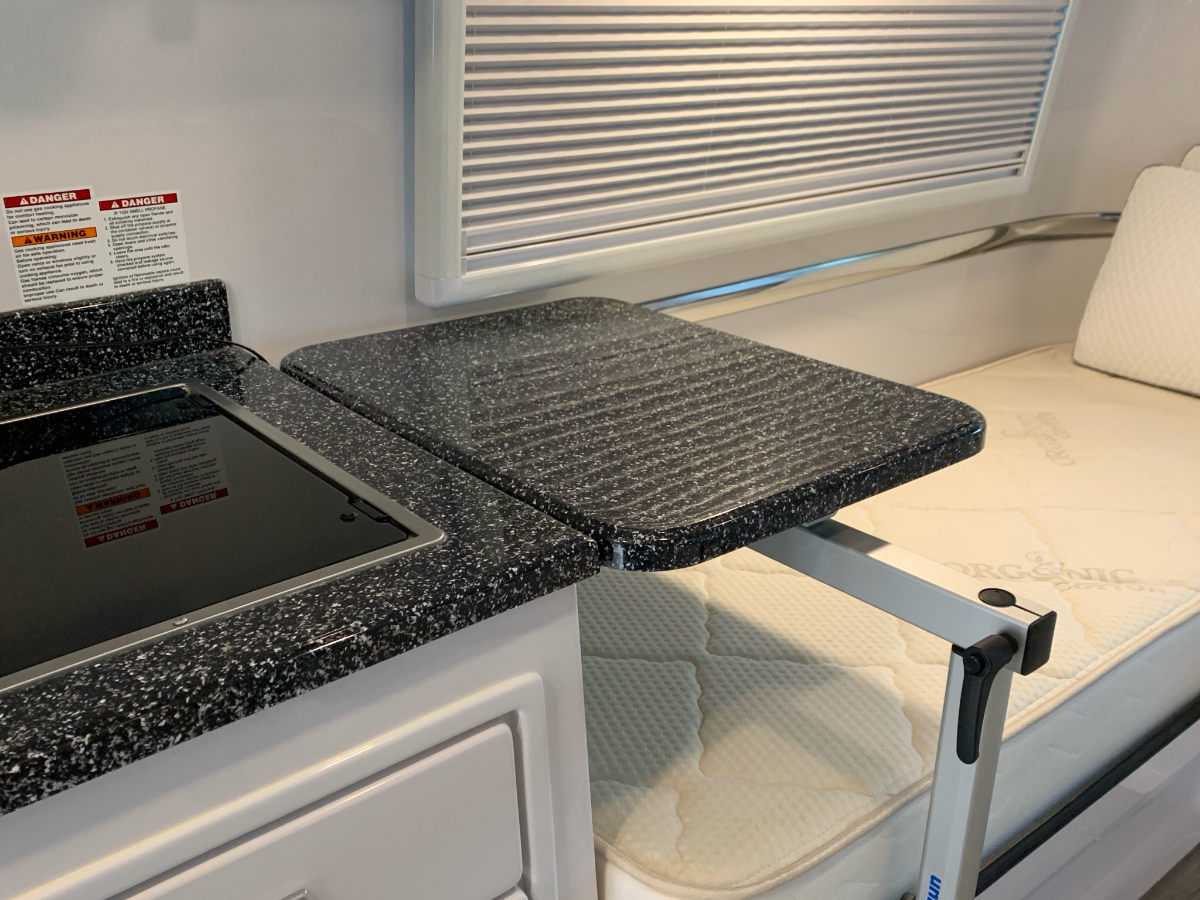
I find the Lagun most useful as a bed table, especially in the morning to accommodate an iPad and coffee while sitting up against the rear wall, as well as the evening in similar manner. I can also use it at the other end when watching TV. Of course the table serves other purposes, as you mention, and thus its’ versatility and usefulness justifies leaving it up full time. Currently in the process of mounting a second for the wife’s bed.
1 point
-
We have had a fast introduction to our new-to-us Elite I (hull 731) since we picked it up over Labor Day weekend in McComb, Ill. We are four years into retirement and felt ready to do some camping and to get out and see more of our country. We thought we could fit camping trips in between our life with our many local grandchildren – and help with visits to our non-local grandchildren. From our home in Pittsburgh, we’ve now taken 5 trips, visited 7 states (from Illinois to NY to Tennessee), travelled 3400 miles and camped for 13 nights. This has given us a deep dive into the Oliver camping world. I thought we’d share our first impressions and ask some questions. Overall, it is evident that the Oliver is a complex and capable trailer. We love it!! We are glad for our purchase and our start into some years (God willing) of camping adventures. The Oliver online forums and the Oliver University have been a goldmine of advice. Thanks to you all, more than once!! As we got started, we had to: · Upgrade our TV capabilities, adding a class 3 hitch, air bags and a brake controller to our 2022 V6 GMC Canyon. All this was new to me, and I’m glad to say we’ve had no towing difficulties. · Learn how to tow. I got my first lessons from our seller at pickup, a *great* guy. Caution and care were important as we started. As of this writing, we’ve been through the Adirondacks and the Smokies at least once. · Learn how to travel with our Cocker. ‘Brecon’ goes with us, almost always. But she does not sleep on our bed, so… the floor by the door proved perfect for her bed, leaving the isle free to walk to the bathroom in the middle of the night. She travels well, and is a sweet companion. · Learn the basic systems, including parking, electrical, propane, solar, water, sewage, heat, and solar. We were told at sale that both our previous owners sold after 1500 miles in part because of the complexity of these units. We sympathize! · Learn the basics of finding places to camp. We studied up on federal, state and private options, including Harvest Hosts and Hipcamp. We quickly concluded that we love remote camping, so we had to learn how to boondock. Hipcamp has been our favorite. · Learn how to live in tight quarters! We’ve been married for 46 good years, but this is a new season. As soon as we had a week of nights or so under our belt, we began to shape our Ollie to fit us. All these mods are reversable, but to date we have: · Swapped out the Furrion rear view camera (with a dim, small, fuzzy image) for a Haloview BT7 1080p Backup Camera. I used the wiring for the Furrion and relocated the camera below the Oliver light, temp caulking the previous Furrion holes. The difference was well worth it. · Taken the TV and its mount out. We don’t use it. · Taken the rail btw the front dinette seat and the rear dinette seat out. The added headroom in sleeping is well worth it. · Added 6 Tireminder TPMS transmitters. I may add 2 more to our spare tires. · Made solar work for at least two or three night stays offgrid. 8 of our first 13 nights were remote (by choice) with no hookups, so we learned to keep electrical use to a minimum, turned off the inverter when off shore-power, and added a 100 watt portable solar panel to our 230 watt rooftop panels. As we sit here and think back on our first weeks with the camper, what have we liked, what do we love? · Without exception, we have enjoyed the people we have met. This country has a lot of great people, many of them living out in the country. · The Oliver has made visiting our large family and other friends a cinch! We happily sleep in our trailer! · We are pleased with the Oliver itself, with its aesthetics, its evident craftsmanship, and its ‘mod-ability’. It fits us well. · We love being warm and snug and dry inside when it is cold and windy and wet outside. · We love waking up to sunrises streaming in the windows. We love going to sleep with night breezes across our faces. We love the hoots of the owls and the barking of the coyotes in the hills. We’ve loved sitting pondside and watching snapping turtles cruise in the evening, the swallows as they dart, and the fish as they leap. · We love the quiet and the calm of the countryside and the hills. · We love the stars deep into the nights in the countryside. We travel with a small telescope and binoculars. The stars have long been a love. Geoff and Becca Chapman
1 point
-
We payed for Hot spot on our phone plan, so I found that placing the phone on top of the blind next to the indoor antenna made a difference of weather our devices would work or not in poor reception areas.
1 point
-
Try this - turn the power off for both the monitor and the camera. Assuming that you have verified that the camera is receiving power - turn it back on while looking at the monitor, turn it back on - does it give instructions as to "re-pairing" it with the camera? If yes, then do what it says. Good luck! Bill1 point
-
Its a shame that the first owners gave up after such a short period of time - but good for you guys. There is nothing about RV's and Oliver's that is "rocket science". And, by now you are really getting a handle on a good understanding of how the various systems work together. Unfortunately, you are (probably) now entering into an area where you really do need to pay attention. Its when you think that you know the drill and you get over confident and/or something out of the "normal" routine causes you to deviate from the way you normally do things. Checklists are good at preventing this trap. Let us know if there is anything we can do to help make the journey better. Bill1 point
-
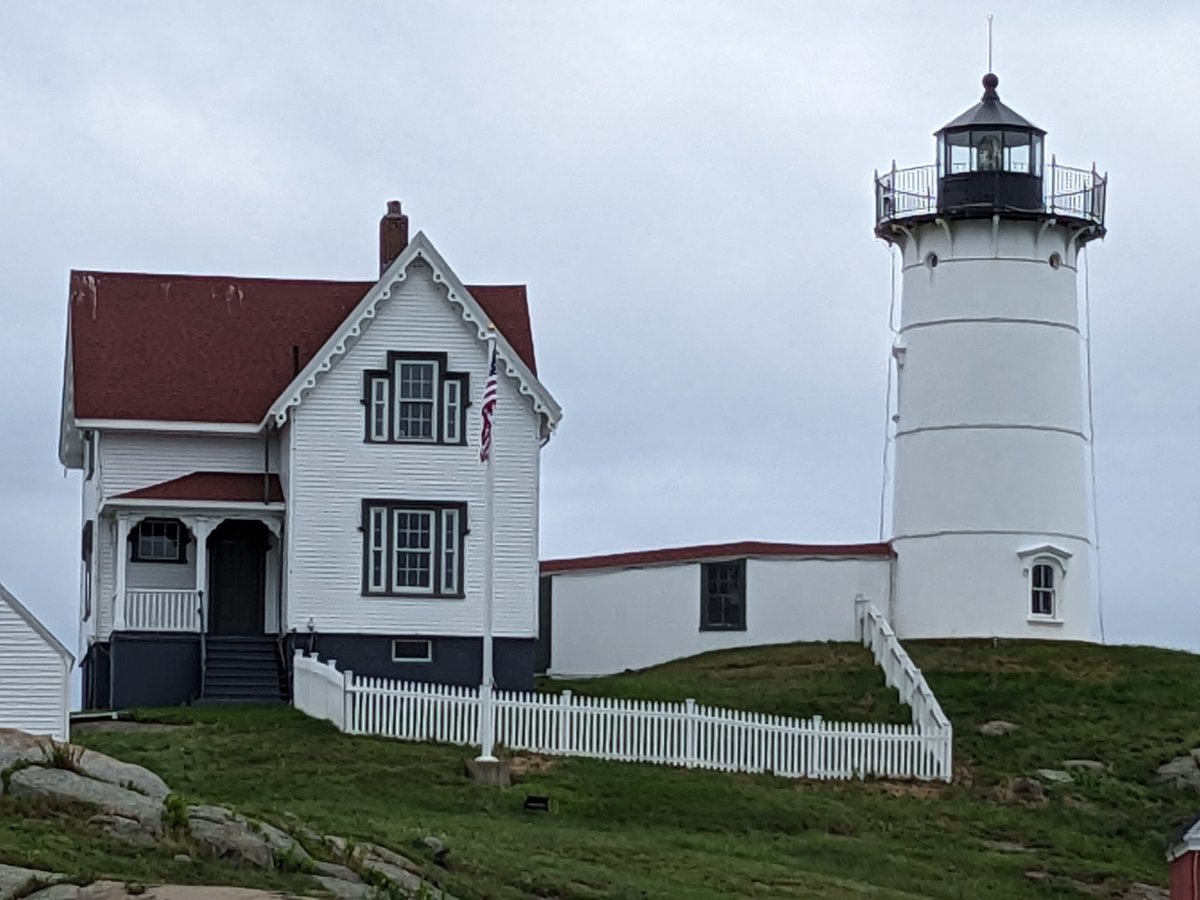
An old friend of mine called me this evening and told me about finishing up his day of fishing near Maine's Nubble lighthouse located just outside York, Maine. In the parking lot he noticed what he thought was an Oliver, so, he went over to check. Indeed it was an Oliver that is about one year old. My friend didn't catch the owner's name but did supply some information as to where he could park and even some place that the Oliver should visit while in that area. Nice to hear that even friends of Oliver owners treat other Oliver owners kindly. Bill1 point
-
We were in York this summer and rode our bikes to Nubble. Great place. Olivers definitely draw attention.
1 point
-
We had an electronic lock on our last trailer and really liked it, so we ordered the RVLock Oliver installs. Don't like it as much as the one we had, which seemed to be better quality. It was made by LatchIt. It's an easy self-install. Same here. Great on the highway and I also use it if I have to back into a site solo. I put an orange leveling block on the ground as a target where I want the back of the trailer to end up. I'm going to use it backing into the garage, too. (Always better to have a human spotter when you can, though!) We like our upgraded non-KTT mattresses, so that's a matter of taste. You should go to the factory and try them out if you can.1 point
-
LOL, my guess is that he is parked on a steep upward slope, there is no way in this universe that an Ollie can actually be towed with a foot and half of droop at the hitch. If I am wrong, please post some pictures. And yes, leaving the fridge on in any mode at that angle is very very bad for it. https://olivertraveltrailers.com/forums/topic/8865-fridge-fires-if-you-have-an-older-hull-you-really-need-to-pull-out-that-fridge-now/ John Davies Spokane WA1 point
-
Absolutely correct - just giving examples of propane usage. Yes, these are the "averages" that I've read about also. However, my current lead acid batteries are still running strong going into their 8th year! Bill1 point
-
We didn't get the electric door lock on our 2022 Elite II, because some folks on this forum noted issues with them. One poster got locked in the trailer when it malfunctioned and had to crawl out the rear window! We have not regretted saving $$$$ by going with the standard key lock. We keep the key in the center console of our truck.1 point
-
All Olivers come standard with a surge protector. And all Olivers use a 30 amp electrical connection - not 15/20 amp and not 50 amp. Of course, you do know that if you have a 30 amp connection to shore power you can still use a lower amperage connection. However, you can not run all the things in your Oliver (i.e. microwave and air conditioner) at the same time if you are on the lower amperage supply. With regards to how long a bottle of propane will last (particularly running the air) - that depends. How hot is it outside, how cool do you want it inside? what other things are you using propane for - cooking, hot water, fridge? Perhaps what you are really asking is, "in typical usage, how long does a 20 pound tank last?"?. Or, should I really get the 20 lb tanks or the 30 pound tanks? I can run my fridge on one 20 pound tank for about 6 to 7 weeks. But, during this time I'm usually camped at altitude where the average temps are cooler and I usually camp solo, so, there isn't a bunch of opening and closing the fridge. I also use a solar shower for heating shower water except for those times when its cloudy and I use a Mr. Heater propane heater for taking the chill off those frosty mornings (this saves both propane and electricity - don't run the furnace blower). While I agree with the two comments above relative to learning - don't be discouraged! We all had to start this journey someplace and most of us are still learning. Bill edit addition: I forgot to mention the 20 versus 30 lb tanks. Obviously if you get the 30's then you will not have to get them refilled as often and you have 33% more with you. This 33% really matters if you plan to do a bunch of winter camping in cold weather. However, the downside of the 30lb tanks is that they MUST be refilled at a business that does this sort of thing. With the 20lb tanks you can "swap" them for other tanks at most grocery stores, gas stations, hardware stores, Lowes, Home depot OR you can get them refilled just like you do with the 30's. In addition, the 20's are lighter than the 30's. It should be noted that when you "swap" the 20's, they are generally not filled to the same capacity (i.e. they are not really full) and the cost per gallon or pound of propane is generally more expensive than it would be at a refill facility. But, if you are in an area that simply doesn't have a refill facility, there isn't really much you can do with that empty 30 pound tank.1 point
-
Count us as another saying that solar is worth it. Our previous trailers were lead-acid batteries and generator. The solar package is so much better in every way.1 point
-
Welcome to the Tampa Bay Ollie contingent! Since you plan to carry and run your generator in the basket, you'll want to tell your sales rep that you want the second electrical connection up front. Also, make sure you have a neutral ground plug in your tool kit. (While you're at it, get a decent 12v meter, dedicated to the trailer kit.) If you plan to chase the cooler weather up north during our hot summers, as we do, the standard ac is probably fine, as you won't use it much, anyway. If you later find it drives you crazy, the new Dometic freshjet is a quieter upgrade (not available from Oliver, yet), using the same interior distribution unit and drain, for much less than the full Truma package. The Truma ac requires a bigger generator than the Freshjet. (We changed our dometic ac to a Houghton after 12 years of mostly boondocking because of its age, and a severely cracked shroud.) The 6 gallon standard water heater is fine for most people, very simple, and if you're bringing the trailer home to tampa, you'll never need the easier winterizing fearure of the Truma, anyway. If you've never had an rv or trailer before, the simpler the better, imo. You can spend more time enjoying the great outdoors, and less time reading manuals and fiddling with features you rarely use. Pretty much everything but the rooftop solar can be upgraded fairly easily if you decide later that you "need" some features you didn't order. A portable solar option is easy. Adding rooftop, since Oliver no longer pre-wires for solar, is not as simple. Battery choice is the last conundrum. We have a 12v danfoss compressor fridge, similar to the one Oliver now installs, with just two 12v agm group 31 (105 ah capacity) , and we manage fine with solar, and the occasional use of the generator. Without solar, you will need to plug in to a power source (generator or campsite) pretty much every day, or every other day, with the standard batteries, a bit less frequently with the 4 agm 6 volts. Some of that decision depends on which batteries Oliver is using now. I've seen a number if issues on here with the Brightway base batteries, but I heard they are not using that brand anymore. (Ask your rep.) Upgrading batteries is also a pretty straightforward process, from flooded to agm or battleborn lithium.1 point
-
Dennis& Melissa, It’s great you’re in the planning stage.. I only have a LEI., I was not going to get solar, but we had planned a national parks for the summer of 2022 ( took delivery July 2022). It’s the best money I spend.. you might consider the 30 lb tank.. since you getting Lp generator.. good luck with your choices..1 point
-
Good choice on the truck. I towed with two different Ram 1500s, both with the 5.7 V8. It would be helpful if you told us what kind of camping/traveling you think you’ll be doing, if you know. We had never camped when we ordered our trailer. I didn’t think we’d do much boondocking but went ahead and ordered solar. Lithium wasn’t an option then. As it turns out many National Parks have campgrounds with no hookups. Many other desirable camping locations are also no hookups. We’ve utilized Harvest Host locations and they are mostly no hookups. So, I would recommend thinking about where you will go and how you’ll camp before going without solar. Mike1 point
-
My valves are Shurflo brand (Trinidad style) the same manufacturer as our water pump. These are very similar to the Scandvik brand if not identical. I actually did not buy the valves because I had the Oliver folks do the modifications before we took delivery of our trailer in 2017. I would imagine that we could buy direct from the Shurflo folks. Also, we don’t leave the shower head hanging while traveling. We wrap the shower head in a towel and then lay it on the floor.1 point
-
Failure cause found. I've installed a few TVs and the mounts often come with some spacers to go between the mounting plate and the TV - to account for obstructions, curvature, etc. Careful examination of our TV and mount reveals that the wings of the mounting plate itself are bent slightly upward. Look carefully at the TV back and the plate mounting screws in this picture and you can see it. Tightening the screws at installation pulled the center of the TV against the center post, causing two of the mount points to pull out through the plastic TV back on the left of this photo. Two possible solutions for the new TV: disassemble and try to flatten the mount plate, or install nylon washers or rubber spacers between the plate and the TV to stand it off away from that center post. https://pointerclicker.com/where-to-put-spacers-on-tv-mount/#:~:text=Report Ad-,Do I Need Spacers for TV Mounts%3F,the back of the TV.
1 point























-
Recent Achievements
-