Leaderboard




Popular Content
Showing content with the highest reputation on 03/20/2025 in all areas
-
Another reason I love this Forum. My Fridge would not light up. Tried pushing all the buttons. Saw someone used a butter knife and I got a Phillips and pushed all the buttons, many times. No luck. Looked at the fuses. (Why in the world does the door open the wrong way?) Then tried pushing the buttons again with the screw driver. No Luck. Then tried your “Smacked it” approach. All the lights came on and it started working. Will not tell my wife this, she might try it on me… Thanks3 points
-
Once you get those little buggers cleared, working or replaced - you might want to consider "zerk caps" like THESE if you don't already have them. If the ones that are "plugged" don't respond to the "normal" grease pressure to free them then I'd use a small punch and a light tap with a hammer to get them free. Of course, I assume that you have already tried the old taking the weight off the wheel, cleaning them, etc. Bill2 points
-
We were just on a seven week trip. The freezer side was stuffed with soups, casseroles, and whole meals that we had prepared and frozen at home. The fridge side had beverages, produce, and larger containers such as spare eggs or juice. This left the trailer‘a fridge free for day to day items, and ice cubes in the freezer. It worked out great!2 points
-
A Honda 2200 EUi has a continuous rating of 2,000 kW which means it is capable of putting at most 2 kilowatt hours (kWh) of energy into an EV battery if it runs for an hour. An EV pickup like the F150 lightening will travel from 2-2.5 miles on a kWh of battery power in normal driving. That means if you wanted to add driving range using an Honda 2200 EUi, you would need to run the generator for a full hour for every 2 miles of additional range you wanted. Level one chargers at home (120 volts) are limited to about the same charging rate as a 2200 EUi; a rate of about 2 kW (15 amps x 120 volts equals 1.8 kW charging rate). Level 2 home (240 volt) chargers can charge a vehicle up to a 16 kW rate (i.e., the F150 Lightening) depending on the specific vehicle. The charging rate using AC power from home is limited by the charging circuitry in the vehicle that converts AC power from the home plug to DC power into the batteries. These internal vehicle electronics limit the charging current (whether 120 volts or 240 volts) so charging the vehicle will not trip the circuit breaker in the home panel. The charging stations being built along freeways, et. are DC fast chargers. They supply DC power directly into the vehicle batteries and typically are capable of charging the vehicle at a rate of 150-250 kW rate which is why they can charge a vehicle like an F 150 lightening from zero to 80% charge in way under an hour. It would take a 2200 EUi over 50 hours of continuous charging to do the same. The good news is if you had an EV like the F150 lightening that is capable of bi-directional power flow, you wouldn't need much if any battery storage in the Oliver itself. When you set up camp, you plug the trailer into the F150 (with 130 kWh of battery), you have over 100 kWh hours of battery reserve for over a month of camping assuming you arrive at camp with close to a full charge in the vehicle. My son is a rural large animal veterinarian and has an F150 Lightening (11,000 lbs towing capacity) as his work vehicle. It gives him several hundred miles of range which is more than enough for a day of ranch calls and he can recharge it from empty to full overnight at home with his 16 kW level 2 charger. Last summer his batteries in his travel trailer were nearly shot but he didn't replace them. He just took his family camping and plugged in to the F150 when they got to their campsite. My son did keep his gas powered F150 for now for the rare times he needs to travel out of state or go on hunting trips more than several hundred miles from home.2 points
-
Last summer I had some difficulty getting a couple of my zerk fittings to take grease, and THANKS to the forum members for all their great suggestions, it was solved by taking pressure off a tire. But rather than jack the side up, I used the tandem trailer ramp that I had purchased (and never used before). It worked! Here's what it looks like: https://www.amazon.com/Trailer-Aid-Tandem-Changing-Change-Trailers/dp/B000I4JPZE?th=1 That way I didn't have to actually remove any tires. I also use the small caps on the zerks to keep them clean; only once have I found one of the caps missing. They do keep a lot of dirt out.1 point
-
Starlink is great for being on the road. I was looking at the Starlink website today, and they have a special -- Standard kit for $149 (less than half normal price) offered until 3/31/25 "in select areas". Just FYI.1 point
-
Bill, thanks! The Zerk caps are waiting to go on, as soon as I finish getting them lubed. Also may take the wheels off to get some better access. I’m going at this slowly, as I’m dealing with some arthritic shoulder issues.1 point
-
I sent a message asking the folks at RV Trip wizard if they had a feature to overlay multiple trips on one map...and they said no but to try exporting to Google Maps and using layers....here's a result as an example of what's possible, I'm still learning. So Google Maps allows direct import of the .gpx files that are output by RV Trip wizard. Normally the .gpx are used to load into Garmin devices, but Google Maps reads them as well. I started by opening up a new map in Google Maps created "My Map" as a BASE map with the first 2019 trip where we picked up the trailer, and added a layer for each subsequent main trip. I found that 6 is the maximum number of individual layers you can add in Google Maps. There are controls to change the type of marker, color, line width etc. There are also controls to turn on/off the titles for each stop. To create more graphic maps, Google enables embedding photos by geotag into the maps as well. I'm considering adding pictures of each campsite for each stop to see if it's at all useful. The map below lets us see big holes in our travel...so we've still got miles to go before we sleep! Craig & Rose Hull 505 - Galway Girl
 1 point
 -
Thanks. I put shampoo and conditioner bottles there and they fell out during travel. I will try different size bottles.1 point
-
Yes, to all the above. shampoo, conditioner and liquid hand soap stay secure during travel. 👍🏻1 point
-
I think I posted info on the freshjet in Australia several years ago. I agree. Apparently, Americans will be expected to put up with old tech for longer than the rest of the world. Perhaps, in perpetuity.1 point
-
Shampoo, Conditioner, and Body Soap are tall enough that they stay in place. Hand soap dispenser has to go behind to prevent from falling out. Hang a small hand towel. Never had anything end up on the floor.1 point
-
We have shampoo and conditioner there.1 point
-
Many use this space for shampoo and/or liquid soap. I also have a small box of Kleenex type tissue in there. Bill1 point
-
This doesn’t hide the brackets, but protects the sleeper from scratches on the sharp edge. We used them when our granddaughter camped with us last summer. https://a.co/d/bfuirDi1 point
-
We like the duel zone especially because we definitely need extra freezer space while traveling, but it’s also nice to have fridge space while exploring away from the camp site. Drinks and cold foods like sandwiches, hard boiled eggs and such are kept cool in the fridge side. Set up properly the system operates 24/7 with little involvement.1 point
-
I might have put my foot in my mouth while chastising them on prices as a little more in depth research shows that on dual zone units their price is not that extreme a search does show a dealer network Dealer network As suggested above, a great idea to consider dual zone capability we are eyeballing the dual zone offerings appreciate all the suggestions !1 point
-
Wonderful, need to place another order!1 point
-
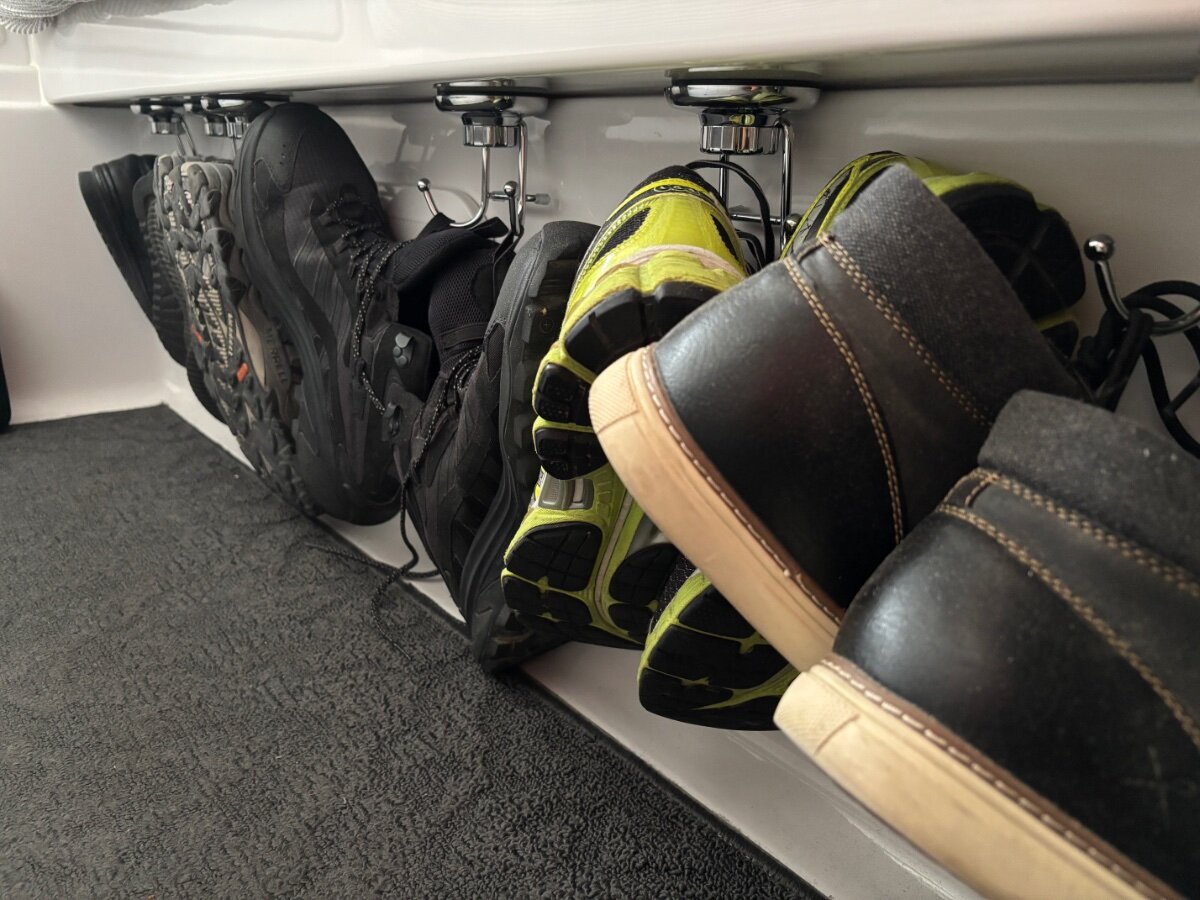
Yes love these Hasko vacuum suction cups, we also have a dozen or so all over inside the trailer, including below the street side bed for shoes…wife’s idea!
1 point
-
Is THIS the post you were looking for? Bill1 point
-
I installed the standard duty version of RAS on my 2021 Silverado 1500 and was able to do it myself. It reduced the squat from the trailer by about 1.5 inches so I've been satisfied with it. They are adjustable and I have it about middle of it's range. Towing and non-towing with it now for 45K miles and I can't say I really noticed much of any change in handling/ride quality when not towing and that's fine with me. I'd recommend the RAS but it seems like airbags are good as well.1 point
-
Yes, I sold our “Demonic Penguin” on FB market place to guy who owns a food truck somewhere near Statesville, NC for $600. It sold about 3 hrs after posting it.1 point
-
Canyon Point is a nice campground, we enjoy staying there. I think the campground is open mid May to mid October. The Ranger can verify. Mike1 point
-
Yep. Sold mine for $550.1 point
-
I have my DPll 11K listed on my go-tos, FB Marketplace and OfferUp. I’ve brought in thousands of dollars in past listing and ultimately someone will buy this unit. However, typical inquires include ridiculous offers and money-stricken individuals who can’t really afford, but with patience a viable buyer will happily pay the asking price or a perceived ‘bottom line’ price. There is no fee paid for use of these two sites.1 point
-
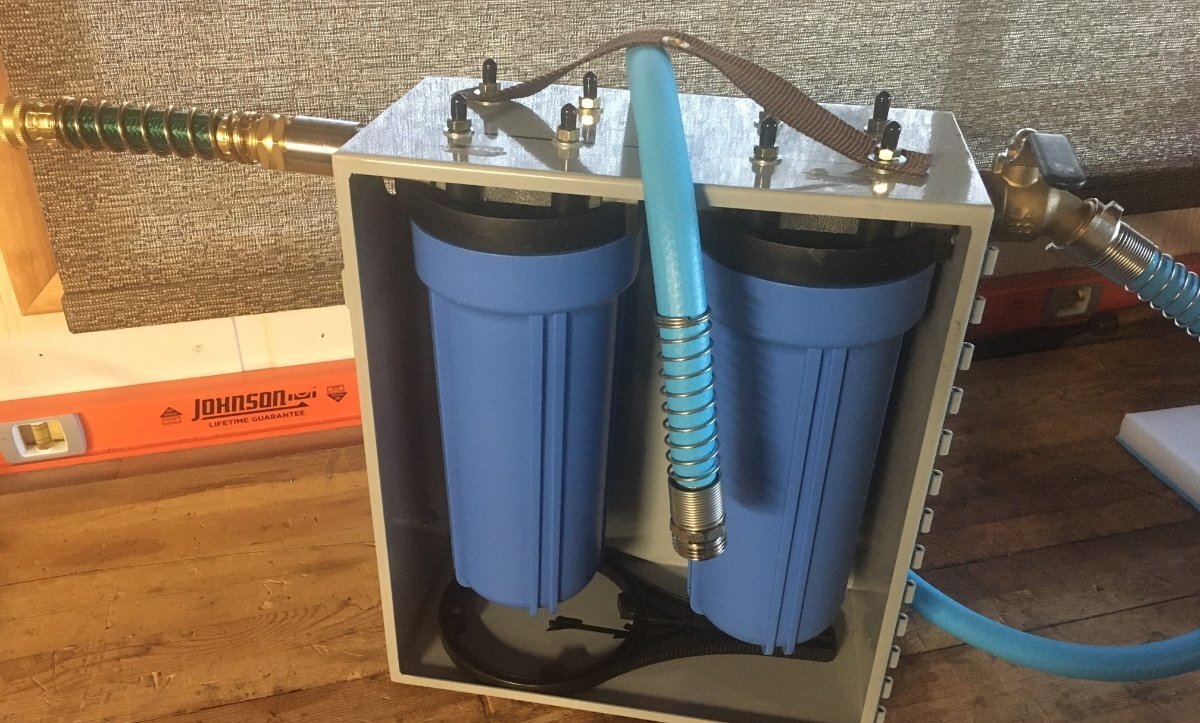
I was questioning the idea of a RO system in the Oliver, but Given @Galileo now lives fulltime in an Oliver, I certainly now understand the need. The obvious space is the back basement area. The water lines are there where you could add a 'T' to the RO system and then plumb a line to a countertop spigot. You'd want it far back so the remaining area is still usable for storage. The issue is getting back there to install and later to change filters. You either must have real narrow shoulders to fit in or perhaps the furnace could be removed for the installation. I was thinking of building in water filtration there but after advice from @SeaDawg I went with a portable unit that I use when filling our tanks. First pic shows the idea and the second pic shows what I ended up with. I used Clear Source filters and housings. Their parts are cheaper compared to their $400+ RV filter systems. This was intended for better bath and kitchen water on the road. We do not drink the stored water.
1 point
-
I’m certainly not suggesting that the Berkey does what an RO system does. We have had an RO system for 20 years that supplies drinking water and water for both of our fridges with ice makers (we’re actually on the second system, we wore the first one out). The RO removes everything, which is why we add back electrolytes to our glasses of water during the day. For camping, the Berkey has been effective. It gets top ratings by the EWG. I asked them about microplastic removal and they said their carbon filters remove some but that their new ceramic filters remove most/all micro and nanoplastics. Plastics is becoming a major health issue, they’re finding them in our arteries, artery blockages, brains, organs, etc. I applaud anyone who engineers a good RO install in their Oliver. I’m not that smart or talented so we’ll just roll with our Berkey. Mike1 point
-
All excellent points here. We used to have an RO system at our old house, primarily to eliminate the 0.010ppm arsenic that our shared well had. Larger RVs can easily rig an RO system because they've got the real estate available, the OTT, IMO, just doesn't have the available space. We run like @Mike and Carol with a Travel Berkey and as Mike mentioned, we too will switch the activated charcoal filters over to the ceramic filters once they've been exhausted.1 point
-
While a marine “watermaker” certainly IS an R/O system, it’s more of a specialized system for making drinking water out of sea water. They’re quite expensive and overkill for most of our purposes. (We also have a sailboat and briefly considered a watermaker.) I just like bottled-water quality without the waste of all those plastic bottles going into the waste stream (then into the ocean, landfill, or into our bodies via microplastics) a conventional R/O system as one would install under their sink at home can be had for $150 or so these days. Conventional water filters (like Camco sells) are basically for particulates and maybe taste via a carbon filter. They won’t remove dissolved stuff in the water. These days, with industrial waste in the ground and agricultural runoff, you really have no idea what’s in your water supply and I prefer to ingest as little of the unknown chemicals as possible.1 point
-
That rotary switch disconnects the solar panels but not the batteries. If you have Lithionics batteries, each one should have a power switch on top. As long as it's above freezing you can turn them off. (Otherwise, there are specific instructions for cold winter storage.) Just make sure the inverter is off (silver button off) before turning the batteries off or back on later. They shouldn't be powered up under a large load.1 point
-
We used to run our jacks up until they clicked, until one jack wouldn’t reseat and I had to use the manual handle. That was in the first couple of months back in 2016. Since then we run them up to about an inch of shaft showing. It takes two to do that, or one checking a couple of times. Mike1 point
-
THIS is why I feel the need for R/O in the Oliver. Wife and I TRY to drink more water (except in Italy or France of course - where wine is less expensive…) and I was literally alarmed as I saw we were going through a 24 bottle case of water every day or two. The gallon jugs cost more than the equivalent number of 16.9 oz bottles, and the 2.5 gallon jugs are even higher - and still add to the plastic in the ocean or landfill. I had this issue licked last season with my portable (no tank) R/O system. I’d fill 8 1-liter recycled plastic bottles and fill our totable water bottles or coffee maker from those. Unfortunately, I seem to have left my R/O system (and my pressure regulator) in storage in Texas. So we’ve been pretty bad for the environment lately. 😥1 point
-
We have an RO system at home for drinking water. We get electrolyte drops to add to put back some of the minerals lost through RO. We try to drink out of stainless steel or ceramic with the new warnings about microplastics. Micro and nanoplastics seem to be everywhere and have been found to contribute to artery clogs, brain issues and other bad things. I checked with Berkey and was told their regular black filters should remove most microplastics, but they haven’t tested for that. Their new ceramic filter is advertised to remove microplastics. We’ll replace our black filters with the new ceramic filters when the time comes. Mike1 point
-
I know nothing about LazyDays. However, a tour of the factory in Hohenwald will help you understand more exactly what you have in a camping trailer. If this visit to Hohenwald does fit into your schedule, I would strongly encourage you to do it. Besides the tour you will get a chance to meet Oliver personnel and get to know them. This might help you down the road when you have a question and/or need help - you will personally know who to call. Bill1 point
-
I suggest reading through the Yelp reviews on LazyDays.1 point
-
I’m ready for that ! plus a starlink smartphone and a starlink tablet chunk this Apple phone in the rubbish1 point
-
Ever since @Patriot started this thread, I've had the Starlink Mini on my list, TY. Chris made me aware of a new Starlink Beta working with T-Mobile (gotta love Elon)! I'm not sure I understand it fully, so we just signed up for the beta. We have a T-Mobile business account for our cell phones and Pepwave router. Want to add the Starlink Mini wired to the WAN port on the router, but if this new technology comes to fruition will we need the dish? Looks like Starlink may become a satellite based cell tower for T-Mobile. Motorla was working on this with the Iridium Project in the 90s which never came to be. We went with T-Mobile since recently their 5G network is more capable than the competitors and they actually have 5G in Prescott and nobody else does. Verizon and AT&T could be in trouble when this launches! Check out this link FYI: T-Mobile Starlink Satellite Phone Service: A New Era in Connectivity1 point
-
Welcome and happy travels. Here's our web page showing our trips for inspiration and ideas. If you ever come out west let us know. Craig & Rose Hull 505 https://4-ever-hitched.com/trips-overview
1 point
-
Starlink monthly billing works as follows: Payment due date The first month's service fee is automatically charged on the payment due date, which is the earlier of the date you activate your Starlink Kit or 30 days after it ships. Recurring billing The service fee for each subsequent month is due on the monthly anniversary of the payment due date. Billing cycle The day you activate your Starlink becomes the recurring date for your statement. For example, if your billing cycle is June 28th–July 27th, you'll be billed on June 28th. Pricing Pricing may vary based on your location and selected equipment. Additional charges You may be charged additional automatic charges for Priority or Mobile Priority data if you opt-in to purchasing it after hitting your data limit. Payment methods Starlink accepts most credit cards, debit cards, and ApplePay. Alternative payment methods are supported in various regions. Pausing and reactivating If you pause your service, the month you pause is not pro-rated. If you restart your service, the month you restart is pro-rated.1 point


















.thumb.jpg.e34bf01ef7f7d5e99ad31856d45afbeb.jpg)

-
Recent Achievements
-