Leaderboard




Popular Content
Showing content with the highest reputation on 09/25/2025 in all areas
-
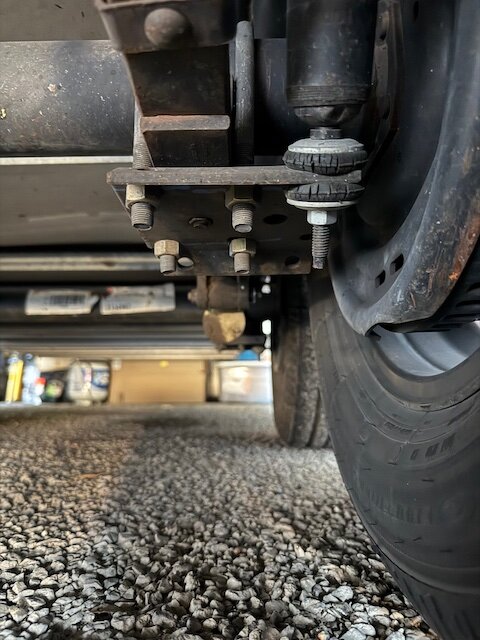
Good grief this is quite a story and horrible experience. Glad you made it through unscathed. May I ask what tires (LT or ST and or brand) you have or had on your Oliver? PSI setting? I can't imagine what would cause so many tire failures in such rapid succession. To answer your questions I suspect you will receive a variety of different answers but I do not carry a jack along and use the built in electric leveling jacks if needed for an emergency. Oliver no longer recommends this but people have been doing it for years. If I were to bring an extra jack it would be a bottle jack stacked on platforms if needed. I have used bottle jacks directly under those plates exactly where the tech used his jack. BTW looking at those rubber grommets on you shocks they seem over tightened and cracking pretty bad. Might want to consider replacing those too. I have an impact wrench which makes for quick work with tire and wheel work but have never carried it along on trips, though I have thought about it for this very reason. Perhaps I should reconsider this. Good luck getting this all figured out.5 points
-
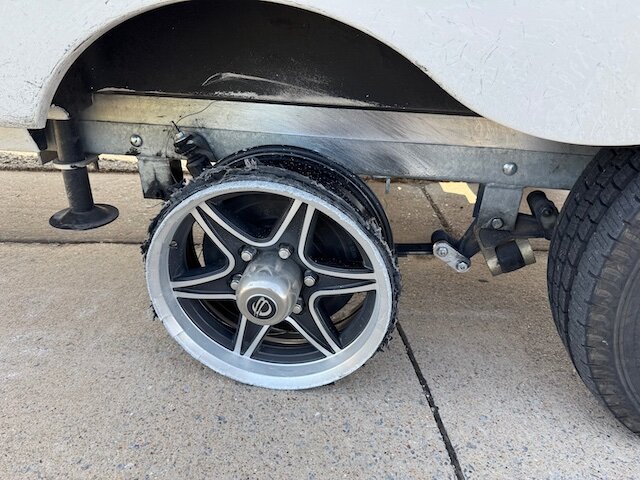
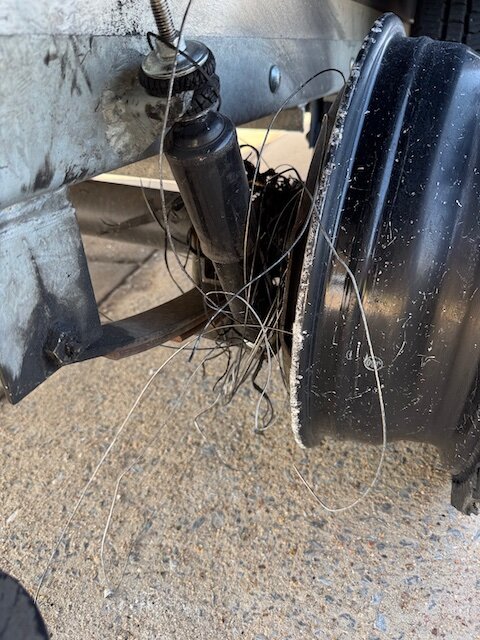
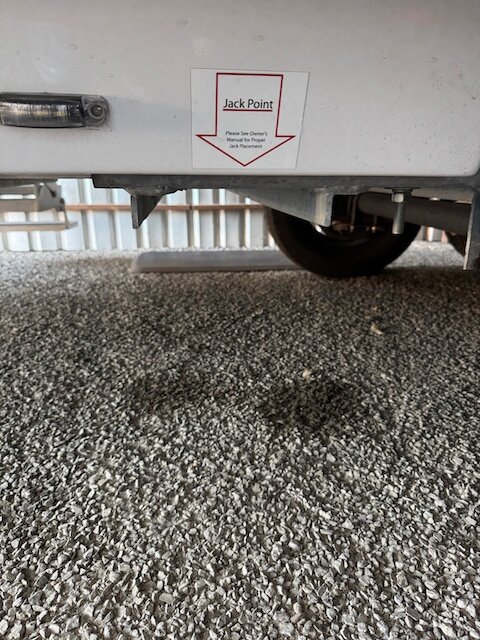
On our last trip, we had significant tire issues (we replaced two tires, one valve stem, and one wheel), so I wanted to share a little of what we experienced and hope to hear from others on ways to make the next time easier. What happened: Entering Wichita Falls, TX on US-281 from the south driving around 60-70 mph, we heard an unfamiliar noise that we couldn't place or locate. The noise would come and go. Five miles later we exited the freeway onto the frontage road, stopped on the shoulder, and hopped out to make sure everything was alright. It wasn't. The right (curbside) rear (RR) tire was gone. Its wheel was an aluminum nub. Some thoughts: Our LE2 handled fine. I think the weight distribution hitch/anti-sway really helped. The noise coming and going was due to us driving near concrete barriers on the side of the road that reflected the noise back to us, such as on a bridge. When we were on straight road, we couldn't hear or feel anything. We were lucky. No damage other than scratched gel coat. There was a considerable amount of steel cable wrapped around the axle and brake area. Taking the tire off: The first task was to get the trailer "jacked up". We pulled forward onto our Andersen Rapid Jack to elevate the right, front (RF) tire. This worked well until the RF tire went flat also. In addition, taking the weight of the trailer off the RR wheel made it more difficult to remove the lug nuts. Fortunately, a passerby stopped to help us and had a powerful impact wrench and an extender since the lug nuts are recessed quite a bit and the center dome got in the way of the wrench. Also, my personal wire cutters were no match for the steel cables. We needed heavy-duty snips to remove all the cables. It was apparent that we were not fully prepared for this situation, so we called a mobile RV repair person. He ended up using a low-profile hydraulic jack to hold up the trailer. Some thoughts: If we had simply run over a nail, we would have been fine. The Rapid Jack would have been all we needed. I have to upgrade my wire snips and am struggling with choosing a hydraulic jack. A low-profile jack is bulky and heavy, can get into places with low clearance/uneven terrain, and has extended lift range. Bottle jacks are smaller and lighter, but have more limited lift range. Any thoughts on what you use? Where to place the jack? The trailer has a jack point for the frame, but, rightly or wrongly, the repair guy put his jack behind the wheel near where the bolts are in the photo below. Getting to our spare: This wasn't a big deal. We do have the rear bumper receiver but it slid out easily. I was glad that the spare had good pressure since I hadn't checked it in about a year. Some thoughts: Check your spare. I had even installed a tire valve extension (something like this) to make it easier to check and fill. Put this task on a checklist to do periodically. Putting a good tire on: A full light truck tire is bigger and heavier than a passenger tire. Also, a full tire has a larger radius than a flat tire which means the tire may need more clearance. Changing it on uneven ground introduces clearance issues if the axle is not up high enough. Since we had lost our tire, once we put the new one on, we spun the tire and checked for brake operation. We found a 3 second delay from the pedal push to the application of the brake on the wheel. This caused us some concern at the time, but both our technician and myself confirmed that the delay was due to the truck's brake controller. It's probably obvious, but put the wheel on and hand-tighten the lug nuts with the wheel off the ground and then tighten the lug nuts to the proper torque (we did have a torsion bar) when the wheel is on the ground and won't spin freely. Some thoughts: If you are going to check your trailer brake while the wheel is jacked up, use the manual control on your brake controller, not the floor brake pedal. A second tire went flat: Our hearts sank as we watched the RF tire lose pressure as the RR tire was replaced. We only had one spare. The technician's fix was to pull out a can of fix-a-flat and refill the tire with air. It was enough. Again, we were fortunate to have pulled off the road 2 miles from a great RV park, so we headed over with the technician following us to ensure we arrived safely. Some thoughts: Carry a can of fix-a-flat. Purchasing tires on a trip: The next morning the tire "repaired" with the fix-a flat was flat again. This time we refilled the tire ourselves and drove the trailer to a Discount Tire for a replacement. This store had a limited selection so we only replaced the one bad tire and risked driving to our destination one hour away with no spare. Before leaving, the store manager offered to "top off" all our tires. In the process of putting in air on the left (street) side tires, the TPMS sensors were very difficult to remove. To make a long story short, they were finally removed, the tires topped off, and we were off to our destination (Lawton, OK). Upon arriving in our campsite, a camper remarked that one of our left tires was low. It was flat. We don't know for how much of our hour-long drive it was flat. The next day I brought that tire into a Lawton Discount Tire where they replaced the damaged valve stem and I bought the only compatible wheel they had and a spare tire. Some thoughts: Fix-a-flat works for emergencies, but only to the nearest tire shop. Although limited by the store's available tire selection, it will be a cold day in hell before I ever drive the trailer again without a spare tire available. Lessons Learned: As we pulled away from home, all four of our trailers' tires had TPMS sensors on them. I never pulled out and turned on the monitor. It might not have prevented the blowout (or whatever it was that happened), but the alarm would have told us that there was a problem and we would have pulled over much earlier, reducing risk to ourselves and damage to the trailer. I thought I was prepared for tire issues. In fact, I was only prepared for the simplest, most basic scenario. The next time we go out, we'll have a few more tools. I'm interested to hear from you what's in your tire changing tool kit. Open issues: Still trying to figure out which type of hydraulic jack to bring with us. I'd appreciate your thoughts. Still trying to figure out the correct jack point. I'd appreciate your thoughts on this as well. We hope this has been helpful to some and interesting to others. Let us know your thoughts.
 4 points
 -
I normally use the griddle insert on one side of my Weber Q for bacon and eggs and veggies.
4 points
-
Wow, glad you were able to resolve with no accident or damage! Thanks for the write up, it’s proof how well the Oliver tows. General thoughts: Use the onboard leveling jacks. We’ve been doing this for years, to include at Discount Tire on a few occasions and at campgrounds to remove wheels. The TST TPMS shows both pressure and temperature of each tire. I keep the monitor on the dash and do a visual check every 15 minutes or so. Whatever TPMS you use, use it and keep a regular watch on tire health. Mike4 points
-
In the last 6 months we have shown our Oliver twice to prospective buyers. These showings were scheduled with us and the prospective buyers by Oliver Sales. After the showing a few weeks later we received a checks for $50 for each showing. If the prospects end up purchasing a new Oliver (completed signed contract) we will receive an additional $200 for each showing.4 points
-
Rob is absolutely correct! Use your onboard Stabilizer Jacks! It's the easiest and safest way to change a tire. Using the labeled "Jack Points" and the trailer weight shifts and then you have other issues. OTT got legal (not engineering) advice on not using the stabilizer jacks. I have posted before what Oliver wrote in the 2017 User Manual, where they detail the tire change procedure using these jacks. I also carry a bottle jack and jack stand, for more major repairs. Hard to imagine any of this on a 3-year-old hull. I expect and have never seen tires self-destruct in less than 7 years, except for China-made ST tires. If you are original owners, I would think about what may have caused or led to these failures (two tires). The steel cable must be the cable from the blown radial tire The shock bushings look awful. Remove one shock to see if it has compression along the full length. My guess is you need 4 new shocks and if I were you, I would be buying four (4) brand new top-of-the-line LT tires, mounted and balanced at a reputable shop. I'd like to ask again re your tire make-model and running tire pressure. Use your TPMS and "see something, hear something, say something!" When you hear any odd noise, get out immediately and inspect all 8 tires, leaf springs, shocks, etc. Look under to see if you're dragging some road debris, then look again. 😎4 points
-
Thanks for sharing your story. I think you are correct in that we think we're prepared but in reality, we're prepared for the most basic incident. I think a contributing factor was the Oliver tows so well, you were unaware of the disintegrating tire behind you. In the past, I've relied on the Oliver's jacks to raise the tire high enough for removal and replacement. My thought is to use the scissor jack, that came with the truck, as a back-up jack. I've never had much luck with Fix-a-flat. Instead I carry a tire plug kit and compressor (12v or 120v if you have an inverter). Tire plugs can be controversial. Some feel once you plug a tire, you should replace it as soon as possible. Most tire stores refuse to repair a previously plugged tire. Others plug a tire and just run it. The plug kit allows you to deal with as many flats as you have plugs until you get to a position where you can purchase a new quality tire. In addition to learning from your experience, I've made a note to bring along my impact driver. Thanks again for sharing.3 points
-
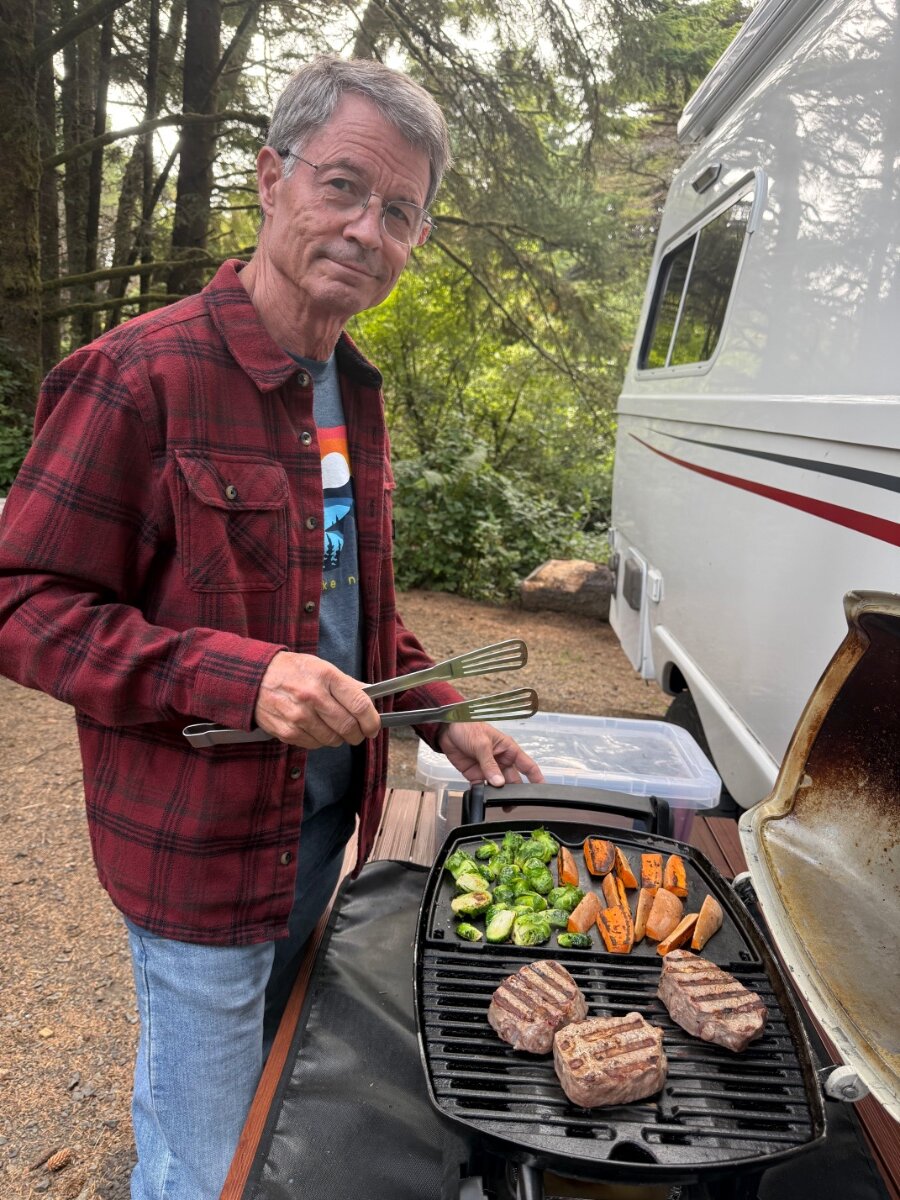
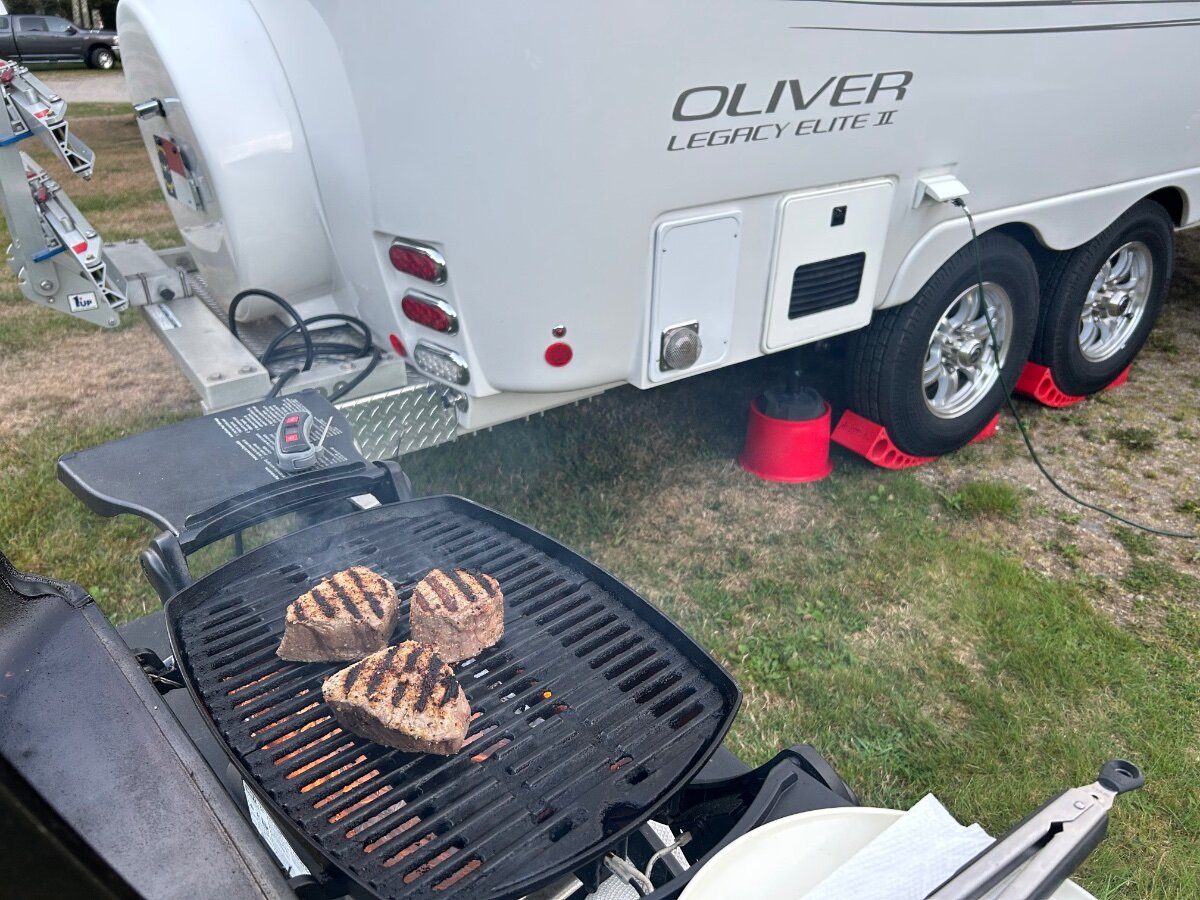
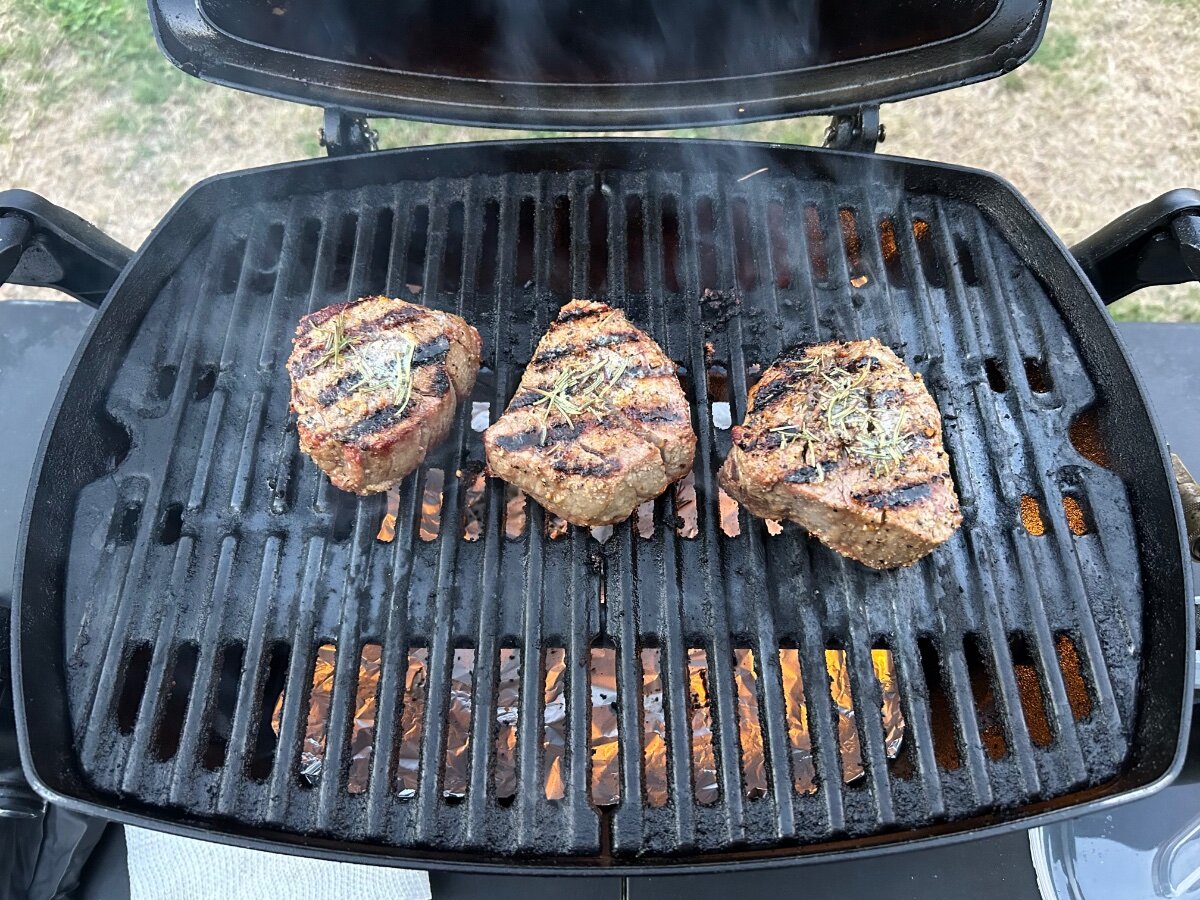
6 years in we are still enjoying our Weber Q1200…scooped up these corn fed tenderloins locally in Booth Bay, Maine the other day. Super tender and full of flavor! They were so good we slipped back in a few days later and scooped up 4 more. Butter, garlic, our own NC home grown rosemary. Plate em up at 138D! 😋🤩🍽️👨🏼🍳
3 points
-
The wire wrapped around the axle is probably the bead wire. I worked in radial passenger and light truck tire manufacturing for 32 years.3 points
-
We've had two rubber valve stem failures on our LE2 fitted with TPMS sensors. Fortunately, both were slow leaks. Rubber stems can crack due to the flexing from the extra weight of the sensor. Ours are TPMS sensors from TST that they claim can be used on rubber valve stems. Our TV has metal valve stems also fitted with TPMS sensors, but they're not immune to failure. Even the rubber gasket on a metal stem can leak. I think part of the problem is that the sensors are difficult to remove, so the stems get flexed more than they should when adjusting tire pressure. As already mentioned, the electric jacks can be used for tire changing as long as you're still hitched and the TV parking brake is set. It's much more convenient than carrying another jack. Also, is the wire wrapped around the axle from the tire's steel belts?3 points
-
Yes folks - I believe we have a winner! Matt Duncan has sent me what I believe is all the material necessary for a quality print shop/service to reproduce these Oliver Hull Plaques. There is the original artwork via a digital program (adobe illustrator), and instructions. Anyone interested in receiving this should Private Message (PM) me with their email address and I will send them what Matt has given me. There are a number of vendors on Etsy.com that produce these types of metal "business cards". Bill2 points
-
Yes - thanks for sharing your story - even the parts that were not so easy to share. This kind of situation helps us all as both a reminder and (perhaps) as a source of other things that we might consider doing (or not doing as the case may be). Bill2 points
-
Glad you guys are OK and that there wasn't any more damage than you had. I believe that your experience was ( as you mention) partially your "fault" due to not turning on your TPMS. However, the extent of your tire issues is very extraordinary. I don't think that you can prepare for every possible situation while on the road - unless, perhaps, you are ScubaRx 😇. Yes, checking your spare tire air pressure should be done more often OR simply get yourself another TPMS sensor for that spare and remember to turn that TPMS monitor on. I also agree with the advice concerning the use of the onboard "leveling" jacks. Your experience is yet another reason why we bought an Oliver and believe that everyone should consider before purchasing virtually any other brand. Bill2 points
-
I think they've discontinued the rewards program and gone back to the old site visit system. Saw an email about that recently.2 points
-
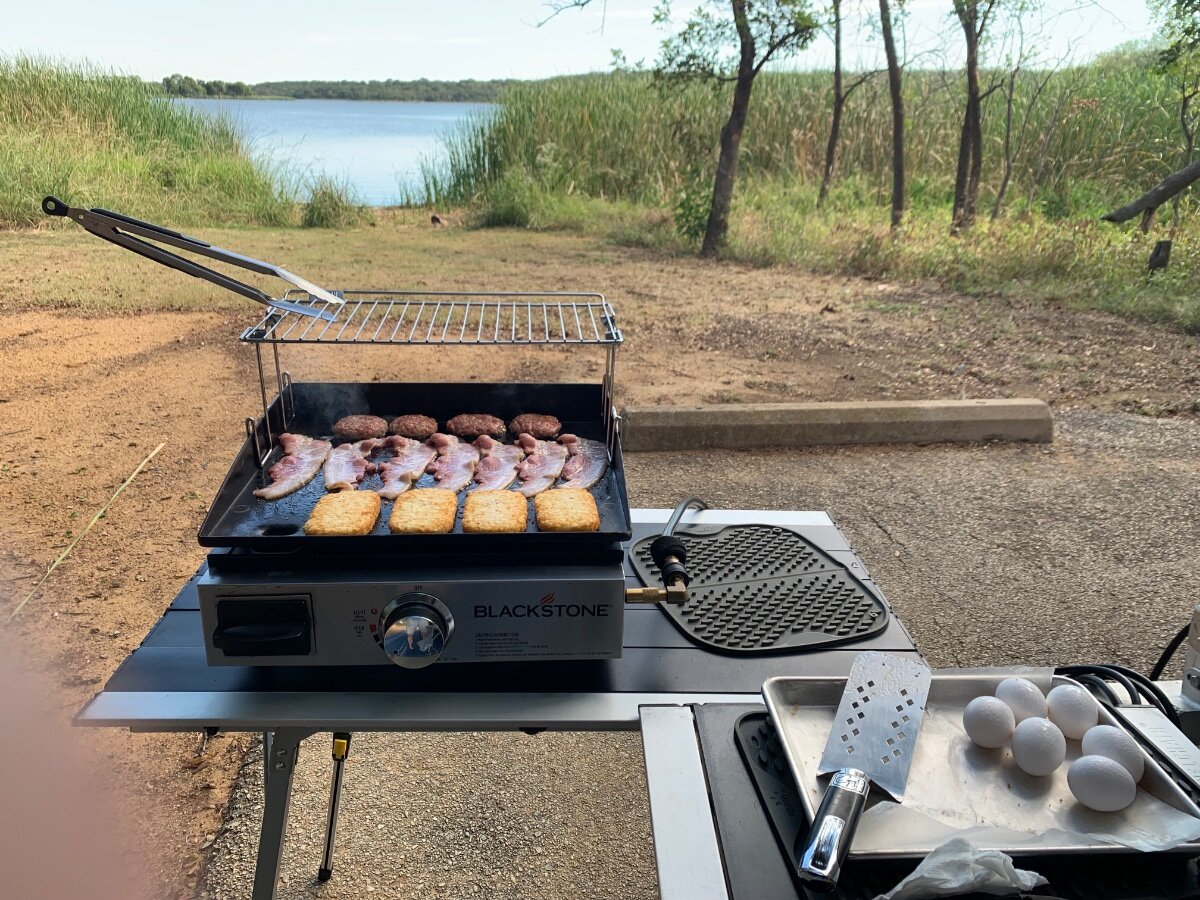
Too late for breakfast, but be here around 6:00 this evening for mesquite smoke infused Prime ribeye and fix’ns ‘ON’ the Blackstone and GrillGrate! Camp R&B, Lake Mineral Wells SP.
2 points
-
Don't forget to get two "extra" sensors - one for the Ollie spare tire and on for you tow vehicles spare tire (all the TPMS systems that I know of that are included on vehicles do not monitor the spare tire on the tow vehicle). Bill1 point
-
We have a TPMS on our purchase list but, after your story, it's now at the top. Thanks, Tony1 point
-
Thank you very much, Chris & Stacie! You sold me without trying! 🤣 You linked the silver model and yesterday I purchased the black model Amazon used "Like New" model at a very good price. https://www.amazon.com/dp/B07KSNTSVR/?th=1 Most of us have LP grills too but the induction hotplate has a different purpose (e.g. boil water quickly). When you have 600 Ah you need to use it! We traveled with the Weber Q for 8 years, shown by @Patriot and @Mike and Carol above. The Q is a nice small grill but a single burner design does not allow for indirect cooking (can kill a baked potato quickly)! if you cook smaller, meals for two, the Weber Q is the way to go. The Napoleon is about 5 inches longer and 7 pounds heavier. Our old Weber Q1200 is cleaned up and I gave it our son for his camping trips. https://www.amazon.com/Weber-51190001-Liquid-Propane-Orange/dp/B00RFXRZ9Y/?th=1 For $50 more, we strongly recommend the Napoleon! We use these items and vouch for them: https://www.amazon.com/Napoleon-PRO285-BK-Portable-Propane-Grill/dp/B00J4576FE/?th=1 https://www.amazon.com/Reversible-PRO285X-BK-PRO285-BK-TQ285X-BL-Accessories/dp/B0BJDM93QD/?th=1 https://www.amazon.com/Napoleon-Grills-61286-Premium-Grill/dp/B077SLW6L4/1 point
-
Glenda Burnes now has your site. She was on a waiting list and was thrilled to hear a site was available. They purchased hull 202 earlier in the year and this will be their first rally1 point
-
@Townesw I just purchased a new roll of butyl, even though I have some left in an older roll. It's hard to keep butyl, glues and tapes fresh in our very dry Arizona climate. I'm rebuilding the rear stabilizer jacks on our hull which includes removal of the jack post assemblies. They were caulked at both interior and exterior hulls. I'm thinking butyl wrapped in a circle will be easier and cleaner to apply than caulk from a tube. I just received this product today. it looks fresh, of good quality and the roll is huge! This might be worth your consideration and for others reading. https://www.amazon.com/dp/B001FCB4JS/?th=11 point
-
I carry a Safe Jack RV Jack Kit in my tow vehicle. When testing it, I have jacked from the marked "Jack Point." That said, I plan to use the "stabilizer" jacks as well if I must change a tire by the side of the road. As jd1923 noted above, the trailer can shift if the ground underneath one jack point is soft. Three jack points is better than one, and the electric jacks are so easy to use. We also use our Tireminder TPMS system, with monitor mounted on the windshield, hoping to catch any trailer tire issues early! The person in the passenger seat checks the monitor regularly.1 point
-
I don’t have a LE so I don’t have any definitive answers. Your picture is of the left side wall of the attic, can you provide a picture of the entire attic to include the right side wall? Have you removed the wall panel? That might provide answers to where the 12V and 120V cables terminate. Mossey1 point
-
Looks amazing Mike! We typically grill 3 tenderloins as well. That third TL is for next day breakfast omelets or to be sliced thin for salad!1 point
-
This is correct. If you show your Ollie be sure to let Oliver Sales know so that when the person you showed your trailer to actually pays for their Ollie you will get a "reward" (i.e. cash). Bill1 point
-
What time can I show up for breakfast? Looks great!1 point
-
Not giving up my BS, this 17” griddle is so versatile; the grease trap is a must!
1 point
-
Not trying to sell anybody, but if you like electric camping alternatives and adding options to your camping utilities, EcoFlow has some real awesome pricing right now on some of their bigger power stations. I'm talking 65% discount from normal pricing. The Delta Pro even has a 30 amp plug right on the panel that can power your camper for a few hours of AC when dry camping overnight. This is what I have in the back of the truck and use it mostly to power our portable fridge, but it offers many options including emergency backup for short power outages at home. I also love that it's a no noise option in the campground. I'll post some links here to the items I spoke of in the previous post for anybody interested. The sky's the limit on this stuff. EcoFlow Delta Pro https://us.ecoflow.com/collections/delta-series/products/delta-pro-portable-power-station?variant=40516140138569 Duxtop portable induction hot plate https://www.amazon.com/dp/B01FLR0ET8?ref=ppx_yo2ov_dt_b_fed_asin_title&th=1 Greenpan ceramic coated induction ready griddle and skillets https://www.amazon.com/dp/B0D2J2LL5B?ref=ppx_yo2ov_dt_b_fed_asin_title&th=1 https://www.amazon.com/dp/B074CWBJ5D?ref=ppx_yo2ov_dt_b_fed_asin_title Storage bag for griddle https://www.amazon.com/dp/B0CZJFFGMM?ref=ppx_yo2ov_dt_b_fed_asin_title1 point
-
Donna and Scott -- It is with regret that Marianne and I inform you that we will not be able to attend the rally. So site No. 37 will become available after I cancel the reservation today.0 points













-
Recent Achievements
-