Leaderboard




Popular Content
Showing content with the highest reputation on 11/29/2020 in all areas
-
Hi Jairon, these are factory installed Lithiums. Just picked up on the 18th this month. As far as insulating, I'd recommend just buying a roll of Reflectix BP48010 Double Pack Insulation, 48 in. x 10 ft. It's twice as thick as what Oliver uses and I've already added an additional layer of this Reflectix on top of what Oliver installed on the basement door, so in essence I tripled the insulation - I removed the factory piece of reflectix and used it as a template. I'm doing that where ever I can reach on the outer hull in the basements too.4 points
-
The series/parallel trade off is a bit tricky. Like John said, in parallel lower voltage from one panel will bring down the voltage of the entire array. In full sun, that’s never really an issue since panel voltage stays pretty consistent until a steep drop off with very little light. It’s the amperage that varies with stronger or weaker sun and in parallel, the amperage is additive. In series, it’s the opposite, low amperage from one panel is a bottleneck to the others while the voltage of the panels is additive. Again, not a problem in full sun even if the amperage is changing, since the amperage of each panel should track pretty closely with the others (so long as your panels are all alike - adding in a half size zamp panel like I have would cut the current of the larger ones in half!) Also, as John points out, the panels themselves are made up of modules of grouped cells connected with bypass diodes that allow current to go around a shaded module to minimize current loss. I think the problem with running panels in series though is that you won’t have bypass diodes between the panels so if one panel has reduced amperage, the other will as well, and that can affect total power even more than the loss of voltage. The advantage of running them in series is typically smaller wiring, but in this case you’ve already got the heavier gauge wiring in place. I guess you’ll get less resistance nonetheless and possibly more headroom for the MPPT to do its thing? Of course in the end you have to ask how often it is in the Ollie, with a fairly small array of two adjacent panels, that you’re going to see significant shading on one panel and not the other. Certainly it will happen on occasion, but my personal experience is that we’re almost always either in deep shade or full sun. I’m not sure it’s worth the trouble myself but I’m definitely curious to see the results and maybe learn something new.3 points
-
JD is correct about a nice separate circuit for that camera. However, since these camera's don't draw a bunch of electricity, it would be fairly simple to splice a positive wire into either one of the backup lights - obviously they already come on when you select reverse. Make sure that you put a fuse in that positive line. Of course another thought is to wire the camera such that it has a "on-off" switch and is always "on" when you are going down the road. That way you can see if someone is tailgating you prior to changing lanes. Bill3 points
-
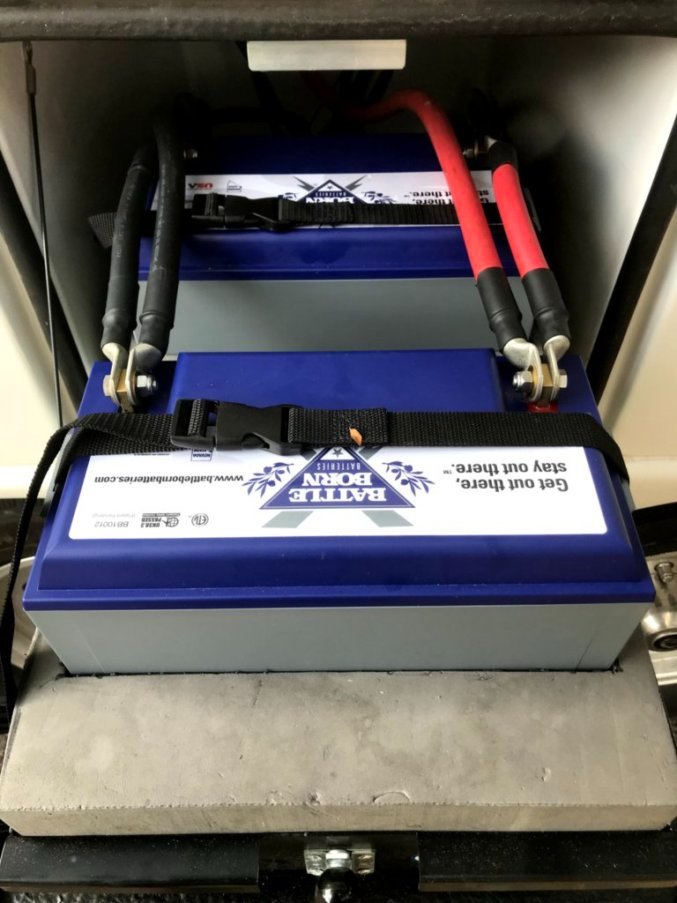
I used a dense closed cell foam and a base of plywood with cut-outs to hold 2 battleborns in place. It didn't have any signs of movement or damage after >3000mi.
 2 points
 -
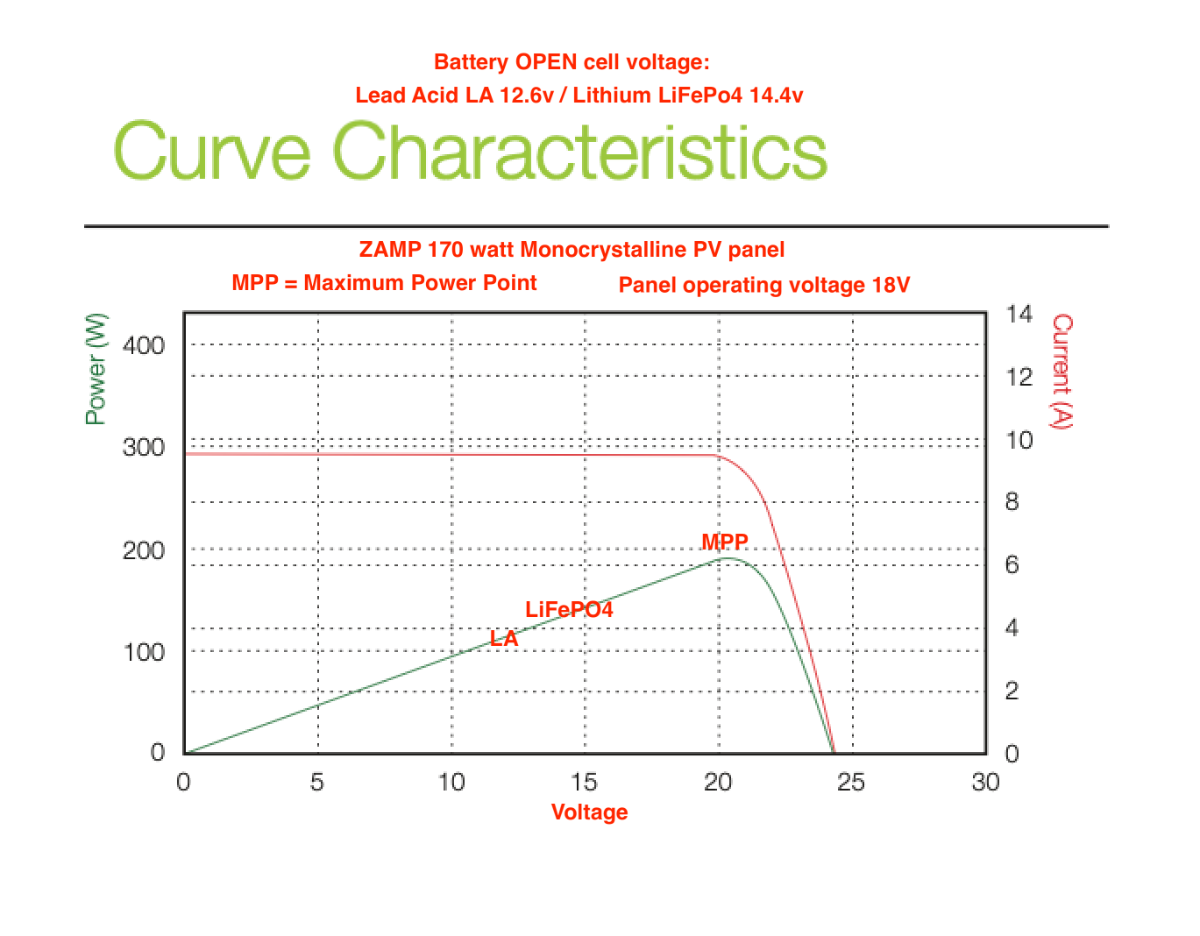
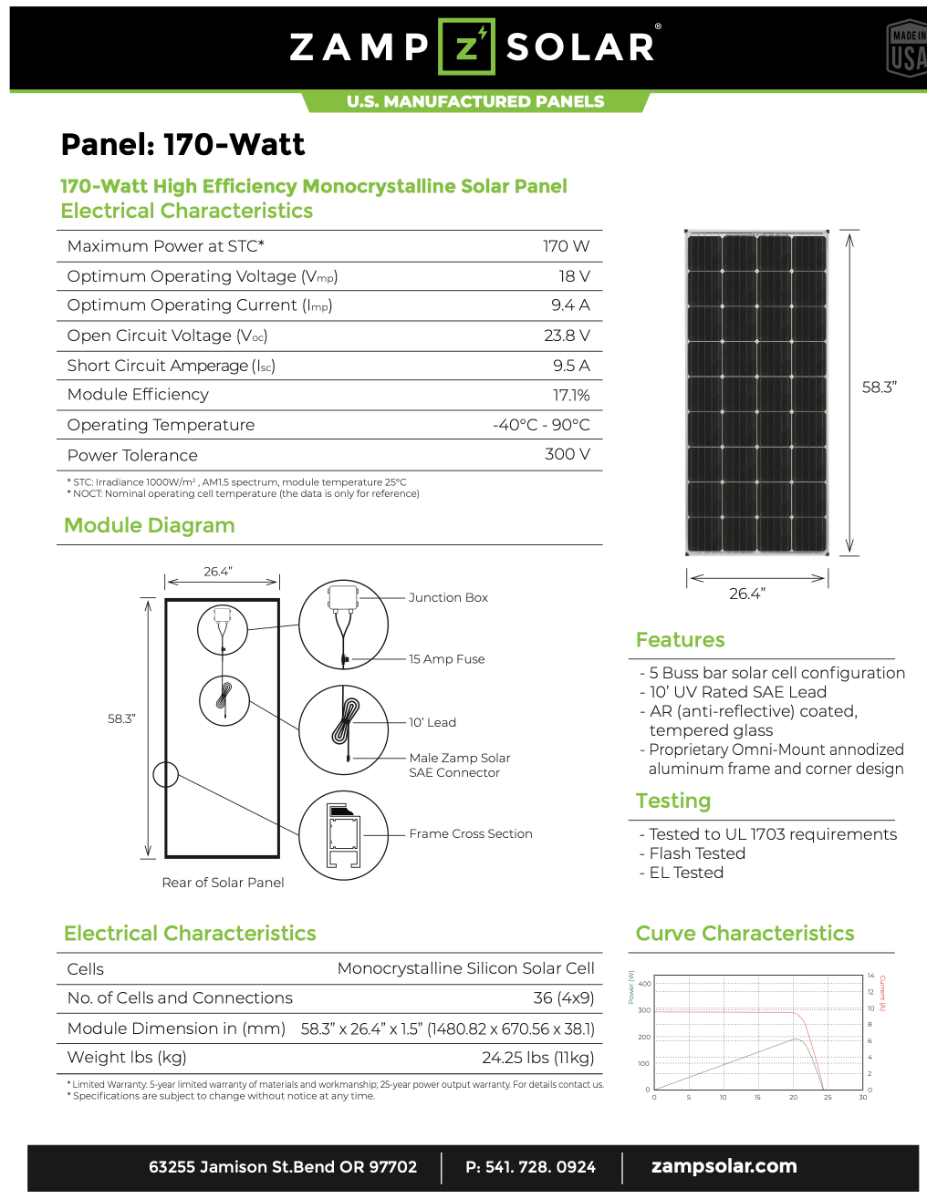
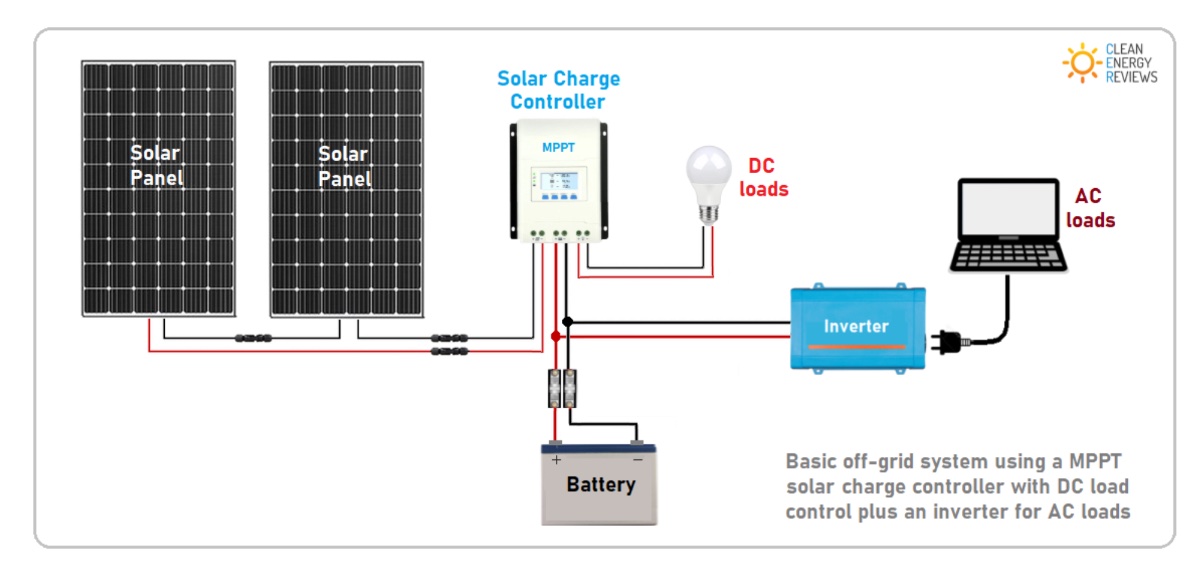
LOL, I hated those lights. But you are talking old tech vs new tech, golf cart vs Tesla. Solar panels are made of lots of individual cells wired together in series/ parallel appropriately to get the desired voltage; a standard Zamp 170 watt panel is 18 volts maximum (operating) with 36 cells and 5 bus bars. Shading a few cells in any panel will not completely kill it. The reason the paralleled panel drops off line with a PWM controller is that the panel is only operating at battery voltage because the wires are essentially hooked directly to the battery (the controller just cycles it on and off reeeeealy fast). So your panels are operating at 12+ volts not 18 volts. Shade the panel enough for the voltage to drop too far and that panel appears to go dead. Not really, it is still producing some current but the voltage has dropped too low for the stupid controller to use it to charge a battery. Lead acid batteries are around 12.6 volts open cell, no load, and require a slightly higher current to charge. Lithiums operate at 14.4 volts open cell. So installing a lithium battery into your Zamp system just makes this low voltage cutoff even worse because the lithiums require a higher charge current for a 100% charge. A forum member has noted this when charging his lithiums by Zamp PWM solar alone, but the shore power converter takes them all the way to 100%. I enlarged and annotated their tiny power chart for clarity: A MPPT controller with series panels keeps the panels in the higher MPP range and at the sum of the panel voltages, 36 volts, instead of at some artificially lower voltage, it can adjust both voltage and current for the best results. More amps to the batteries, MUCH more precise control of the system. The Victron parts are "Smart", they all talk to each other wirelessly to monitor battery voltage, individual cell voltages, temperature and charge rate, to optimize and refine the charging. It is very cool. When I add a Victron MPPT controller to my trailer, with Victron batteries and Victron Smart Bus, all I have to do is create a virtual network (click a button on the app and rename it) and join everything together so they all know what the other parts are doing. (It does require the optional $20 battery temperature probe to be installed on the Smart Bus, so the bus can transmit that number to the other components.) And I can see all that info blended together on the Victron Connect app. It would be easy to do a "shade the panel" experiment for parallel vs series, it probably has been done but I haven't seen one yet. (I did watch a video where he did compare parallel and series but it was in full sunshine, not shaded, and the current output to the batteries was identical, which I would expect.) Just park in the direct sun and gradually shade one panel with a blanket until the output drops away. Repeat for both panels together. Record the shaded percentage of the panels. Reconfigure them to series and repeat the test. This would be very easy if all the connections on the roof were MC4 and not the standard Zamp reversed polarity double bullet connectors. You could change the Zamp roof cap to series but it would require complete removal to do that, NOT something you would want to repeat if you added another panel up top.. With exposed connectors, just unplug and rearrange as needed. PLEASE, if there are any mistakes in my chart or reasoning, please comment. I am still learning this stuff, it has baffled me for a long time. If I had known this before I might have not ordered the factory solar setup and just done it myself with better parts. I personally would much rather optimize my two roof panels, than just add more of them to a dumb controller. John Davies Spokane WA
2 points
-
All, I have had two Battle Born batteries for a year and a half now and have had no problems with the batteries getting cold. I did plug the four holes on the door, insulate the door with the bubble insulation and a seal around the edge of the door. The fiberglass plugs, insulation and the seal came from Oliver. We routinely camp, where night time temperatures are near or below freezing. During our last trip it was 34 to 36 degrees at night and the lowest temp at the battery terminal was 59 degrees. The lowest battery terminal temperature I have seen was 49 degrees, when it was 16 degrees and windy overnight. I honestly don't think most would need battery heaters. Andrew2 points
-
We don’t get real cold here in south Texas either. Tonight it will dip into the mid to high 20s. This afternoon, I will go to my storage, turn on my little Vornado electric heater, turn on my hot water tank and then lift the mattress and open the basement access where the water pump is. I will open and drain all the exterior water connections (just let whatever water is in there drain) then recap. I’ve been doing this for 5 winters and have not had a problem. Last year we did have 3 or 4 consecutive days of night temperatures in the 20s, no problems. We’re heading to AZ in early January and it is nice not to have to de-winterize. Mike2 points
-
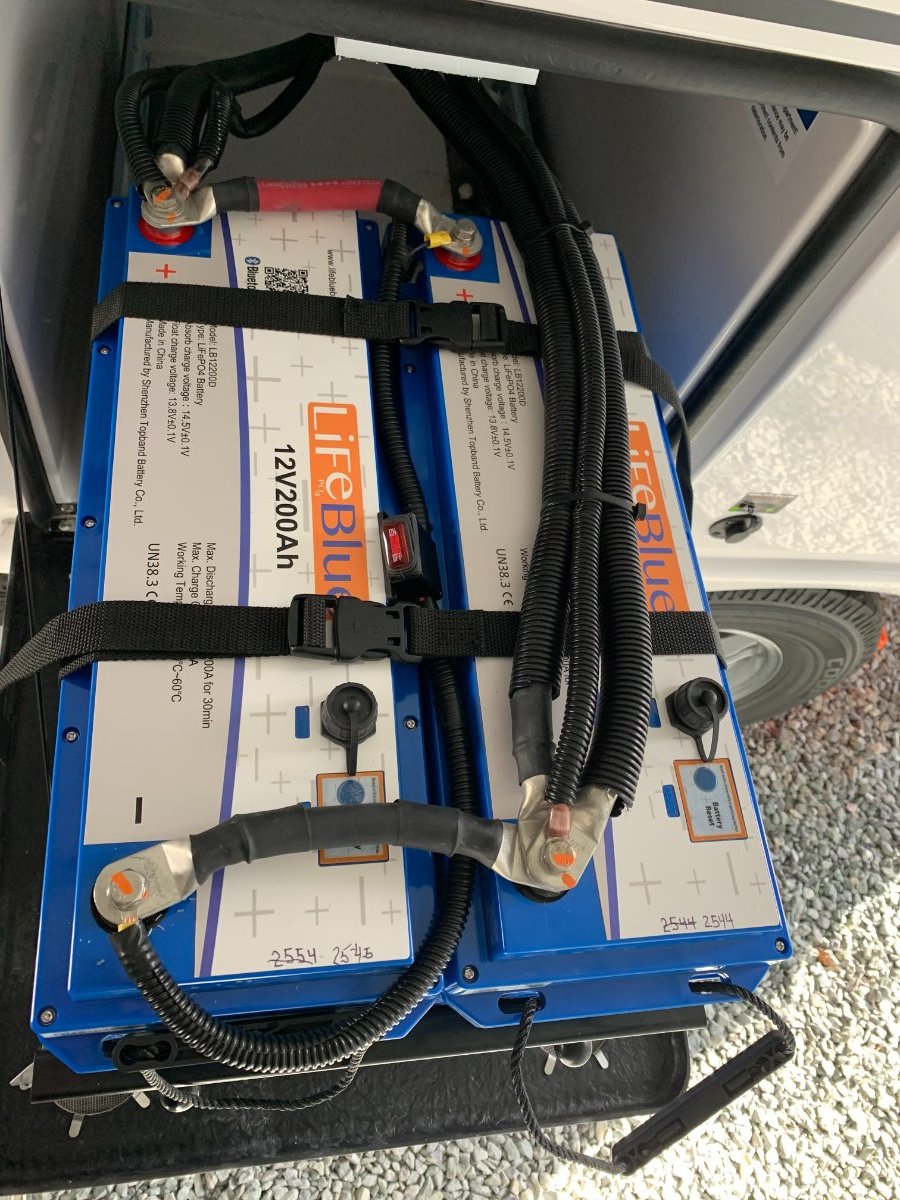
John, they are using a 12V heating mat of some sort. You may want to consider 12V instead of inverted 120V. I can see it is directly hooked to the battery terminals and the switch is sitting on top of the batteries. I don't know what brand but I can ask my sales guy tomorrow for you (I'd have to take the batteries out to see the mat). I'd like to know the brand anyhow. I know the mat has a thermostat, so on cold camping adventures, I'd likely just switch it on and leave it on for the duration. I prefer this over the automated version even though it's something additional to remember when it gets cold. I'll have a temp monitor in the battery bay and am also planning on insulating. The monitor can send me an alert when the temp gets down to whatever I set it for, so no big deal. Here's the verbiage that came from LifeBlue on the new thermal approach: New State: All of the blue tooth and other specifications of the new battery will remain the same with the exception of the internal heating feature. When a charge cycle is desired on the LifeBlue LB12200D lithium battery and the temperature outside the trailer is above freezing (approximately more than 35 degrees Fahrenheit) then no action is needed. If the temperature outside the trailer is below freezing then check the core temperature of the battery (blue tooth app.). If the core temperature is above freezing, then no action is needed. If the battery’s core temperature is below freezing, then access the battery compartment and switch on the battery thermal blanket (the switch will be an in-line on/off switch located on the battery harness on top of batteries). Close the battery compartment door. When the batteries core temperature is above freezing then the battery will accept charge. Note: the colder the core is the longer it will take to warm up to above freezing. The battery’s thermal blanket is thermostatically controlled between 35 degrees Fahrenheit and 45 degrees Fahrenheit. If single charge is desired then switch off the battery’s thermal blanket when charging is complete. If camper is being used in a cold environment then leave thermal blanket switch on for the duration of trip and switch off when trip is over.
2 points
-
Admittadly, I am a beginner in the Solar set-ups, but I do have a long standing - once professional- experience in the electrical world. The various posts remind me of my motorcycle racing days - we were always looking for the next best set-up - power, suspension, you name it. I find it fascinating. Really enjoy the conversations. How far one goes towards the hot set up - really depends on your goal, or in some cases, its a continuing fascination with just making the Oliver a better solar home. But to Mossey's point - for the casual user - me- with the original AGM/Zamp install - wanting a little more - would it not be a dollar wise choice to just use a good remote panel set up, with a nice quality 10 gage cord, using the installed Zamp port - and add a charge controller as indicated? As it is tied directly to the battery bank, the rest of the system can gone on until the AGM's reach their usable lifespan. At that point - upgrading to Lithium's, new controller - etc. - would seem a wiser choice. I agree, the standard SAE is not the best - but given a regular inspection, it works fine, I've been using them on the farm - out in the element's for a while now and my solar charge on tractor/battery equipment is doing fine. Not the optimum set-up but working. NOW - if its your goal to run large loads - say - the AC - then have at it. To me the dollar value doesn't cut it: - a value gen set - while a little more cumbersome - just makes more sense. If I was starting over with my Oliver build - well - the options are certainly there. I still think - for me - it would be a balance of performance over cost. Carry on - all. I'll sit on the sidelines and learn. - JD , your reference site was great - thanks much. Edit here - what is a good estimate on the life span of the AGM's - kept in good condition, never abused?2 points
-
Battleborn 100 Ah 12V LiFePO4 Deep Cycle Battery size: 12.75" × 6.875" × 9" tall Going to measure Ollie's battery tray today, length and width. We currently have two Duracell Platinum group 27 AGM 12V marine/RV batteries: Size 12.75" x 6.75" x 9.875" tall2 points
-
For RVs, I don't know of any advantage other than when using long cable runs with portable panels. The higher voltage output lets you use a higher gage wire for the same power transmission. With a portable panel you have the option to move the panels and keep them in the sun. The disadvantage is that when in series, if one of the panels gets shaded your pretty much done for output. MPPT controllers help, but they can only do so much. When the panels are paralleled, shading of one panel will not effect the other panel and you will be down to half power, but at least something. This may not be an issue for some that camp in sites open to the sky however much of my camping has some shade. Sometimes one panel is shaded in the morning while the other panel gets sun and vice versa in the afternoon. With the panels in series, I wouldn't get anything.2 points
-
I want to change to series with a MPPT controller because they perform better than a PWM controller in parallel, up to 30% better. Especially in challenging conditions such as clouds or shifting shadows. This is a different situation than the solar panel I was discussing in the other thread. Rather than spend an extra $1100 on a third 100 amp hr battery, I am choosing to go with two batteries, but to also optimize the charge from my roof panels and add amps with the portable panel that I can move to stay in the direct sun. I can always add more batteries but I think this setup will work fine for me. The Victron MPPT controller is a real wizard, much more efficient than the junk Zamp unit. Why cripple it by keeping the less desirable, less efficient parallel wiring? https://www.cleanenergyreviews.info/blog/mppt-solar-charge-controllers John Davies Spokane WA2 points
-
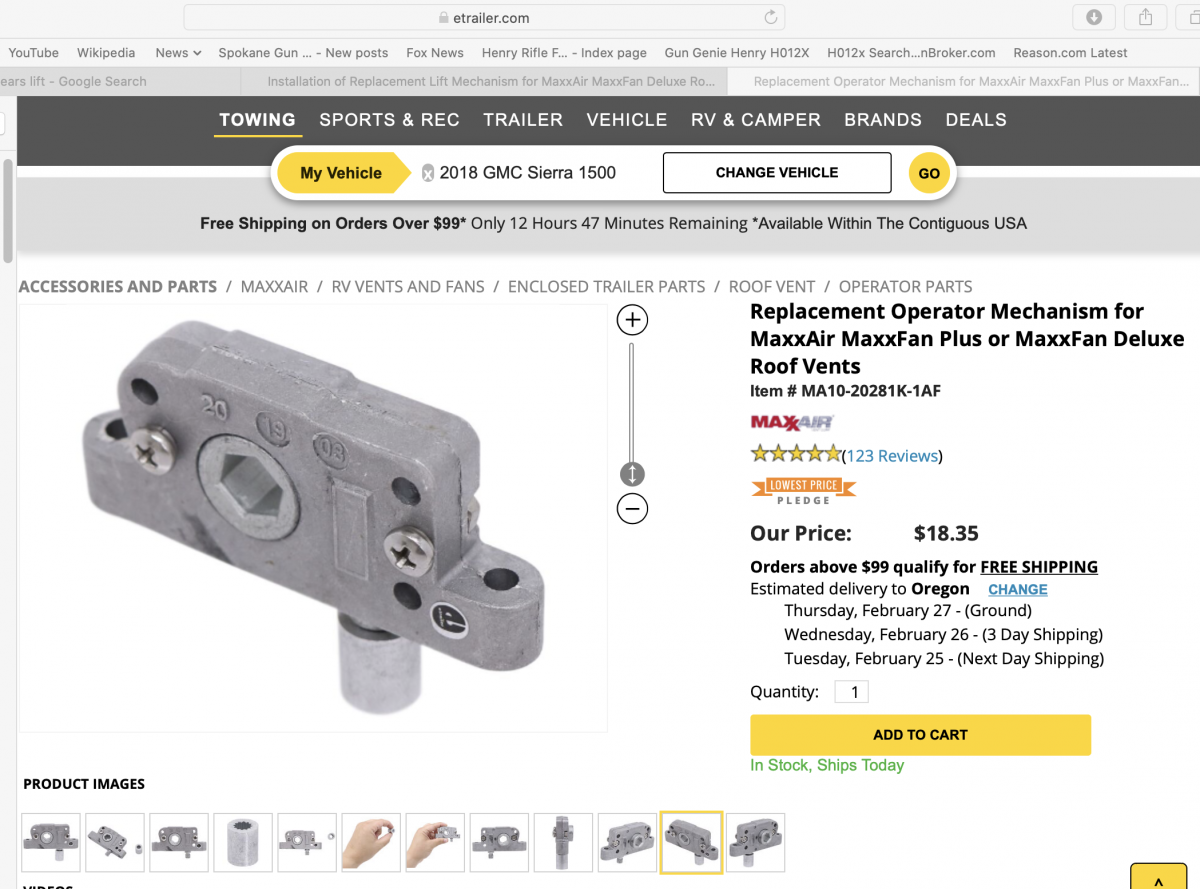
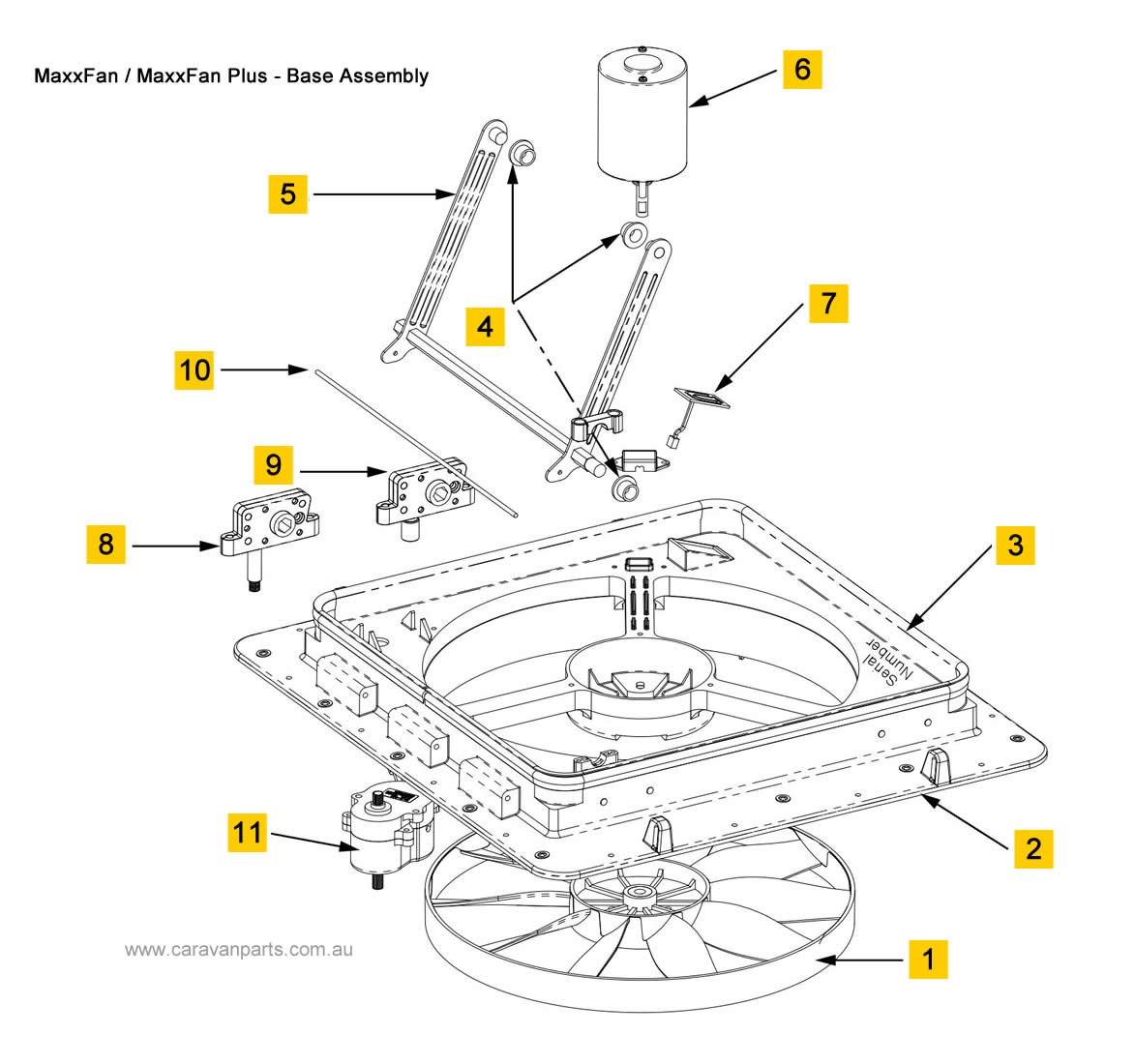
The lid shudders and jerks when operating. I have removed the whole fan from the roof and plan to investigate further. The lid gearbox AKA "operator" appears to be two halves held together with screws. Has anyone dissembled this unit, cleaned and lubed it? What lube did you use? Mine has a bunch of accumulated crud around it and I suspect the lube has leaked out. I can get a new one but since mine is out of warranty I would rather just service mine if possible. I haven't found anybody who has done this online. Operator replacement and SYNCHRONIZING instructions: ... https://www.rvupgradestore.com/v/vspfiles/assets/pdf/MaxxFanLiftInstructions.pdf Thanks for any comments. John Davies Spokane WA
1 point
-
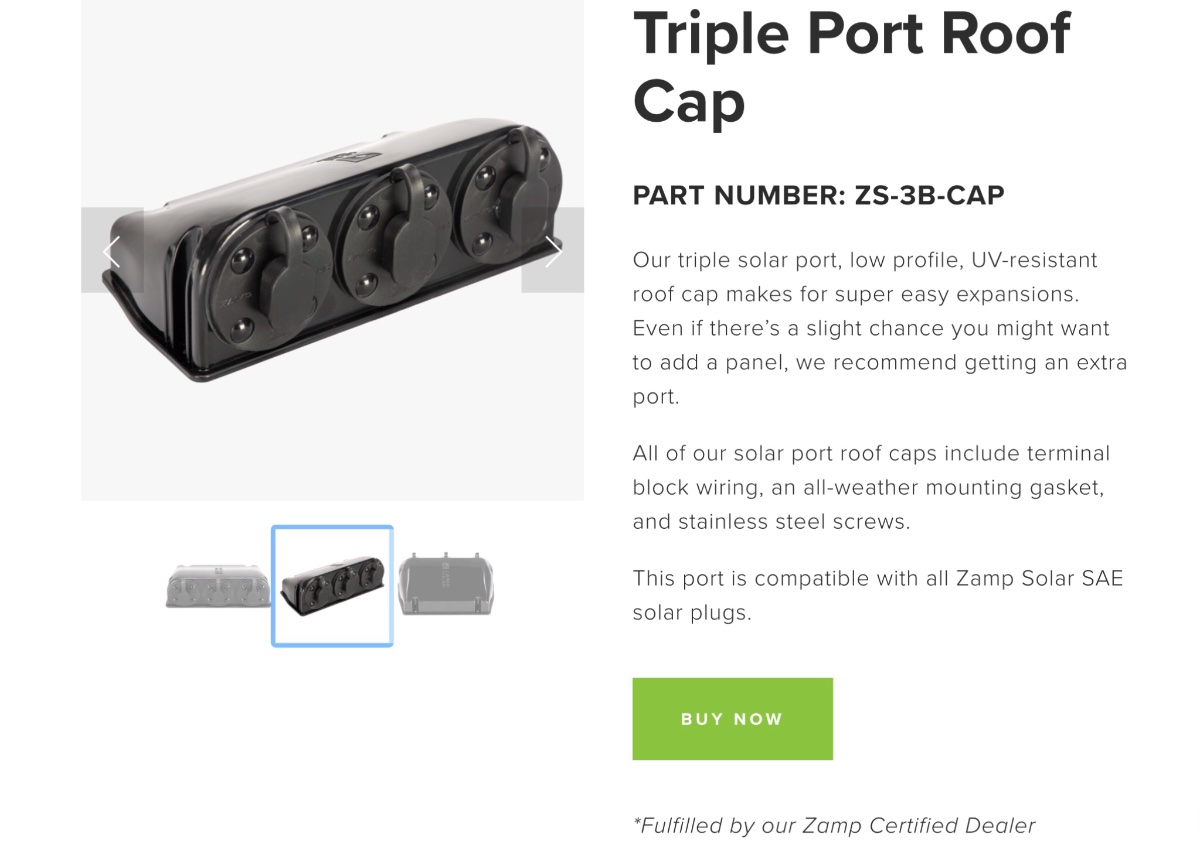
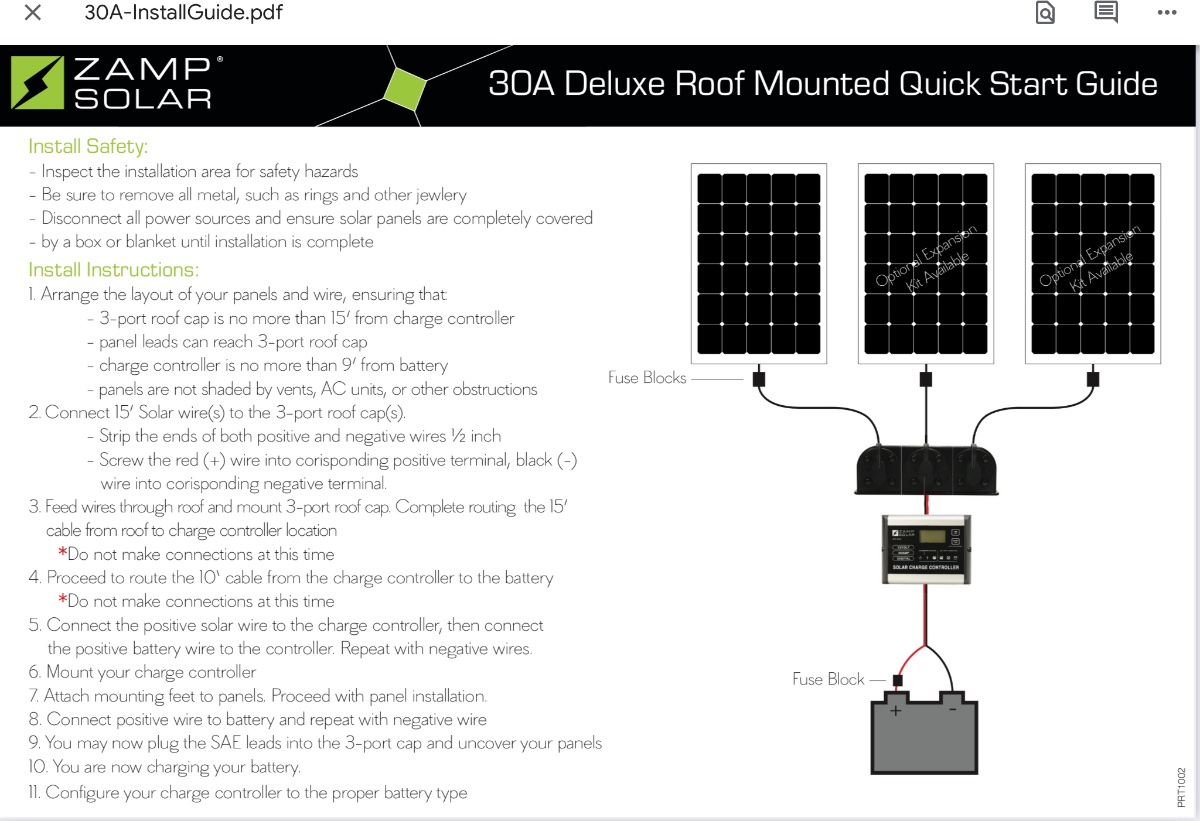
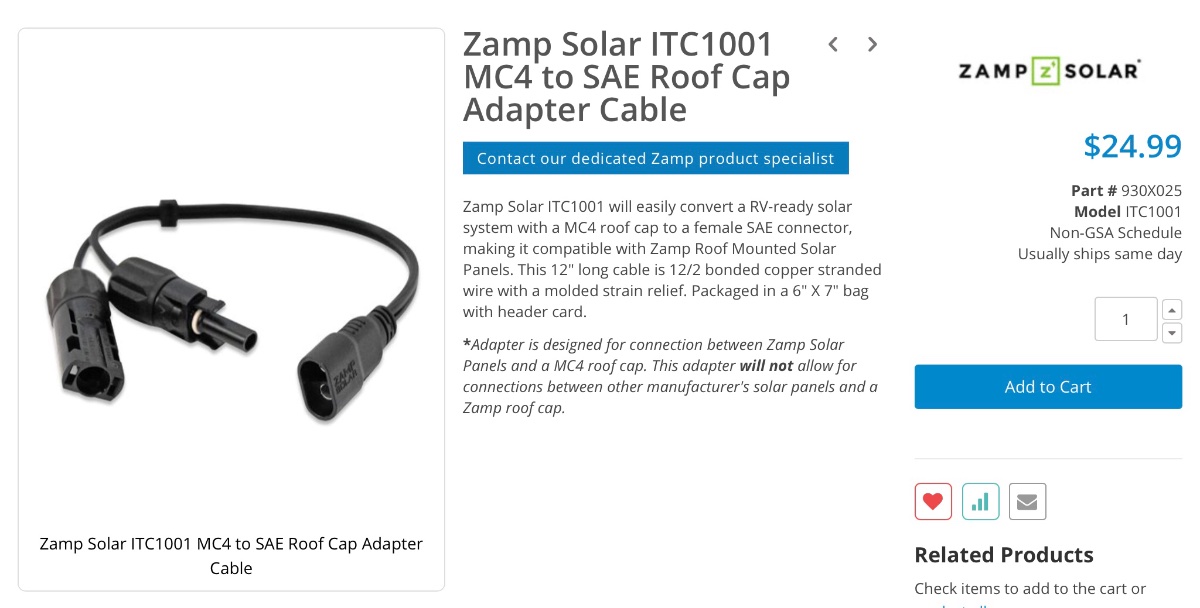
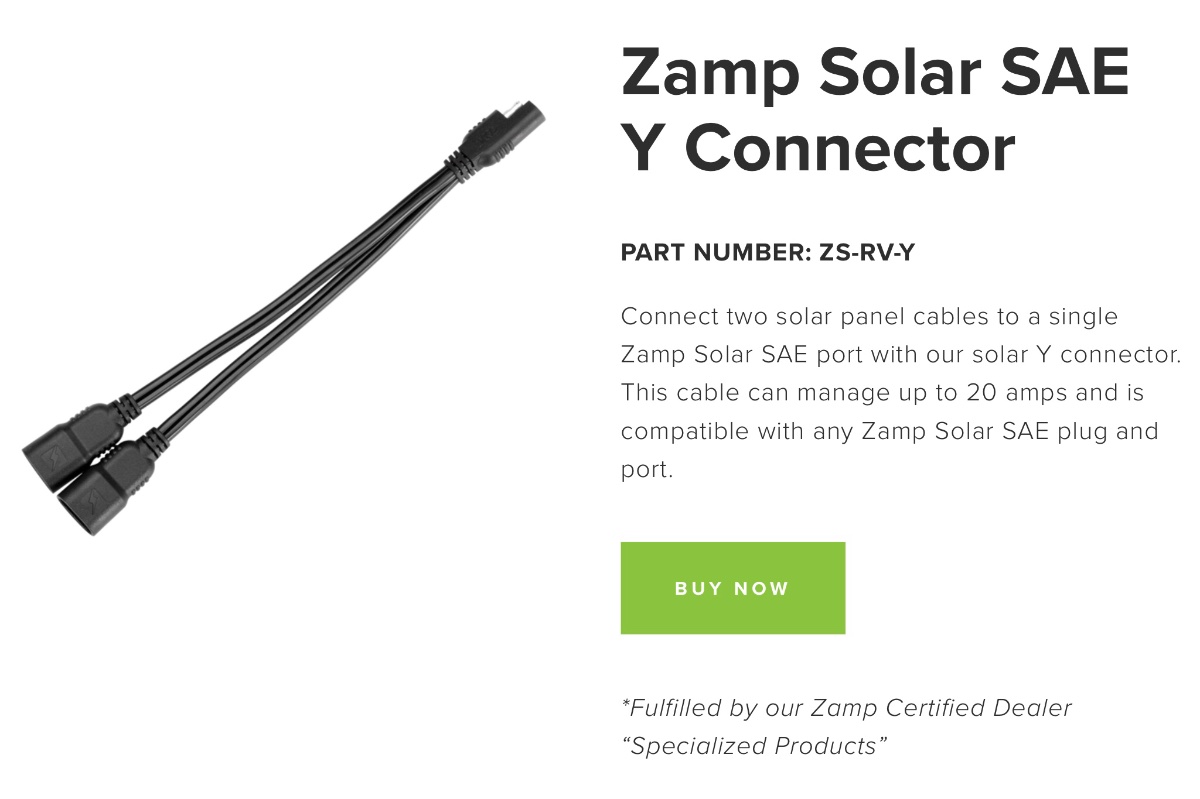
I am replacing my controller with an MPPT Victron unit which requires the panels to be in series (higher voltage instead of battery voltage). The Zamp panels use 2 conductor SAE connectors. Can anyone tell me an easy way to reconfigure the wires, without cutting and installing splices? Zamp: Victron MPPT: I prefer a non-invasive way so the panel wiring remains undisturbed and the warranty is not voided, but it can’t put too much current through any one port or cable. Maybe I have to change out the Triple Port Roof Cap for something different? They make a Y splitter but I don’t think that will work. They also make an adapter cable, that could work if the roof cap has MC4 ports in it. I emailed Zamp asking for their advice. I thought I would check here too. This is all brand new territory. Thanks. John Davies Spokane WA
1 point
-
No pictures, yet . . . . but exciting news. I received a call from Rodney Lomax yesterday. My heart just about stopped when he announced who he was - the sales manager calling use???? I was sure the plant had burnt down and we weren't going to get our Oliver! But, not to worry. He called to say they had a build slot open up and wanted to know if we would like to take delivery the first part of December. Of course, I said yes. After requesting a Feb 3 delivery, because we were hesitant to travel cross country in the dead of Winter, I was getting nervous about making the trip in February. The beginning of December we'll be less likely to run into Wintery weather; we might even be able to take the most direct route, on I-40. Now I have to decide on our options and complete the order . . . . . 60 days cut off our wait time . . . . . yahoo!1 point
-
$150 to $250 off on their 100AH LiFePO4 batteries today if anyone is looking. https://battlebornbatteries.com/product-category/lifepo4-batteries/1 point
-
Kinda of tangential to this thread but now that I've been FT for 1.5ish years and had some time to experiment... Attaching shelves and similar to the walls... You can see the dollar store baskets I've been using for shelves above. I've tried a couple of things to attach them to the walls with no real luck until(!) now. I've been through suction cups, industrial suction, cups, command strips, industrial velco, and a combo of velcro and command strips without much luck. Temperature cycling in the winter really seems to do a job on the suction cups and if you go anywhere bouncy then the velco + command strips option eventually fails as well. The area that has been hardest is above the sink + stove where there's lots of moisture and temp changes. A possible solution? Yes: "Nano Tape". It appears as though Nano Tape may just be a trademark name for a particular type of clear, double-sided, directional tape. Aka: https://www.amazon.com/s?k=Nano+Tape&ref=nb_sb_noss_2 and in particular, the one I purchased: https://www.amazon.com/s?k=EZlifego&ref=bl_dp_s_web_0 There are some YT videos of this stuff with mixed reviews so let me tell you what I did. It appears surface prep is pretty important. 1. I roughed up the plastic on anything that I needed to attach to walls with a piece of fine grit sandpaper. 2. Cleaned and dried both the plastic basket/shelf and the wall with generic "windex". 3. Mounted the shelf. Press firmly! 4. Left it in place 24 hours before "loading" it up with the usual contents. So far both I've loaded the baskets up with sizeable salt and pepper shakers, spices, keys, pocket knives, cell phones etc to the point where I thought sure it would come off the wall the next time I pulled but everything has been holding up. No spills yet and it has been 2-3 months for the stuff above the sink.1 point
-
Thanks! I'll be doing something similar so I appreciate the material suggestion. I'm guessing the 2021 models are left without insulation. Somewhat related, has anyone ever attempted to insulate the bottom of their Ollie? The spacing between the aluminum cross-members seem ideal for some type of foam board. Something with a polypropylene backing would be even better. I have no idea if this would help to keep water lines from freezing but I'd love to hear from someone more knowledgeable in thermal engineering. It could be worthless and a huge waste of time 😁1 point
-
Like Overland posted, the tray is 14" X 21" on the LE2. Just looked at Ollie's battery tray and saw the next Ollie project. There are pull or pop rivets protruding 1/8" on both interior sides of our tray front & back. Going to place at least 1/8" thick plastic, stealing one of Debbie's cutting board again, between battery and tray with holes drilled at rivet locations to keep rivets from damaging batteries. The actual width of the tray is 14 1/8" to 14 1/4", but rivets protrude 1/8" on each side making 14" wide tray clearance. You could gain up to 14 1/8" to 14 1/4" tray width by installing flush head rivets or flat head screws pointing outward from the battery, if additional width is needed.1 point
-
Hi Fritz, I use SensorPush Wireless Thermometer/Hygrometer for iPhone/Android - Humidity & Temperature Smart Sensor with Alerts. Developed and Supported in The USA. Have used them for years in many other applications. Love them. They can be calibrated if needed and if you have a wifi hotspot in your Ollie, for example, you can monitor them remotely as well. I'm using velcro to secure them in different places around the inside of the Oliver. I put one outside when camping or when parked in my RV garage, but they are not waterproof, so you can put it anywhere it's protected from rain, but can't really have one on the outside while driving or anything.1 point
-
I've sent a request to my sales rep for the model and part number. Will let you know as soon as I hear back.1 point
-
The Elite 1 tray is apparently 14x14, which will accommodate 2 Battleborn batteries, it’s the height I’m worried about. Battery height is 9” and height from tray to ceiling of compartment is a little over 9”, so looks like they will fit (?).1 point
-
Appreciate the info. Visiting Ollie later today, will be taking a close look at the battery tray.1 point
-
I chose 100W heaters as a function of maximum load (three heaters, or 300W). That wattage at 12 volts equals 25 actual amps. I think even that amount of load will seriously deplete my battery bank by dawn on a really cold night. Hopefully the combination of my Honda 2200 for 3 to 4 hours the next day, PLUS the solar will allow full recovery. I will have the option to run one, two or all three heaters as needed/possible. I cannot see any way to get more reflectix between the two water lines and the lower hull on the drivers side... (Bummer!)1 point
-
The tray that Oliver uses in the Elite II is the MorRyde SP60-042 Utility Tray, inside dimensions 14" x 21" x 2.75". There's 12.75" clear from the floor of the tray to the bottom of the aluminum catch for the lock. 4 Battleborns will fit, but you have to stand them on end. It’s tight. I’m pretty sure that Battleborn’s dimensions include the tabs for straps, since I’ve got about a half inch clearance between my batteries and the latch. I cut off the tabs on one side so that they’d lie flat on end in the tray.1 point
-
From the sources I have read and linked to, this is incorrect. A series panel works at the sum of the panel voltages, so shading a portion still leaves plenty of cells (voltage) to drive the system. A parallel panel when shaded “tanks” because the voltage drops too far, and the panels are already operating at battery voltage, which is well below their optimum target voltage. I am still learning like crazy, but that page link in my previous post is very adamant. PWM is a very primitive ON OF ON control. “MPPT or ‘maximum power point tracking’ controllers are far more advanced than PWM controllers and enable the solar panel to operate at its optimum voltage for maximum power output. Using this clever technology, MPPT solar charge controllers can be up to 30% more efficient, depending on the battery voltage and type of solar panel connected. The reasons for the increased efficiency and how to correctly size an MPPT charge controller is explained in detail below. As a general rule MPPT charge controllers should be used on all higher power system with 2 or more panels, or whenever the panel voltage is much higher than the battery voltage.” John Davies Spokane WA1 point
-
The LifeBlue batteries that Oliver uses do have a built in heating system. But according to at least one post here by someone who’s spoken with Oliver, they’re disabling that feature due to overheating and are instead installing a heat mat. The temperature limit appears to be an advantage of the Battleborn batteries, since they allow charging at an internal temperature of as low as 24 F. Why the difference? No idea. Perhaps they’re just less conservative or maybe they use a different type of cell. I do suspect that Victron’s 41 F degree limit (5 C) is probably due to their typical conservatism. The typical limit seems to be ‘don’t charge below freezing’, but my guess is that’s just a convenient reference since there’s nothing special about the freezing point of water that should be relevant to the battery. So what’s the real limit and does it vary among batteries or is it universal to all LFPs? I assume that since Battleborn’s limit is very specific that they’ve tested it - I can’t see them pulling 24 degrees (-4.44 C) out of a hat. Another point worth mentioning is that I don’t think that the Victron BMS will cut off charging at low temperatures, like the Battleborn will. I haven’t read the full Victron manual, but from their description and spec sheet, that seems the case. So it’s really up to the user to make sure that they don’t kill their batteries. From what I understand, all it takes is once, since what happens is that the anode doesn’t soak in the lithium ions at cold temperatures and as a result gets plated with lithium, rendering it useless.1 point
-
Thanks on that John. Much appreciated.1 point
-
I haven't looked any further into it than noticing this in their marketing copy "Pair RV 890 with our BC™ 35 wireless backup cameras (sold separately) or compatible third-party wired cameras to help you can see what’s behind you." So what I wonder is, and haven't found in a fairly quick hunt, is what constitutes a "compatible third party wired camera" and for instance could you use a Rear View Systems camera (excellent IME and used by a lot of fleet vehicles fwiw)?1 point
-
Thanks for the information. Based on your feedback I think it may be best to just go with the AGM batteries for now. We can worry about lithium when it is time to replace the batteries.1 point
-
Yes, what BoB said. Plus, if it were going down into the teens, I'd seriously think about giving the exterior water inlets (fresh water tank, city water, black tank flush and even the winterization port) a couple of pumps of anti-freeze with a hand pump. Bill1 point
-
Several have done just that - run a small electric heater. I would also open up an air passage to the lower enclosed areas to allow the warmer air to circulate through. Might add a little insulation to the outside of the exterior shower - between the hatch cover - just in case. RB1 point
-
David, Our tow vehicle draws five to six amps from the trailer, to the vehicle, when the engine is not running. It does this for five to ten minutes and then gradually diminishes. I believe it is because we have LiFePO4 batteries in the trailer and they run at a higher resting voltage, than the vehicles AGM. This causes power to be drawn for the higher voltage in the trailer to the lower voltage in the vehicle. I suspect that would continue until the voltages are the same. If we stop for any extended period of time, I disconnect the 7-way. I forgot once to plug it back in so be careful doing so. I have also tracked down the fuse providing power to the and have seriously considered just pulling the fuse. Andrew1 point
-
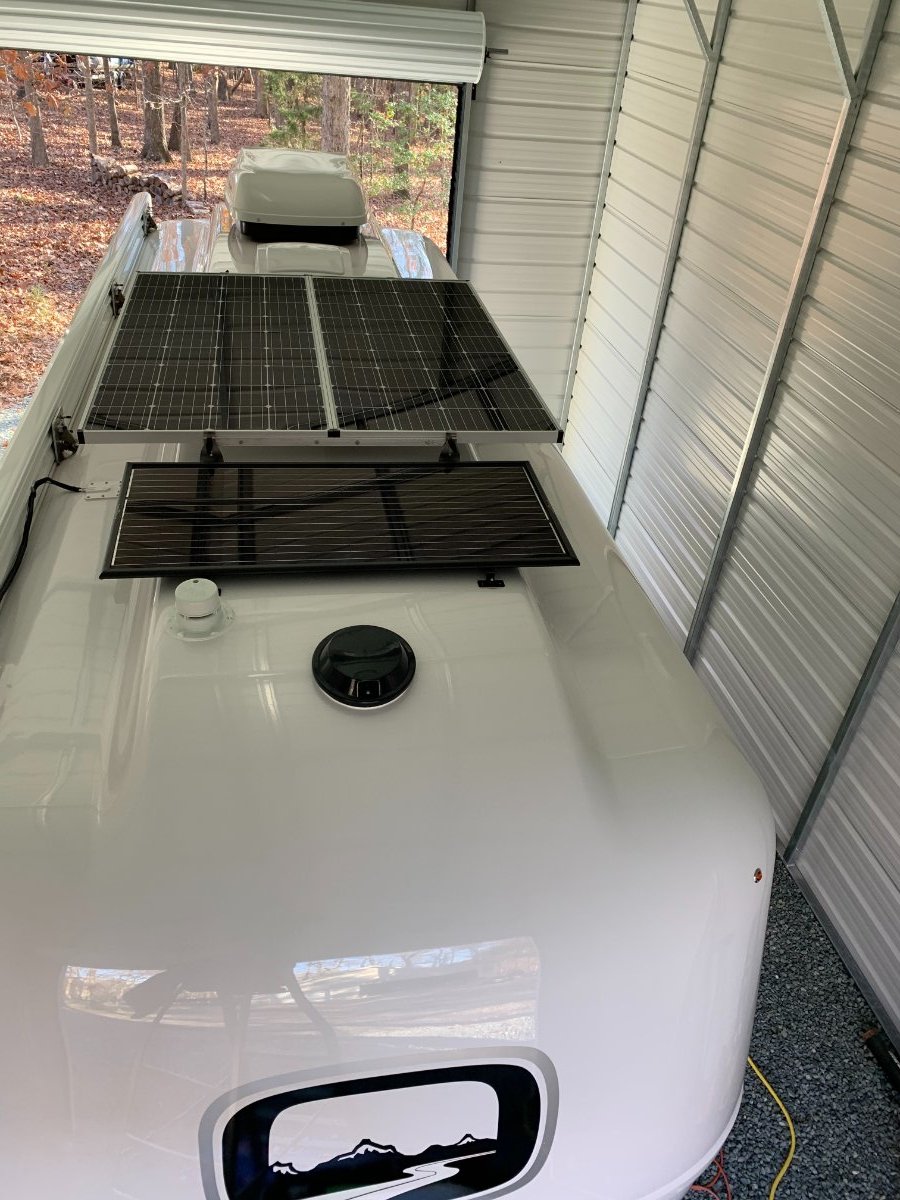
Here's a picture of a partially installed Zamp Obsidian 100 Watt panel on the front part of the roof. This super simple addition doesn't require any changes to the standard Zamp 30 Amp charge controller or access port on the roof (there are only 2 of 3 ports used). Anything additional will require an upgrade to a 50 or 60 Amp charge controller. There's still a decent federal rebate for solar this year. Before anyone goes crazy, I haven't finished mounting this yet. I've got a question in to Jason about using some sort of stainless screws in addition to the VHB and then I'll seal it up with 3M 4200 just as Oliver did to the mounts on the other 2 panels.
1 point
-
I have an LE2 so I can’t answer definitively. Direct replacement depends on the battery tray and battery dimensions. I can say that the Zamp Solar charge controller does support lithium batteries and the Progressive Dynamics Power Distribution may or may not support the lithium batteries. You should contact Progressive support and provide your model and serial number and they will guide you. See this post: Mossey1 point
-
In 20 years we have only had a blizzard one time, it lasted about 10 minutes. Snow in Middle TN - while not rare -doesn't last long- a few days at best. On the roadway - maybe a few hours - a day. A bigger worry is ice on the roadway. It has been my experience - bad drivers are everywhere. TN is one of the top destinations for people migration in the US. About 700,000 left CA last year, I know many that settled in Mid TN, along with a few Arizonians, New Yorkers, and so on. A melting pot to be sure. The States That Residents Are Leaving And The Ones They Are Moving To (forbes.com) Along with missing teeth, inbreeding, and perhaps driving in snow, the "south" has left behind the cliché it once represented. Nashville - its a badge of honor to claim originality - FWIW. No - you will not need snow chains - bring a smile, a good disposition, - you'll be fine - , RB1 point
-
Packing up . . . . leaving in 32 hours! Edit: End of day 1; Burns, Oregon - Historic Central Hotel. Made it over Cascade Pass with no problems. Staying ahead of an incoming storm that is predicted to bring snow to the mountains, but veer north before it catches us!1 point
-
John, Thanks for posting this. I am also looking forward to your write-up. I found that the new PD board does an excellent job charging the Li batteries. It is quick at driving the battery voltage up to 14.5V. In comparison, the ZAMP solar charge controller in LI mode does an okay job, but it never seems to get the battery voltage quite as high as the PD shore powered system does. For this reason I am considering swapping the ZAMP PWM controller out for a Victron MMPT controller. Note that I don't believe that the Victron charge controller is a necessary upgrade for LI batteries, but I am hoping for a measured improvement in battery charging capability that better leverages the existing PVs. Mike1 point
-
I was told that they will also have some scratch and dent stuff for offer on Monday - batteries with cosmetic blemishes or which fell slightly outside their rated capacity, etc.1 point
-
We have the Anderson wedges and love them. 0-4 inch lift for side to side leveling. No need to cut them to fit between the tires (at least on the 2017 model).1 point
-
I'm sure glad I started camping with a trailer some 45 years ago, it seems that I'm doing it pretty much the same way and using the same setup items that I did back them. trainman1 point
-
I agree with this. All the other bits and pieces are just nice to have. Everything you might have forgot or didn’t know you wanted can be purchased at Tractor Supply or Walmart just a minute or two drive from your pickup. All you absolutely need is payment and proof of insurance if you paid for the trailer via a secured loan. If you’re paying with cash, I don’t know if proof of insurance is required by law in TN or not.1 point
-
Jim, The Collar works great, no worries at all there. The Discus lock is a kinda lame (easy to pick), there are much better choices in the $40+ range. I have this one..... Stanley padlock hardened One way to prevent somebody from dropping your locked coupler onto their 1 7/8” ball and driving away - insert a 2” ball bearing into the Bulldog coupler socket. https://www.amazon.com/Inch-Chrome-Steel-Bearing-Balls/dp/B007B2A3VQ Keep the extra one as a spare or give it to a kid as a toy. What a cool stocking stuffer! You could use an old 2” hitch ball if you have one, cut the shank off with a hacksaw. But the bearing is a more elegant solution. John Davies Spokane WA
1 point
-
Take a look here, there have been lots of discussions. https://olivertraveltrailers.com/forums/topic/3930-truma-hot-water-heater-questions/?tab=comments#comment-38221 I remain steadfastly in the KISS camp. Keep It Simple Stupid. The standard unit is primitive and inefficient, but VERY easy to maintain by the owner, and cheap to replace it if fails. It is also fairly loud if you are sleeping on top of it, I turn it off at night, then switch it on in the morning when I start to wake up, the switch is easy to reach from that bed without getting up, if your head is toward the galley. OTOH, if you are plugged into city water and sewer often, you might love the endless hot water the Truma offers. For boondocking, not so much. Where and how do you plan to camp? That is the question.... ,John Davies Spokane WA1 point
-
If you have (quite) a bit of time on your hands, some lengthy but informative (somewhat repetitive) info on the various Garmin inreach units. Some good photos and insights into operation, features, and benefits. https://hikingguy.com/hiking-gear/in-depth-garmin-inreach-mini-review/ Costco had the inteach mini bundle on the shelf last month. Sherry1 point
-
This looks like a good alternative to the telescoping ladders. I don't know if one would fit in the closet, but it would take up little room in the bed of a truck.1 point
-
I know this probably isn't what you meant, but if someone is going to get a telescoping ladder like many of us have, it's not something you'd want to cheap out on. What you're getting with a telescoping ladder is compactness rather than a bargain; and since the price of failure is rather high, absolutely buy the best quality one you can find. I went with the taller 12.5' Telesteps model for added rigidity, and also got the 300lb rated model. I'm happy with it - it weighs an extra 5 lbs over the 10' 250 lb model, but it barely deflects at all when I'm on it and feels very solid, so I think it's worth it. I wrapped some foam around the rungs that I don't use, which both protects the trailer and tells me where to start extending it. And of course like all the telescoping ladders, it takes up the awkward space in the back of the closet pretty efficiently.1 point
-
John, Excellent installation. Thinking about installing a back-up camera on our Ollie, too. Edit: Hope you don't mind if I build a similar back up camera installation. Been looking at different backup camera systems, was not aware of the Garmin backup camera used with the GPS until seeing your unit.1 point












.thumb.JPG.dd838cdb3df463dab6a16861fa23a319.JPG)





-
Recent Achievements
-