Leaderboard


Popular Content
Showing content with the highest reputation on 01/07/2022 in all areas
-
12.1 volts is OK, but just barely. Looks like you took them out just in time. There are lots of "phantom electrical draws" in your trailer. Something on the order of 0.4 amps/hour. That's 9 amps per day. In a week that's 63 amps or more. Looking at your battery pic, you have 210 available amp hours before you reach 50%. You state the batteries are "fairly new". We don't know their history of if the PO let them go down below 50% a few times. I would have them checked under a load (free at Auto Zone or such) and see how much reserve they have left. The poor weather you speak of most likely had a lot to do with them not charging too well. Can you plug up to 120 volts? Also, judging from the 4/0 negative cable (I hope there's an equally large red positive wire) I am assuming you have an inverter. If so, you really need to replace all those small 10 AWG connecting wires to 4/0 also.4 points
-
Dudley, you probably already know this, but for the benefit of newer owners who's 12VDC electrical knowledge may be a little rusty. In Oliver's 4 x 6 volt battery package you have two sets of two 6 volt batteries. Both batteries in these sets are wired together in series to make a 12 volt battery (one wire from the positive terminal on one battery to the negative terminal on the other battery - think as if you're putting batteries in a flashlight, each battery's voltage is added to make the total). The voltage doubles for the set but the available ah remains the same. Then, the two sets are wired together in parallel by connecting the positive and negative terminals. This keeps the voltage the same for the four batteries but doubles the Ah capacity of the pack. This wiring scheme gives you a 12 volt system with a aH capacity of double the stated aH of any one battery. This is how many aH you can use before reaching the dreaded 50% point of no return. Then, to properly connect the battery pack to your trailer the positive and negative wires should come off the opposite corners of the set of batteries. This will enable each battery to be discharged and charged equally.3 points
-
There should be a large red rotatory switch near the charge controller. If you turn this off all solar input will be interrupted. On my unit this does not kill the power to the IPN Pro display. About the IPN Pro display. That shown is a screen that would only be seen during boot up, whenever power to the screen had been interrupted and then restored. The photo would have to have been taken during this stage. On my unit that screen and green indicator light only stay on for about 2 seconds. I've found that when I first turn everything off mine will show your 0.6-0.7 Ah draw, but a few hours later it almost always has dropped to 0.4 Ah.3 points
-
Yes, this is a great feature - but - be a bit careful in that the battery in the 890 does not last all that long when disconnected from power. Certainly it lasts long enough for the navigator to look up things like campgrounds or gas stations or even places to eat or things to do. But, be sure to put it back on its mount when the job is done. My 890 has not taken me down a "strange" road - yet. On many occasions I will use the 890 while at the same time using the navigation system in my F-150. At least 95 percent of the time they agree, but, when they don't and when I don't have a good idea of where to go, I'll always rely on the Garmin. Certainly this is true when the Garmin tells me to take a detour. But, here again, be a bit careful with this "feature" in that if the Garmin tells you that there is a "traffic problem" some 30 miles down the road - just keep an eye on it for the next 15 miles or so. I've found that more often than not many of these "traffic problems" will clear by the time I get there. Finally, probably the single most useful feature that I've found with the 890 is in getting gas. On longer trips I generally do not have a navigator. The big screen really comes in handy in both reading it and hitting the "buttons" (or simply talking to the Garmin if I'm in traffic) while bouncing down the highway. At around 100 miles to empty I'll start looking for a cheap (relatively) convenient gas station. Bill3 points
-
We upgraded to the Garmin 890 before our Dec trip to FL from OK. We really liked it and enjoyed the additional features and bigger screen size. It also has a great magnetic holder/charger that makes it easy for the navigator to remove and search for and input new destinations while traveling. BUT - we were upgrading from a Garmin Nuvi 1450 that we had been using since 2009 so just about any "modern" GPS would impress us.😂 We do use our Iphone Google maps sometimes but find GPS usage faster and more accurate at times. Except in 2010 we let the old Garmin take us, on two different occasions, to a small airport in the Orlando area - instead of to Disney World. At least we had plenty of turn around space.3 points
-
I received a email from my local Toyota dealer wanting to buy my 2020 Tundra Crew Cab 4X4 with 49,000 miles for $41, 250. Figured it was a scam since I paid $41,000 brand new. Eating wings with some buddies a couple of nights later and a friend tells me his son sold his Toyota. So I go down the next day and in 15 minutes the paper work is done. I would have never believed it. They now have it listed for $48,000 on the lot. I guess I could have sold it for more on my own but that was sure quick and easy. My next move was ordering a 2022 Ford 250 Plat. Tremor so I guess it will cost me more in the long run. I loved the Tundra but always knew I had to watch my payload when camping. Payload will not be a problem now. I do have a 2011 Lexus 570 that I will be using to haul until the 250 gets built. When building the Ford online my wife told me her company has a program with Ford and when I finished we would build the same truck with the code. Saved me a tad over $4K using the company code. I met the dealership and they informed me that they could not change the price one penny coming from the corporate program agreement, so I would not have to worry about an up-charge one it was delivered. The salesman did say it may take longer than normal for the delivery but I will be patient.2 points
-
That is the reason we are not ordering a front storage basket on our Elite II. I have been required to jack knife my raft trailer many times when backing into tight spaces. I welded a 3' straight steel extension onto the front of that A-frame trailer many years ago after denting a bumper during a jack knife maneuver. Problem solved. So, I want as much leeway between the Oliver trailer frame and the TV bumper as possible. If I could get one of the extendable tongues that was available on very early Olivers, I would get that upgrade for the same reason: maximum clearance if you must jack knife the trailer when backing.2 points
-
We arrived on a Sunday and had service Monday and Tuesday. We picked up Tuesday afternoon and stayed at Oliver Tuesday evening . No fee. We found a hotel room for Monday night. We went to visit my wife's family in Aiken for a few days. Stayed at Aiken State Park. We are long gone now. We are in Destin Florida now at Henderson Beach State Park after spending time in Naples, Marco Island and Venice. Tomorrow we leave for Fort Pickens National Sea Shore. Then to Dauphin Island, New Orleans, Austin, Waco, and Fort Worth on our way to the Grand Canyon and Zion.2 points
-
Looking for stray current being used in the winter is important. For instance, if you have a composting toilet there is a fan that stays on all the time unless you disconnect the power cord at the toilet. Do not store your batteries on a concrete floor and charge them a couple of times throughout the winter.2 points
-
This is the second story of this nature that I've heard. However, in the first story the situation was exactly reversed with the owner of the F-250 selling it and getting on a waiting list for a new Tundra. "Crazy Times" for sure. I'd probably look into selling my F-150 and get either a new Tundra or a new F-150 but since the current truck is the only means I have for towing the Ollie, I'll wait. Bill2 points
-
The batteries are connected in series so the voltmeter agrees with your trailer battery monitor. 6.1v X 2 = 12.2v. I doubt you damaged anything by disconnecting the batteries as long as you kept the + and - wires away from each other and the + away from any metal trailer structure (even without the batteries there will still be voltage coming from the solar panels).2 points
-
You don't like the weather in the South? Give it a day or so. It'll be better (usually).2 points
-
Everything changes. Keep an eye out. My brother and I talked this morning. Weather in his part of Minnesota is this year like the "old days," when we were kids. Crunchy snow, subzero. Frozen nose hairs. Always loved the snow view,, but I'm glad to be in Florida.2 points
-
Two things come to mind about this. One, I really wish that people would post about failures like you did. I realize that not every owner is on the forum (of course, they should be); but if someone who had this failure is on the forum, shame on them for not posting about it. Two - more importantly, if this has happened more than once and Oliver knows about it, then every owner with a Truma should know about it.2 points
-
Fill the toilet with peat moss and you’re there I think.2 points
-
The Garmin 890 is on sale for $379 at Amazon ($499 normal price). Looks like there are several vendors, one has it for $509. Mike2 points
-
Downloading detailed “offline” maps in any quantity takes a whole LOT of data and even more time. A fast wifi connection is best, and that is often a problem when you are on the road. In BC we had the hardest time finding ANY public wifi, and the commercial campgrounds had it, but it was about $5 per day and had a very low data limit. Enough for web browsing and maybe a low res movie download, but no more. The Provincial Parks have none at all. The USA is not as much a problem, but don’t expect to download a bunch of maps sitting outside of a Starbucks or public library, that isn’t viable. Neither are commercial CGs, they are usually so busy that their systems bog down and stall out. A stand-alone GPS never has these problems. Plus you have more time to enjoy your vacation without having to worry about a cell signal vanishing. John Davies Spokane WA .2 points
-
Thanks all for your input. Based on the inpurt, I am going to purchase a Garmin RV GPS sometime before next spring. I am going to call Garmin to see if the 890 is going to be updated/replaced soon. Richard2 points
-
LIVE TRAFFIC AND WEATHER When paired with the Garmin Drive app on a compatible smartphone, live traffic helps you avoid delays and find detours. Also, view detailed weather forecasts, current conditions, animated radar and more. How well does this work? My old 660(?) requires a wired computer connection (not a portable device) to update maps and the traffic info requires a special bulky “antenna cable”. I paid $5 for the optional weather display (transmitted by the Garmin phone app) and was dismayed to see that it is a still image and only functions at a scale of 20+miles. That is totally useless for searching out thunderstorm cells in front of you…. Does the weather radar OVERLAY the current map and route, and can you zoom way in? I would buy a new one just for these features, and the ability to view in portrait mode would be nice. Oh yeah, and a functional voice command system would be great, mine is at best 50% accurate at recognizing words. At least it gets the country right, when we went up into BC last August it did say “What city in ….. Canada?” I have found that my “Garmin Gertie” is not the brightest kid on the block. FYI, in the past when a Garmin device becomes heavily discounted everywhere, it usually means a new model is close to being announced. You might want to hold off so that you have the latest technology. Thanks, John Davies Spokane WA2 points
-
Looking at how far forward the cargo/generator basket is mounted. Has anyone had a problem with the basket interfering with tight turns? It does stick out a bit from the A-frame. Or is it far enough back from the coupler to be a non-issue? Also, while on the topic, does anyone have a problem with their pickup tailgate clearing the basket? Thanks.1 point
-
Very nice truck, you didn't ask (as there was no need to), but I can assure you that you won't have any trouble with either towing or cargo carrying capacity. My SIL and BIL live in Sandy Hook and they said they got a bunch of snow with more coming. You need to head South to the land of Mint Juleps and Tennessee sipping whiskey. Congrats on your upcoming Oliver acquisition from Hull #050.1 point
-
Looking at your photos, it would "appear" that your solar panels were charging the batteries. (See the green light on in the photo of the blue sky remote), and possibly in bulk state, unless you were lucky and just captured that photo on a blink. But, the 12.1 on the seelevel gauge means it wasn't really charging, (should read 13.4 or so in bulk), or you had some huge power draw going on, like the 3way fridge running on dc. The Dometic 3way never defaults to 12v like the Norcold. It has to be set to dc, but it can be done accidentally. Your solar panels would not be able to keep up with that big draw, especially in cloudy weather. The other possibility is that the panels weren't actually charging the batteries, at all. We have about a .35 ghost draw in our trailer. In 3 to 4 weeks, that would draw your batteries down to 50 per cent. Do you have a breaker near the pd charger/converter to cut the power from the panels? We do, but I don't remember if we installed it, or if Oliver installed it, back in 2008. @ScubaRx would probably know, as your hull numbers are only 17 apart. If you don't have one, you can cover the panels with a dark packing quilt so they won't be making power, and I'd suggest you do that when you reinstall the batteries and connect the cables. I'm also curious about the message on your display. Mine never shows "blue energy v4." It always shows whatever setting i was last looking at, instead. Maybe this is different in the newer remotes. Again, @ScubaRx or one of the other owners of newer systems may see that. I don't know.1 point
-
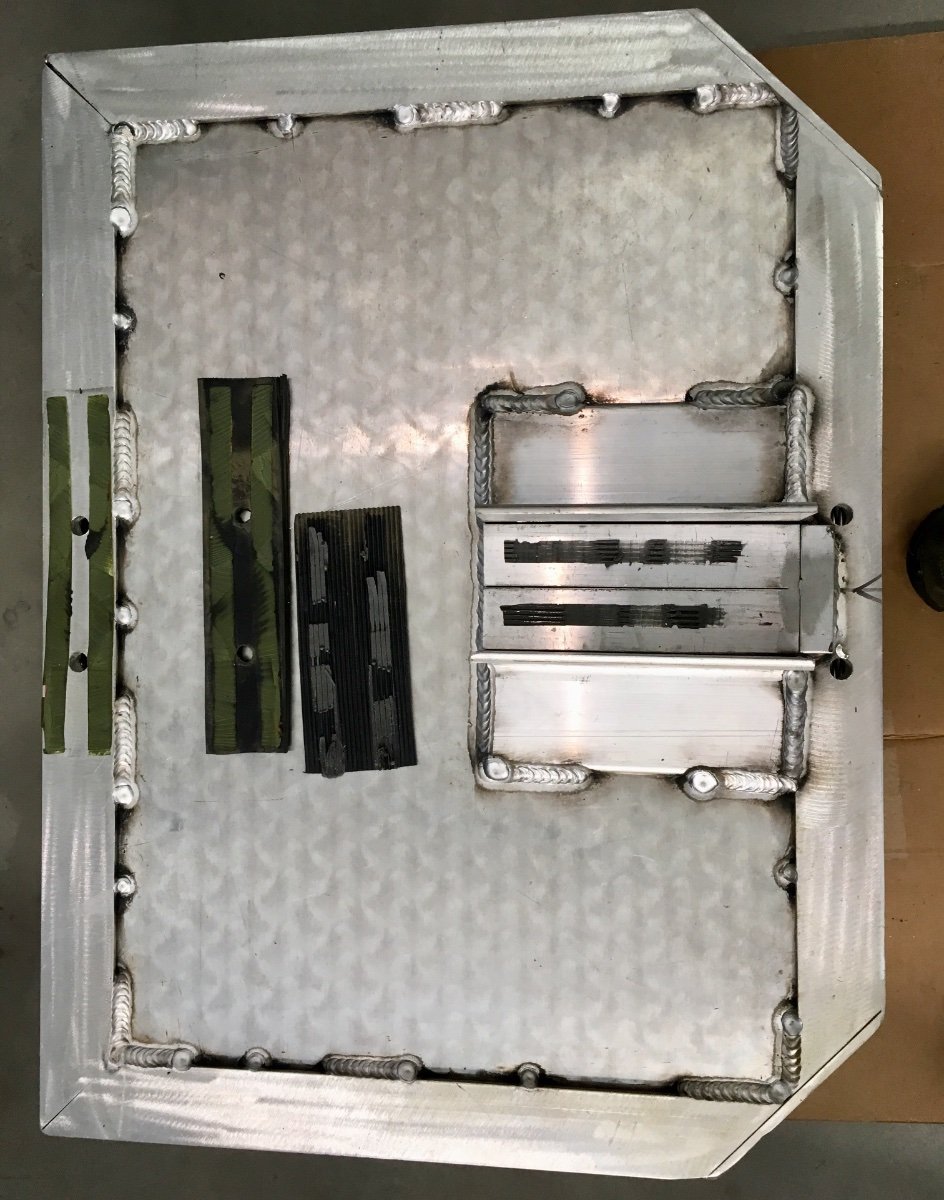
FYI, If the basket collides with your truck hard enough to damage the truck, you should also inspect the basket itself for damage, it possibly could have cracks on the support brackets or mounting holes. It is only held down in the middle by two rather undersized u-bolts. Here is a pic of the early style tray, showing the angle brackets that "straddle" the tongue, and the two sets of holes for the u-bolts. (The rubber strips have been removed in this pic.). This design is adequate for a heavy load like a generator IF it is centered over the tongue, but if you load it unevenly, it may not be OK. For example a full Jerry can on just one side might be a problem Since relocating mine to the back, I no longer worry about damaging the truck, but I now have to worry about ramming it into my house (; John Davies Spokane WA
 1 point
 -
Indeed - During the winter months I store my Ollie under a cover. I also turn the solar panels off and flip both of the dc circuit breakers to off. Then I plug in a 25 watt solar panel that is wired directly to the batteries (4 lead acid). Yes, the solar panel is pointed towards the sun but it is partially shaded by a cyclone fence and doesn't get any sun after about 3pm due to a tree. Even with all this, my batteries have always been fully charged. Also, I agree with Mike's comments about looking at your Blue Sky display to help with the draw. Bill1 point
-
On both of my Ram 1500’s the lowered tailgate hit the top of the Andersen hitch. On my Ram 2500, with no Andersen, the tailgate doesn’t even come close to hitting the hitch. Mike1 point
-
On our return home from delivery, I had to jackknife the trailer sharply to make it into our driveway. The next morning I noticed the $600 dent in the bumper of our brand-new 2021 GMC Denali HD's bumper. It has been repaired, and the basket is now sitting in storage; we do not miss it.1 point
-
All of these comments have been extremely useful and educational. First off, after getting my first cup of coffee this morning and starting to read the feedback, we immediately jumped in the car and went to the Oliver to verify/address whether the 4/0 positive cable end was touching anything metal. Well it kinda was I guess because it was laying on the bottom of the metal battery tray. We put pool noodles on both the positive and negative ends of the 4/0 wires, thankful we didn't get shocked touching the trailer and nothing appears to be amiss. Thank you Steph and Dud B for that comment and the math. I realize a 6 volt battery is probably full at about 6.7 then. ScubaRx thank you for the comment on upgrading the connector wires for the "in series" batteries, that was a gold nugget and we will be changing those out. Dewdev - we will have to learn our new to us trailer in order to know where any electrical draws could be coming from during the winter storage. We don't have a composting toilet but will look for other consumers. My lingering concern is why wasn't the solar panels able to keep up with the amount of phantom electrical consumption that ScubaRx mentions. I don't think the past month has been mostly cloudy but I wasn't keeping track (now I realize I better). And the winter sun is at a lower angle so the angle to the panels will reduce their production. But I'm still left wondering if something else might be going on. I had the stray thought could I use the voltmeter on the positive & negative wires in the battery box to see what they read, as I'm presuming that would reflect the amount of charge coming from the solar panel. Huge education ahead.1 point
-
To answer some of the questions that John asked, I do carry the re-bar in the bed of my pickup (4' lengths) and the potting bench was a free lance design, made from old cedar 2x4"s and ran through the table saw to remove the outside paint that was on them (approxmently 1/16" to make them look new. I also installed an old porcelain sink for potting, my wife really enjoys it. Sorry for not answering, I just over looked this post. trainman1 point
-
Where in SC? We are in Pinopolis, by Lake Moultrie 🙂1 point
-
Whoa...pickup a week from today (13th). Glad the weather seems to be moderating. Thanks for the update 🙂1 point
-
We've had similar experiences, with gps and Google maps. Each have taken us to places we should not have ventured. I will say, our latest gps is 4 or 5 years old. We still carry paper maps. Sometimes, we even use them.😁1 point
-
Btw, Dometic bought Zamp this past year. I do think zamp quality is great. I just don't want to open the wallet quite that wide for panels we don't always carry, or use. Probably bought by Dometic because so very many rvs have the zamp port installed, across so many brands. Plus the high quality of their (imo overpriced) panels. Plug and play is great. Until it's too pricey and heavy to deal with. In my sister's rpod, we just ran alligator clip ends to the battery itself, with a panel with an on-board controller. No big deal, as she had no other solar, no other controller. She and her husband started their trailer camping and boondocking career with first trip, with us. She's a veteran tent camper.1 point
-
Zamp uses some interesting verbage, but Overland is correct. Zamp wires the sae connector for their port reversed polarity of normal/standard sae connector wiring. The connector is not proprietary. They just claim better safety wiring different from industry standard, which is actually true. So, you can make up your own cable, if you want to use a different brand portable, or, you can buy a cable with same connector, and buy a reversed polarity adaptor. Plugging in panels without the correct polarity could ruin your panels or other circuits. Or, you "could" reverse the wires from the port... but label it. And whatever you do, check with a multimeter. The zamp port goes through a fused line directly to the batteries, so you need a controller mounted to the panel, which most suitcase systems include. Or, a controller in the trailer. Zamp panels are quality plug and play, but they're quite heavy and very expensive. We have a different brand, my husband made up the connector cable, and we wired up a slave controller for the portable panels instead of using the controllers on-board the panels. (Full disclosure, we also installed a furrion port, instead of zamp, so this is not our experience. My sister had the ubiquitous zamp port on her rpod.) We set up portable when we'll be in the same spot for awhile. It's too much work, as our panels are not featherweight, either, for an overnight stay. The rooftop panels charge our agms fine if we're traveling, so not necessary.1 point
-
It is a lot warmer Maine, right now, than in Tennessee. Also there is a whole lot less snow too. Hope our luck holds out...!1 point
-
Wow. I check my computer after a day away and it is filled with thoughtful and helpful responses. Thank you all, the Oliver forum does not disappoint. You have given our kids some good counsel and plenty of food for thought, including some innovative ideas - camper brands, “disposable” trailers, tent/camper combo, etc. A great example of group think on this forum. Most helpful, thanks very much!1 point
-
Our 2022 Single Rear Wheel Silverado 3500's tailgate does not hit anything,1 point
-
Yes, it does, so that will help with turns. Our dually does sit a couple of inches lower than single axle 3500s. I think the tailgate will clear the coupler, but I suspect it won't clear the storage box.1 point
-
The basket can contact the truck when reversing at too tight an angle, for sure (jack knifing). During normal full-lock turns while driving forward it is fine. The open tailgate may hit it if the trailer is at a severe angle, you should try to park with it aligned. Many have noticed that the tailgate can hit the Bulldog coupler, this depends on the tow vehicle, and where the receiver is located in relation to the gate. There have been a number of threads discussing tailgate clearance. With your HD truck it is less likely to be a problem. My 2006 Ram 3500 had tons of room, my 2013 Land Cruiser would hit, until I installed a longer Andersen ball mount. I moved my basket from the tongue back to the rear bumper and I much prefer it there, for a number of reasons, including a greatly reduced tongue weight. It certainly is easier to climb over the tongue without it in the way. Until you get used to it, have a helper stand out there watching while you reverse, to make sure you don’t over do it. When backing sharply, go really slow once the angle gets past 45 degrees. Does your GMC have a backup camera? John Davies Spokane WA1 point
-
As long as you have (1) a cellphone with you and (2) a cellphone signal that is strong enough.1 point
-
I don't have the Garmin 890, but do have a Garmin that will do just about everything for $200. Now here is the kicker, we use AppleCarPlay 95% of the time over the Garmin and plays on the big screen in our vehicles, it works great. I know the Garmin RV has some features that might be useful, but really in todays world just about everything can be found on your phone. trainman1 point
-
Another point about the 890: If you are thinking about a rearview camera or want an additional camera without adding yet another screen to your tow vehicle's cockpit then you can get the Garmin (or compatible) BC-35 camera. However, there are two "catches" with this camera: 1. The resolution is not very good. That doesn't specifically bother me in that I really don't need to read the license plate of the guy behind me. It is good enough to see that kid or tree or rock or cars/trucks when changing lanes. But, it certainly is not as sharp as the Furion. Then again, the BC-35 is about $150 and fairly easy to install. 2. Speaking of install - the camera is hard wired to the WiFi sending unit. And, this sending unit is not considered to be water proof. So, if you are going to mount the camera on the rear of the Ollie - what do you do with the WiFi sending unit? Sure, place it in the attic right under the camera that is on the outside. But, with the distance from there to the tow vehicle cockpit plus the amount of "stuff" (like the foil faced insulation inside the Oliver) the transmission of the WiFi signal is not strong. So, even though Garmin says that an extension cable is not available for the sending unit to camera connection, there is ONE that will work. Unfortunately, I found out that you can only use one six and a half foot extension cable due to the voltage drop caused by using more. In turn, this means that I could only extend the WiFi sending unit from the attic to the front kitchen cabinet. The good news is that this was enough to allow the 890 to receive the camera signal. Note that the extension cable's male end is just a tad too big for the female end of the Garmin - a little very light sanding of the exterior of the extension cable solved this problem. Bill1 point
-
I contacted Garmin and they said that the RV 890 $100 discount is a short term promotion they are putting on for the holidays. They said there is no plan to discontinue the 890 for a new model.1 point
-
I'd say that the newer ones (890 in my case) are easier to use. The 8 inch screen is very helpful since I often travel (RV wise) alone. But, a friend of mine who has an 890 has told me that his navigator finds the 890 very easy to pull off its magnetic mount to search for "next exit" info or campground info or where to eat info. All of these are accessible via "apps" and really do not get in the way of the "normal" GPS function. The traffic information on the 890 works better than my older Garmin (via the cord which I really didn't find to all that "bulky"). If I have found an "issue" with the newer Garmin it would be that there have been occasions when the Garmin alerts me to traffic congestion some 30 miles ahead but it is "cleared" by the time I get there. I guess I'd rather have that kind of warning than only giving me a couple of minutes or no warning at all, but ... I don't know the answer that. I've only used the weather function when I've been stopped - at a camp or at a gas station - and have not had the need to zoom in or out in that I'm usually only interested in what the weather will be tomorrow or for the next couple of days. The portrait mode is super for looking way on down the road. But, I usually use the 890 in landscape mode because I can zoom in or out when needed and with the 8 inch screen there is usually enough room to see far enough ahead. Last Holiday season when the 890 was fairly new to the market, Garmin also discounted it - I think it was a discount similar to the $100 for this year. Also, other Garmin devices have been discounted from time to time without any hint of a new model coming out. Honestly - I have not used voice commands very often. Perhaps its because I've tended to avoid ANY of these because I've found them to be frustrating and temperamental at best. Still a technology that needs improvement in what can be a noisy environment. Finally, I do have an "emergency" cellphone that I always have "on" while in the truck - it is how Ford dials 911 for you in the event of an accident if nothing else. Depending on cell coverage out West is a bit problematic in that you can never be "certain" when you will have coverage and when you wouldn't. Downloading maps ahead of time both takes time and planning and memory in the phone that (generally) I don't have - my cellphone is a cheapie since it doesn't take a $1000 phone to dial 911. Bill1 point
-
I successfully use my phone without cell coverage as a navigation device via GAIA GPS while riding my adventure motorcycle in unconnected parts of the country. You can download the maps onto your phone and use the gps within the phone to navigate. You can also download rudimentary maps from Google Maps for the same purpose and I have had good luck with that as well. I also use a Garmin XT on the bike which is awesome. Bottom line: If you’re traveling in non-cell areas you can still get great utilization from your phone’s GPS, it just takes a bit of planning. Google Maps download: https://support.google.com/maps/answer/6291838?hl=en&co=GENIE.Platform%3DAndroid&oco=1 GAIA GPS: https://www.gaiagps.com/1 point
-
Google Maps does allow you to download the map data for use where cellular service is unavailable. Of course, that only works if you anticipate the problem...1 point
-
Bill, since you've had a few Garmin, would you say that the newer models are easier to use than the older ones? We've had several brands of GPS. None rv specific. Some better than others. Our newest one is now probably 5 years old, and probably do for replacement . I use my phone when possible, because it's so much easier than the Garmin interface, but we normally run a gps, also, as a backup for the many times that signal is lost.1 point
-
I also carry an older Garmin that I keep up to date for occasional use out west. We rely on the CarPlay display of Apple Maps or Google maps and sometimes Waze. The GPS in my Ram and Audi were out of date the day I drove them off the lot. Why pay the dealer for updates, use that cash for a new Garmin. Mike1 point
-
Also check out the Overlander. These Garmin units are far more resource rich and user friendly than the GPS that came in my 2021 F150.1 point
-
Richard - I've actually got two of the Garmin GPS devices with the latest being the 890. These are in addition to GPS being in each of our vehicles as they came from the factory and a cellphone GPS. Out of all of the above I prefer and rely on the 890 the most. Yes, I still carry and refer to paper maps but for "on the fly" directions plus all of the additional information that this unit provides, I find it hard to believe that I'll ever be without one in the future. On this Forum some time ago, I detailed a situation where my Garmin GPS was telling me to "take the next exit" and I thought that I knew better. About a half mile further down the road the traffic came to a stop and it was then that I realized what the Garmin was trying to tell me. As you mention, the 890 includes several "apps" that I've also used to find campgrounds, places to eat and things to do all of which can be used without cell service. I HIGHLY recommend both Garmin and the 890. Bill1 point
-
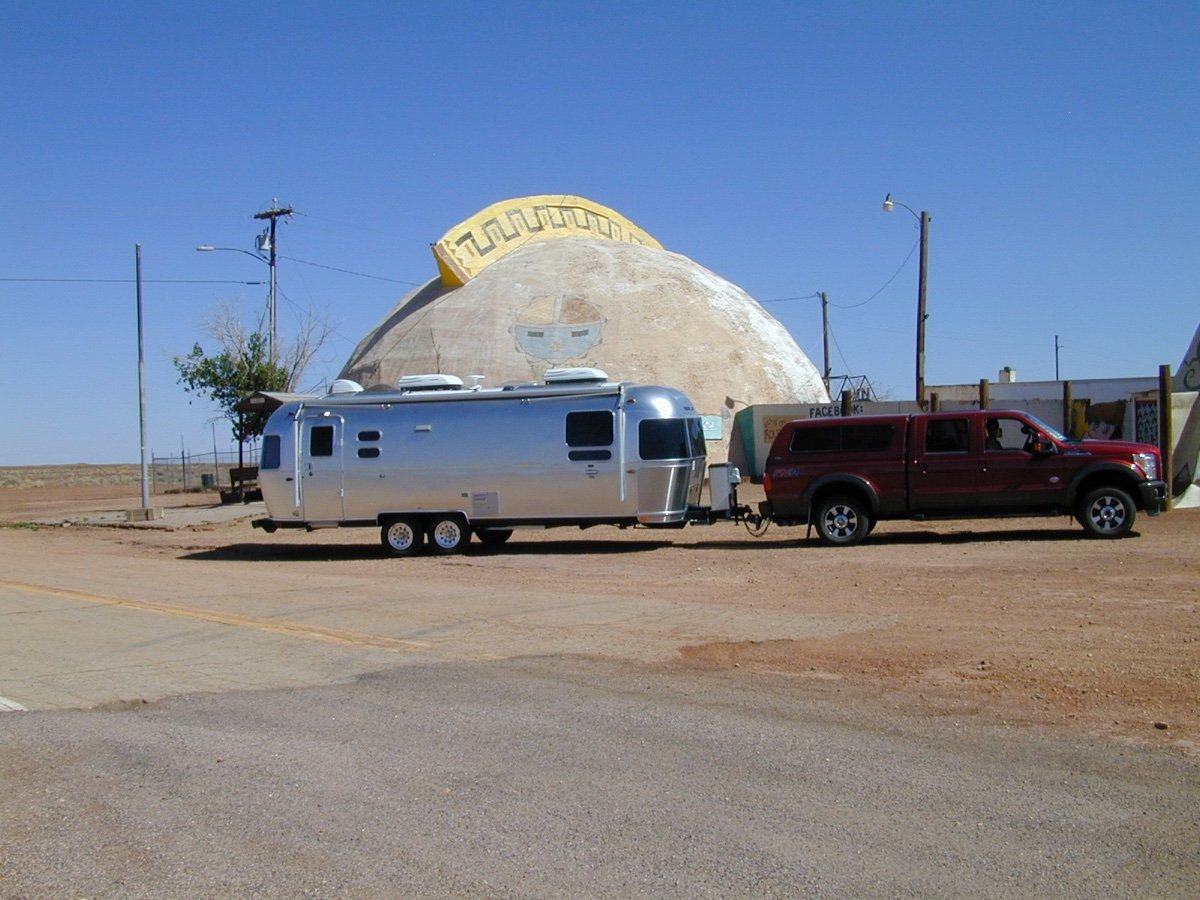
We dry camped this year in Montana, Idaho, Wyoming, Utah Colorado, Arizona, New Mexico, South Dakota and a few over nights in Kansas, Oklahoma, Texas and Nebraska this Spring, Summer and Fall. No restrictions and 'wide open' for hikers and outdoor people in general. The Air was fresh, cool and brisk! A couple camped in Utah at 10,000 feet were staying inside their trailer wearing face masks. They never left their trailer. We found everyone was enjoying the outdoors and not concerned about what City Folk were fearing... no body. Had lively discussions about camping and how to find great camping spots. Known or undiscovered places. Smaller towns had a sign asking you wear a face mask. Many Service Stations did not in some less populated areas. It was hit and miss this Summer. Campsites... no Covid fears. Bow hunters... no Covid fears. Fisherman... the same. It was a wonderful experience getting out and feeling 'normal' again. If you are planning to Boondock in the NFS and BLM or State Lands... it was wide open in the Rocky Mountains. We laid back and aaaaaaah.... 🙂 Planning a Western Adventure? No congestion of campers... the trailer crowd were at RV Camps. The public lands were wide open during peak season. It was a pleasant surprise that we were all... alone. Popular areas like Cedar Breaks at 10,200 feet in July & August, just east of Cedar City, Utah had 80% vacancy in the trees and in the wide open spaces. It snowed and hailed one day... in August by Duck Creek. Enough to cover the ground for several hours. Anyone who says the RV Parks were crowded... they missed out on the wide open trailer accessible dry camps. Those who manage to be comfortable Off the Grid... do not Plan to go out West into the Rocky Mountains. Just... GO and be the 'accidental tourist'. We have done it since 2006 and return to many of our favorite campsites... never to be disappointed that the area was full. We even got a Daily Campsite on the west side of Flathead Lake in Montana... by just driving up and had NON Reserved spots available... for people like us. No Plan. No Reservations. No worry... Try it. You will become Young and Ambitious Boondockers. After a few attempts learning how to manage at the worst spot in nowhere... it is better than having neighbors within five feet of you camped! Any day. Even Meteor City, west of Albuquerque, New Mexico... was great. Blue Heelers, too.
1 point














-
Recent Achievements
-