Leaderboard



Popular Content
Showing content with the highest reputation on 10/24/2020 in all areas
-
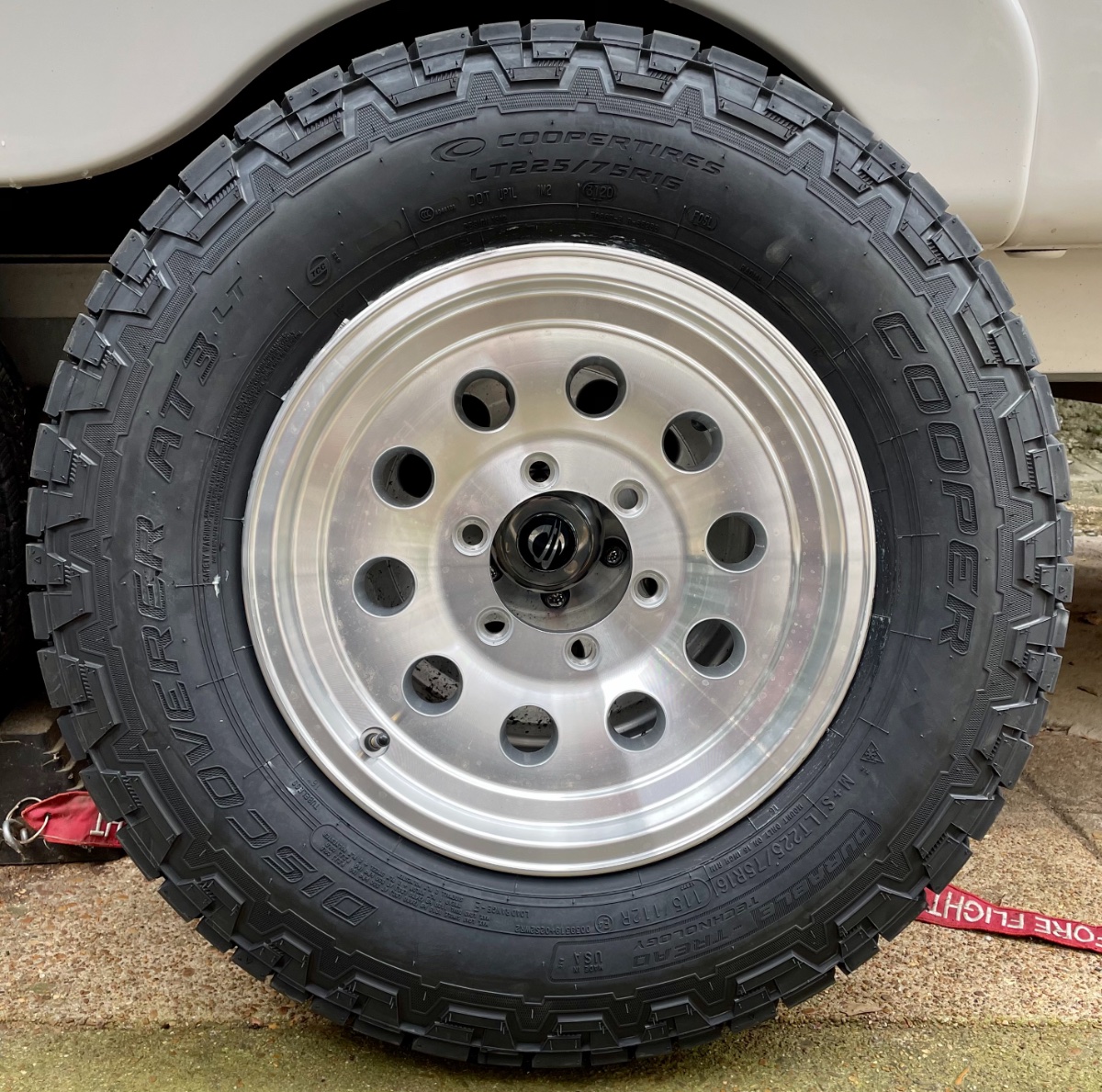
Looks the part, I think... Comparing the tread to the Michelin’s, I have to say that there’s not a huge difference in the size of the tread blocks or the siping, so I’m feeling pretty good about the highway potential. I ended up getting a free tire for my Raptor as part of the deal. I had asked them when they put on the new tires to save me one for a 2nd spare and when I went back today to have it mounted on the rim I got, they told me I’d bought the wrong sized rim, which was odd, since the rim was a pretty much new Raptor takeoff I got on eBay. Turns out that they had actually given me back the wrong tire and since they couldn’t find the old ones they’re ordering a brand new one for free.
 4 points
 -
We have lived in several states mostly due to career upward mobility moves with our former employers. We found the state we enjoy living in most is where we are right now. We love the beautiful temperate spring and fall, the long summers and short easy winters of Western North Carolina. We feel very fortunate and blessed to be able to choose where we could eventually build our home and retire. Here in the foothills of Western NC we might get one snow fall of 5” and with a few days it’s gone. So no shoveling or plowing of driveways, or driving and slipping on ice! Very little snow and ice covered roads and power lines suits us well. A short drive to the gorgeous South Mountains a part of the Blue Ridge Mountains and 4.5 hrs to Sunset Beach we are completely content and very happy. We now farm a small Blueberry grove, (a record 43 gallon yield this past season) we also hunt and enjoy wild game and the trout fishing is not bad either. Being “Patriots” we enjoy tremendous amounts of awesome revolutionary war history here symbolizing the birth of this great country. 🇺🇸
4 points
-
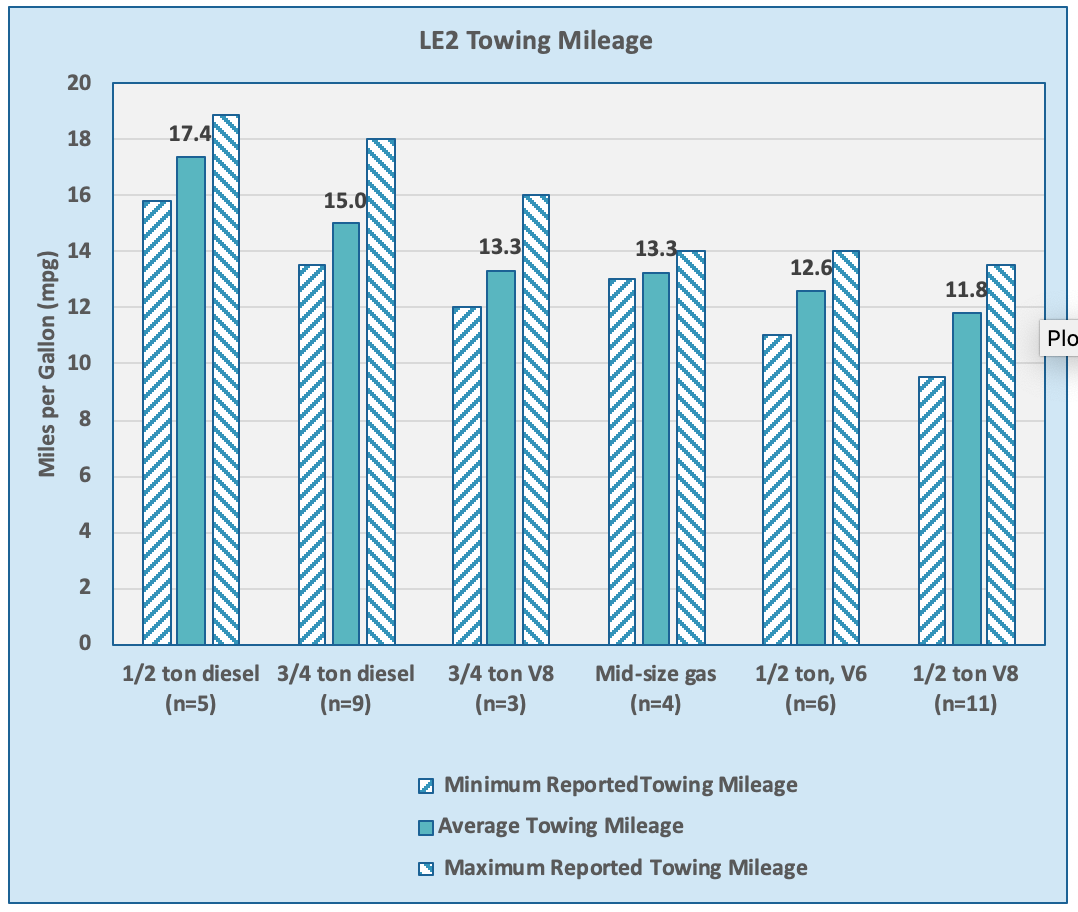
Here is an updated graph of LE2 towing mileage; the update includes responses in this thread or additional references that I found in the archives. Data are summarized in this PDF: LE2 Towing Mileage (Table).pdf For illustration purposes, I've aggregated data by general vehicle and engine type (see graph below). The "n" value is the number of mileage data in a group; the higher the number the more reliable the average (although this case the number of data are insufficient to be statistically significant). Nonetheless, these mileage estimates likely fall in the ballpark of what one might expect for these vehicles. I found only three references to LE1 towing mileage (which ranged from 11.5 to 15); these are listed in this PDF:LE1 Towing Mileage (Table).pdf Bottom line: most folks see towing mileage with the LE2 ranging from about 9 mpg to more than 18 mpg, depending on vehicle, terrain, wind and temperature, speed, city/highway, etc. In addition, fuel mileage for various vehicles over millions and millions of miles are compiled at Fuelly.com. Data can be sorted by engine type, and include a mix of towing and no-towing, city and highway, etc. conditions. Fuel mileage is but one of many criteria for selecting a tow vehicle. Nonetheless, I hope thread helps others (like me) for whom towing mileage is one factor in choosing a tow vehicle.
3 points
-
I’ve lived all over the US and the western US is top of my list when I retire. I love the area around Bend Oregon plus coast is not that far. I’d probably head south for part of winter but that is what the Ollie is for! Texas is home so I have thought about having a small place in the Hill Country for winter between Austin and San Antonio.3 points
-
Nature is a complete menagerie of moving things - plant's that reach out - that's the appeal..... As for overall cost of living - TN is hard to beat. Seems real estate has gone crazy most everywhere we "once" considered in our retirement planning. I have come to realize - the grass isn't always greener on the other side of the state line -err - fence - so to speak. And like SH - low population density is an attraction for us. This summers wanderings throughout CO was in stark contrast to the people numbers of the same trips 10 years back! Amazed at the traffic, congestion, and sheer building activity in CO. Course I remember when DEN was just a thought. My attraction to the west is the boondocking - really great if you like that kind of thing. Our time in the PNW - well it was fun - not a place I want to live - my spouse rust's - she says. - AK - I love the openness, the attitudes, the last frontier? - not the winters.... My son - however - says he will never leave - . To each his own - Oliver EII - and a good TV - the world is your oyster.3 points
-
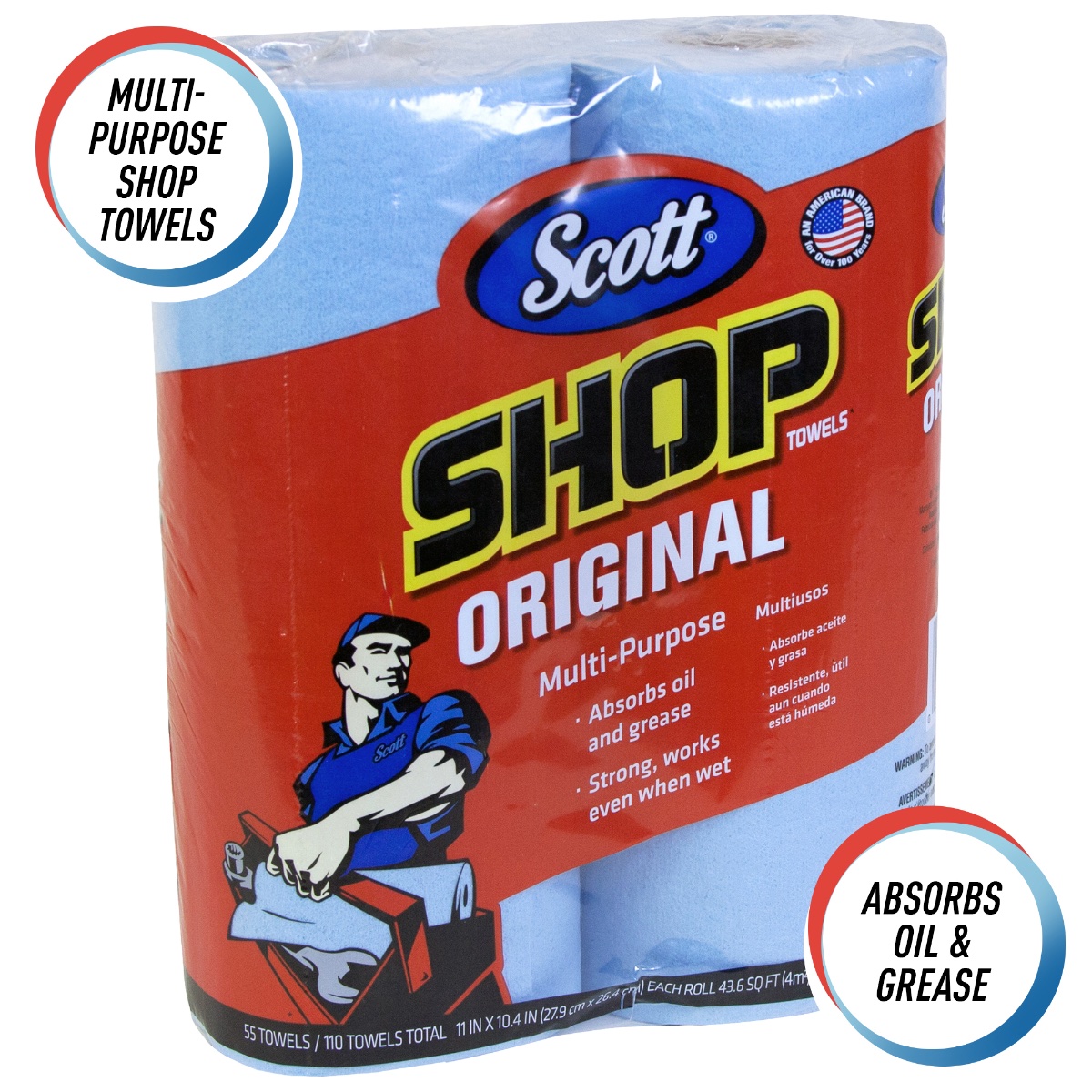
One REALLY effective trick to locate a mystery leak is to place a folded up blue paper “shop towel”, not a white one, under a suspected fitting. If there is a slow drip, it will show up as an easy to see dark blue spot on the light blue background. Don’t buy from Amazon, you can find them for around $2 per roll at any place that sells auto parts, including Walmart. John Davies Spokane WA
2 points
-
I’ll second John’s recommendations, since that’s exactly what I’ve been using. The crimper is tough to work with in some of the cramped spaces but I’ve made it work. It can be a workout at times. The crimps are extremely strong.2 points
-
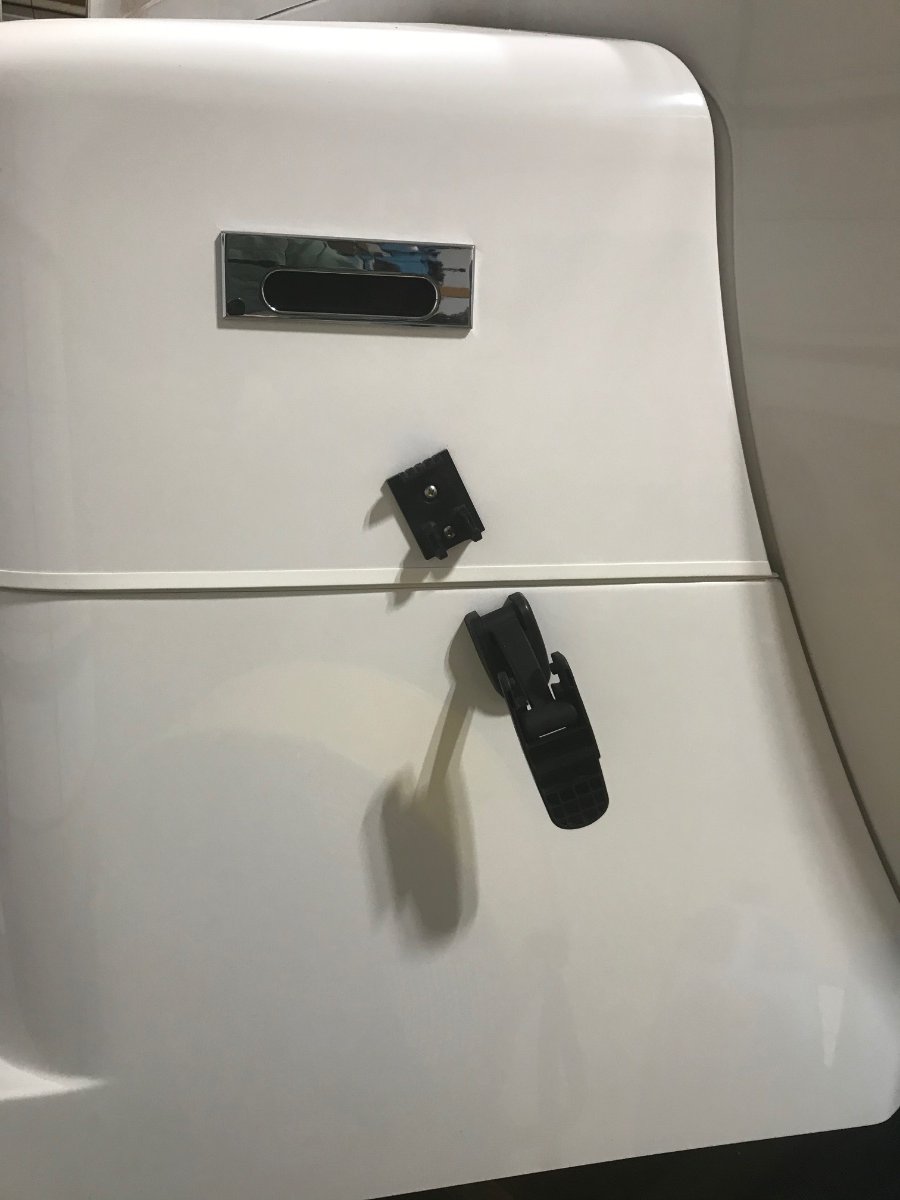
I know of at least one Oliver owner that will once a month lift the tires off the concrete and spin them leaving them 90 degrees from where they had been. I leave the propane lid latches undone to keep from permanently stretching the rubber pieces. This also allows the foam bumpers to expand so that when the lid is latched the bumpers are not already flattened out.
2 points
-
Western Oregon does have its share of ticks, rattle snakes, and poison oak. On the other hand, Oregon has a lot of great boondocking sites.2 points
-
We've lived all over the US/world. PNW is hard to beat. On the west side of the mountains there are hardly any ticks, poisonous snakes, hurricanes, tornados, etc... We may all face some sort of doom in an earthquake or volcanic eruption though. Boating is awesome here, fishing (Salmon, Cod, Halibut, Tuna, etc...)/shrimping/crabbing can be interesting despite the governments' attempts to ruin it. WA/AK have no state income/capital gains tax and fairly low property taxes if that matters. Seattle/Tacoma real estate pricing is insane, and gets more insane by the minute, but there are plenty of places that would be awesome to crash outside the beehive: San Juan Islands and the Peninsula are good bets if you don't like as much rain. Pretty much any county except King or Pierce will be fairly reasonable.2 points
-
We've many times camped into the teens, maybe upper single digits in the older elite. But, we don't intentionally seek out winter weather. It finds us, in the mountains in shoulder season, and sometimes in fall in Canada. .I know the insulation is different in the newer models (we really don't have a lot). And, the furnace location has moved. If it's in the 20s or low 30s when we go to bed, I usually open the bathroom door, and open the lower drawer a bit. So far, so good. It was below 32 twice this past 2 weeks, during the night. I did nothing extra. Left the bath door closed. Ran furnace on low. We were fine. Toasty, actually. But daytime highs were in the 50s and 60s.2 points
-
The Ram 1500 can have a 23, 26 or 33 gallon gas tank. My 2016 had the 33 gallon. My current 2020 has a 26 gallon. They factor in a full gas tank when they figure payload capacity so the 33 gallon will yield a lower payload number. I was a bit concerned going from 33 to 26 gallons but honestly it hasn’t made much difference. We stop every 2-4 hours anyway so filling up isn’t the issue I thought it would be. I think most Ram 1500s come with the 2” hitch receiver and 7 pin connector. The towing package comes with some extra cooling, a larger alternator and brake controller. It’s important to make sure the towing features you want are listed on the window sticker. Mike2 points
-
Interesting thread. Where we live in the Texas Hill Country north of San Antonio has some advantages for RVer’s. We have mild winters with no sustained below freezing weather, so no need to winterize. We do usually get a week of night time temperatures in the 20’s but usually well above freezing during those days. Being right on I-10, it’s an easy two day drive to Arizona, Colorado or the Florida panhandle. If you are young and ambitious those can also be done in a day. San Antonio is in the top 10 largest US cities so has all the cultural, medical, sports, airport and shopping that goes along with being large. We’re not in the city but only a 30-45 minute drive to any of the big city features. What we don’t like are the hot, humid summers that usually last from June through September. We usually make a July/August trip to NM, CO or AZ during those hot muggy months. Mike2 points
-
We also love Western NC. Lovely, friendly small towns. 4 gentle seasons. Asheville is a very fun town, with great food, craft beer and music. We don't live here year round. (No sailing), but we spend months here every year, and find it a great jumping off point for other adventures. Much closer to New England, the Midwest, and Canada. As for Colorado, it's beautiful, but never really my favorite. My sister lived in Grand junction a few years, and was thrilled when her husband was transferred. One of my college roommates moved last year from Parker, CO, to a small town in Wyoming. Our daughter is out in Colorado now, on a hiking trip. I'll see what she has to say. If I were ever to go west, I'd probably look in Idaho.
2 points
-
Good question. The outlet tester is just that, a simple and safe way to test outlet wiring. It will verify the outlet is wired correctly and indicate any faulty wiring with idiot lights. The newer models incorporate a push button GFCI function which does the same thing as the push button on the GFCI outlet by creating a ground fault condition at the push of the button. This action will trip the circuit at the the GFCI outlet between the fault and the breaker panel. It can only test 120V AC circuits. A multimeter is a much more sophisticated piece of test equipment that can provide useful information when testing and troubleshooting electrical problems. It can test both AC and DC circuits of varying voltages. An outlet tester is similar to the yellow idiot light on the dash which tells you to put gas in your vehicle. And a multimeter is like the gas gauge in that it tells you how much gas you actually have. Mossey2 points
-
I’ve cut five access holes in my trailer: one under my composting toilet, which obviously won’t apply unless you have one; one under the fridge; one under each set of galley drawers; and one in the closet. The most useful and easiest are the ones under the drawers. (Oliver service will cut one of them for you if you ever need to reattach your overflow drain.) The closet one is the trickiest - you can do real damage to your trailer if you mess that one up. I’ll see if I can put some photos together and make a post about them next week.1 point
-
I can’t help with the hole locations, but you should buy this wonderful crimping tool. https://www.homedepot.com/p/SharkBite-3-8-in-1-in-PEX-Clamp-Tool-UC961/202688118 Use the appropriate diameter stainless steel crimp rings. They are easy to install, and what is more important, they are easy to remove. A crimped copper ring requires cutting or chiseling off. The stainless rings pop off with the twist of a flat tipped screwdriver. https://www.homedepot.com/p/SharkBite-1-2-in-PEX-Barb-Stainless-Steel-Clamp-10-Pack-UC953A/202032891?MERCH=REC-_-plpsearch_multi-_-NA-_-202032891-_-N My hand strength is low and I have to have help for the 1” size, I just slip a couple of steel pipes over the tool’s handles. Once you try this system you will never go back to the stupid copper ones. You can tell your wife that you need this stuff to repair your house plumbing too.... it would also work on irrigation lines, but the parts are kind of pricey for that application. I used mine a while ago to install hot and cold water lines and valves for a bidet toilet seat, it worked great and made my wife very happy indeed! I have never had a clamp fail, but if you are repairing a joint that will be forever hidden, like inside a wall, you can double up (install two clamps instead of one) per connection, and you will not ever worry about a possible failure. John Davies Spokane WA1 point
-
Hi Susan. You may already know this but the valves and fittings you use to configure the trailer for boon docking and winterizing are underneath the bed on the curbside of the trailer. You'll need to remove the mattress or cushions covering the banco and expose the plumbing underneath. We do our own winterizing and we boon dock frequently so we're aware of the valves and the plumbing in that area. It's also where the Truma and furnace are located so they're accessible as well. (In our case we discovered the leaks in the valves after we had to replace a faulty Truma. I'd left that part of the hull open, periodically checking the plumbing the Truma tech had worked on. His work was fine, the leaks were in the fittings.) So now I'm doing what topgun2 recommends , and thanks for that advice TG2, looking and feeling for anything damp. I did not know about the scuppers so I'm on to that now too. Every day something new. It's good to be alive.1 point
-
I sure would be interested in your recommendations for access holes...and the crimper while you’re at it...1 point
-
We had a few shake down issues - one broken elbow and something that came loose inside the Truma. This was some time ago, but it was a similar situation. Gravel and rough roads testing the limits of the trailer. The broken elbow was caused by a water line that had been cut short, and so was pulling on the all the nearby connections. The truma problem was possibly related, possibly an install problem, possibly a truma problem - who knows. But after the initial issues, I went through and tied down a lot of the plumbing to something solid with zip ties and we haven’t had any problems since, even with rough roads. Maybe my zip tying did the trick, or maybe on the first trip we just broke everything that was ever going to break. Now, recently I’ve gone through and replaced all the plastic fittings with brass. Basically replaced all the plumbing. It was an already ambitious project that got out of hand - don’t ask. Will it be better? I’ll find out. But to answer your question, yes I do think that the brass fittings are far stronger than plastic and that crimped connections are far stronger than the press to fit kind. Though I don’t think that either are necessarily inappropriate for Oliver to use. I guess any advice would depend on how you plan to travel from here on. If you think your bumpy road experiences will be few and far between, then I’d say chill, but maybe make up a small kit of pex fittings and some tubing, and learn some basics on doing field repairs. Or if you’re like me and can’t keep your trailer on pavement, then I can recommend a nice crimper and some good places to cut access holes.1 point
-
Could there have been an additional load on the troublesome circuit some where else? Probably not the same thing, but occasionally (not all the time), when our camper van was plugged into 15 or 20 amp shore power, the onboard surge protector would shut power off to the van, giving a ground fault error. One plug was suspect, but the one at our house tested fine. It seems that all it took was to unplug and plug the shore power back in. Almost like the error code needed a few tries to clear. It was always a mystery. The good thing is, if you have onboard surge protection, your RV is protected from things such as power under/over voltage, ground faults, and reverse polarity - at least that's the assumption.1 point
-
I'm still looking into security options for our RV including cameras and tracking devices. Weighing all of the variables like monthly fees, being somewhere with no cell coverage and ease of installation. What happened in the video that John posted was pretty disturbing and could ruin a trip. This link has a few security camera options. I'm still looking and will post anything that looks like it has merit. https://nerdtechy.com/best-rv-security-camera1 point
-
Try to get your hands on the buyer's guide, for 2021 it's here: https://www.fcausfleet.com/content/dam/fca-fleet/na/fleet/en_us/shopping-tools/brochures-literature/docs/buyers-guide/2021/2021_Ram_1500_DT_Buyers-guide.pdf Here are the options listed: Trailer Tow — Four- /seven-pin connector (XFK) • • • • • • • — Class III hitch (bumper; not available with Class IV hitch receiver) (XFJ) • • • — Class IV hitch receiver (included with H1 and H2 Equipment Packages, Tradesman Group, Trailer-Tow Group and Max Tow Package) (XFH) Trailer-Tow Group — Includes Class IV hitch receiver, integrated Trailer Brake Controller, 7 x 11-inch trailer-tow mirrors, Trailer Light Check, Trailer Tire Pressure Monitoring system, Uconnect® 4 with 8.4-inch display on Tradesman only and Trailer Reverse Steering Control (AHC) Max Tow Package — Includes max towing 10-inch axle with 3.92 axle ratio, Trailer-Tow Group, 18 x 8-inch aluminum wheels and LT18-inch OWL On- /Off-Road tires (available with 5.7L HEMI V8 with eTorque or 3.0L EcoDiesel V6 4x2 Quad Cab® only) (AJL/AJQ) My Guess is you want at least Trailer-Tow Group, and probably the Max Tow Group in addition.1 point
-
Btw. Fwiw. My Oliver sales rep told me he knows of Elites being used in -10 temps. He did not get into further detail. I will ask next time I email or speak to him.1 point
-
Just wanted to thank you for this question. I am following. Want to be FT and in colder climates (yes, on purpose) in an Elite 1 due Jan.1 point
-
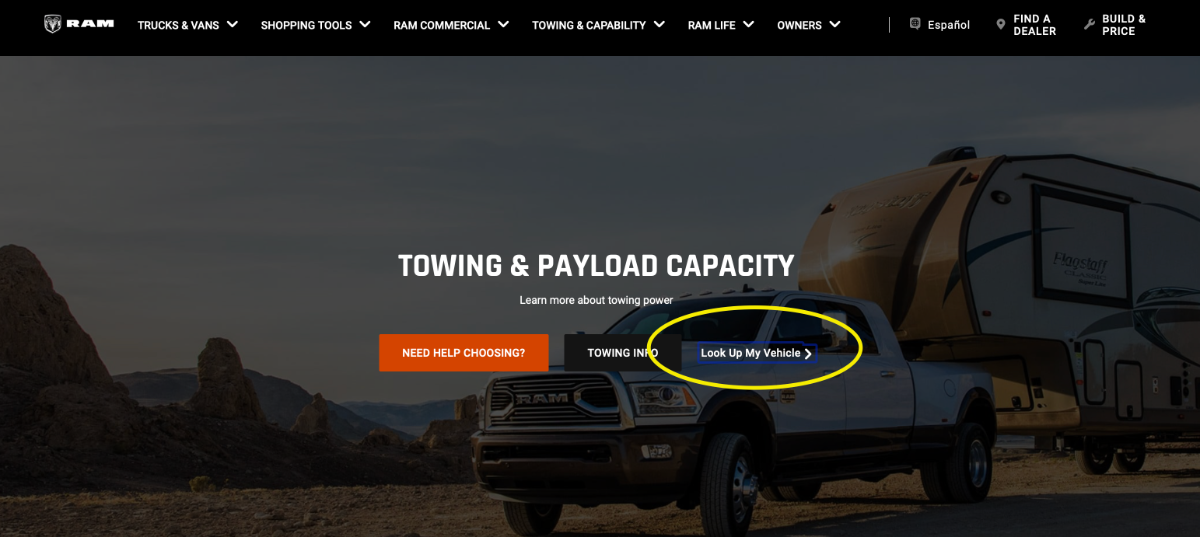
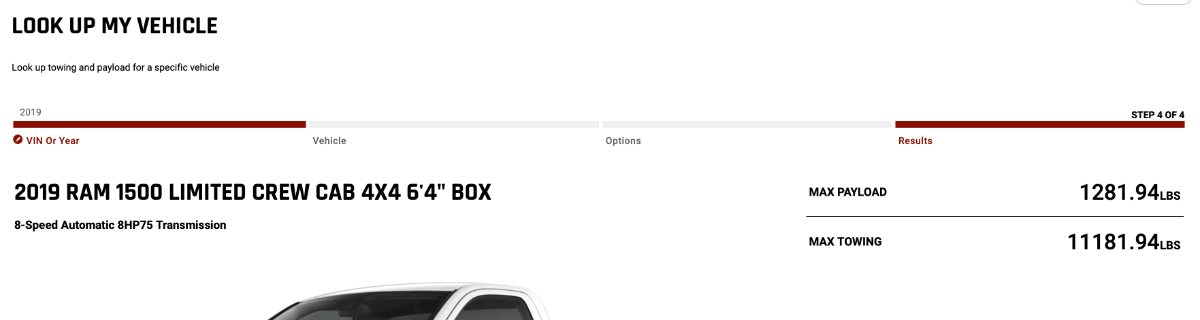
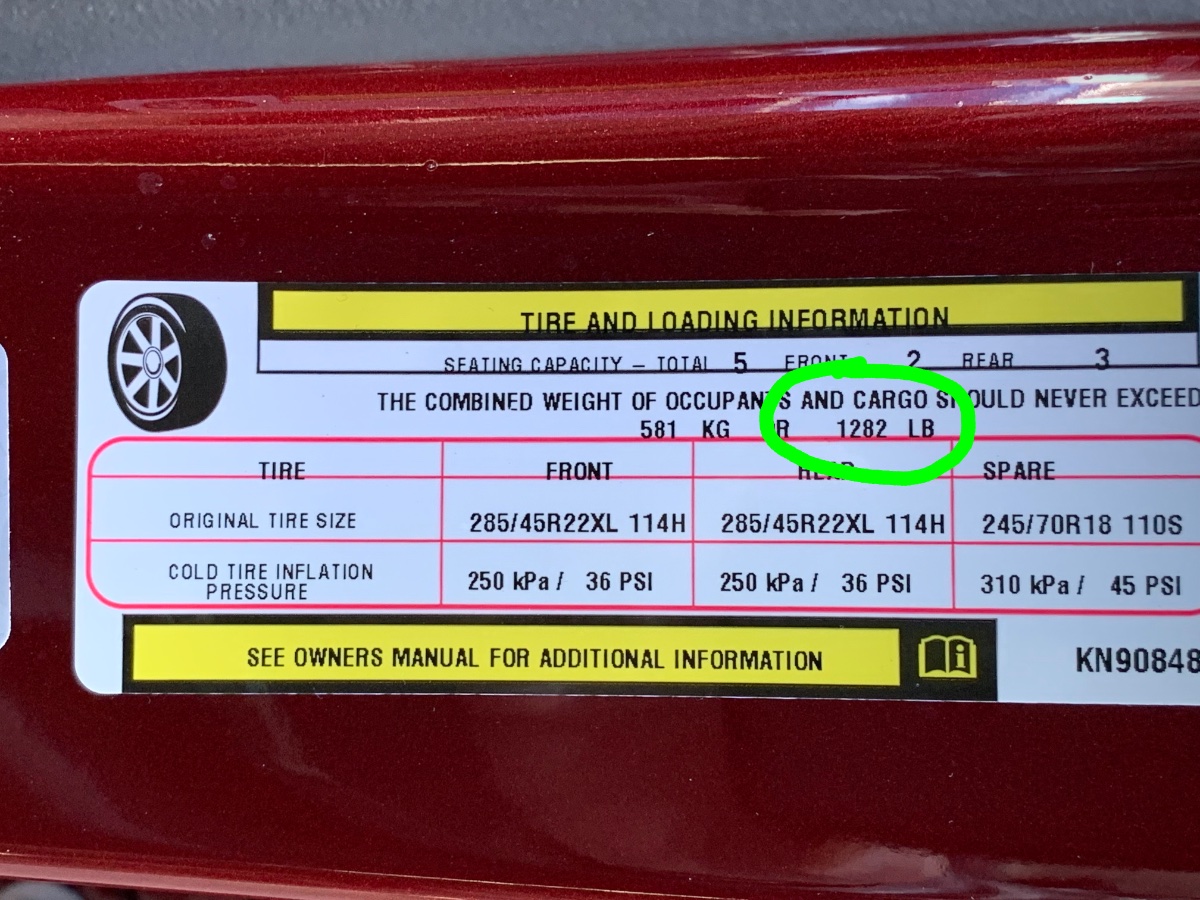
Also for RAM's when you find one outfitted the way you want, don't forget to check the PAYLOAD sticker on the Door Frame before you sign off. If you can't see the vehicle on the lot, RAM has a way to lookup the payload based on the VIN. https://www.ramtrucks.com/towing-guide.html Once you put in the vin you'll see out the door of the "factory" payload. *See the image below* While the picture isn't ever correct (see the disclaimer below the picture of the truck) , it should be the correct payload and tow rating. One thing for sure....don't under buy on Payload...the more glitz in the truck, the lower the final payload. Then as a final check, ask for or go take a PIX of the door jamb Payload Sticker before you sign. I found that on some RAM's their ONLINE payload stickers didn't match the final sticker upon delivery. This one matches with a bit of round up to 1282 lbs payload. (This was a fully loaded truck) one with a much lower trim level had a 1700 lb payload.
1 point
-
How about a great big dead blow hammer and a great big brass drift? Whack the bolt head really hard a few time, check to see if the nut torque dropped, retorqued the nut, repeat until they no longer shift. Like bearing races, at some point they will quit moving and bottom out. Did you install new nuts? They are self locking and should not back out by themselves. OTH old nuts possibly could. If you are really worried, just double nut each bolt with a free running jam nut, which will prevent the “primary” nut from moving. Good luck. John Davies Spokane WA1 point
-
Wow, I could go around and around with this topic. Similar to others that do this exercise, a list of wants, needs and like to haves gets you started and then you go explore. Fortunately (or not) we have seen a good bit of this country, and lived in it - from coat to coast, and in-between, and at the top of out list was seasonal weather - which almost drives two places. So that is where the Oliver came in, we plan to spend winter months in dry warmer areas - and then explore the rest of the year. I put a little wrench in the plan - as I enjoy the home place, and my spouse desires the dry, warmer winter of the desert southwest. So we plan to adopt a hybrid - keep the current home, and just go when we want, keep the options open. Perhaps one day we will find the perfect place.1 point
-
After my wife and I retired we started looking for a place to "settle". With so many choices we found that we were going around in circles. So, we decided to re-start the whole process by each making up a list of things that were important to each of us individually and then get back together, compare those lists with the intent of prioritizing the choices we were making. Since fairly high on each of our lists was a four season climate without hot summers or cold winters we next went to the computer to search climate data and that led us to fairly narrow regions of the country that satisfied that demand. Then we looked within those regions for areas that possibly had the other items on the list - recreation, church, cultural activities, a college, nearby medical facilities, nearby grocery, nearby hardware/lumber, etc. This further narrowed down the possible choices such that we got in a car/plane (no Ollie at that time) and took a look at the areas we had identified. During that process we stumbled on the small town where we currently reside. Long story short - first take your heart out of the equation and approach the problem systematically. Most places around this great country of ours have neighborhoods that are fairly similar to each other but it is the weather that you will have to contend with each and every day. That rural place may seem great but a drive of an hour to get a quart of milk or loaf of bread will get very tiring after awhile. You may only go to the baseball game once a year or to the movies a couple times a year or to a concert or to a ...., but, living in a place without those facilities removes your choice of going which just may be unacceptable - or may be just what your looking for. Finally, do not overlook the availability of medical treatment. Yes, these days you can be medevacked fairly quickly from one place to another. But first you must be stabilized enough in order to be on a chopper. As you get older this becomes more and more important. Bill1 point
-
Nearer the coast would give you more variety. We live in SW Oregon which is great, but mountains have us hemmed in during Winter. Oregon does have most everything: beaches, forests, mountains, deserts, snow, rivers, fishing, hunting, skiing, boating. However, I think Idaho might be a good "jumping off" place; my preference is less populated areas.1 point
-
The difference is that I used a different outlet and a 10 ga drop cord rather than a 12ga. I think there were multiple issues going on. At first the GFCI circuit I used was acting fine and tested fine. Later in the day as time went on it started tripping almost as soon as I plugged the system in. The other outlet in the house was probably not a GFCI circuit. I think the 10 ga drop cord also helped with the occasional power drop. It has run fine now for almost 20 hours with no problems.1 point
-
Are you saying, when your inverter is set to "charger only" or "off", the outlets are not powered, even if the trailer is connected to shore power? If this is the case, and I have my trailer connected to shore power to run a space heater during storage and the power goes out, the inverter will power the heater off the batteries? That wouldn't be good. Is this correct: in a 12v system with a hybrid inverter/charger, the inverter/charger is one unit whereas with a 12v system with a non-hybrid inverter, the inverter is stand alone and works independently of the separate charger? Oliver needs a video crash course - 12v Electrical Systems 101.1 point
-
Heard from Oliver first thing this morning. Our Oliver will be the last of the 600's . . . . . . . our hull# 699 . . . . . . . #666 if you're dyslexic like @Dennis11 point
-
Like a lot of people a year or so into ownership, I've been working lately on reducing the amount of stuff I carry - getting rid of things we never use and also finding strategies of making what we do carry lighter and more compact. I've also been working on a dedicated toolkit that would just stay in the truck permanently, so I don't have to worry about packing tools up and inevitably forgetting the one tool I need that trip. So what I've been after is, 1) a complete toolkit that has everything I might reasonably need for roadside or campsite repairs; 2) compact enough that it can be stored in the cab of the truck permanently, without being in the way; 3) can be stored in a way that still gives easy access when traveling; i.e., I don't have to completely unpack the truck to get to them; and 4) contains quality tools that can be relied upon. Certainly the easier solution is to ignore requirement #2 and just put a toolbox of some sort in the bed of the truck. I think that's perfectly fine; but personally, I'd rather keep them in the cab to protect them from moisture, trail dust, theft, and getting all scuffed up from being jostled around. Plus by keeping everything compact, I'm also forcing myself to keep the weight down. So in the following posts, I'm going to try to list all the tools I've placed in my kit, the reasons for choosing what I did, and then some ideas on how to best store them in your vehicle. The tools I've included are, as I said, what I think constitute a "reasonable" tool kit for repairs while traveling. "Reasonable", of course, is subjective. If you're the type who is likely to call Good Sam to change a flat tire (nothing wrong with that), then your "reasonable" might be limited to a few screwdrivers and a pair of pliers. On the other end of the spectrum, there are guys over on Expedition Portal who wouldn't go to the grocery store without a welder in their Jeep. And nothing wrong with that, either - to each his own. With that in mind, I'd like to think that my following posts are just a starting point for conversation. I'd love to know what others think about these choices - surely I've forgotten something, or one of you knows some better options or alternatives. With some additional voices, hopefully this thread can provide some guidance for new owners or others like me who are looking to pare down what they've been carrying. Fair warning, I do like nice tools, and have a thing for German tools in particular, so some of the stuff listed below is pricey. But I don't think that there's anything here for which you couldn't find a decently priced alternative, and arguably a better value. Or, you might be the guy who doesn't accept anything shy of Snap-On. Either way, buying all of these at once will put a good dent in your checkbook, even if you're shopping at Harbor Freight. So keep in mind that this isn't intended to be a "must have" list. Like I said, you probably don't "need" any of this. All you really need, in most situations, is a cell phone. But if you do decide to put together a toolkit of any size from scratch, I suggest you make an Amazon list and then set price alerts for each tool using 3 Camels (www.camelcamelcamel.com). That way you can buy at the lowest price and spread your purchases out over several months to make the cost seem more palatable. (I've also found after explaining that strategy to my wife, that when the packages arrive, she asks how much we saved vs complaining that I've bought yet another tool.). Actually, she does both, but I think there's less complaining than before.1 point
-
Overland - Great write up. I have been putting together a revised travel tool kit in preparation for our Ollie delivery. First, let me say I'm glad that you included the Knipex pliers. They are so much better to use than adjustable wrenches. With a little technique they are equivalent to using an adjustable ratchet! About a year ago I purchased their cobra pliers, too. I decided to go with a breaker bar, but to forgo a torque wrench. My rationale is that I can get home without a torque wrench. Also, each vehicle I own is getting a breaker bar and right socket for its lug nut size. I decided to go with one big bag for tools (a real downside for the reasons you mention above) because this one set has to be shared between multiple vehicles. I'm afraid to weigh it! This is the tool bag I purchased. Great for on the road weight training! I would say that it stands a fair chance of holding everything Overland included in his list. Quality looks good to me, but let me stress - it will be heavy when outfitted. https://www.amazon.com/gp/product/B000EDTSZG/ref=ppx_yo_dt_b_asin_title_o04_s00?ie=UTF8&psc=1 I might need to include more RV specific tools. Thanks for sharing your thoughts!1 point
-
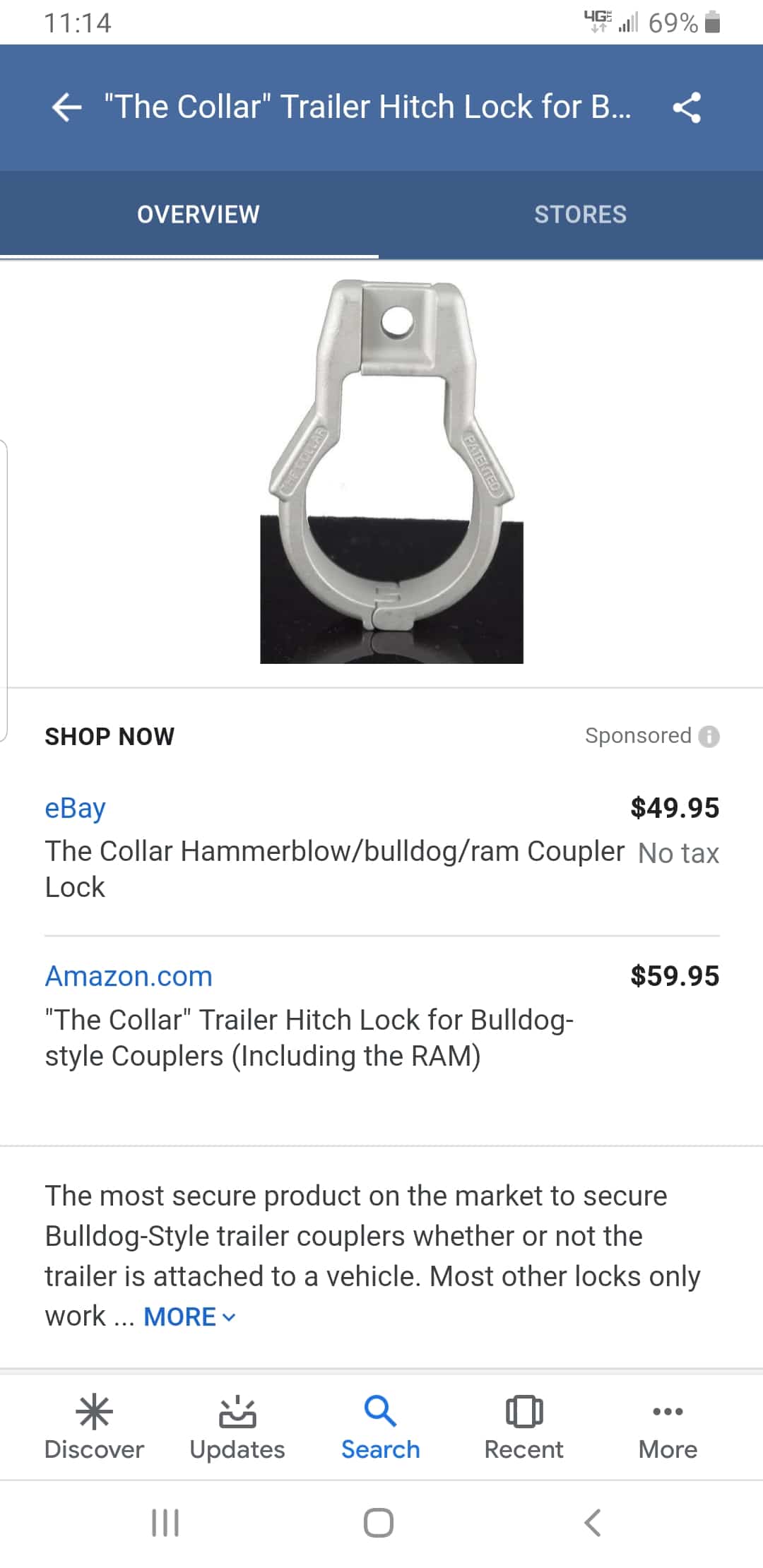
We use a bulldog collar lock. Traveling, or at camp.
1 point
-
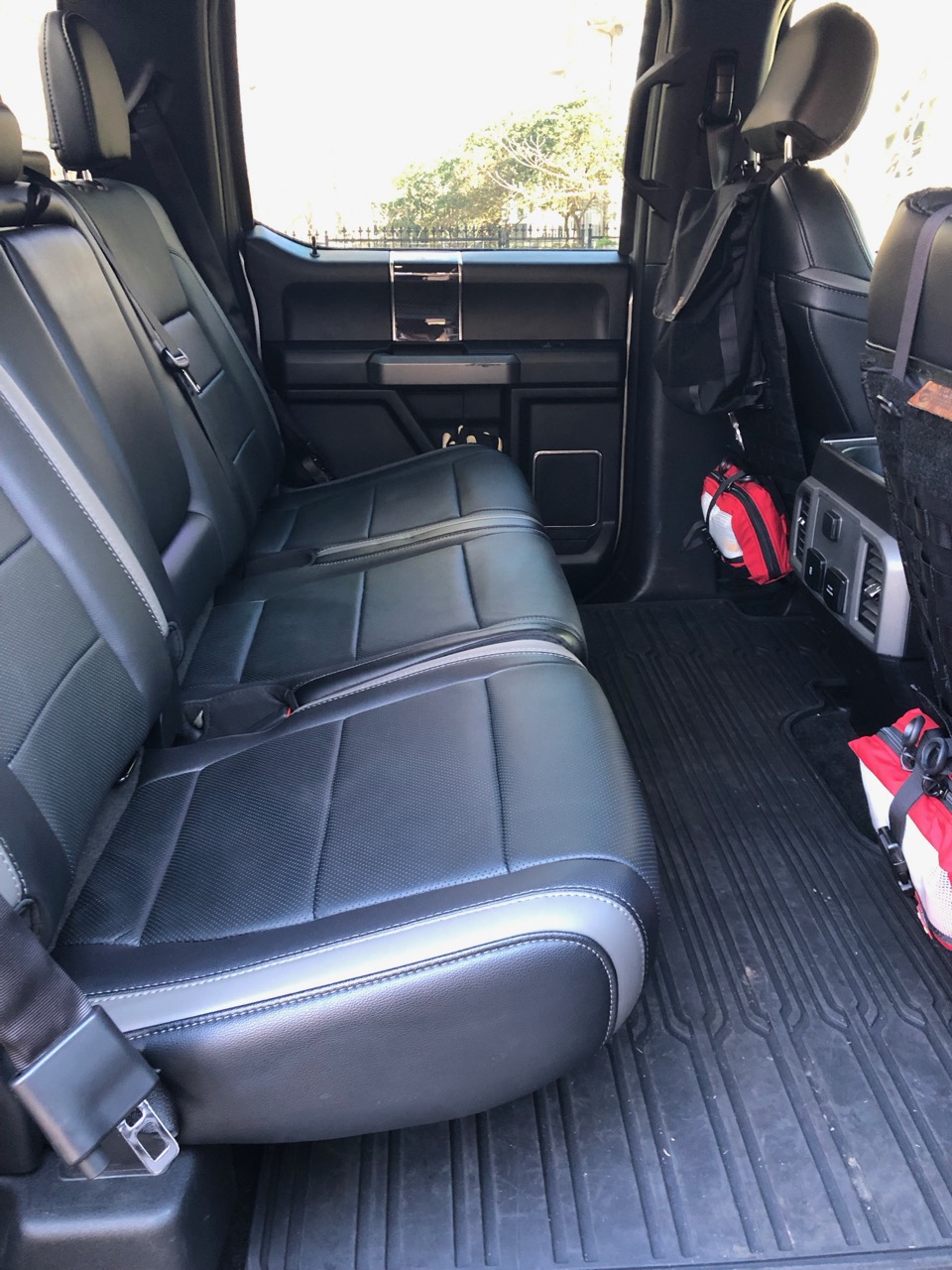
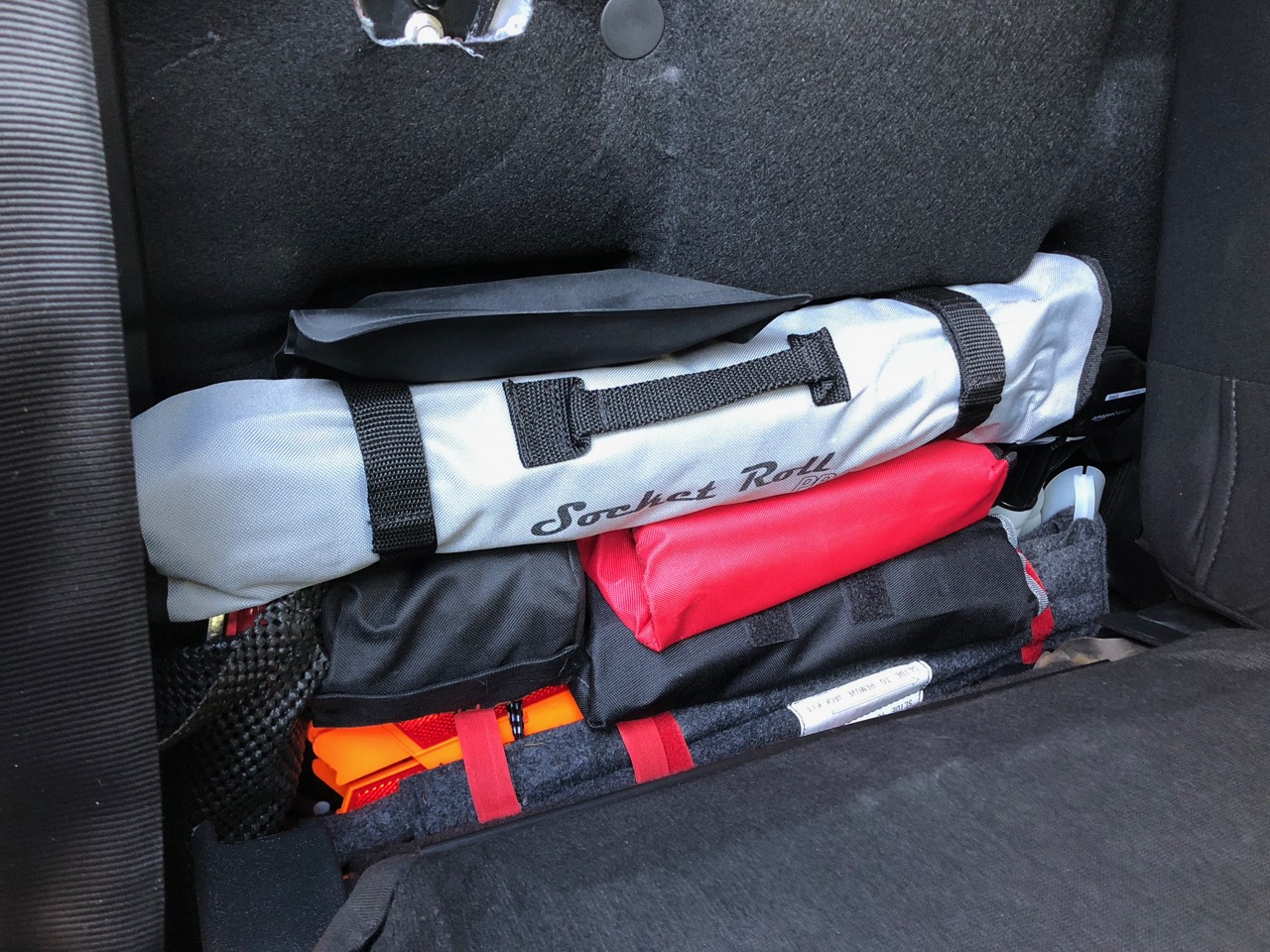
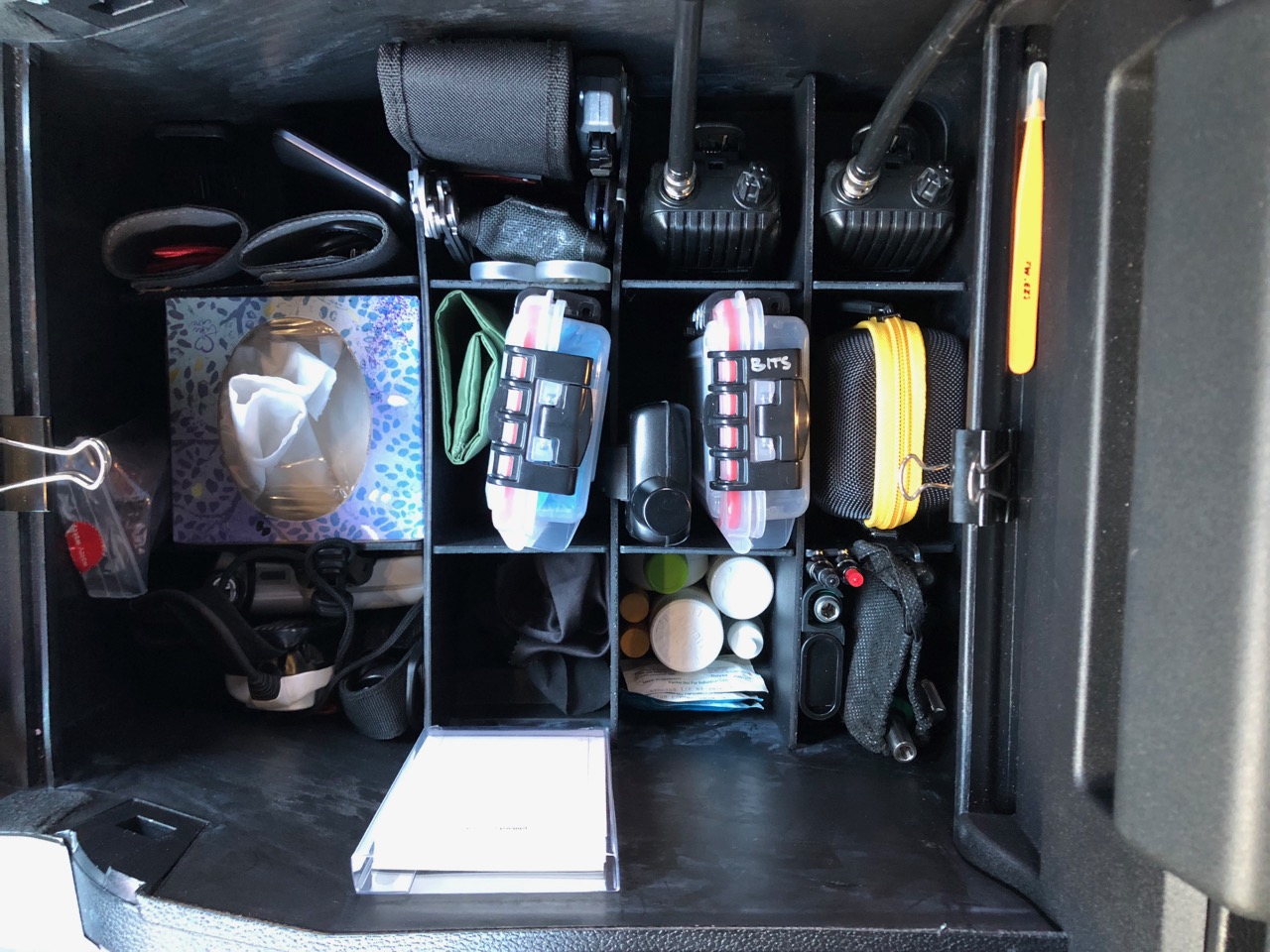
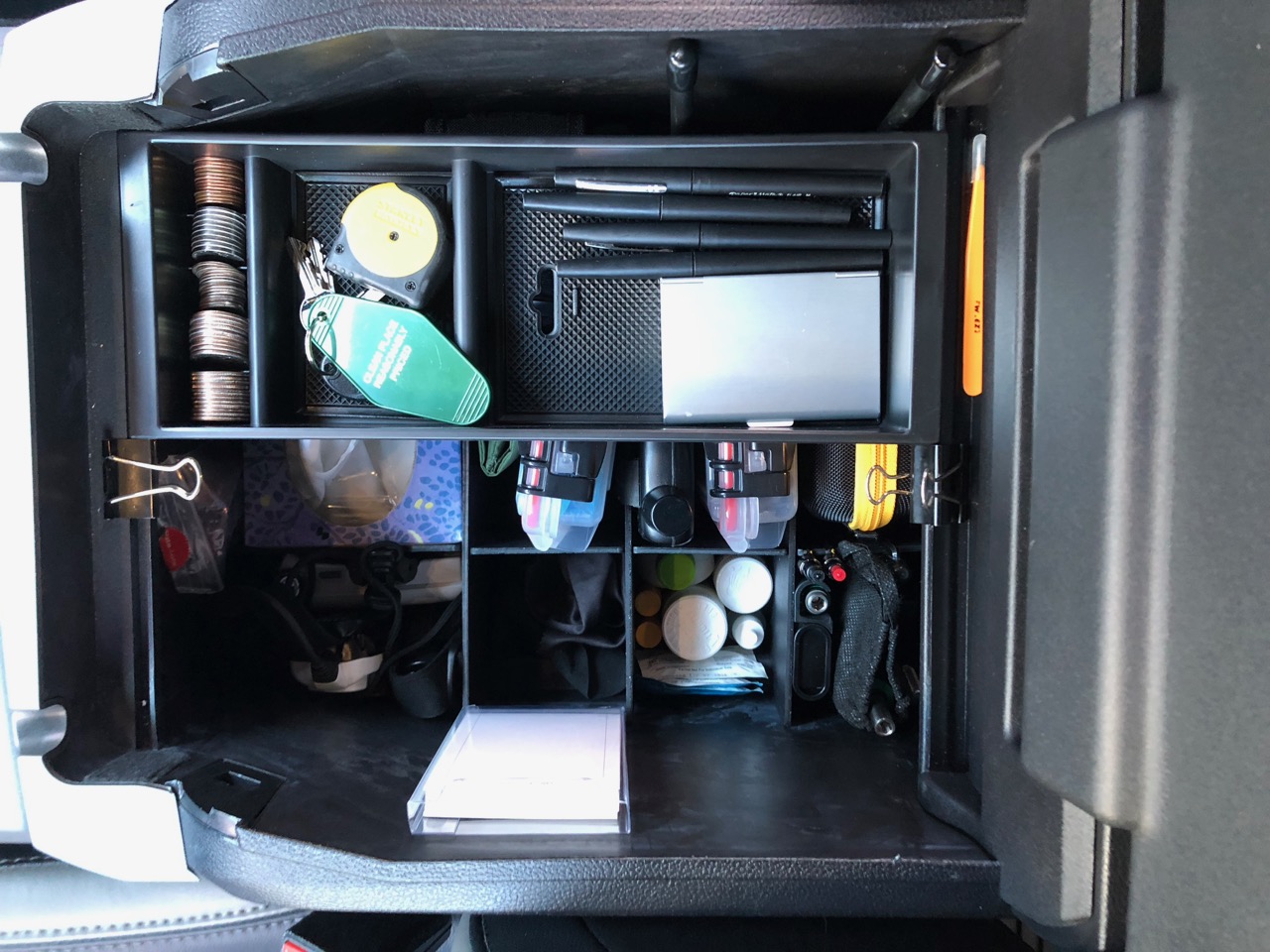
Storage I'm not a fan at all of tool boxes for inside the vehicle. They're noisy, bulky, and your tools get scuffed up. If you're keeping your tools in the back of the truck and don't care if they get banged around, then go for it. I have mixed feelings about tool rolls. On the one hand, they're the classic way of storing tools for travel, they're relatively compact, they keep your tools protected and quiet, and they keep everything organized and easy to find. But while great in theory, I've had a hard time finding tool rolls that work well in practice. Too few pockets, too many pockets, the pockets are too narrow to fit your tools, or too wide and your tools fall out, or they're too short for that one wrench that you then can't find a place for, etc. I have found that they're great if they're tailored for a specific tool kit, like the Tekton Wrench Sets above, and I do like the Socket Roll that I mentioned earlier. I do use this tool roll for my wrenches and this one for my misc. stuff. In both those cases, I bought the rolls so I'm determined to use them; but honestly, I'd rather use bags. But those leather rolls do smell great. What I really like are tool bags. Specifically, I like having my tools divided into a number of small tool bags that I can grab individually rather than pull out a big, heavy bag with all my tools in it. I've had good luck with these bags from Blue Ridge Overland. They're a little pricey, but they're good quality; and most importantly, they just seem to be the right size and proportion. The vinyl front doesn't really let you see anything inside, like they claim, but what it does do is provide a nice surface for some bright orange gorilla tape, which can be marked with a fat sharpie and is perfect for labeling the bags. I've found that these bags stuff well wherever I want them, and they're flexible enough to wrap around the tools to keep them quiet and protected. I absolutely hate rattles in cars, and these bags keep me happy. I also like these waterproof DAKA bags from Magpul. They're more expensive than the Blue Ridge bags, but they're definitely tougher. Plus they have a nice grippy surface, so I can see them being a good choice if you have to get out in the rain. I've tried cheaper bags from Home Depot and places, but those always end up being a difficult size to fit things in, or they tear up and so I seem to keep buying the ones from Blue Ridge. This larger size version fits my impact wrench, work light, charger, and spare batteries perfectly. As for how much space in the truck all of this takes up, well, judge for yourself: About half of the tools go into the storage tray under the rear seat. The ones velcroed to the seat bottom hold tape, zip ties, electrical repair stuff, etc. (The red bags on the back seat are first aid kits, which get stuffed into backpacks when we travel, and the larger black bag is for trash.) The remaining tools go behind the smaller, fold down seat back: The center console is packed, but is organized well enough that it stays that way: And even the glove box stays clean - the grey bag holds the key to my wheel locks and a few other things that the dealer might need to get to, and the red one holds a couple EpiPens and some other first aid things. Then some USB cables, window scraper, owners manual, and a pair of gloves: So there you go - a (hopefully) complete tool kit that takes up next to nothing inside the truck.
1 point


















-
Recent Achievements
-