Leaderboard



Popular Content
Showing content with the highest reputation on 11/06/2021 in all areas
-
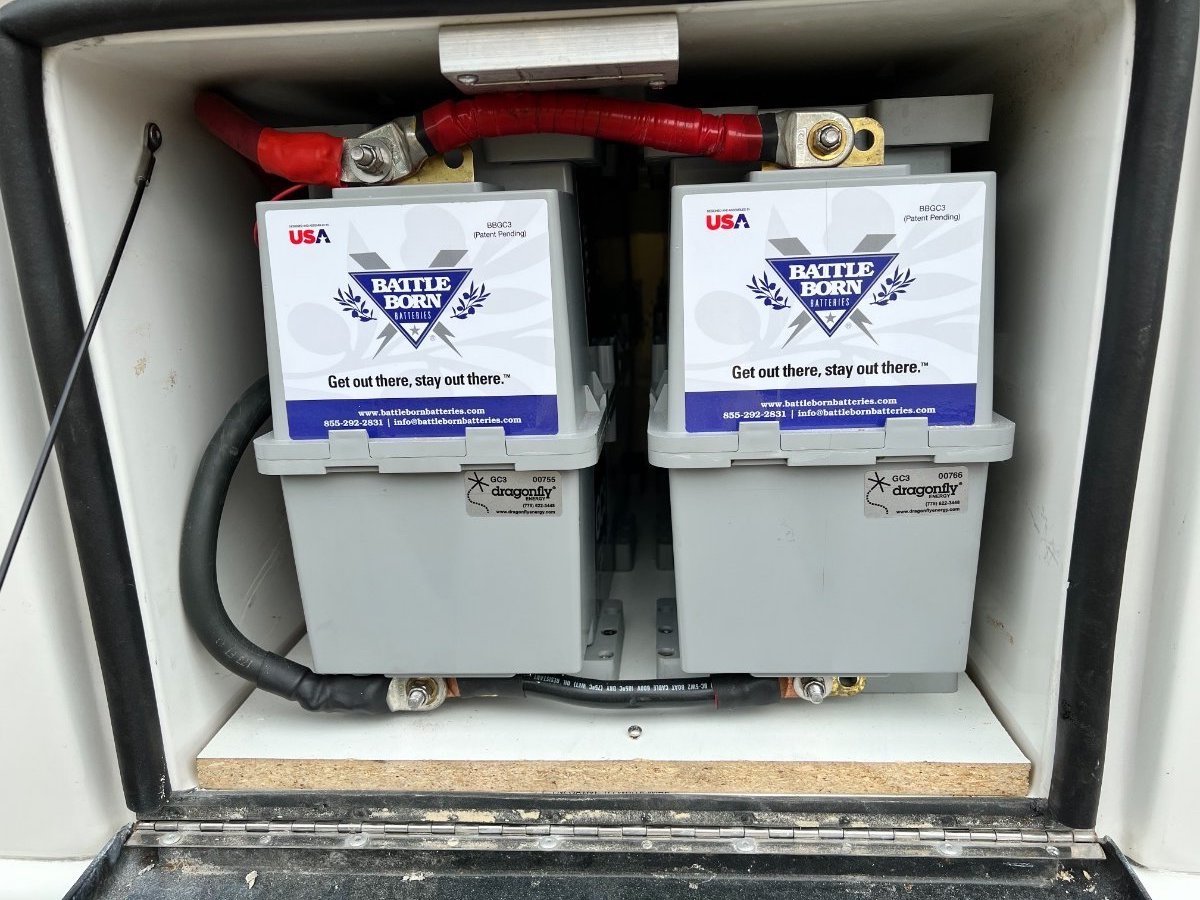
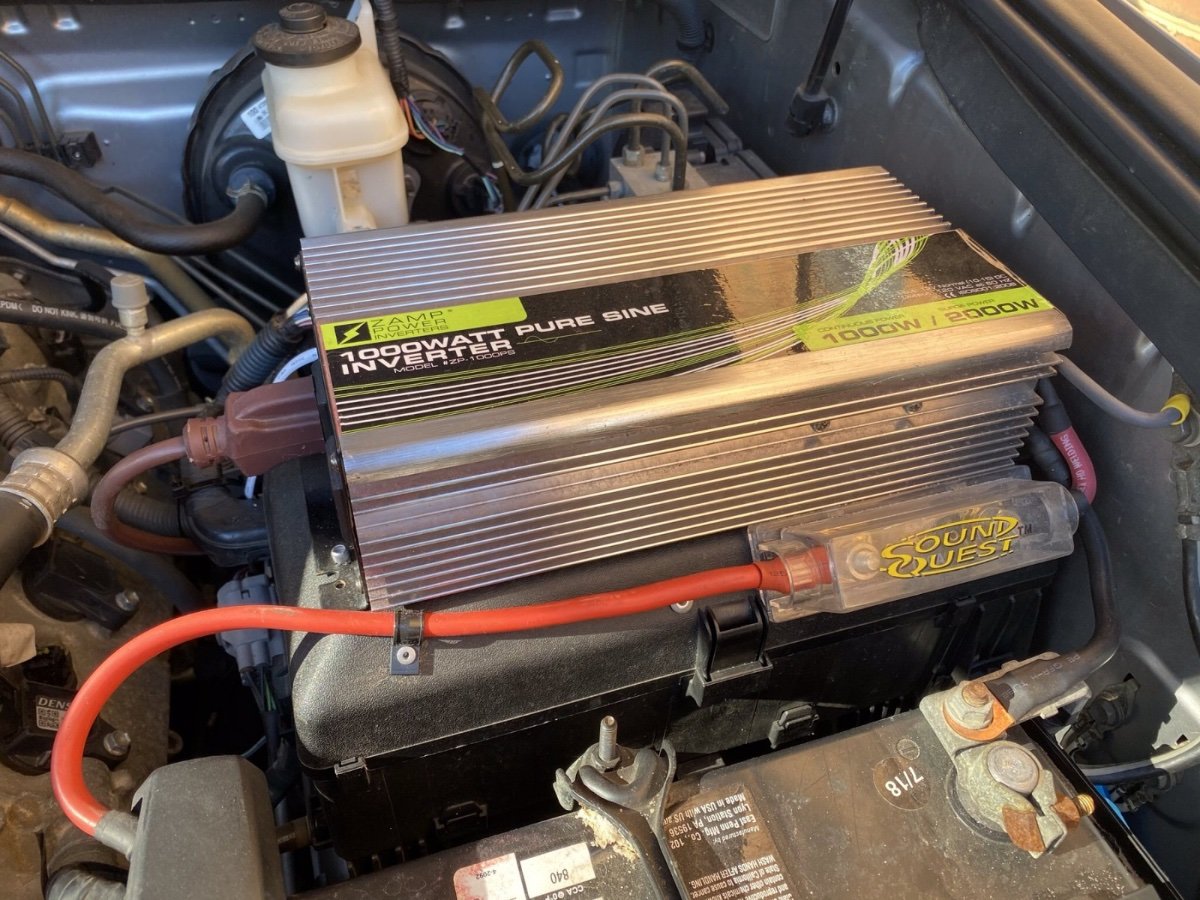
Minnesota Oli-I have had the same experience. I upgraded to three Battle Born batteries and have the Blue Sky MPPT charge controller/system. The Blue Sky controller is fully programmable. I sent the BB folks a copy of the set-up page and asked them to put in the parameters that they wanted to see and it only took me a few minutes to program. My solar panel total back in 2017 was 320 watts. I do carry a portable 100 watt panel and have used it a couple of times just to test what the little extra can do but, have never really needed it or the 2000 watt generator. I have the usual installed electrical equipment plus a couple of years ago I switched out my unreliable propane fridge for a NovaKool compressor fridge so also have that constant load as well. 320 watts isn’t really ideal but, for reasonable power usage it does work. Even connected to shore power I never have needed the PD4045 shore power charger unless we have had several days of clouds and then only if the batteries were below 50%. All in all I’d say that the “older” factory set-up with the Blue Sky MPPT controller, three or four Battle Born batteries, and 2000 watt inverter is a great entry level system.5 points
-
This may start a firestorm but.... I picked up an Elite II last December. Have driven it all over the eastern seaboard including the Adirondacks, Whites, Blue Ridge and Green Mountains. About 7.5k miles so far, all with a 2016 Chevy Colorado. I use the Anderson weight distro/anti wobble hitch and aside from the trailer brake system the only modification I did was adding Sumo springs (easy install). The truck is rated to tow 7,000lbs and my loaded trailer is running about 6,000 with a full fresh water tank. Pros: Great daily driver, gets 13mpg while towing, owned before I got the trailer. It handles fine, don't really feel fast passing semis, no sway or porpoising. Gets up to speed on highway on ramps without my ever having to stomp on the peddle. Cons: On hot days and extended mountain climbs the transmission can run up to 225 degrees which is fine but close to the edge. With a passenger, kayaks on the roof and a bed full of toys, I am pushing right up against my payload limit. Hits 5.5k rpms when passing on a hill which is acceptable according to manufacturer but I can feel and hear the strain. Takeaways: I feel the Colorado can safely get the job done in rolling terrain but there is little room for safety margin. The braking, drive train and suspension are rated to do the work (read up on SAE rating requirements). That said, is it really prudent to run against the capacities on a frequent basis? Will certainly effect the longevity of the tow vehicle and I worry about ability to handle an emergency avoidance maneuver. If I were limiting my towing to modestly hilly terrain and staying out of the mountains and willing to compromise on my payload options, I'd consider sticking with the Colorado. My new F150 (tow capacity is 11k lbs and the payload more then doubled) is due for delivery in December. Side note: I bought the Colorado with 18,000 on it for $30,000 and can sell it now, with 80,000 miles for $25,000. Even at the obscene price of the new Ford, considering the 0% financing and a more sensible match for towing, it's a no brainer. Gerry4 points
-
I do not have a clue but flipped it for you. I am hazy about how you mounted the board to the compartment, some additional (upright) pics would be helpful. The board appears to be regular particle board... Are you aware of its unsuitability for a structural mount? Especially in a potentially wet area? https://www.livspace.com/in/magazine/materials101-particle-board-vs-plywood John Davies Spokane WA
 3 points
 -
Like our other outdoor cooking gear, the Dutch oven resides in a box in the truck bed, if I carry it.3 points
-
Whatever you decide on this question - do not stash it in a drawer.😁 Sorry for the bit of an inside joke here. Back in the not so distant past there was an owner who stored cast iron cooking things in the drawers. It took some time for this to become common knowledge. The owner also had serious problems with the kitchen drawers not wanting to stay shut when traveling around on curvy roads.3 points
-
We like the convection microwave and can’t imagine not having a hot meal on a cold windy rainy night. ✔️ We have a Weber Q1200 that we use all the time when weather permits. My wife has two Dutch ovens which she uses primarily for her homemade sourdough bread recipes. As for carrying one in our Oliver we don’t as it is boat anchor heavy and we likely would not use it enough to justify carrying it on trips. You will find a lot of opinions on likes and dislikes on the finer details of the Oliver which is certainly subjective. We weighed everything prior to ordering and read this forum extensively to help educate ourselves. It’s also important to determine how you intend to use your Oliver. Oliver owners FB page if you have a FB acct has at times interesting owner feedback. I suggest you take time to read through the Owners manuals and also Oliver University. This is great information that any owner or new potential owner should read prior to ordering an Oliver. The Oliver videos are also very well done. - Patriot3 points
-
I don't think that's a "cheap out." I think it's more an easier option for most owners. Zamp is in no way "cheap" equipment. It's solid, well tested, well received, usa based, and an integral part of the Oliver solar package for a long time. Is it appropriate or best for lifepo4 batteries? No, imo, not really. I suspect that will change, in the future. In the meantime, if I were buying a lithium option, I'd ask for an mppt controller, and if turned down, I'd swap it out. The more people who ask, the greater likelihood of change. Heck, maybe zamp will even come out with an mppt someday soon. A solid industry tested mppt controller would be a great addition to the system, imo . We have victron on the boat, blue sky in our trailer, and lithium in neither (yet.) Both solar controllers are capable of working with lithium. We may, or may not, change up to lifepo4 in the future. I'm personally not sold, yet, on the expense or necessity, for our needs. But, truth is, most relatively small pv systems (like what fits on the Oliie rooftop) could not fully recharge the big lithium batteries being sold today, on a regular basis, if drawn down to zero. The math doesn't support it. So, reliable, proven easy to use Zamp is not such a bad choice, either.3 points
-
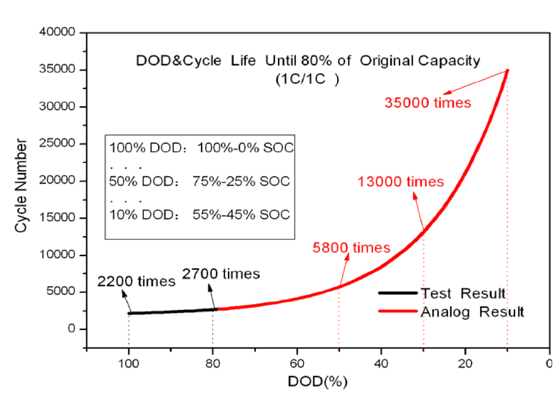
There have been numerous posts in this forum about Oliver’s lithium battery systems—about their usefulness, limitations, and value with respect to cost. Despite reasonable arguments against it, a number of us have purchased the lithium package. Reasons for purchasing the option have included the ability to run the air conditioner (A/C) for short durations (like at highway rest stops), greater usable energy (more boondocking in cloudy weather without needing a generator), faster charging, and longer battery life. This post summarizes things I’ve learned over the last 6 months about the Xantrex/Lithium/Zamp system. This post might also be titled “Things I Wish I’d Known from the Start.” This summary is a work in progress. Hopefully, with your corrections and additions, this thread will be of use to others that have purchased the Lithionics option or are considering doing so. At the time of this writing, manuals and other information for the Lithionics batteries are in the Service Center Knowledge Base — see links at the end of this post. I assume at some point Lithionics information will be compiled with all of the other trailer manuals in Oliver University. Battery State of Charge A key component of the Lithionics system is the app that lets users monitor State of Charge (SOC) and voltage (see links below). The reliability of the SOC values (which describes the amount of energy remaining in the battery) depends on (1) maintaining SOC calibration and having (2) up-to-date Lithionics firmware. The SOC should be near 100% at 13.6 volts, and about 50% (+/- about 10%) at 13.2 volts. If this is not what you’re seeing on the Zamp controller, Xantrex remote, or Lithionics battery app, then something’s wrong. By way of example, a couple times we’ve experienced the SOC readings of 60% when the batteries were dead -- not good. Note that the voltage reading on the app while there is a load on the system (e.g., electric heater) is different than when there is no load; the “resting” voltage may be higher. SOC Calibration The SOC requires periodic calibration. According to the manual for the 130 Ah batteries, the SOC can be calibrated simply by charging the batteries to 14.4 volts. The manual also states that fully charging the batteries to 14.4 volts should be done at least once every two weeks for battery life. Get the 130-Ah battery manual from Lithionics using the links below; at the time of this writing, Oliver has the incorrect manual posted in the Knowledge Base). When charging with shore power, it is not always apparent that the batteries have reached 14.4 volts, because when charging, the batteries only stay at ~14.4 volts for a short while before dropping back to about 13.6 volts. You can verify that batteries have reached 14.4 volts by monitoring battery voltage using the Lithionics app during a charging event. If you are unsure that the batteries are reaching 14.4 volts, you can at least confirm that the Xantrex charger/inverter is set to charge to at least 14.4 volts in the Xantrex app (https://support.olivertraveltrailers.com/portal/en/kb/articles/xantrex-remote-bluetooth-pair-operation) and, under Settings, check the custom absorption voltage. Ours came from the factory set at 14.6 volts, which is sufficiently high to get the batteries to 14.4 volts. Lithionics Firmware At least some of us that picked up our trailers in spring or early summer have batteries with outdated firmware. As I understand from Lithionics, more recent firmware versions have an improved SOC algorithm (our initial SOC readings were unreliable). You can check firmware version with the Lithionics app by clicking on a battery, then clicking on the settings “sprocket” in the upper right side, and then clicking on firmware. Our battery came with firmware version 1.0.05; I’ve recently updated to 1.0.07 by clicking on flash firmware. This has to be done with your phone in close proximity to the battery, and has to be done separately for each battery. Updating firmware comes with a “…this is a critical operation…” warning; you might want to check with Oliver or Lithionics if you have any questions about doing this. Has updating firmware improved our SOC readings? I’m not sure yet, but I think so. So far, the readings seem more reliable, but I’m still testing. SOC Calibration by Cycling A Lithionics rep told me that the SOC can be calibrated by “cycling” the batteries, and that this should be done every two months. Cycling consists of discharging the batteries to reserve voltage (e.g., ~12.1 volts) and then charging to 14.4 volts. However, the rep could not point to written documentation supporting this form of calibration. As the batteries support more partial cycles than full cycles (see graph below), calibrating by simply charging to 14.4 volts (assuming this effectively calibrates the SOC) seems better for battery life. Lithionics batteries will not charge from tow vehicle The standard 7-pin connection from tow vehicle to trailer cannot be used for charging the Lithionics batteries. Charging the batteries from the TV requires a DC to DC charger, which is an aftermarket installation. For more discussion on this, search for John Davies’ Redarc DC-to-DC charger installation description. Batteries Turn Off Twice now one or two of the three 130-Ah batteries have turned off when reaching low voltage (which happened because we were relying on incorrect SOC values). The SOC readings themselves looked OK, but the voltage did not correspond with SOC. The battery State in the Lithionics app reads “Off” for each battery when it is off. There is no flag on the Zamp or Xantrex control panel that alert the user to one or two batteries being off. The lesson (at least for me): monitor all three batteries, not just one, and note the Current, Power, State, and Status Code settings. If one or more batteries are off, turn the battery(ies) back on, and fully charge to 14.4 volts. Inverter Noise The Xantrex charger/inverter can be noisy charging the batteries with shore power (I’ve measured 60-64 decibels in the cabin when batteries are charging, and about 72 decibels adjacent to the inverter). The noise comes from (1) the charger/inverter fan and (2) the way in which the inverter is mounted (the fiberglass wall to which the inverter is mounted propagates noise into the cabin). The noise can be masked by turning on the A/C. Alternatively, the noise level can be reduced somewhat by lowering the charger current. In the Xantrex app, go to settings, and change the Charger Current from, for example, 100 amps to 30 amps. This will reduce fan noise. It will obviously take longer to charge the batteries with lower current. If you would like to be connected to shore power (to run an electric heater or the A/C, for example), but not charge the batteries (to avoid keeping them fully charged for long periods of time, or to reduce inverter noise) you can set the charger ignition control in the Xantrex app settings to “auto-on” (thanks to NCEagle for figuring this one out). In this mode shore power energizes the 110 outlets, the A/C, and the fridge, but does not charge the batteries. Turn the charger ignition control “off” to resume charging batteries with shore power. There are likely ways of re-mounting the inverter so that noise does not propagate into the cabin, with either a different mounting location or perhaps mounts using rubber bushings. Has anyone tried this yet? Xantrex Communication Errors Too often, I’ve gotten “Code 20” communication errors on the Xantrex remote panel. This can be resolved by pushing the red button on the 300A breaker under the streetside bed, waiting for at least 30 minutes, and then pressing in the little red flag on the breaker. Yes, this is a pain (I wish this breaker were more accessible), but it usually resolves the issue. Leaving the Xantrex inverter on battery mode for 25 hours or more will result in the Code 20 communication error. The time limit can be changed in the Xantrex app, but cannot be lengthened to more than 25 hours. As long as the inverter has not timed out, turning the inverter off and then on again at the remote panel resets the 25-hour time-limit clock. Battery Storage Lithionics provides guidance for storing the lithium batteries (see link below). Long term storage can include lowering the SOC to about 50%. Discharging to the appropriate SOC can be accomplished by turning on an electrical load (e.g., A/C or space heater) while in battery mode and monitoring frequently. Theoretically one could set the inverter cutoff voltage (in the inverter app, under settings), to something like 13.2 volts, but the highest cutoff-voltage option is 12.8 volts. Lithionics recommends keeping a log of SOC and voltage readings prior to and after storage for warranty purposes. ------------------------ Hope this helps. Again, please correct any errors that you see, and please add your observations and tips. Fritz ------------------------------------------ Relevant Links Lithionics battery app: https://support.olivertraveltrailers.com/portal/api/kbArticles/386680000012415191/locale/en/attachments/lpqvx861bbc9c842d48f7995281b07d0a193d/content?portalId=edbsnfe5dceb1ade7571879ff200cb63e14a94b62f48e3338c31a6401acd00130b0bc&inline=true). Lithionics battery manual: At the time of this writing, the Oliver Knowledge Base has links to Lithionics manuals for 125 Ah and 320 Ah batteries. However, our LE2 has three 130 Ah batteries as part of the 390-Ah package, and the manuals for the 125-AH batteries and the 130-Ah batteries are not the same. A manual for the 130 Ah battery can be found on the Lithionics website: https://lithionicsbattery.com/wp-content/uploads/2018/12/12V130-G31LRBM8-Battery-User-Guide-R1.pdf. Lithionics Storage Procedure https://support.olivertraveltrailers.com/portal/api/kbArticles/386680000012415191/locale/en/attachments/lrotz3ebee5a7020f42a58eb0d4db18a41356/content?portalId=edbsnfe5dceb1ade7571879ff200cb63e14a94b62f48e3338c31a6401acd00130b0bc&inline=true Lithionics FAQs https://support.olivertraveltrailers.com/portal/api/kbArticles/386680000012415191/locale/en/attachments/lrotz0edc34bc92ef4dce941bbb7f3f2d89db/content?portalId=edbsnfe5dceb1ade7571879ff200cb63e14a94b62f48e3338c31a6401acd00130b0bc&inline=true Xantrex Remote Bluetooth Pairing and Operation https://support.olivertraveltrailers.com/portal/en/kb/articles/xantrex-remote-bluetooth-pair-operation
2 points
-
seems like a mad scientist kinda idea...maybe i should have had my nap today..?2 points
-
Thank you, John. You and others have set a very high standard!2 points
-
My Colorado is the first Chevy I've ever had. Drove Tacomas for 35 years straight and that was a total of just 3 trucks. To my tastes, the Toyotas kept inching up in price and down in value so I thought I'd try something new. Loved the Colorado and had no problems with it aside from routine maintenance. Super comfy and dependable ride. The only reason I went with the Ford 150 instead of a Chevy 1500 is that I am a one vehicle guy so need a semi fuel efficient (for a truck) and capable tow vehicle. The Ford seemed to offer the best combination and has a similar dependability record to the Silverados. Managed to get the build I wanted with all the tow and safety add ons at just under $50k so am pretty happy with the order. Trucks are obscenely and unfairly expensive but, like most of the folks on this forum, there's no getting around it. Even if I never towed, I'm live a very "trucky" lifestyle.2 points
-
I’ve never owned a Chevy truck… I don’t think you can go wrong with any of the truck manufacturers. I’ve owned Toyotas (2), Fords (3), Rams (3) and International Harvester (‘71 - a classic). All were good, I’m sure a Chevrolet or GMC would be good as well. In the current market you may not have a lot of choice, if it has the features and comfort you’re looking for it will be fine. Mike2 points
-
It really is a very odd car market. Used pricing is up 30% over last year. We have been looking for a new crossover for my wife, certain brands are unobtanium, the local Toyota sales drone actually laughed at us, we walked in and expected to see a new RAV4. How droll! They are not even taking orders. In Seattle, some dealerships are pretty much ghost towns, what comes in off the truck is already sold at well over MSRP (“Market Adjustment” AKA theft), so there are no cars to view, much less to test drive. Unless you want a Volvo, he had all kinds of inventory. But those dealers list all that ghost inventory on their websites. They do not say “In Transit” they say “Call for availability.” what crap, pardon my language. My wife made a special trip there, a five hour drive, to look at cars, and then found out that they were expected next week. We test drove a 2019 Acura RDX A-Spec yesterday at Autonation here in Spokane, what a wonderful car! It was Certified Used with 40,000 miles, and had just come out of the detail shop. By the time we returned it, it had been sold for $45,000, sight unseen! We placed an order on a brand new 2022 model with much more equipment at MSRP ($52,000). It won't get here until spring, we can wait. The salesperson did not even take a deposit. “If you back out, it will be gone within four hours.” I feel sorry for folks who need a vehicle right now and have to pay new car prices for old cars. I do not have ANY faith that 2022 will improve, on the contrary it may get even more difficult. So far Acuras do not seem to be so hard to find, too bad they don’t make a truck. John Davies Spokane WA2 points
-
Sorry but these new Toyota trucks are not due at dealerships until December and even then it will not be the full line until late 1st quarter next year. There is a lot of chatter because their trucks have proven to be reliable, comfortable hard working trucks over time and have a great, loyal fan base. Whenever a major manufacturer announces a totally redesigned line and its being the first major change from Toyota in its larger truck in something like 16 years, there will be great interest. I've said it many times on this Forum - there is not a "bad" 1/2 ton or even 3/4 ton truck out on the new market today. Comfort is subjective, interior design is subjective but all of the performance specs on these trucks fall fairly close to each other. In today's market - good luck in finding the "right" truck for your needs. Bill2 points
-
In addition to SeaDawg's suggestions above on places to "go", there are always the use of a portable waste tank - I use a small size that is reasonably easy to handle (i.e. when full I can still pick it up to dump in a pit or regular toilet) - or, something like "wag" bags (plastic bags with dry chemicals in the bottom) for waste disposal like THESE. In over 25 years of RVing I've never had an issue with "going".2 points
-
I just want to mention that earlier this year in April I spent ten days in Colorado and Utah with the Oliver with out shore power. The Oliver had 340 watts on the roof and Zamp 30 amp charge controller. The only up grade was four 100 ah Battle Born batteries and Victron battery monitor. We used the furnace every night, inverter for coffee maker every morning and microwave a few times to thaw food. Plus lights, water pump, fan, music. I brought alone a generator but never needed it. We always had batteries top off with the morning sun. This was a big improvement over my previous experience with the AGM batteries. At this point I am happy that I kept my 2000 watt Inverter, it handles everything just fine including the new Houghton AC with out any of the new inverter charger issues. I recently up graded my roof mounted solar only because I live in MN and can not expect to harvest as much energy as Colorado or Utah. I do think simpler is better, like the Battle Born batteries are easy to use when coupled with Victron battery monitor and a cut off switch, which make it easy to care for off season. So eventually they will work the kinks out but simpler is better.2 points
-
When our Dutch oven travels with us it’s usually only on short trips and has a place in the bed of the truck. On extended trips weight becomes more of an issue….We tend to come home with more in the truck then we left home with, and it’s usually pretty heavy stuff…. Like rocks…. so we try to pay attention to our payload to some extent.. We use the convection oven quite a bit and it works out great for us… we cook everything in it we use the oven at home. The only factor to keep in mind is the size of it.2 points
-
I would agree with SeaDawg, I have recently completed a up grade to roof mounted panels and have had talked to Zamp about recommendations for charge controller for the rated watts of my solar array. They are very helpful and easy to talk to and for my size of system they recommend a mppt charge controller, they said they currently do not have one to offer to me but that in the future they will have one. It was in the process of being developed, I did purchase there panels for my project, I do think they make a quality product and I like the made in USA.2 points
-
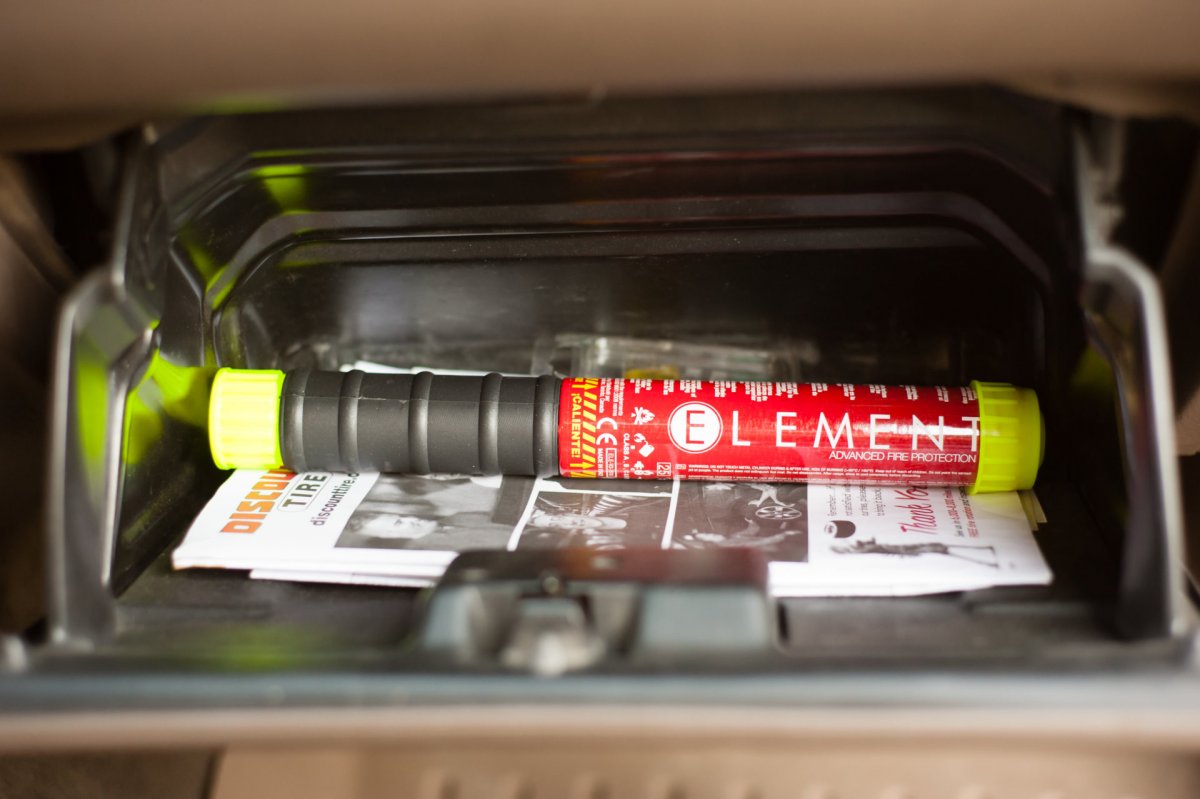
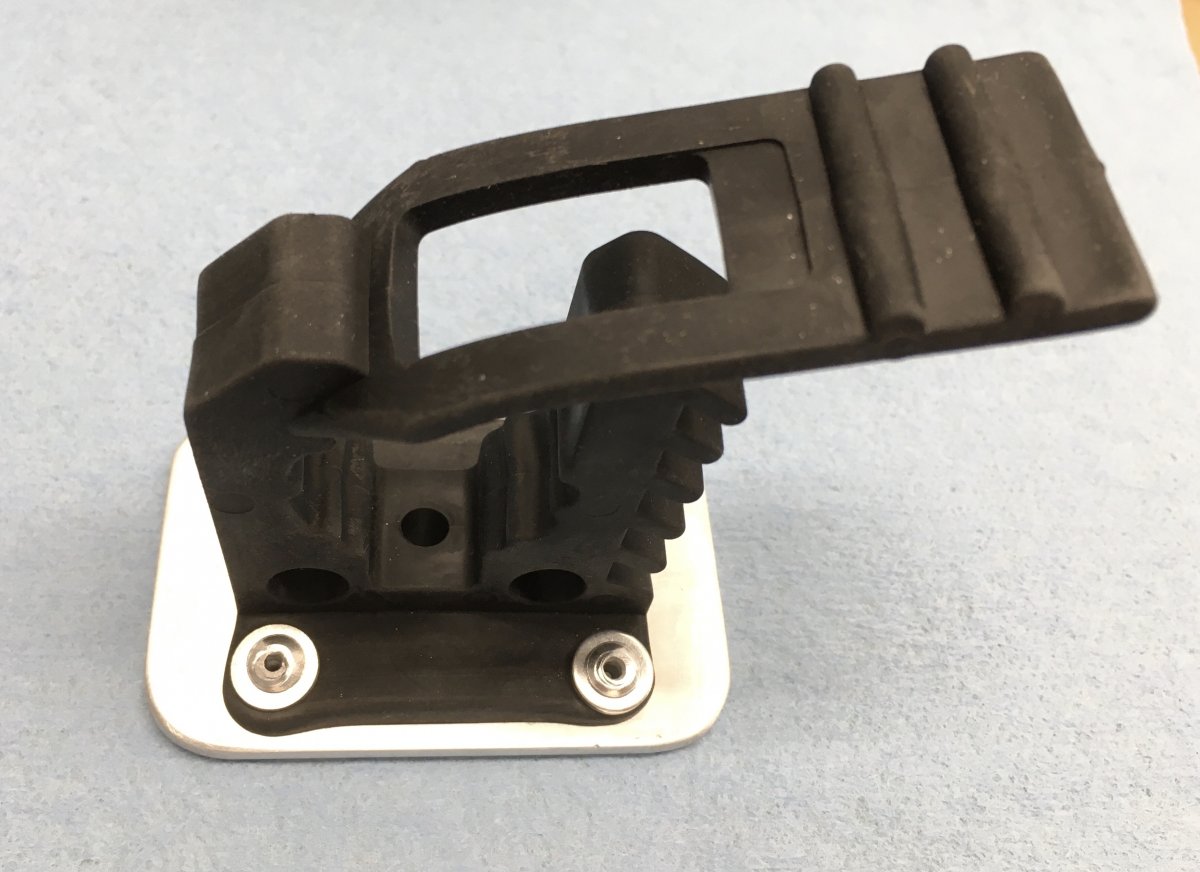
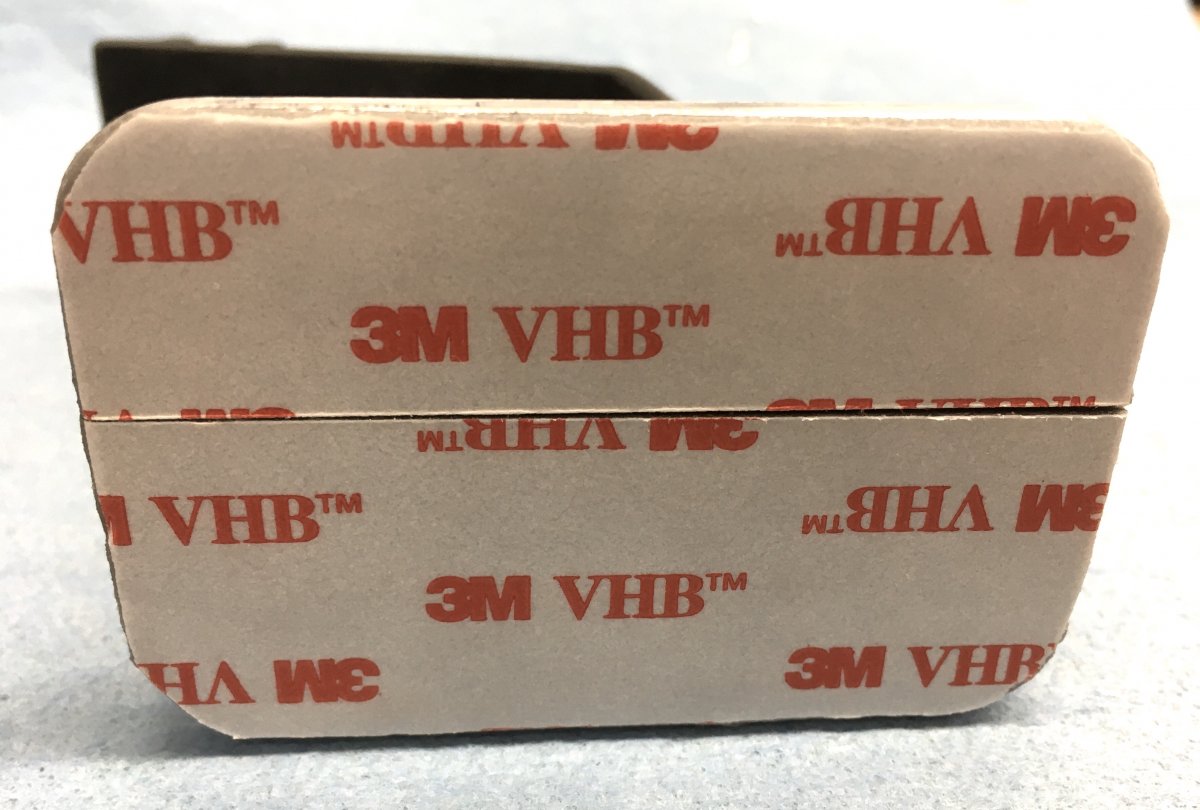
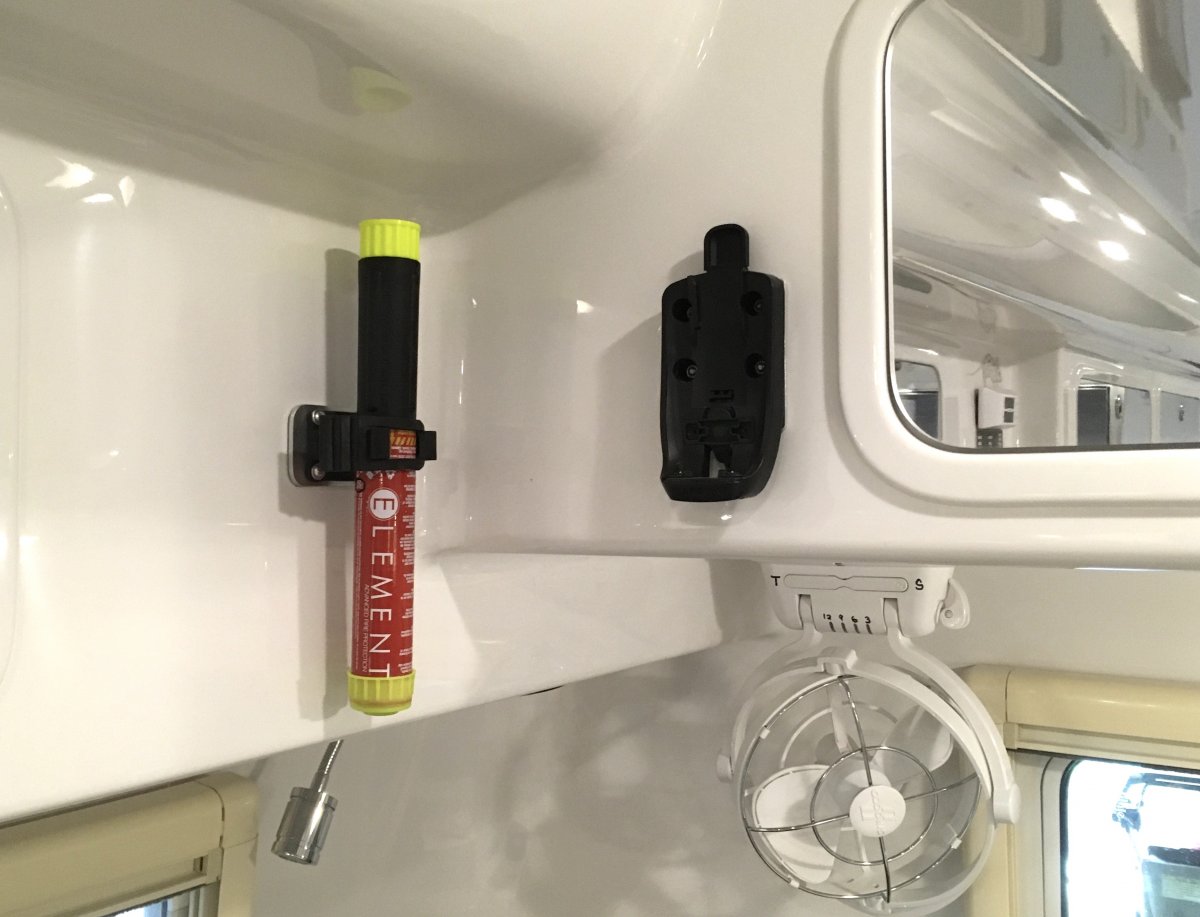
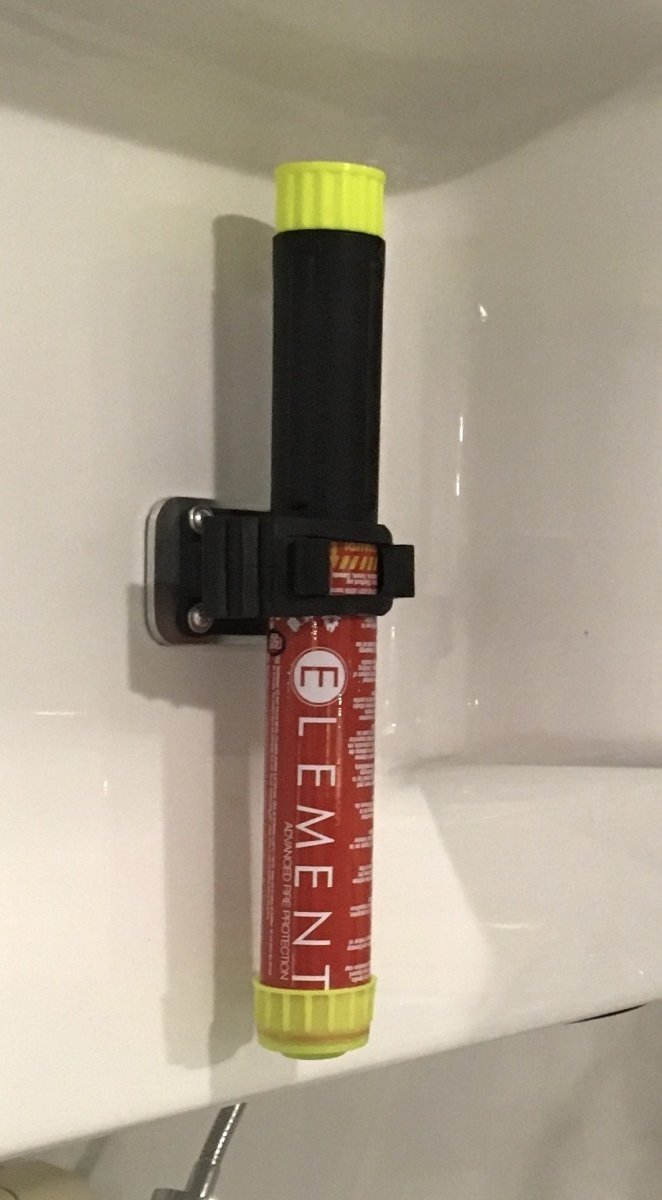
This is a relatively new type of extinguisher, it is common in Europe but since it is not approved, it cannot be the primary extinguisher here, in terms of Oliver supplying one at delivery. As a supplement for the dinky little dry chemical one, it is a great choice. Jay Leno did a story on it, the video is at the following link. https://elementfire.com There are two sizes, the smallest (Size 50, $80, at the top) is perfect for a vehicle or garage., The big one is more for a shop or business. Not my pic: It is a good fit for a glovebox - not my pic: The unit ships with a simple C shaped plastic mount with two holes in it. I wanted something more robust so I got their optional Quick Fist. I did not want to drill holes in the trailer for this device so I made a simple aluminum plate and attached it with 1/8" pop rivets and washers. I counterbored the holes in back so the rivet tails would be below the level of the back surface, and sanded them flush: I added the 3M VHB (Very High Bond) tape: And mounted it to the cabin wall next to my Garmin inReach charger. I chose this spot for several reasons. Since the primary extinguisher is near the entry, it is going to be blocked by a galley/ range top fire for anybody sitting or lying in back. This location puts it in easy reach. Plus it is VERY visible up high and is near the emergency exit, which might be useful in the event you had to bail out the back.... The rubber flap is quite easy to open, but the mount appears undersized. It is really hard to reattach the strap. I suspect that a larger size might not be available. Anyway, once, mounted it is not a worry. I have a second unit that I bought for my TV. It is riding in the glovebox and I am trying to figure out a good (visible) location that won't be in the way. They do offer seat rail mounts for various vehicles. EDIT: here is a technical discussion describing the chemistry involved. Basically it emits a potassium jet that grabs onto the oxygen around the fire, causing it to snuff out. .... https://cdn.shopify.com/s/files/1/3001/3080/files/ElementOperationDescription.pdf?9543567154874779486 John Davies Spokane WA
1 point
-
I appreciate the effort that you put into this post. My soc percentage on the app and battery voltages never seemed to correlate. After reading your post I have flashed firmware. Hopefully the new firmware will do a better job. Thank you.1 point
-
I did not watch much of that video, enough to know I would not use him as an example of safe engineering. He actually drives around with all this stuff just flopping around? Darwin Award nominee. It is not quite as scary as this: John Davies Spokane WA
1 point
-
He says in the video, "Don't do it with something that's obviously an RV." Don't think the EV owners and charging station owner would take kindly to a truck and trailer backed up to their charging station.1 point
-
Fwiw, I still love my 2005 Silverado stepside. One of my favorite vehicles of all time. I wish it had more modern features, but, it still runs great, and I like it's smaller size compared to today's half tons. Even when I get a new vehicle, we'll probably keep it.1 point
-
Glad you got everything sorted out, Imelda. Happy camping.1 point
-
Hi all, thanks for your help and support. Happy days again. An update on my no shore power topic. Progressive sent a replacement surge protector that I just now installed and I am very happy to report all electrics are working again on the trailer. AND I am ordering the soft start and an electrical engineering colleague will install it for me. It looks simple enough to do from the you tube videos I have watched. I could install it - I am an Electronic Engineer but I have a fear of heights so there is no way I could go up on the roof of the trailer. My younger, fitter colleague can. So I will get that done and use the lighter weight, low noise 2K watt generator that I already have. Happy Trails. Imelda1 point
-
This is what we hope to do as well and why we chose an Ollie. When retired, we want to do more extended trips.1 point
-
Spike - I started this spring using the Tire Tracker brand TPMS system. I ordered 2 extra sensors for the spare tire on the Ollie and the spare tire on my TV. The system works great and I have not needed to use the reapeater which came with the system. You can order extra sensors for your TV as well as the Ollie and the display system will show all of them.1 point
-
Do a search on TPMS and you’ll find other threads over the years. I haven’t heard anything bad about the Tire Tracker and have been happy with my TST, so I don’t think you can go wrong either way. Mike1 point
-
We don’t use a Dutch oven, we mostly grill on the Weber or Blackstone and keep meals very simple. We don’t have a convection oven but use the microwave occasionally to warm things up. Mike1 point
-
Thank you so very much for all the responses, much appreciated. Still thinking about Oliver and the beds👍👍1 point
-
I think the "design capacity" in the older trailers included the volume contained in the pipe between the valve and toilet. That can be considerable, depending on where the valve is/was. I'm pretty sure we get an extra 3 to 4 gallons in our older Ollie, in the pipe. The math isn't that difficult, just never had to figure it out. We dump when we can, use cg facilities when available, including pit toilets, and never been a problem for us. Except for when we are on extended stay, at our camping property, we don't tend to stay in one place more than a few days. Then, it's off to new sights.1 point
-
Do you already own the Ranger? It's a nice small truck, good safety features, great seats and visibility, kind of a small version of an f150. I test drove one a year ago, and liked it. It would be fine to tow my smaller Elite, in most situations. If you stay in the east, (I don't know where you are), you'll likely be "fine." Flatter roads, not too many 5 per cent or higher grades, ok. You'll likely struggle in even some roads in the east, like i26, green river gorge. A number of places on i40 in TN and NC that I can think of. Southeast, coastal, (sc, much of NC, ga, al, ms, fl,) you'll probably be golden. If I were looking for a TV, I'd look for something with at least half ton capacity. Look for a bigger, used suv , maybe. Trucks are really hard to come by, these days . Where do you live , and where do you want to go? Everything everyone says about gas tank size, comfort, joy, is really true. We've towed our elite with three different vehicles, Volvo xc90, 2005 Silverado stepside, ram 1500 4 x 4. Big gas tank, bigger TV weight, stability comments are all true. The bigger, heavier ram, with the big 34 gallon tank can get us from sw Florida to Asheville in two gas stops, if we so desire. The Volvo was probably 4. And, green river gorge was slow lane slowww, with the heaviest trucks. That said, Volvo was great around flatlands, local. It's a big decision. Take your time.1 point
-
You haven’t mentioned where you might want to be camping. If you stay in Florida you should be okay with a Ranger. If you head north into the mountains in north GA and the Carolinas you will be less fine. Mountains and elevation in the west will be much more challenging. Payload capacities for trucks on the lot are usually much less than what is advertised. Once you add any options the payload decreases. I don’t know what the gas tank size is for a Ranger, but figure about 12 mpg at best and see how far you can go. Yes, you can always upgrade but probably at a higher cost than just starting out with a half ton. Have you considered an F150 or other brand 1500 without all the bells and whistles? Of course Oliver says you will be fine with a Ranger. “Fine” means a properly equipped Ranger will pull and Oliver. Again, a smaller truck means more work, less margin for error, less payload, less range. The decision needs to be what’s best for you and your current situation. If it’s a Ranger, go for it! Don’t let a truck decision spoil your Oliver acquisition process…. Mike1 point
-
NCEagle: Good catch. It appears that Oliver noted your post highlighting the 18.5 gallon vs. 15 gallon discrepancy. I have a 2022 on order, so after reading your post, I checked the specs for the 2022 Elite II: 15 Gal. Design Capacity Black Water Tank with pressure flushing system for the Tank Standard So, maybe thanks to you, new buyers like me are on notice that they are getting only 15 gallons, and maybe less, depending on the difference between actual and "design" capacity.1 point
-
Well done Fritz. Thanks for taking the time and providing in-depth detail. We are scheduled for March 2021 pickup. I thought lithium was a no brainer to add but rethinking a bit. Might opt for AGMs and upgrade later.1 point
-
Last winter I blew mine out with the one hour wait and then repeat tactic mentioned by John and it did experience some overnight lows in the teens as it sat idle outdoors. Perhaps just beginner's luck but the plumbing came through fine. I think it took about 30 minutes of active time plus the wait between blow periods.1 point
-
Try the Embassy Inn in Hohenwald. It's not fancy, was being remodeled. Stayed there one night last year when we took delivery of 802.1 point
-
Columbia is a large town 30 miles due east, you could visit Henry Horton State Park if you would like to hike or picnic, it is very pretty. Or drive up to Nashville for a day trip. https://www.bringfido.com/lodging/city/columbia_tn_us/ John Davies Spokane WA1 point
-
The simplest solution for vibration control would be to add a single layer of stereo sound mat under the inverter charger. Unfortunately it is quite heavy, but I don’t think you would have to cover the entire cabin wall with it. The standard “isolation mount” in aircraft avionics is the Lord mount. Normally four are used in a horizontal position, but they do offer ones suitable for vertical mounting, these might work but they would move the inverter much further away from the cabin wall and that might create clearance issues or hinder access to other electrical stuff nearby. I have no clue how big the inverter is, so you would need to get the dimensions, weight and mounting hole sizes, study the compartment clearances, and maybe consult with a Lord tech advisor….. https://www.lord.com/products-and-solutions/vibration-and-motion-control/aerospace-and-defense/equipment-isolators/multiplane-mounts These high capacity chargers (as well as the batteries themselves) need better cooling than the factory design, but cutting vent holes in the lower electronics compartments will also let out the noise. It’s a big catch 22. Having that unit located right under the sleeping area is very unfortunate. It gets quite hot in there in summer and the air can’t get out…. I agree about the lack of an MPPT solar controller, it is a head scratcher; I sold my Zamp and replaced it with a Victron one when I converted to Battle Born lithiums. It is a much more capable charger, and it is fully programmable and can be networked through the VictronConnect app. And the lack of vehicle charging is also disturbing. IMHO Oliver should at least run two large gauge cables from the battery area up to the tongue and terminate them there in a weatherproof junction box. The owner could then easily add a big dc to dc lithium charger in the truck with minimal hassles, before or after delivery... the factory lithium packages are definitely works in progress. Yours is a most informative and professionally presented post. Thank you. I hope you will do more of them. See my “HOW TO” page for my lithium and other mods. I am glad those have been informative over the years, as will be this thread. John Davies Spokane WA1 point
-
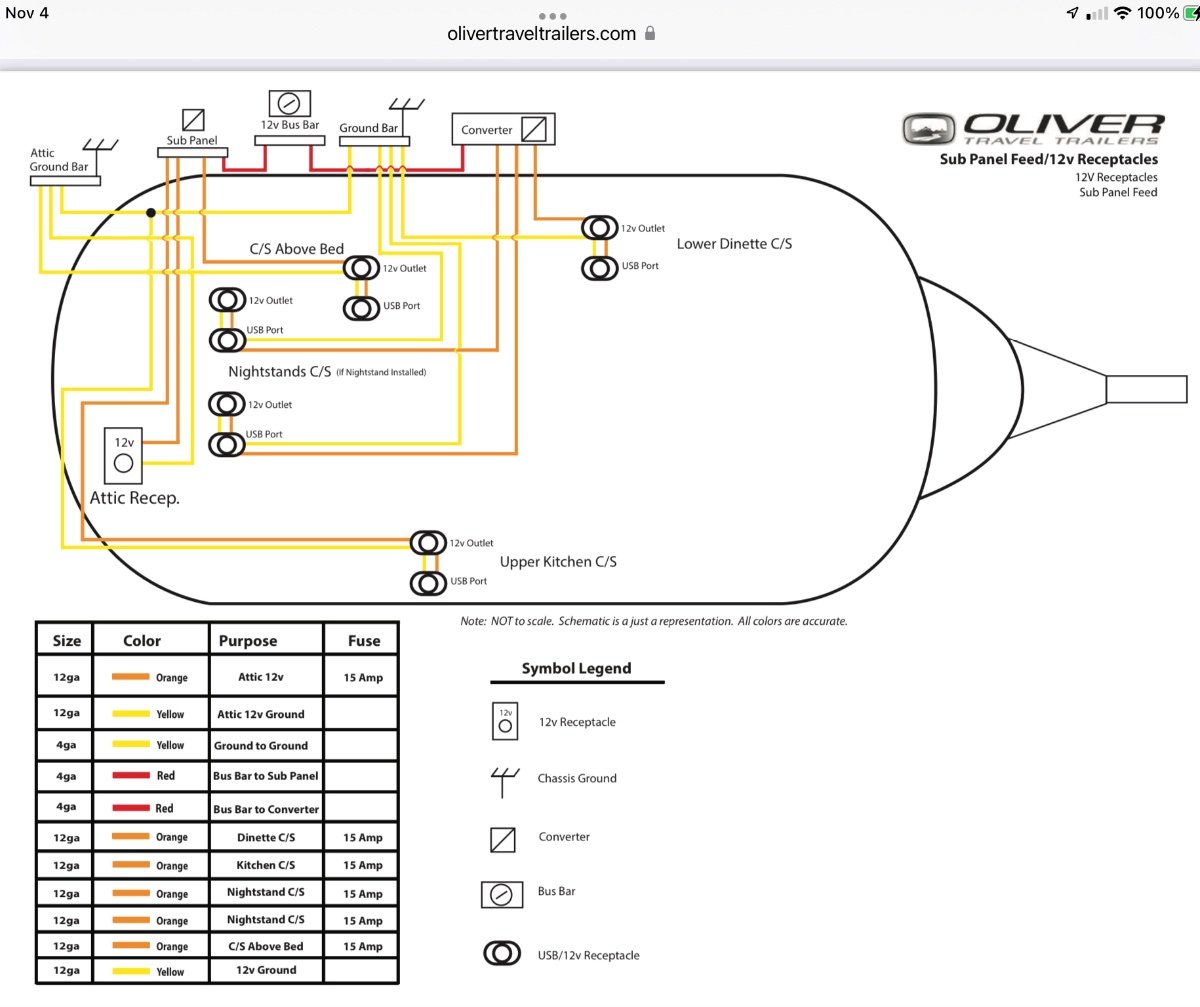
Cars and trucks are mass produced, and use drop in harnesses with all connectors in place. RVs are not, and having specialized automotive grade wires would really drive up the cost. Aircraft wires are actually individually labeled with a code and gauge (size) using a special wire marker device. Really high end RVs like an Earth Cruiser use individual heat shrunk labels at each end, that identify the purpose. Both those are really labor intensive. Not all wires are yellow, just the ground ones. They no longer supply a detailed set of wiring diagrams, just a “component location” diagram which is (very slightly) better than nothing. If you want to look at wires, an older Owners Manual will have them. Here is one from the 2018 LE2 book. .John Davies Spokane WA
1 point
-
I am sorry and also very surprised to hear about your fire. That engine has been stone reliable in the past, it must have been a build issue… did you smell gasoline or could this have been electrical? Every vehicle needs an onboard extinguisher. A cheap dry chemical one will do if it is rated for fuel fires, but the powder residue is highly corrosive and must be removed immediately after! I suggest that everybody buy one of these for each of their vehicles, it fits in a glove box easily, runs for 30 seconds, leaves zero residue and never expires. I hope the price will come down, it is definitely too high IMHO, but it might save somebody's life one day. Most likely you would have to use it on another vehicle, but you never know. Do not call me anal, but my LC200 has two cheap box store extinguishers in the rear door pockets, for fast access from either side, and an Element in the glovebox…. And my small house has five extinguishers. 😳 Like bear spray, if you do not have a backup and need it, you could be in deep trouble. https://olivertraveltrailers.com/forums/topic/4291-how-to-element-fire-extinguisher-install/ Please post some pics and keep us advised. Good luck. John Davies Spokane WA
1 point
-
Yeah, it was a disaster of a night. Siri gave us some bad directions that took us down some super bumpy roads. When we finally got into the campground at around 10pm I got out of the truck and heard the alarm. It had gotten knocked lose from its mount and somehow that triggered it. Took forever to dig it out from between the hulls. And then I couldn’t get it to turn off so I had to bash it with a rock, lol. Lots of fun. By the time I started hitting it with the rock we were laughing so hard that we we could barely stand up. And that was before I turned on the water pump only to have my feet get soaked from water spraying out of the return air vent. And before I realized that I’d lost power to the fridge. We went to Santa Fe the next day, dropped off the trailer at a repair shop and found some tequila. That was her maiden voyage, and now you know why I’ve spent so much time tying down all the plumbing and electrical and why I carry a lot of tools and spare parts. She’s tough enough now to handle pretty much anything. 💪🏼1 point
-
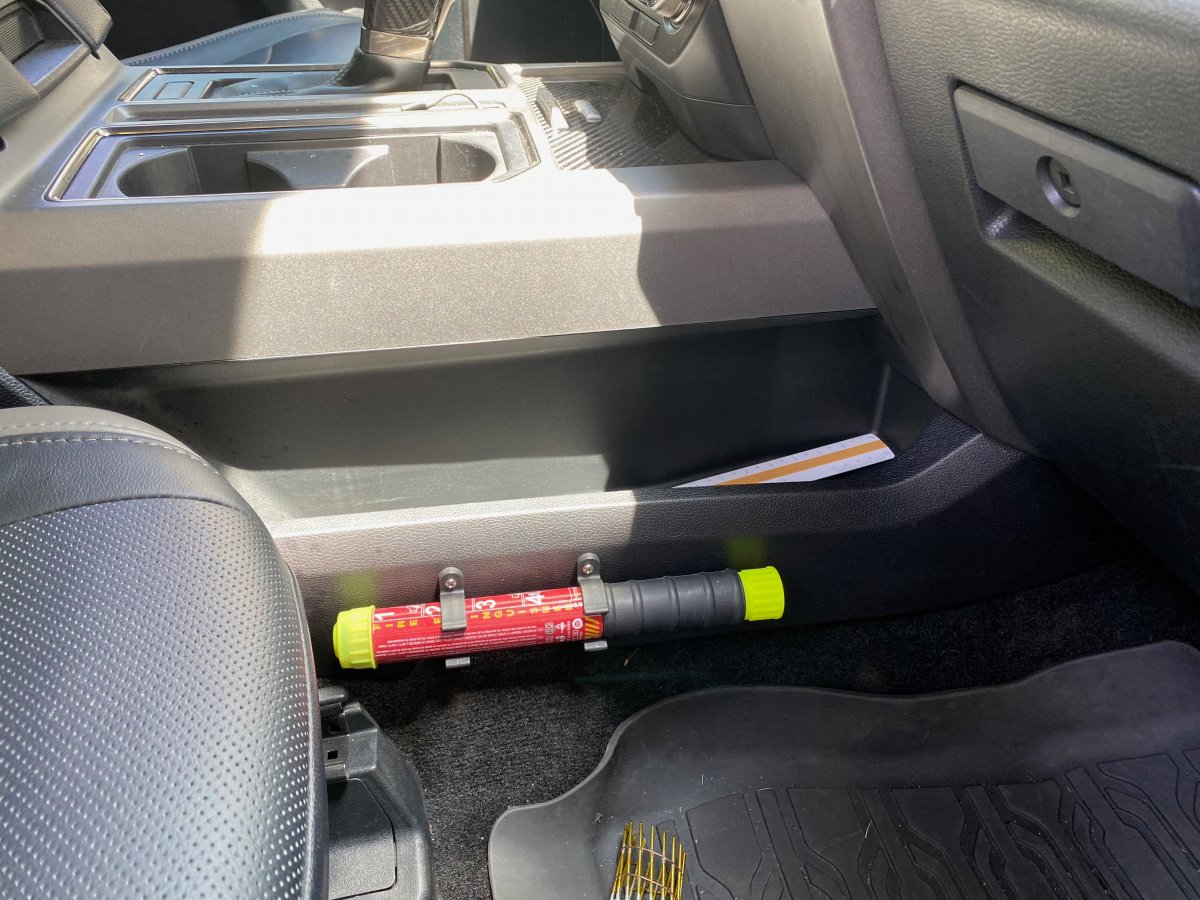
I placed one on each side of the center console - they're out of the way but visible and in reach even with a jammed seat belt. I thought we had a thread on these a few years ago. Maybe that was over on expo. They're great, but not cheap. I keep both mine in the truck and then just grab one to put in the trailer when we're camped. The clips that came with them hold them pretty solidly.
1 point
-
Mac, we have an F150 so this may not be of any help. We have two big dogs & their comfort & safety is important to us- along with preserving the backseat upholstery. With the rear seats folded up they would need to stand to see out the window so we built a platform for them to ride on. It's designed with a good amount of storage underneath. To keep the dogs from becoming projectiles, they wear harnesses that clip to the seatbelt latch. They've logged 19k+ miles with no complaints. Baxter sleeps 90% of the time; Maddie is Duke's copilot. Happy travels! Chris
1 point
-
The stock suspension has an equalizer to balance the load between the front and rear tire on each side by allowing the springs to change angle instead of flexing. This allows the system to "step over" bumps without flexing the springs much or jarring the trailer. It's good trick on tandem axles and it works well on uneven surfaces. Then there are the shackle pins that deliver the load to the shackles and from the shackles to the frame. The shackle pins and the equalizer pins are all working bearings that are constantly under load and completely exposed to the elements. Dexter supplies this system in different configurations. What Oliver uses is the dry nylon, non serviceable bearings. Just nylon bushings. These wear out before very long and allow metal to metal contact of the pins to the spring eyes and iron equalizer. Then the wear begins to elongate the shackle pin holes. After a while the whole system has lots of play in it and it gets weaker and weaker. All of this takes a while, but I had a set on a utility trailer wear to an alarming degree and I began to look at other utility trailers, the same system as on our Ollies, to see how they were doing. I've seen some that have worn to the point of being dangerous. Dexter also has a system called E Z Flex. It has heavy duty shackles, greasable bronze bushings and a different equalizer than our stock setup. I've looked closely at it and it is nice, but in my estimation, isn't doing much or anything in this application to improve the ride. It works where trailers are very heavily loaded with much stiffer and more massive springs. In that situation it will compress a rubber donut to take some of the initial shock of a sharp bump. In our trailers, the load is relatively constant and the springs are set up to be fairly soft. Plus the overall load is not too much at only about 4,500- 5,000 lbs max without including the unsprung tongue weight. I decided to get the kit for mine to upgrade the bushings and shackles. So I went to a friend in the trailer business I've dealt with for many years. He was very hesitant to order me the kit and said some of them have had the rubber fail. But, he said, we can get you the heavy duty kit instead. Dexter also supplies the Heavy Duty Kit, part number K71-449-00. This has a heavy duty equalizer (with bronze bushings and zerk fittings installed for greasing) instead of the rubber cushioned equalizer. It has bronze bushings, new pins (drilled with zerk fittings installed for greasing) and heavy duty shackles. This is the best option of the three as far as I'm concerned. It is what Oliver should order their axles with from Dexter to minimize the additional cost. There is no doubt this setup will hold up better than the dry plastic bushings. The kit sells for about $100. less than the EZ Flex too.1 point
-
Hopped into the truck yesterday afternoon to go to the market and it burst into flames. When I started it, smoke started rolling out from under the hood. I told my wife to get out, move away from the truck and call 911. When I got out of the truck there were flames in the drivers side wheel well and my driveway was on fire under the engine bay. I ran to the house and grabbed a fire extinguisher. I killed the flames under the truck and then the flames in the wheel well. I stepped back and it burst into flames again. I gave it another shot and put it out (or so I thought). I opened the hood and there were still flames so I attacked it from above and finally extinguished it. Fire dept. showed up and made certain that the fire was out. My truck is a 2020 with less than 8,000 miles on it. Not happy. Not a good time to buy a new truck if they total it. Even if they can repair it I don't think I want to keep it after it suffered a fire like that. Who knows what hidden damage it caused in addition to the obvious.0 points
-
The dealership has disconnected the battery and will do nothing further until a Toyota inspector comes to look at it. Due to the serious nature of this failure Toyota wants to send their own expert to try and determine how this happened. I had to call Toyota USA and report the incident so they could open a case file. They gave me a case number and said that an investigator will call me back. I used a dry chemical fire extinguisher on the fire and used up about the whole thing. It was a full size household type. Never smelled gas when I went out to the truck. I can't rule out rodent damage, but I have never had a problem with them fooling around in my vehicles. Plenty of more comfortable places for them in my 92 year old garage! Thanks to all of you for your concern. We are sad and upset but safe and unharmed. We are fortunate this happened at home rather than on the freeway with our Ollie in tow!0 points

















.thumb.JPG.dd838cdb3df463dab6a16861fa23a319.JPG)








-
Recent Achievements
-