Leaderboard



Popular Content
Showing content with the highest reputation on 01/01/2024 in all areas
-
May the New Year be safe, happy and filled with many great Ollie adventures. Bill8 points
-
Happy New Year!! Now, let’s go camping…..
 7 points
 -
Happy New Year and safe travels to all in 2024!!🎊🥂🎊 Patriot🇺🇸 Hull# 634
6 points
-
Happy New Year's everyone6 points
-
6 points
-
I took the time and read up on the 'Smart' Plug. I didn't find any evidence that the Smart Plug is a better product than the power receptacle that was supplied when the Oliver was delivered. But, wanting to give it the benefit of the doubt and in the interest of sharing accurate and reliable product information, I offer the following information: From their website, under the heading About Smart Plug: Our vision... Smart Plug Systems is a privately held manufacturing firm specializing in power delivery systems. It was founded in 2007 and is located in Seattle, WA. Its flagship product, the SmartPlug, is a patented device positioned to replace the current power delivery system for RV’s, Boats, and a variety of specialty vehicles and miscellaneous industrial applications. Every corporation has to have a Vision Statement, Right? Designed to be versatile Developing and providing innovative world-class solutions that make power delivery safer, more secure, and easier to use. Continuing our aggressive growth strategy and expanding far beyond the domestic recreational power delivery market to industries and geographic locations that can leverage our technology. We’re just getting started Establishing strategic partnerships and building long-term relationships with our suppliers, customers and the consumer. Sustaining a preferred work environment that will create positive share-holder value while maintaining a high level of innovation, quality, and customer service. This nothing but corporate techno-babble and tells us nothing about the Smart Plug. Here is additional BS from their website... Contrary to popular belief, the #1 cause of shore power failure and fires is not electrical shorting, but rather overheating caused by poor electrical conductivity. This is very true...but, on our Oliver’s, not for the reasons stated below How does this happen? The problems with many plug designs are that the shape of electrical pins allow for very little contact area, and the pins themselves are also largely responsible for bearing any physical stress placed on the cord (from constant movement of the boat, someone tripping on the cord, etc…) This is partly correct. There is plenty of surface contact area on the standard Oliver supplied power cord. Last I checked these are NOT boats moving around while attached to shore power. This results in the pins working loose, further lessening the precious little contact area they had to begin with. Furthermore, such loose connections allow for moisture intrusion and ultimately corrosion of the pins. This does Not apply in our situations. Arcing occurs and the connection heats up, scorches, and in some cases, catches fire. Because the current draw is unchanged, all of this happens long before a breaker or a GFCI can cut the power. Additionally, the old design can be very difficult to use in low light or hard-to-reach scenarios since the “L” shaped pin must first be located and then oriented before connection. The actual #1 cause of shore power failure and fires is not electrical shorting, but rather overheating caused by poor electrical conductivity, not from the pins in the connectors but from the screw connections between the pins and the supply wires not being tight. This has been the source of the problem in every overheating situation I’ve seen or heard about concerning Our Oliver's. Then I decided to go right to one of the vendor’s that supply this product for their say in the matter. In about an hour long chat session, this was revealed... Ashley: Hi! Can we answer a question for you? If not, feel free to close out this box. Steve: I am curious about your Smart Plug product. I am familiar with the plethora of other "smart" products like smart phones, thermostats that can be adjusted via an app on my phone, Alexa etc. What is it about this product that makes it Smart? 'SMART' OBJECTS Ashley: Hi Steve! Let me get you some information for you Ashley: There really is no "Smart" Feature as you are thinking about, but here is the description: SmartPlug is the highest quality electrical plug in the RV industry. This is the ultimate solution to replacing your standard twist plug, and it completely eliminates typical heat issues due to poor electrical contact. The standard twist plug that comes on many RVs has problems with electrical transfer because of minimal contact from the plug to the inlet. The SmartPlug has 27 times more contact and this makes for efficient electrical transfer and drastically reduces the heat on the plug. If you have a standard twist plug on your RV then you need to get that changed to the Smart Plug today! Steve: What is the amount of surface area that is contained in the Smart Plug in square inches? I'm confused about how their contacts are 27x larger than normal. Ashley: Let me see if I can find you a video I am going to post a link below to one of our Installation videos. Let me know if it helps https://www.youtube.com/watch?v=jTkd_nMW-sw Steve : Let me take a quick look at the video. I have other questions. Ashley: Ok, sure Steve: This appears to be nothing more than an installation video. Can you tell me more about the claim that this product has 27x the surface contact area of other plugs. How was that determined. For instance, if a standard RV plug has say 2 square inches of surface area spread between the contact legs then your claim would be that your plug has 54 square inches. How is this possible? Ashley: I am not exactly sure why the manufacture claims that. I am trying to find some more information on it. Steve: OK, Thanks... Ashley: "27x more electrical contact than the old twist type connector" This is all I can find; I am unable to get an exact explanation. Steve: Thank you for all your help Ashley. But can we agree that this plug is really no better or worse than a standard plug and there is no way to cram in 54 square inches of contact surface area? Yes, No? Ashley: Apparently, they are claiming that is 27x more that the "Old Twist Plug" According to your logic, no it does not make sense. However, I couldn't find enough of an explanation to really say one way or the other what exactly they are comparing it to. Steve: Ashley, I want to apologize to you for putting you on the spot like this. I realize that you could not possibly know all the technical details of the products your company sells. I just could not find this information published anywhere, and I wanted to see if there was information I was missing. I'm sorry. You're a good sport. Ashley: Absolutely! No need to apologize, I couldn't find it either and you brought up a very good point. It is extremely vague about what they are comparing it to. I would like to think I know enough about what we sell but sometimes, unfortunately, I met my match. Is there anything else I can help you with today? Steve: No, we’re good. Ashley: Ok! Have a good day! I didn't find any evidence that this is a better product than the power receptacle that was supplied when the Oliver was delivered. If any of you want to change your plugs out, go ahead. Or, you could just make sure the screws are tight instead.5 points
-
I pulled my propane tank out and was horrified at all the rust around the bottom ring of the tanks, and on the mounting tray. That area seems to attract dirt and it eventually wore away the paint and rusted. Sand paper and paint fixed the immediate problem, but I wanted to prevent it from happening again. I started looking for some sheet rubber on Amazon, but then I discovered inexpensive rubber rings by Mopeka Products for$ 7.99. They are designed to fit on the bottom ring of the propane tanks. They fit perfectly, and they also stop that cringe worthy grind when putting the tanks on pavement.
4 points
-
Happy and healthy New Year!🎊4 points
-
Happy New Year, everyone!4 points
-
Happy 123123 day! The end of a year, the promise of new beginnings and new adventures!4 points
-
Here are a few ideas that may be useful: If you are hooked up to the 30 amp plug, try the 20 amp plug for grins. Camp site power poles are generally grouped down a line and each set often use different transformers. Hence, try moving to a different camp site power pole that is well away from the one you are using. If you are using a generator, have you connected up your bonded ground plug? If you are at home, have you had any mother boards fried recently? GJ If you have concerns, don't plug in there.3 points
-
For a critical element of your camping support gear, having a refrigerator that can run from 12 or 120 volts gives you twice the onions when electrical weirdness happens. I like having a back-up plan so, any refrigerator I get to replace our Dometic "Fire Starter" boiling ammonia HazMat unit will need to have two power options. I like options. GJ3 points
-
True, @topgun2, since we usually camp without hookups, made no difference to us, but... Also, if 12v system ever went down, 110 can be plugged in and you'd not lose all your food.3 points
-
You didn't mention the conditions under which you are camping. Are you boondocking or in a campground with full hookups? If you have electricity, I would suggest going out and buying a small electric heater. It will easily heat your trailer to 70 degrees or more. We keep one with us at all times. If you are boondocking, just put on some extra cover or clothes. You could still buy the electric heater and run it off your generator or for short stints off the batteries. How long you can run the heater is dependent of the type batteries you have. We even carry a Mr. Heater Portable Buddy gas heater that runs off a small propane bottle or a larger tank with an auxiliary hose. We like to have every eventuality covered. I don't like being inconvenienced by something breaking down on the road.2 points
-
Wow Steve that's some great investigative work. So much that as the Chairman of the Oliver Rabbit Hole Society, I hereby bequeath upon you a lifetime membership at the Professional Level. At this level you have the rights to the title of "Chief Rabbit Hole Excavator". Congratulation!2 points
-
While it would work right out of the box with virtually any RV, the EEL (Easily Engaged Lock) is marketed toward the marine industry. In looking at the stats, it doesn’t seem to offer any earth shattering benefits over the twist lock cord that came with our Oliver’s. You still have to line up the terminals, twist it into place and release the locking ‘wings’.2 points
-
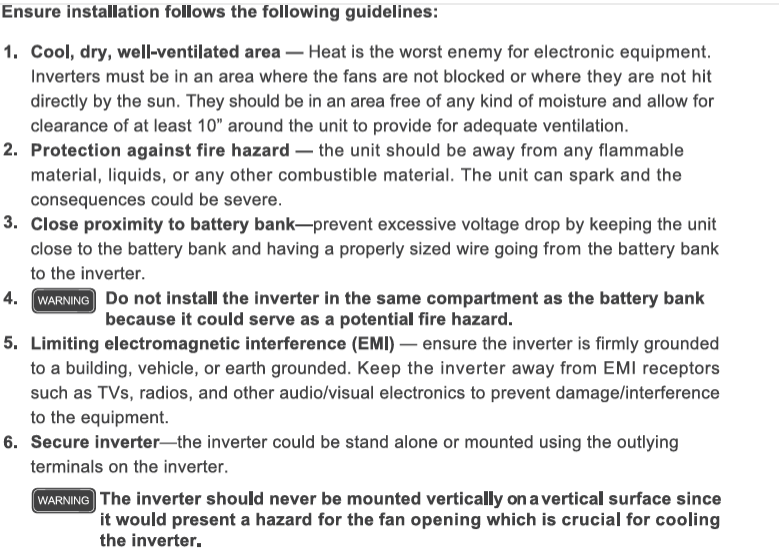
Tilt. Below is the Renogy installation instructions.. Kindly scroll down to item 6, and the warning below it. What I think they are saying is do not mount the unit up and down with the fans below the unit. Doing so will burn up the unit cause you cut off the air flow. That said, I mounted mine on the inside wall of the street side bed, using all the space of my former Xantrex... that died.... and then some forward. You'll need to add some shims to mount additional phenolic cutting board mounting. I highly, as n VERY STRONGLY, recommend using SS thru bolts (six I believe) from the unit thru the cutting board, thru shim stock and thru the fiberglass wall below the bed. Additionally add material below the Renogy to help support it's very heavy heft while installing. And nimble fingers to get the nylocks on the bolts between the cutting board and the Renogy mounts. Finally, the heads of the bolts are on the hallway side and have SS fender washers to spread the load. This mounting approach survived 45 days in Alaska, but the kitchen drawers did not..... GJ
2 points
-
8 amps 60 hertz 125 volts and CODE 7. Below may be useful GJ OM - Progressive Industries HW30-50C (4 MAR 2023).pdf
2 points
-
I carry one of my throwable boat cushions with me at all times. Generally is sits between our Honda 2200 and the curb side rear of the F-150 bed. Great to kneel on when doing low work, or place on a 5 gallon bucket when doing mid height work. Much better than a towel. An because it serves as a pad between the generator and the aluminum truck bed, it is almost always where I am.2 points
-
Another - it depends. If you normally camp "plugged into shore power" then a 120 volt unit makes sense. And, vise versa if you use 12 volts most of the time. The reasoning is that if you mostly "convert" 12 volt to 120 volt then there is a built in loss of energy by doing that conversion. Conversely, if you invert 120 volt to 12 volt you have an energy loss during the inversion. Obviously, if you tend to do a bit of both then a dual unit would be the ticket. Bill2 points
-
If the price is similar or same, I'd just go with the dual power.2 points
-
Always, always, but always disconnect the negative terminal first! I believe I shared the story about trying to arc weld a wrench to a Huey airframe.😳2 points
-
No doubt, as well as Amazon. However these Eley connectors are commercial grade, made with quality materials to ensure longevity and safe drinking water, of bigger overall size for a full 3/4” unobstructed flow, have serviceable o-rings and a 10-year warranty! You definitely get what you pay for IMO. That said, I also have been very pleased with several of the Gorilla Easy Connect hose terminal ball valves/couplers/nozzles, which I will share with if anyone is interested.2 points
-
If you have the available space and budget, bigger is always better. I built a 30'x30' x 16' H (to the bottom of the rafters) "boat shed" for my raft trailer, rafts and related boating gear in 2018. It has a 16' W x 14' H garage door. It seemed spacious until the wife decided in 2020 that we needed an Oliver Elite II. Our 2021 Elite II fits in one of the two bays of the boat shed, but I have had to rig up some creative rafter storage for my rafts frames, etc. to make it work with my raft trailer on the other side. And, I am now out of storage space! So, we are laying plans to add another bay to it, hopefully beginning next spring. Moral of the story: If you can afford it, overbuild. You will never regret it. But, like me, you may regret underbuilding.2 points
-
Wondering how this is better than the standard twist-lock. Reviewers talk about standard cords with melted connectors or arc damage on standard cords. Melted connectors are usually caused by operating large draws like the A/C with low campground voltage (a problem addressed by the Progressive EMS), or by loose connections. The standard twist-lock should provide ample connection surfaces if it is used correctly (twisted to the locked position). As far as arc damage, that will happen to any connector that is disconnected under load. The pedestal breaker should be opened before disconnecting the cord. The same would be true with the Smart Plug. With a special plug like this, you'd have trouble sourcing a quick replacement if something happened to it, while standard cords are available at every RV shop and replacement plugs/receptacles at any Home Depot. And what is "The retro-fit connector...designed to be used with your existing cord"? If it's an adapter that goes on the end of your regular cord, you still have a twist-lock in the system. I'd need a lot more convincing before purchasing.2 points
-
Here is an interesting video which gives a pretty straight forward way to disable the speaker on an Apple Air Tag. Removal of the speaker eliminates the continuous audible chirp after 72 hrs. Removal of the speaker will not allow a bad actor to hear the chirp, then find and disable the AT by removing the battery after he/she locates it. For example an AT hidden in a car under the seat or in the trunk. Or in a piece expensive camping equipment say a portable generator or even an Oliver TT. The bad actor will eventually figure out there is an AT on the stolen item tracking them if they have an iPhone. Without the speaker chirping it will be more just a bit a lot more difficult to find. A common misconception - the map location is not the location of the air tag, it’s the map location for your truck or campers air tag that would have been the location of the persons phone who parked or walked or drove by close enough for their phone to hear the air tags broadcast. Patriot🇺🇸1 point
-
Couldn't find that error code either. Did find a couple of British YouTubers showing how to reset the control panel to clear some errors. Not sure if the American version is the same. Here's one: https://youtu.be/Xzo9tTWB7T0?si=OH-eBlG8-nNGb4UY1 point
-
We'll, that's pretty cool. We're always short of onions. 😁1 point
-
An update- 9 months later and the Air Tags are still going strong. Patriot🇺🇸1 point
-
Do you carry a multimeter in your Oliver? If so, check out the power readings at the campsite power pedestal. More often than not, EMS issues are caused by "dirty" power from a campsite pedestal. I always verify the voltage at the pedestal with my multimeter before plugging in my 30A power cord.1 point
-
I would not switch from a 3 way to 2 way fridge unless you have a large lithium battery setup. Sometimes you can’t find a sunny camping location to feed the solar. For extra food capacity necessary for longer trips I would consider a portable cooler set to freezer mode. For the health of the lithium it might be nice to run the fridge on 120v and bring the SOC of the batteries off the stops when using shore power.1 point
-
Why not? Let me see - its New Year's Eve, ALL service centers are closed (to include the chance of getting hold of anyone at Oliver). You have a problem and you get THE answer in short order. What's not to like? Besides, it is the collective knowledge of this Forum's members that make the Forum the place it is. Certainly there is something or some place that you can add to the discussion that will surely help another member have a better experience with their Ollie and camping in general. Thanks to GJ for the information above - it looks like you are plugged into shore power that is not up to standard. Bill1 point
-
Another great use for the two step Rubbermaid step ladder we carry. Makes a decent seat, when working lower. My husband uses knee pads a lot, too , sometimes along with a gardening pad. Even if you're younger, it's important to protect your knees. And if you're not, like us, well.... it's just that much more comfort.
1 point
-
Smart plug has been around a good while, but it's earliest iteration probably gave it the "smart" label. First gen had a bimetal thermostat that cut power at 200 degrees farenheight, but resumed sending power at 120. This is no longer part of the smart plug, as a) users got frustrated with random power outages, and bad mouthed the product, not understanding why they lost power (didn't read the manual) b) (most importantly) ABYC (yacht equipment rating/approval system, like rvia, for rvs) didn't like the concept. Imagine if you will, ac goes out in the middle of the hot night, and owner digs in, removes covers, digs around, gets a heck of a shock when cord resumes sending power, because the thermostat on the smart plug cooled to below 120. Lights, etc., on boat are still working, because they're 12v , so they didn't check 120 input. C) thermostat didn't always work as designed, and they still had some meltdowns. The integrated thermostat has been discontinued, years ago. I do like the no-fail, odd shaped connection design, and the latching mechanism of the Smart Plug, but not enough to consider changing the connections on our boat for the many $$$$$. I, too, can't figure out the 27x greater contact. I'd like to see an engineering report in that. Most meltdowns are caused by overloading, or corrosion, or crappy connections, or all of the above. BTW, Marinco has a new EEL cord (easy engagement something) connector with spring wings, a slight twist, positive locking mechanism, probably designed to combat Smart Plug, that works with the standard twist lock input. It's a whole bunch less than smart plug cords, and undoubtedly tested to Marinco safety standards. It even has a little led light in the plug, so you can (sort of) see what you're doing, if you're setting up in the dark without a headlanp. I haven't seen an EEL yet, in person, but likely will at the winter boat shows. I like the videos, though. Many boats use a strap for stress relief at connection point. Those 10/3 cords are really heavy . Another consideration. On the few occasions that we plug in, we at least drape the cord over the tire, to alleviate some stress (ollie), and use straps at dock and boat. Edit to add: EEL Marinco short video1 point
-
We lost one of ours and didn't realize until we saw the rust ring. Ordered 1 and will keep an eye out for future loss..1 point
-
I don't follow your logic. Are you using the term "converter" to refer to your inverter? When boondocking, my Xantrex inverter supplies 120V power, inverted from the 12V power supplied by my battery bank. When connected to shore power, my battery bank, not my inverter, supplies all 12V power in the trailer. But, my Xantrex inverter/charger recharges the 12V batteries when connected to shore power. And, when connected to shore power, my inverter supplies 120V power to the trailer in "bypass" mode, i.e., "bypassing" the inverter altogether. Since our Norcold runs on either 120V AC or 12V DC power, our Oliver trailer is wired for both. The logical choice for me would be a 120V/12V model, since the wiring should already be in place, and we could run the fridge on 120 when connected to shore power. Any other views from you engineer types on the forum?1 point
-
I bought this Eley Quick Connect System product for all hose connections in my setups. Think one-handed operation! The components. Water pressure regulator and filter configuration. Eley installed at Oliver water inlets. Protective caps in place, utilized chain hardware from original stock caps Caps purchased.
1 point
-
So I’m still thinking about your attempted battery cutoff install. And the forum is a tough format for troubleshooting, kind of like a visually impaired art critic In order to have the 12v lights fading on and off and the radio making strange noises after disconnecting the B+ cable, there must have been 12v somewhere in the trailer that wasn’t coming from the battery. So I have a couple of questions. 1. Was the house battery negative disconnected or just the positive? You didn’t mention the B- cable. 2. I hate to do this, but I assume the tow vehicle was not connected, correct? 3. Your forum signature states that you have a Renogy DC-DC installed, which I have no working knowledge of. Is it installed in the Oliver? Does it only work with the ignition on? Does it have the ability to store energy, maybe an internal capacitor? 4. You might try turning off all 12v breakers and removing fuses. Verify the power is off with the Victron Smart Shunt app or a DC clamp on Amp meter. Then remove the main battery fuse as a different method of disconnecting the 12v supply from the battery. At least you would be inside if the fireworks started again. I’ll keep thinking of troubleshooting methods because I hate being baffled by the unknown. Mossey1 point
-
In the case of 6v batteries, run with 2 less. 2 x 6 = 12. Half amperage, but entirely doable,,with power management. I have a number of friends with sob trailers, who boondock (carefully, for few days) with one 12v battery. As have we, in sob campers.1 point
-
Quick connects are one of the more useful things I’ve added, they really do help as we get older and less flexible! Also, I keep a foam knee pad in the basement for those time I do need to get down. Mike1 point
-
For anyone interested, I posted more details about our experience building the garage on our blog, including some pricing and the vagaries of construction schedules.1 point
-
Thanks everybody for the pictures and suggestions. Truth be I was plan on a 30’ X 30’ footprint. The other half is for a boat. I do think I’ll need a fair amount more for the Oliver’s and boat’s stuff. The pull through eliminating a fair amount of storage is bad but wow, Pull through would be nice. I’ll probably see if I can make it wider, like 40’. Thanks again.1 point
-
That seems like a good size. However, if you build a pull-through, you lose any storage on the back wall. Something to consider if you want to store some camping gear in there, too. We just built a 30'x30' wood framed garage with two bay doors, each 10' wide by 12' high, and some storage/work area on the side. The trusses are 14' up. The 10' wide doors are fine for an Oliver. No trouble backing in. I use a traffic delineator post as a target for the rearview camera. You can see it in one of the photos. (We couldn't do a stripe on the floor because our dually's hips block my view of the trailer wheels.) We didn't install a 30A plug because we don't intend to run the trailer A/C in there, but we do have a 20A circuit for battery charging, etc.
1 point
-
We've built a couple garages, with hopes of accommodating our Elite I, along with other vehicles and trailers. If 15 x 15 x 30 is what your restrictions allow, go for it. If you can go at least 16 wide, I'd do it. An extra foot gives room for shelves, and a workbench on rollers. And, all that other "stuff". If you have room, at least go longer and wider,, for resale, if you ever decide to move. 30' length won't accommodate most class c's or a's. Our pole barn garage is 32 x 36, still short, but we needed room to swing the truck, and have a significant probably 3' incline, in the path. That's a factor, too. We have a 14' high door, so no factor for entry, but arse end of truck is high for "short me" to unload, unless we are well inside, because of the inclined apron, on rainy days. Still, it holds three workbenches, the Elite, two utility trailers, two or three atvs, and the truck, as necessary. And, various "necessary " shelving, genset, weedeaters, etc, etc. But, it's a jigsaw/chiclets game of maneuvers. If all you need is a shelter for your Ollie, you are good to go. Room for a slim rolling scaffold on each side. Remember that you need extra height for the garage door opener, and ratlines/overhead beams.1 point
-
I’m in the bigger is better crowd, too. But then, being the child of depression era parents, I suffer from packrat disease. You never know when you might need (fill in the blank). On the serious side, extra room for the TV, tools, or just space for projects is pretty nice.1 point
-
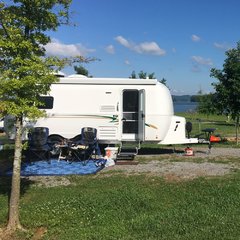
RustyMD , I had our “Ollie Hangar” built at our home in July of 2022. I had a 13’W X 55’L slab poured and contracted with a company out of Mt Airy, NC to have our Ollie Hangar custom built. We decided on 11’H X 13’W X 25’L steel structure. We keep our Ollie plugged into 30 amp while stored here. We presently have 4 car attached parking 3 upper garages and a lower basement garage just did not need a 5th enclosed garage. This open air metal building aka hangar has really worked out well for washing and waxing our Ollie and keeping out of the weather and especially the UV. Needless to say, it’s a real plus having our Ollie parked at our home and under cover. Also note: I have plenty of room to wash and wax our Ollie. Have fun deciding what to build that suits your needs! Patriot🇺🇸 This is where we plot and plan our trips and tell a few true camping stories around the fire - aka base camp. 😊
1 point
-
Did we all survive the holidays? Minimal political or religious discussions with family members of opposing views? Christmas presents we received and don't know just how to say we'd prefer to exchange this item! These are the little things, and there are greater concerns. It was nice Christmas was on a Monday this year, allowing a long weekend! We were home and as much as we enjoy camping, we have a wonderful home we've built over the years. We enjoy being home with family, and for us this year was just our immediate family. I give thanks to ALL we have! The world today is a troubled place, worse we've seen in recent years and perhaps in our lifetimes. Many of us are "baby-boomers" and we worry for our children. It is extremely difficult in our society for those who are younger today. How can the young today be accepted, afford a home, and be secure today? 🙏 God bless you all, God bless our freedoms as outlined in the Constitution of the United States of America! God bless we have the freedom to exist, to travel and camp, enjoy this life, and live the lives we all love! This is what I am thankful for today and in the time to come. Happy New Year! 🤗1 point
-
I've said this before in another post... but at the risk of repeating myself again... Oliver is not a "club" or like most of us, a bunch of retired people who have already accumulated enough wealth to sit back and be philosophical about how we would do it. It's a business that has several hundred employees who come in everyday to the Oliver factory trying to earn enough money to get to the place most of us owners enjoy right now. Warranty work (every dime of it) is anything that fails or wasn't done right the first time... it costs the factory money and is a cash drain. Service work could and probably is somewhat profitable and self sustaining part of the Oliver business, but the real cash cow that the owners and every employee counts on (remember they have their own life dreams too) depends on selling new Olivers. With hull numbers around the 1500 mark they have likely picked the low hanging fruit. Now they need to dig deeper into the existing marketplace to fulfill the burden and obligation to pay for tools, equipment, buildings, benefits, healthcare, wages and everything else that those several hundred people working there are depending on so they can make their house payments, buy groceries and maybe even someday own and Oliver and travel around the country seeing and doing everything we all are doing right now. Growing the business by selling new product doesn't mean forgetting the customers that have already purchased Olivers, rather it is doing both in a way that is fulfills everyones goals. It's not easy. Sometimes feels like a balancing act. There will be the occasional mistake... but I'm counting on the Oliver management to provide that "North Star" to keep the companies core moving in the right direction. We were just recently in the extreme north west and several times had conversations with folks who might have been prospective buyers... they just rolled their eyes when I said you could only buy and pick them up at the factory in Tennessee. All of us need to remember that if we want an experienced service team that is equally invested in our Oliver the factory where they are built needs to survive and grow. Otherwise, "who ya gonna call"?1 point
-
There are a myriad of ways to accomplish our goals. I'm a big believer in using what you already own, if you can reasonably make it work. Congratulations on finding yours.1 point
-
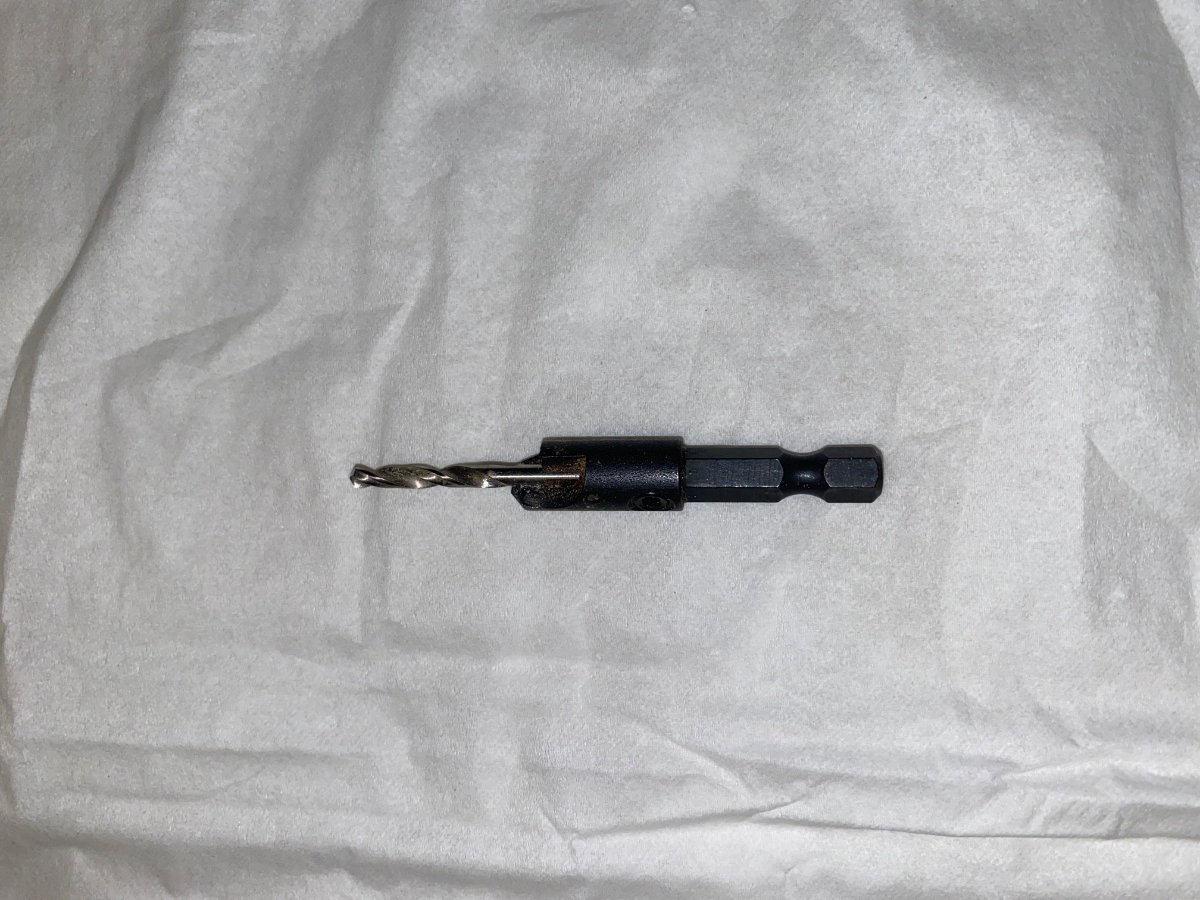
Here’s a picture of the type of countersinking bit I used first on the fiberglass to clean up/chamfer the gel coat surface. This one has a small enough diameter drill bit (1/8”) to fit through the original hole, so only the chamfered section of the bit touched the fiberglass to create the chamfered edge on the gel coat layer. Then after chamfering I used a 1/4” bit to open up the clearance hole through the fiberglass.
1 point























-
Recent Achievements
-