Leaderboard




Popular Content
Showing content with the highest reputation on 01/04/2024 in all areas
-
Your statements are mostly correct, but let's be a little more specific. The Xantrex unit is really two devices: a converter and an inverter. The converter takes shore power (120v AC) and converts it into DC volts to charge your batteries. This happens automatically when you plug your trailer into shore power. However, the Xantrex has nothing to do with solar charging. There is a separate device for that. You didn't post the year of your trailer, but your hull number tells me it's new. Our trailer has a Zamp solar charge system, but I think the newer units use Victron(??). Either way, there should be another control panel somewhere inside your cabin for solar charging. That system should also be passive/automatic for you. It'll work when there's sun without any interaction from you. The inverter part of your Xantrex does convert 12v DC battery power to household 120v AC for your outlets, etc. but it requires interaction from you. Turn it on (silver button pressed in) when you want 120v outlet power from the batteries. Turn it off when you don't need it because the inverter draws power from the batteries even when you're not using the 120v outlets. The green LEDs and display on the control panel tell you what it's doing. (You can press the OK button to wake up the display at any time.) Hope this helps clear it up a bit for you.8 points
-
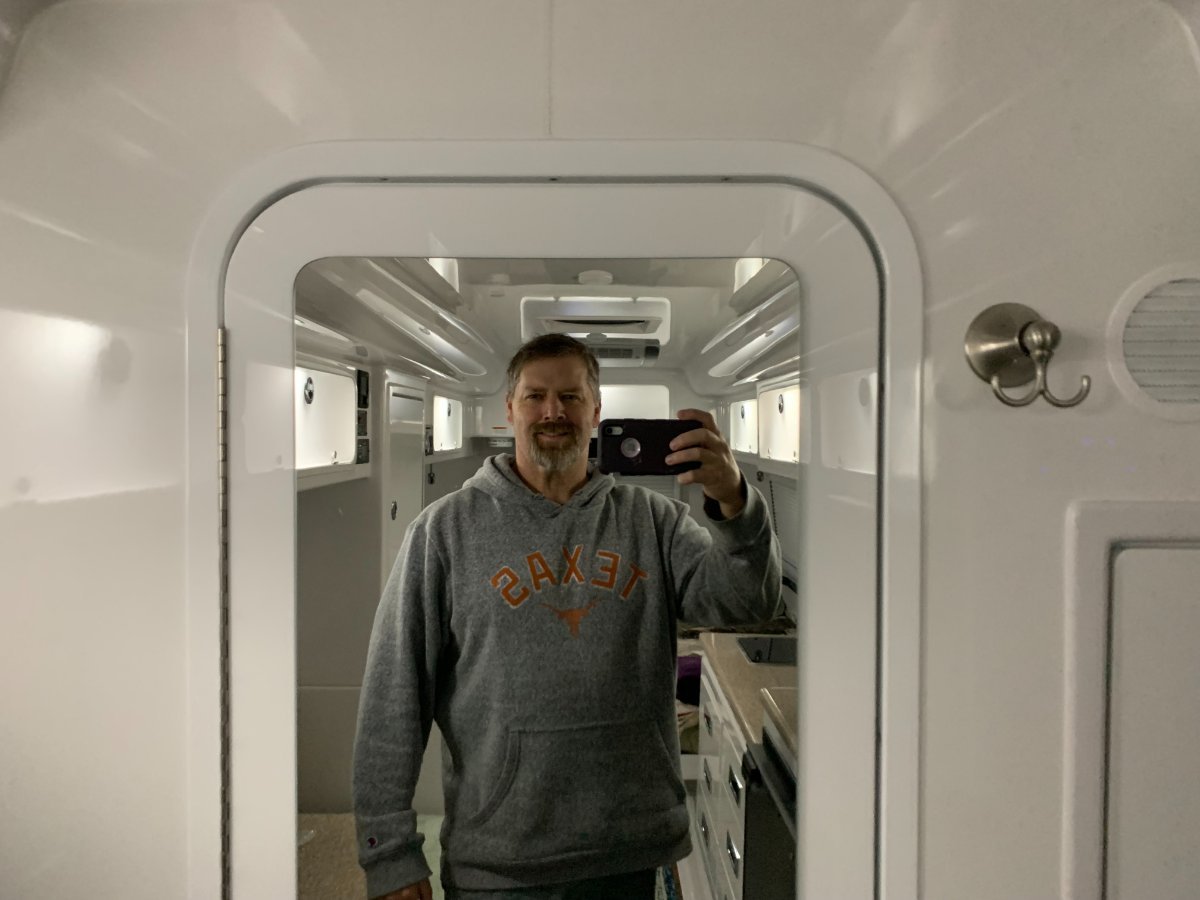
Thought I’d post a few pictures of the new bathroom door. I like the door, it is an improvement over past versions. It appears to be made of a composite material, as opposed to the closet and pantry doors. Smooth glossy finish on both interior and exterior sides. From the inside of the bathroom, it is translucent as you can see light around the perimeter of the mirror. nothing major. There is a drip “rail“ at the bottom of the door to prevent leakage, as well as a rubber gasket around the perimeter. My only concern is the latch. You must give it a firm push / pull in order for the latch to click fully closed. This may stress the handle over time. overall I like it. Time and closing technique will tell. Mark
 6 points
 -
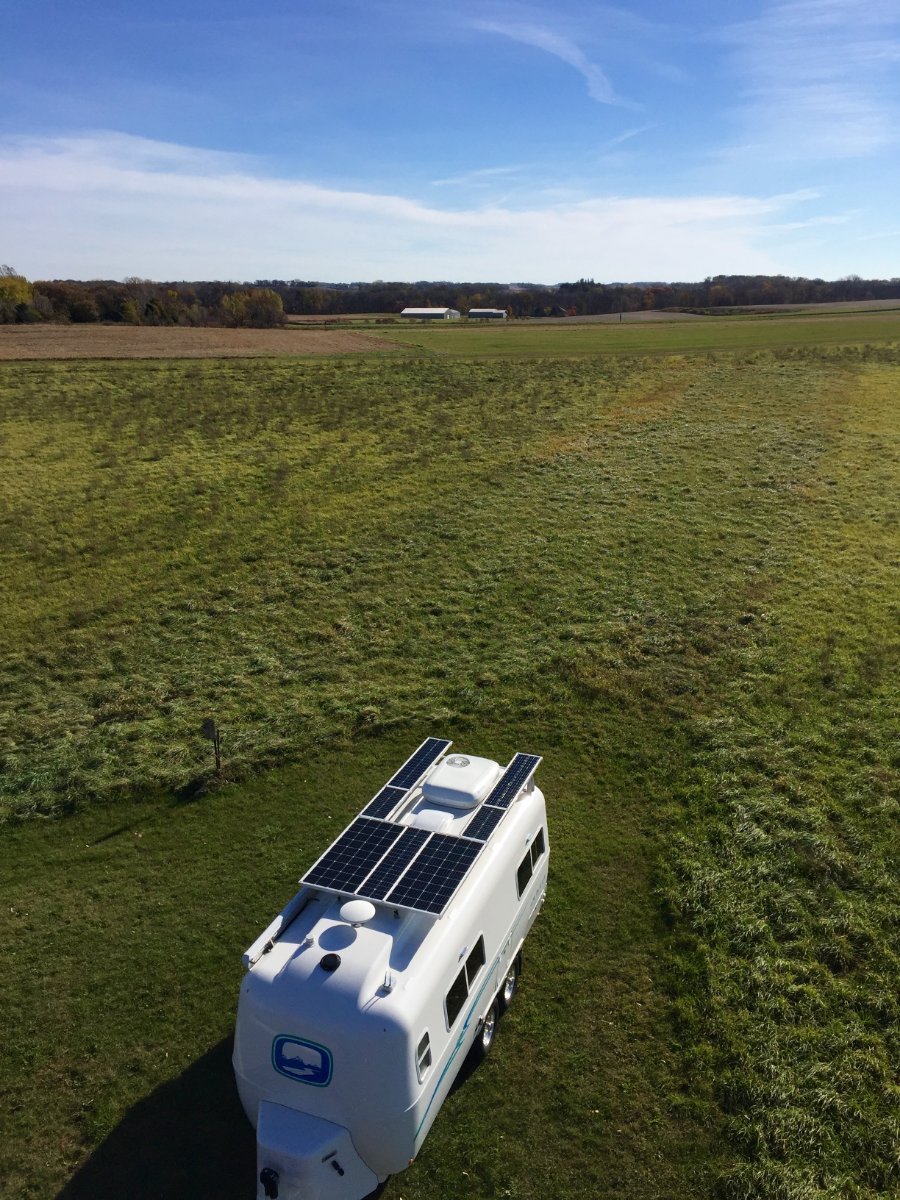
Ever since getting my Oliver I have loved modifying different aspects of it. I have done a bunch of stuff to the electrical system such as going mostly Victron for all components except for the inverter. Here is my latest mod which consisted of building an aluminum rack and adding 3 200 watt Newpowa solar panels for a total of 600 watts onboard. They will feed into a Victron 100/50 SCC. Just got the panels installed today and will be working on the connections tomorrow. I also need to fabricate a bracket for the front panel for a little more security but overall it is very solid. 😛
5 points
-
One more consideration. Replacing an external unit is a lot easier than the cost and time to replace the onboard unit.4 points
-
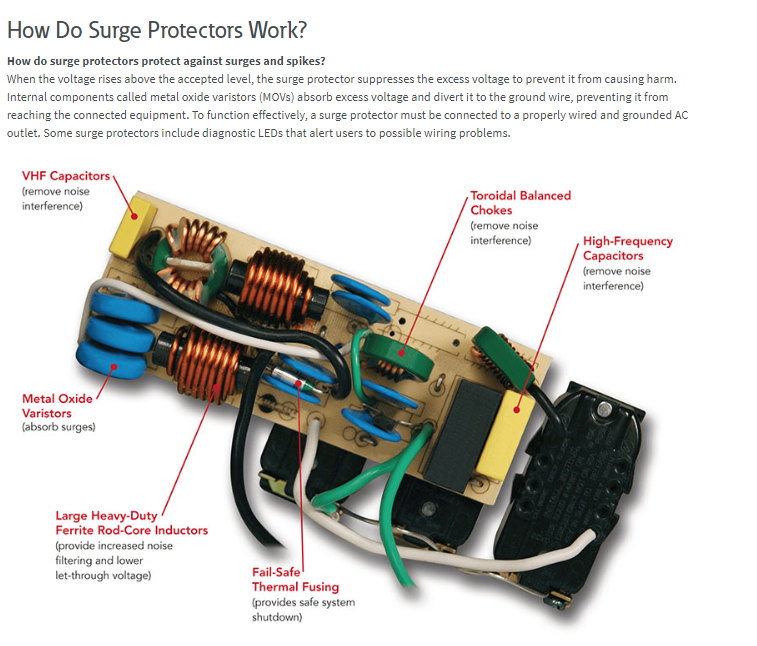
Full credit to the Eaton Corporation for the below graphic. My post addresses a bit of the technical side as to why some owners like double protection and use an additional surge protector at the utility source. As indicated in the Eaton Corporation graphic, there are six components in better surge protectors designed for RV use. Most of them act as filters to block noise and surges. One, the Metal Oxide Varistors (Blue disks below) work differently. They actually absorb voltage spikes. And they do it very well. However, over time they take a lot of "hits" and in the process of absorbing the excess energy they degrade. As they degrade their effectiveness declines. These components generally are not serviceable. So if a spike gets absorbed by a surge protector at the pole, it extends the life of the much more expensive surge protector in our trailers. Additionally, the Metal Oxide Varistors in any surge protector can only absorb a limited amount. Lets say that your camp ground has a tremendous spike heading your way. The Chokes and Inductors of your power pole will "knock down" the spike as much as they can. What gets by then hits the surge protector in the trailer. This one knocks the spike down further. It also gives us an error code that we can see inside the trailer allowing us to take action (hopefully) before the next spike hits us. As is evident, it is for sure belts AND suspenders, and for many locations is highly recommended. Hope this helps, GJ
4 points
-
No, I got the Lithionics 390ah setup when I bought my Oliver. I had ordered it when they were doing the lifeblue batteries but they switched before my final selections so the gave me that price for the Lithionics which was I think around $600 cheaper. The Lithionics are great batteries but if I had wet dells or AGM I would definitely be installing the big Epoch. Epoch also has some 300ah batteries coming out that are sized so you could put 2 in the battery tray. 👍🏻 John4 points
-
Yes leave the on/off button on the inverter in the off position, use the button on the remote/panel to turn the inverter on or off.3 points
-
Yes. Completely separate functions. Turning the inverter off has no effect on the converter (charger).3 points
-
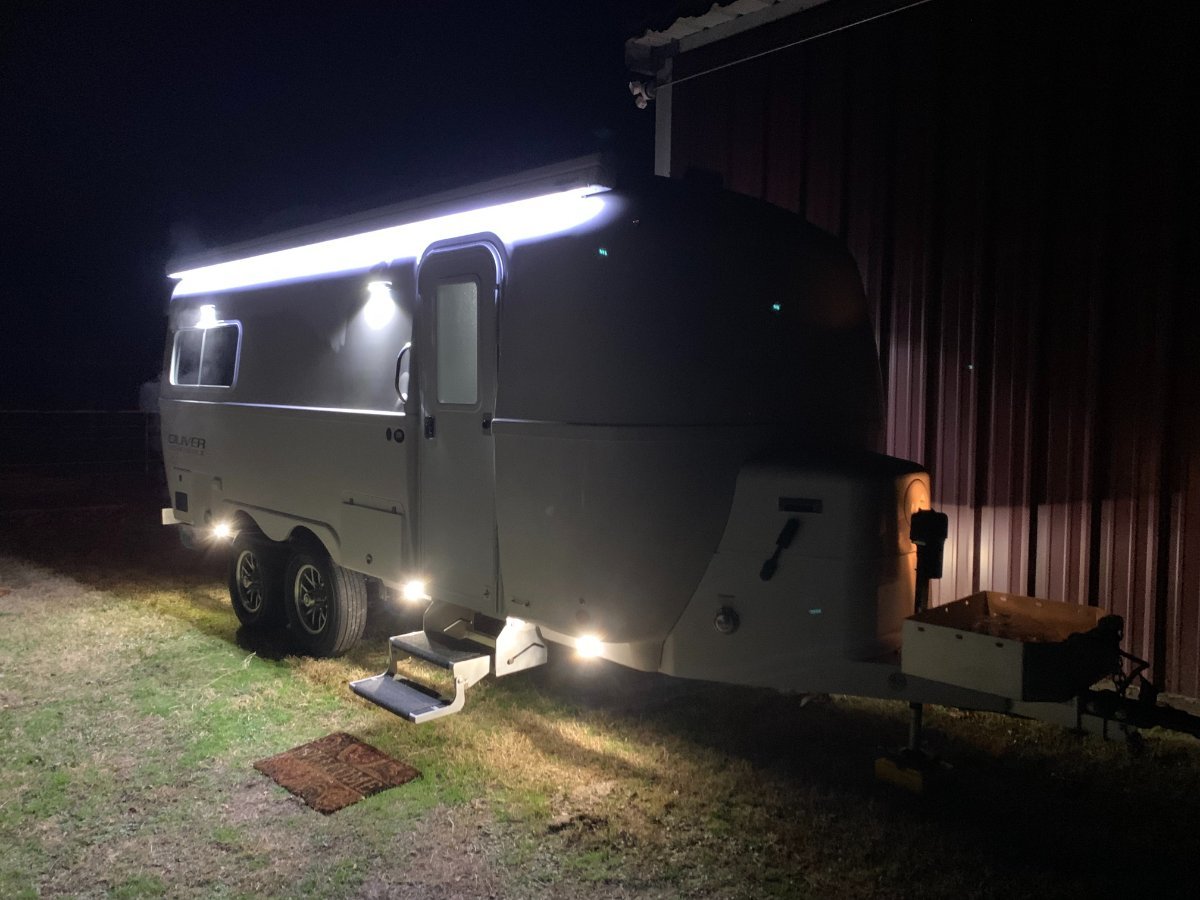
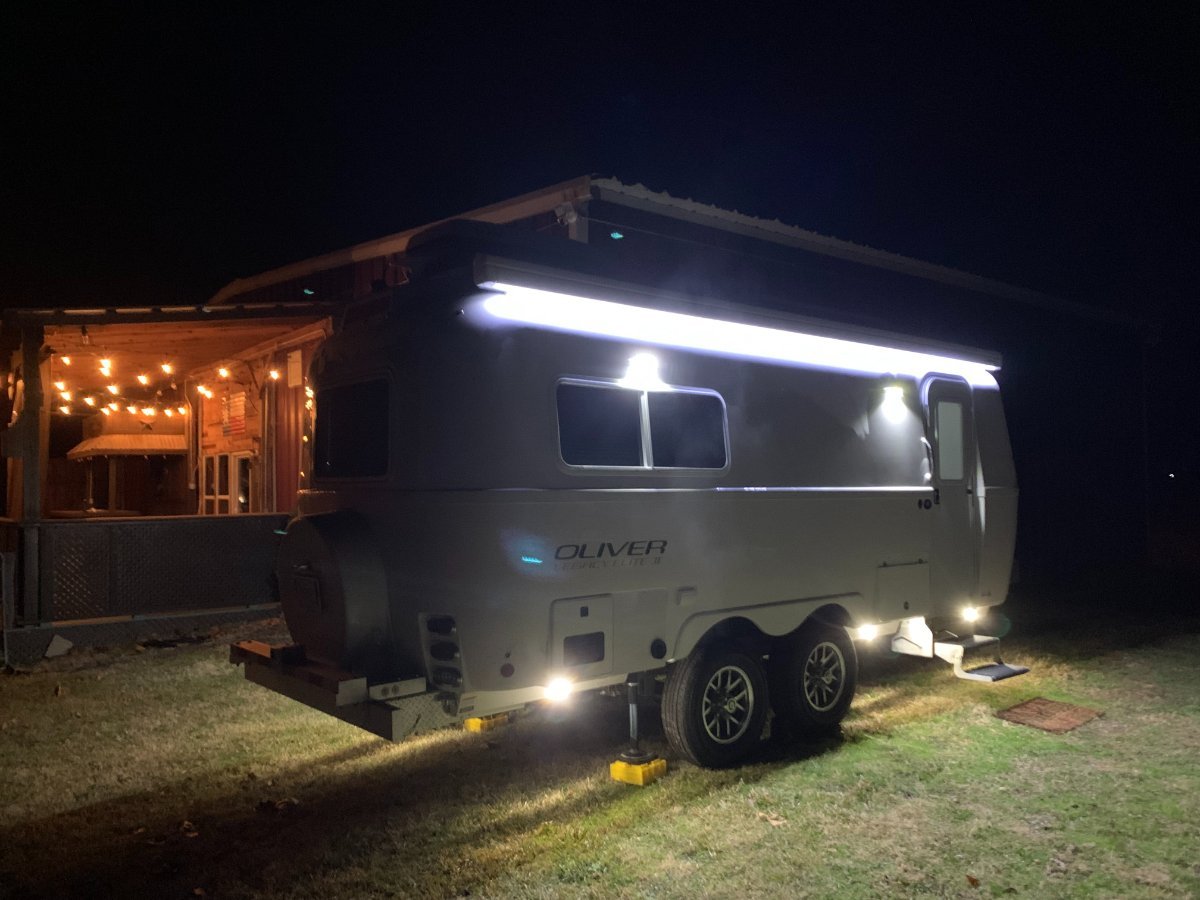
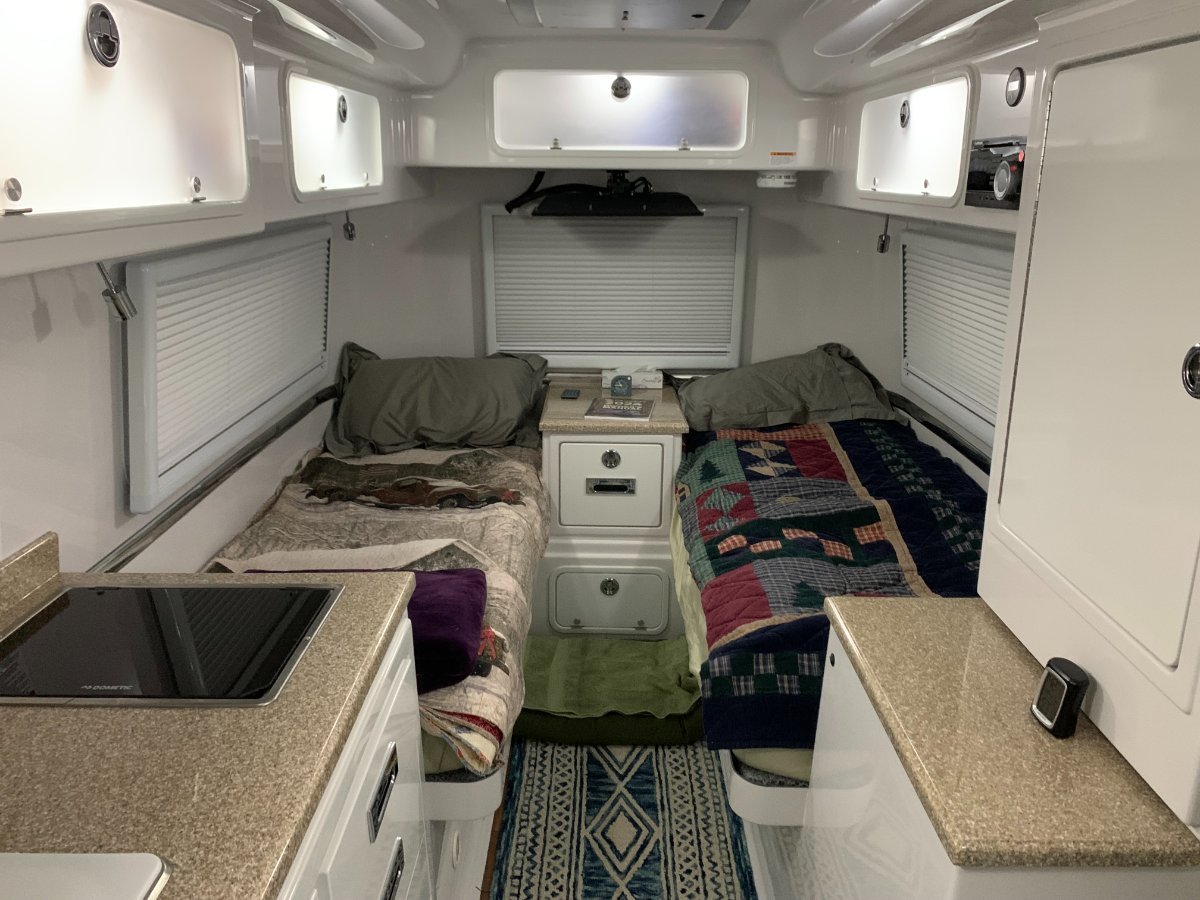
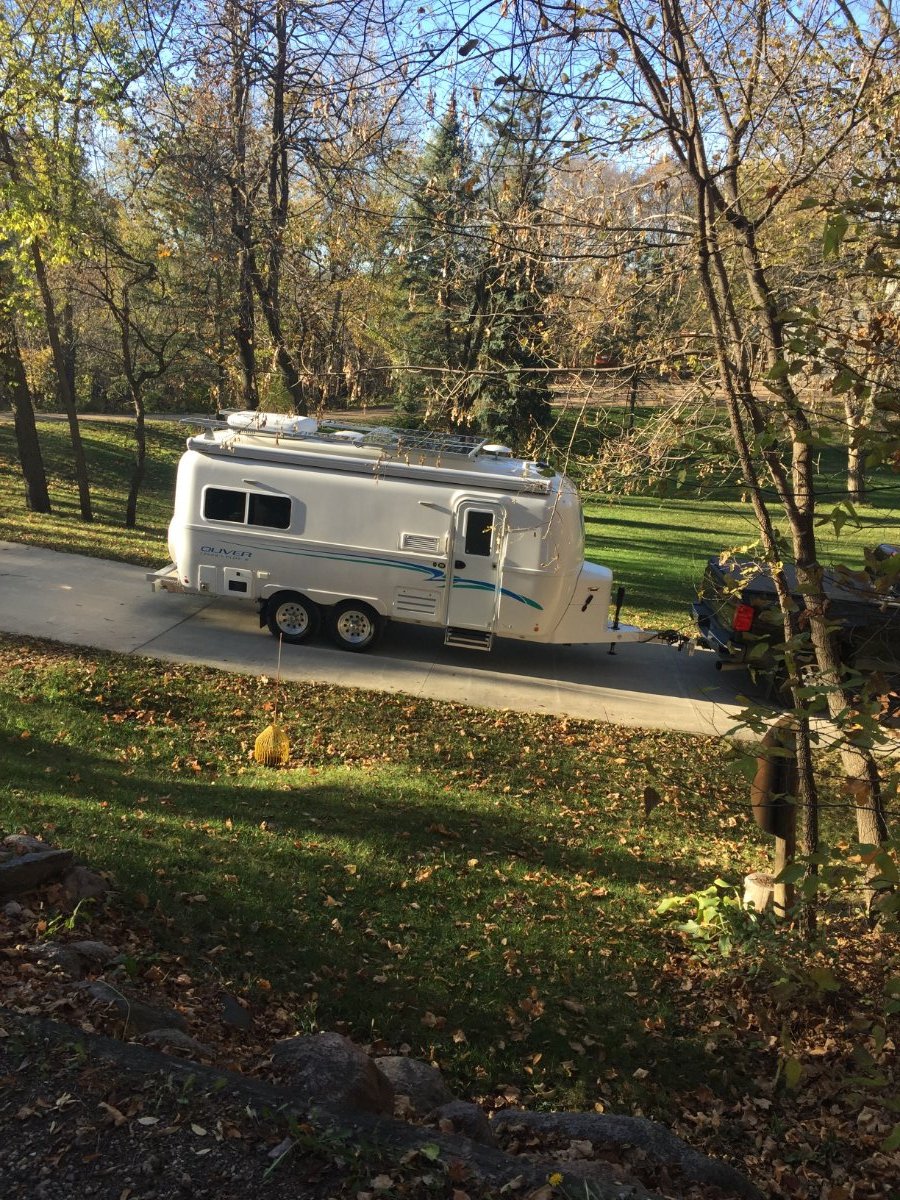
TLDR: We drove to Tennessee, then to Arkansas, where it rained, got sick, drove home and forgot all the pictures. A few bad pictures are at the bottom of this wall of text. Our adventure started on Sunday December 17. It was sunny and cool and stayed that way all the way to Tennessee. The first leg of our journey was my wife's idea. She wanted to extend this trip a little longer, so she talked me into leaving a day early with an unnecessary layover in Hot Springs, AR. We left Longview, TX, at 9am. Traffic was good and we made very few stops, so we got there at 1pm. After checking into the hotel, we drove around and ate at a fast casual restaurant named NEWKS. We have one of these in Longview, so we knew the food was good. With not much left to do, we went back to the hotel and stared out of the window overlooking the lakes. Monday was cooler but still sunny and bright. We left at 7:30am after eating the hotel breakfast, which wasn't that good, but it was free. We made good time until my wife noticed the big blue and yellow IKEA warehouse in Memphis, TN. Unfortunately, we stayed in there...let me clarify, we got lost in there for several hours. Thankfully, we didn't spend much to escape. They have a lot of very interesting stuff but most of it was about three times what we wanted to pay for it. I really wanted an expandable light globe that looked like the Death Star, but I resisted the Dark Side. We bought just enough to get a free bag then left. The rest of the drive was uneventful. After six hours, a stop at McDonalds to load and unload, we arrived at Hurricane Mills, TN. Once we got well past Memphis, the drive started getting pretty, but not amazing. We filled up the diesel tank for the first time here. After checking into the hotel, I drove over to Loretta Lynns Kitchen for some greasy food, then we called it a night. Tuesday started to get interesting. We drove down Dyer Road and feasted our eyes on some Tennessee back country, arriving at Oliver at 7:45. Our appointment wasn't until 8:30am but we got in early, and Hannah walked us through an exhausting power course. I had already learned most of the systems on Oliver's website, but my wife needed the hands-on training which lasted past lunch. My hats off to the people at Oliver. They are some down to earth great people. I made the right choice when I splurged on this trailer. Lori got us squared away on the paperwork and Chase stopped by for a chat over coffee. They had another couple scheduled for delivery later in the afternoon, so we rolled out onto the on-site campground and stayed the night in our new Oliver LE2. It was a cold night, but we stayed quite warm. Sadly, I failed to get pictures because I was too excited, then too tired. We planned to get pictures when we got to my parents' house the next day. That didn't turn out the way I expected. Wednesday started out nice. We slept comfortably, the trailer performed admirably, i.e. nothing was broken or messed up. Since we didn't bring any food, we skedaddled on out and hit 412 back to Arkansas. We slept later than usual, so we skipped breakfast and grabbed brunch at Subway. The trailer pulled like a dream. After big, hefty and obtrusive monsters, this thing slipped through the air like you would expect something with the name of Airstream to do, only much better. It didn't wobble, it didn't bounce. It is so well balanced; I hardly knew I was pulling a trailer. Obviously, my fuel mileage suffered some and the Cummins didn't have as much pep, but I can't say enough about this. I love it. Sadly, the trip started to go downhill once I started going uphill at Alma, AR, and it had nothing to do with the trailer. It started raining. Thursday, rain. Friday, rain, Saturday, rain. Sunday, rain. Did I mention, it rained? We arrived at my parents' house on Thursday at 8:30pm to rain. We parked the trailer, unhooked and got it leveled in less than 10 minutes. I was soaked but still had a great time. Obviously, it was dark, and the trailer was filthy, so we didn't get the pictures we had planned on getting when we arrived. But this week gets better. First the rain, then I couldn't get my dad's power to work with the trailer. Thankfully, we had enough foresight to purchase the 390 AH Lithium package. Since we had no power coming in and the solar panels were denied the glory of the sun, we were careful not to overindulge our electronic resources. Some coffee in the morning using an electric tea kettle, (I know, I need a regular kettle that I can use on the stove.) and a little TV at night kept the tanks above 50% for four days. Saturday, it went from bad to worst. My dad got sick with some kind of flu on Friday. Then my mom got sick the next day, followed by my wife. My sister, who works at the hospital never contracted this illness, so she elected to stay and take care of them while we drove home. Halfway through the drive on Sunday, I started feeling bad. Though I always try to look for the silver lining in adversity, it took some sunlight once we crested the Ouachita Mountains to liven my mood. We got home after dark. The rain had stopped but my wife felt terrible. I got her in bed and left the trailer hooked up to the truck for two days before I got the energy up to back it in, level it and hook it to some good power food. It was an executive decision on my part. I monitored the batteries using the LI3 app, making sure they didn't drop too low, and I left the heat on in the trailer at 60 degrees to combat the early morning chill. Once I got the trailer hooked up, I finally talked myself into some pictures as follows: The first two images are of the outside northeast of my house. The third picture is of our messy interior complete with dog bed. Fourth picture me not feeling too good. We are planning to spend a few days this weekend at Ratcliff Recreation deep in the Davy Crocket National Forest. Though not technically its maiden voyage, it will be the first for what we bought it for: Camping, not mooch docking. I will get pictures this time. I promise.
2 points
-
In order to "complicate" this discussion a bit further - The remote buttons used for being able to turn on the inverter "remotely" are connected to the inverter via what looks like a telephone cable. The little contacts inside that remote have been known to become dirty over time and can make the remote basically useless. If it appears as though the remote is not working - then - try using the on/off button on the inverter itself. Bill2 points
-
So far I've made it my practice to test the plug prior to connecting the camper and rely on the onboard progressive unit to do it's job. I can see the interest some have in protecting the hard wired device, and have purchased a portable device but just haven't put it to use. I purchased a Progressive Industries circuit tester before getting the Oliver. I leave it in the same tote that I store the shore power cord in. Step one - Test the power supply. Step two - If good, drag out the cord and connect. Circuit Tester
2 points
-
I experienced an issue with the factory installed surge protector that damaged my compressor fridge control board. A couple of years ago we were in a campground which was experiencing extreme voltage spikes. The voltage was spiking to nearly 200 volts then dropping back to a normal 120ish then several minutes later spiking back to near 200. We were not at the camper during much of this and as soon as I realized what was happening I disconnected from shore power and operated on 12 volts for the rest of our stay. The problem is that the surge protector interrupts the incoming power but then reconnects the power. This situation is both good and bad. It’s good because it automatically reconnects the power somewhat seamlessly. The bad is because it reconnects power somewhat seamlessly. By the power turning off and on fairly rapidly the compressor control board was rapidly and repeatedly switching between DC and AC supply. Be aware that some electrical or electronic equipment can be damaged by repeated on/off cycles. So, based on this one probably rare occurrence I might be inclined to search for an additional layer of protection. I am leaning towards a boost transformer based product like the 30 amp Hughes surge protector. The boost transformer will increase the voltage if it sags and will absorb the voltage if it increases too much along with the normal surge absorbing solid state devices. I’m still looking into this option as there may be other alternatives out there that are better. Anyway, just a thought. As a side note: I contacted the Progressive Industries folks with a question about the large difference between the amp reading on the remote readout and my clamp meter. They didn’t know the answer nor did they really care to try to figure it out but, they sent me both of the internal circuit boards and the sensor coil. Basically all of the internals of the surge protector free no questions asked. I did tell them that the unit is seven years old but that didn’t seem to matter. So even after seven years they still sent out free parts to rebuild the surge protector……not bad.2 points
-
When I saw the title, I was expecting a different subject matter, that of upgraded 115v receptacles with smart features. I'm not sure what smart features would be useful on our Olivers, but I have considered changing out a few of the 115v receptacles for the type that have the built in USB receptacles. To me this would be well worth the upcharge from the factory. Regarding the actual topic of the thread, I knew of these from our boating days and hadn't even considered it then, let alone now with the Oliver.2 points
-
That's the one we have. Didn't buy it for the Oliver, we already had it from a previous trailer, but figured we'd use it since we had it. I check the LEDs on it before I plug the Oliver into it as a quick check on the power status.2 points
-
Yes, I posted after our Oct 20 visit that Oliver is producing this door in house. A much stronger door/mirro combo with less flex and a much more secure latching system. I hope it will be a retro fit! As always nice work Oliver!! Onward! Patriot🇺🇸2 points
-
Jason, congratulations on getting the Ollie home safely with all the adversity, and please note… your trailer isn’t messy.2 points
-
Jason - You are now an official card carrying member of the family - welcome (again). I too thought that the "Ollie Gods" were against me when I picked up. It had the nerve to rain and we were camped in a mud hole to boot. Sure, I washed (as best I could) the shiny new Ollie the next day but (you guessed it) it only rained again. At least we didn't get sick! Hope all are back to normal by now. Certainly you will have a great story to tell and re-tell about your delivery trip. Hope that the "first real" camping trip goes without issue and you can settle into that lovely new Oliver. Bill2 points
-
Welcome and Congratulations from Hull 1182!! Hope your family is feeling better. I am sure you will enjoy your adventures in your new Oliver. Pictures are always a good thing.2 points
-
This sounds like me. I never buy extended warranties. Not worth the paper they are likely not printed on. Murphy's Law is almost always right. My philosophy is just save the money for a new one or learn to fix the old one. I know Truma offers a free extended warranty by registering, so I will get that but anything past two years is just bonus.2 points
-
And 20K vs. 60K miles is a big difference. You certainly have ample time at near 5 years with relatively low miles. My advice is the same advice Mike already gave, but I'll say it another way. Don't buy tires from OTT, as they are a long way from a Rocky Mountain trip, down to Key West, up to Maine, or wherever you will travel. Discount Tires is likely the largest national tire chain in business today. Buy from them when the time is right (I stick to 7 years max) and whenever you need to check pressure or add air, fix a flat, replace a tire or leaky valve stem, or just to rotate and balance, they will be nearby at no charge for many of these service needs. You may pay a little extra up front for this national service coverage, but it could save you later. They are everywhere and generally have very large parking lots and driveways, easy to pull into with a trailer (except for their store up here in Prescott, AZ!) The fact that they have a store up here, in a small town in the mountains says a lot too.2 points
-
Chris and John: Thank you! Roger I snipped the wrong picture from OTT. Have deleted it above. I went deep into my pictures and snipped this one of our roof line. We just have up front the Omni Antenna, vent stack and bath fan. The Yuma Copper Iridium Gallium Selenide (CIGS) panels are rated at 200 watts and are roughly 26" X 80" in size. Ollie is 7' wide with two puff up/downs along the width of the roof. As such, dimensionally they will easily fit on our roof running starboard and port (S/P) direction with room to spare. With your measurements in mind: Without moving the antenna we can easily get two each 200 watt panels laid S/P. If I relocate antenna, it appears that we may be able to get three of the 26" wide panels laid aft of the bathroom fan and vent stacks. Granted laying the panels over the vertical roof section and their run up/down curved sections will reduce the outputs of the panels likely in the 8% range. "ASS of U & ME" such would de-rate the panels to 184 watts (maximum calculated) output. One of the significant benefits of these panels in partial shade is that they only de-rate by the shade over the sections shaded. Unlike many other systems, partial shade impacts the entire panel. For planning purposes, I'm going to assume only 175 watts max output. So, conservatively we are looking at getting maybe easily 350 watts or maybe 525 watts of power if we relocate roof penetrations. Point is go get what we can with virtually zero aerodynamic drag, and far less visual pollution to boot. I have sent the MFG Rep a series of questions about their panels, and will update this thread with their responses. GJ
2 points
-
If you have to ask then this exalted position is well above your station in this life - sorry. Well said. However through exhaustive study and practice, I have learned that some are engineers who definitely were born with a warped sense of humor.2 points
-
If you have to ask then this exalted position is well above your station in this life - sorry.2 points
-
Don't bet the ranch on that - once down the rabbit hole the rabbits tend to take over!2 points
-
I wanted to add more capacity to my factory 340 watts because you have to remember those are rated watts not what you actually get to use, and the amount you actually get to use depends on where you are located and weather conditions. What I ended up with was additional Zamp panels, three 90 watts and two 45 watts equaling 360 watts. I went this route because it was the easiest way to fit them on the roof and merge them with the existing panels. Another consideration is when parked in partial shade the individual 12 volt panels wired in parallel that is shaded is the only one that is affected by that shading unlike when you have panels wired in series. So I have a total of 700 rated watts on the roof and in prime conditions here in Minnesota I can harvest a little over 500 watts. With that said it makes it harder for me to justify a dc to dc charger for when traveling for it has no problem keeping my 400 amps of Battleborns charged up. So far I'm happy with the outcome of the upgrade.
2 points
-
Rich, I do not - actually, when I had this done it was because I had a leaky black tank valve since I picked up my trailer. No matter what they did to adjust the cable, it wouldn't work. I asked the service department (Jason) if he would be willing to put an electric valve in when they were changing it out. He said they were actually looking into it and they would. Turned out, there was something stuck (plastic) in the valve gate when they took it out. Looked like a manufacturer's defect. I love the electric valve and asked about the gray tank as well. There is actually not enough room where the gray valve is to install the electric version and it is right on the other side of the handle so, there is not much chance of it stretching. So, I have one of each. Only trailer in the fleet configured like this. It has never leaked since. Cheers, Brian2 points
-
If anyone is considering switching to lithium I highly recommend checking out Epoch batteries. I have 48 volt ones installed in my golf cart but they also make 12 volt batteries for Rv applications. Will prowse just did a review on their 460ah battery on his YouTube channel. It would fit perfectly in the battery tray. They also have a holiday sale right now so you can get the above battery for about $1700 which is a steal for that amount of power. Epoch has other sizes as well. The lithionics are nice batteries but there are much cheaper options with the same quality. FYI… John https://www.epochbatteries.com1 point
-
True....but.... As rich.dev instructs, leave the silver button on the inverter OUT (off), so you can control the inverter from the silver button on the remote. My remote is mounted about eye height just forward of the pantry on the street side. Leave the silver button on the remote OUT (off) unless you are not connected to shore power and wish to run a 120V appliance (like the microwave or a blender) on inverted power. Push the silver button on the remote IN (on position) to turn on the inverter to supply 120V power to the appliance. Depress the silver button on the remote (to release it to the OUT (off) position) when you no longer need inverted power. Turning the inverter off when you don't need it will conserve 12V battery power.1 point
-
Yes, my 2023 E II has Victron.1 point
-
Sorry to hear you all got sick. On the bright side, that was actually a pretty good shakedown trip. You were able to test for leaks in the rain, test the furnace, get a feel for the capacity of the batteries, and get a sense of the living space available when one person is sick. Hope you've all recovered a bit now. Yours was the first picture I've seen of the new bathroom door. Would love to see a full length shot of it if you get a chance. Also, we've been thinking of getting another dog after retirement and figured the dog bed would go where you put yours. How big is your dog (photos?) and how did it work out with his/her bed there? Thanks for the report. Enjoy your next trip.1 point
-
I asked Oliver why it didn't have a filter. They didn't have an answer, and I'm still confused about this. Your filter idea is exactly what I was thinking about doing, and even though you encountered the error message, I am assuming it is because you needed to INCREASE the filter surface area to improve airflow. My idea included using a HEPA filter since I have horrible dust and mold allergies. With your test, I will have to create a larger box to allow for more airflow. Hopefully, this will be enough to not cause the error.1 point
-
Sadly, though I indeed have the capacity to dive deep into the proverbial rabbit hole, I am entirely too lazy to dig to the depth of self harm. 😞1 point
-
@SeaDawg and @Geronimo John, Got back up there today, took more pics and measurements... End-to-end there is 84" between two hard constraints, the bathroom plumbing vent and the MaxxFAN. The picture showing the tape measure starts at the rear solar panel mount. You can see from the picture I posted yesterday that there is another 2-3" behind that rear mount to the MaxxFAN. So approx. 84" total front-to-back, where an 80" panel can fit nicely. And two of these, running front to back, could hardly be seen from below! That would be nice, clean and mount nicely. I would mount mine with 3M VHB tape ONLY, no need to screw into the fiberglass (you would only need to drill two 1/4" holes for the solar charge leads. I read here where some members would not put solar up top to detract from the beauty of the Oliver. Two of these lengthwise could hardly be seen, but if you mount 3 panels, wow we're seeing it, just sell the generator! Personally, I would move the TV antenna, and in my previous post I suggested one method. I'm adding a TV antenna soon, and I plan to mount mine at the rear, drill ONLY a 1/4" hole into the roof, straight down to the attic (with only a little dab of Dicor self-leveling sealant you're good). You're there with a straight short cable, not 30+ FT of multiple coax cables and connectors that OTT uses. From what I could see, while up there on the ladder, at 80" wide your panels would hang over the awning(s) and be as wide as my awning, left and right (sorry, not good with the starboard stuff!). Think another 11" each side when looking at mine. Hopefully my measurements and pics will help your plan. Best to you and stay warm somehow! Sheesh I cannot fathom how people install stuff today! Look at my Winegard below. I would have used NO screws, no bracket wings and NO Dicor! The coax only needs a 1/4" hole and VHB to housing to clean fiberglass. It ain't going nowhere, I promise!
1 point
-
Wow! That's great! I'm very excited for you. We put 600 watts on the boat several years ago, and ditched the cord. 400 watts a few years ago on the Elite,,and rarely have to break our the genset. (200 watts portable solar, in addition.) Any more photos of brackets? Did you have solar before the 600? I'm really looking forward to your reports.1 point
-
"some" ??????????????????😁1 point
-
Patience, young grasshopper, all will revealed to you when the time is right. C.R.H.E.1 point
-
Yes - those fish in the streams and all those fire prone trees, bushes, etc. really need that winter snow for moisture.1 point
-
Wait, how do I achieve this level of Rabbit Holiness? This is literally my life dream.1 point
-
Post up a pic if you can. I would be interested to hear your review of the snowblower. Hopefully you won’t get too much winter weather.1 point
-
The Smart Plug looks to be perhaps a quicker connection? Water tight? What is the criteria? Is the OEM outlet/plug inferior? I like the screw ring on the OEM plug, it's in there, a SOLID connection. I'm with some others here, not my time and money. Sheesh, I've made a dozen upgrades in just 6 months, didn't think of this one. With solar we rarely connect, and the cord mostly sits in the Oliver trunk!1 point
-
Smart plug has been around a good while, but it's earliest iteration probably gave it the "smart" label. First gen had a bimetal thermostat that cut power at 200 degrees farenheight, but resumed sending power at 120. This is no longer part of the smart plug, as a) users got frustrated with random power outages, and bad mouthed the product, not understanding why they lost power (didn't read the manual) b) (most importantly) ABYC (yacht equipment rating/approval system, like rvia, for rvs) didn't like the concept. Imagine if you will, ac goes out in the middle of the hot night, and owner digs in, removes covers, digs around, gets a heck of a shock when cord resumes sending power, because the thermostat on the smart plug cooled to below 120. Lights, etc., on boat are still working, because they're 12v , so they didn't check 120 input. C) thermostat didn't always work as designed, and they still had some meltdowns. The integrated thermostat has been discontinued, years ago. I do like the no-fail, odd shaped connection design, and the latching mechanism of the Smart Plug, but not enough to consider changing the connections on our boat for the many $$$$$. I, too, can't figure out the 27x greater contact. I'd like to see an engineering report in that. Most meltdowns are caused by overloading, or corrosion, or crappy connections, or all of the above. BTW, Marinco has a new EEL cord (easy engagement something) connector with spring wings, a slight twist, positive locking mechanism, probably designed to combat Smart Plug, that works with the standard twist lock input. It's a whole bunch less than smart plug cords, and undoubtedly tested to Marinco safety standards. It even has a little led light in the plug, so you can (sort of) see what you're doing, if you're setting up in the dark without a headlanp. I haven't seen an EEL yet, in person, but likely will at the winter boat shows. I like the videos, though. Many boats use a strap for stress relief at connection point. Those 10/3 cords are really heavy . Another consideration. On the few occasions that we plug in, we at least drape the cord over the tire, to alleviate some stress (ollie), and use straps at dock and boat. Edit to add: EEL Marinco short video1 point
-
I agree with both of you, in a way. As per CRM, yea for sure. Heavy too!. As per Steve, yea great idea especially if your TV is a 3/4 ton or higher because such a design to be wind resistant/proof it would sure add PSI to your Ollie Tires. ++++++++++++++++++++++++ But, our OTT's are designed to be aerodynamically minimalists. Hence why I don't like and will not install ridged flat solar panels poking up into the airstream and obvious visual distractions from the elegance of Mr. Scott's design. Especially so to our audience with a minimalist's perspectives of architectural beauty. On the other hand, when we have proven, flat laid, Lightweight, efficient, flexible solar panels, that can last a long time directly adhered to the roof surface; that becomes a game changer for some of us. GJ Note: Can you believe that this pea brained Mechanical Engineer can use so many big architectural concepts and words in a row? OMG I may be turning into an Architect in my ole age. OK REDEMPTION is now necessary::::: It will be interesting to see how the CIGS panels actually pan out in direct sun, as well as the possible impact on the heat transferal through the skin of an OTT roof system. GJ Note: Whoo, that was close. Looks like I'm back to being a M.E. again. That rabbit hole could have been my demise. 😞1 point
-
It is about time. When the Outlaw Oliver was being built in 2013, I specified that each light should have its own switch. If they do this, I can add it to my long list of our original ideas that have now become either standards or options.1 point
-
Very interesting Brian, do you maybe have a post with this mod (quick search but couldn't find anything), and why not the grey tank as well?1 point
-
Our older (#12 Hull here) have separately switched lights, but not as many as the new trailers. I personally dislike touch lights.1 point
-
As I currently understand it - the "new" bathroom door will be similar to the closet door in both look and in the hardware that is used for the latch etc.. Also, as with the current door, the large mirror will still be used on the "outside" of the door - the side facing the interior of the cabin. Bill p.s. I think that the "noise" being referred to is caused when opening the door and the magnets don't all release the door at the same time. This causes to door to "vibrate" which, in turn, causes the noise. It is either that or the door hits against the frame when opened or closed causing the noise. Bill1 point
-
So they haven't gotten rid of the touch lights that have been problems. Two of ours have failed in the first 2 years.1 point
-
Regarding this topic, the following video was just posted today.1 point
-
Thanks Chris. Actually found it, as you said, on the front. Our remote quit working so replaced it (ordered a replacement from Amazon), and the inverter works fine now. David1 point
-
Time will tell. I registered all of our Truma products, to extend the warranty from one to two years. Logically, a simple filter, using purpose-built filter fabric, should extend, not shorten furnace life. But, after 35 years of litigation practice, it does not surprise me when companies latch on to any excuse to deny warranty coverage. On balance, I would rather try to protect the furnace I have, and take the warranty denial risk, than leave it unprotected and rely on the warranty. In any event, Murphy's Law suggests that the furnace will fail two years and one month after purchase!1 point




















-
Recent Achievements
-