Leaderboard



Popular Content
Showing content with the highest reputation on 12/07/2020 in all areas
-
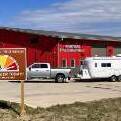
After driving 2,500+ miles from Oregon, we are in Linden tonight . . . . picking up #699 - "Pearl" in the morning. Stay tuned for photos!4 points
-
I don’t have much to add to the comments above. I’ve been able to get into some pretty tight spots and navigate some narrow roads. Remember that the Oliver isn’t any wider than your truck, so if the truck can make it through so can the Oliver. Sometimes gas stations take careful observation before and during pulling in. I like end pumps that allow turns to get out. As far as towing “such a large footprint” I think it is towing a fairly small footprint. Once you size up most of the other trailers out there it’s clear the Oliver isn’t large and is easy to maneuver. Mike4 points
-
I want to caution folks who may be unaware that washing dishes and leaving food residue outside in predator country (bears etc) is bad, and it is prohibited in many National Parks and USFS campgrounds. So is showering outside using scented soap or shampoo. Away from those places, and not close to a stream or lake, that works well though I dislike the wet muddy/ sandy mess it leaves on the ground. In situations where you can shower outside you can often do a slow drain of your grey tank using a garden hose run under a sagebrush, with your dump valve barely cracked open, as long as your soaps are not scented. John Davies Spokane WA3 points
-
One gas station trick, when the lanes face the building, is to drive around and pull through facing out. That way you can get a sense if the trailer can make the turn before you’ve committed yourself, and you’ll be less likely to get pinned in later by other traffic. Just be sure when you pick a pump that you can pull through to the farthest one so that you don’t leave your trailer in the traffic lane.3 points
-
I can only echo what’s been said. For some reason on our recent trip, other people were determined to trap us in gas stations, but the Ollie triumphed. It’s remarkably nimble, within reason. I’m sure that I’ll get in trouble someday, since my initial reaction to any size limit sign is “...except for Ollies.”3 points
-
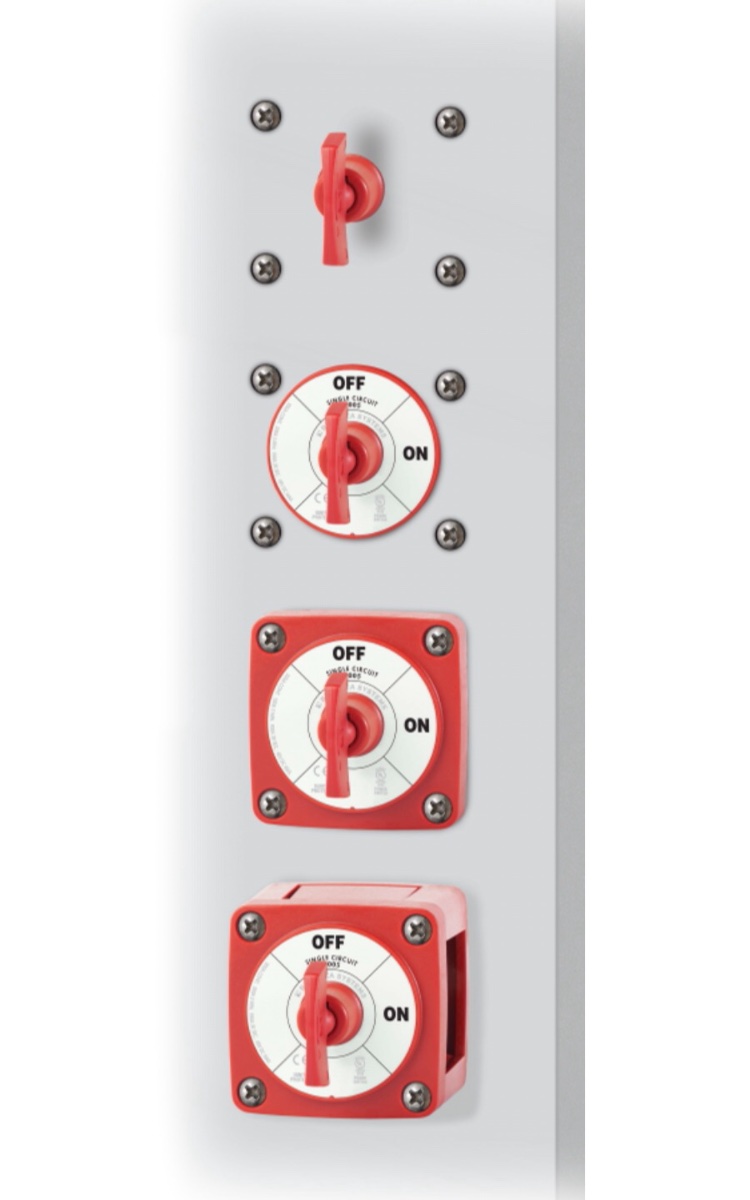
A really simple way to provide a manual disconnect feature for a single source is to use one of the very nice Bussmann circuit breakers, these are available from 25 amps to 150 amps. There is a bigger model that goes higher. You should already have one or more, my Hull 218 has one for the “house bus”. You just push the red Test button and it opens the circuit, simply swing the yellow bar back into place to close it. I plan to use at least two more in various applications like a MPPT solar controller and a DC to DC Redarc charger. They are better than a single massive switch because you get individual control over each circuit as Overland mentioned, plus they allow you to throw away either a fuse or a stupid automotive style auto reset circuit breaker. Don’t pay over about $30 for one, they are easy to source. Several of them located in a neat row will look way better than the odd mix of electrical parts Oliver installs. If you are determined to buy a Blue Sea switch (and they are most excellent) I personally would choose a pair of their mini switches, with their switched sides going together at a positive bus. You could even add more, for other stuff like a portable solar charger, and make a pretty marine style panel. It can be mounted in a number of ways, I am not sure if that applies to the big switches...? I think a master power control panel with flush mounted switches below the rear dinette seat would be quite cool, if you have room there. https://www.bluesea.com/products/6005/m-Series_Mini_On-Off_Battery_Switch_with_Key_-_Red They are quite dainty, about 3” square. .... http://assets.bluesea.com/files/resources/dimensioned_drawing/M_Switch_Key.pdf John Davies Spokane WA
 2 points
 -
A lot of great information is already posted here. I am a relatively inexperienced and I probably worry too much about planning the route... I recommend; Know the range of your TV while towing. Choose a few fuel options before you start the trip (use google maps to preview as others have stated). Keep in mind that you may need to make adjustments for the amount of climbing and/or wind. Don't overdue it. At first you may find that towing is stressful and it is better to have shorter drive days, if possible. You might consider stopping at a few rest stops along the way to help prevent fatigue if you are feeling a bit stressed.2 points
-
Two things we have found: In backing up; Put one hand on the bottom of the wheel. Which ever way you want to trailer to go, is the way you move your hand. It becomes second nature eventually, after you figure out mirrors. Carry plenty of referral cards. People have followed me for over 20 miles wanting to see what kind of trailer it was. After gassing up, I had to pull to the side of the lot. There was that long a line of people wanting to take a peek!2 points
-
Welcome to the Oliver family. Be sure to take your checkbook with you, you will want one. We have gone from tents, to fifth wheel, to Scamp, to a Class A, over the years. We have enjoyed them all, but not to the extent of the Oliver. At only 7 foot wide we thought it might be claustrophobic, but has never been the case. Going through a Garmin short cut, in a mountain pass, the 7' and a back-up camera was a blessing. The Garmin didn't know that the recent rain had washed out the road. It was gone. No problem. We could see down each side of the Oliver with our standard mirrors ( none of those extended thingies to shake and vibrate). In about a half mile we was able to find a suitable logging road to scoot into and off we went. The Oliver has LED back up lights too. The standard solar set-up has allowed us to camp 34 miles into the woods on the NW corner of Moosehead Lake. The CG had a generator that ran for about an hour three times a day. Didn't effect us at all. If the microwave was on we knew the generator was running. Our fireplace and folding recliners are outdoors. A rinse with Maguires Wash and Wax keeps it looking like new. No Black Streak remover like a stick built. The high ground clearance of the Oliver and it's size have allowed us to camp in places we might never have considered before. We usually stay off the Interstates, as there is a lot more to see. And we fit there with ease. I have caught myself on the Interstate clocking close to 80, so that is not a problem. We have found the journey to be part of the adventure, not just the destination.2 points
-
I always recommend that a towing virgin with zero experience simply rent a small U Haul open trailer for a long weekend and just drive all over, and on Sunday morning practice backing and tight turns in an empty shopping center parking lot. Get a skilled friend to teach you a few tricks like S turns while reversing. You will feel a whole lot less scared on delivery day and can focus instead on orientation and enjoying your new Ollie. Some of those twisty secondary highways around Hohenwald are more than a little intimidating... https://www.uhaul.com/Trailers/5x8-Utility-Trailer-Rental/AO/ The base rate around here is just $19 per day. John Davies Spokane WA2 points
-
All the above are great replies, just a little experience will soon have you confident. Just taking your time and not rushing is always the best way. I have found the most nerve racking time is really backing into camp sites. The first five feet of backing up for me is the test. Once my brain kicks in with turning my tires to steer the Ollie in backward I do great. But sometimes I have to just stop for 30 seconds and reset my thoughts. Backing up will be second nature once you get the hang of it. Also use your phone or walkie talkies and the second set of eyes are very helpful2 points
-
Oliver should consider the option of providing the mounts and letting the owner install whatever awning they want on their own.2 points
-
As far as gas stations, I really recommend Costco and Sam's, if you have the memberships. The lanes are clearly marked, one way in and out, and kind of a cattle chute entry, but easy and wide exits, for the most part. Not to mention good prices. No diesel, though.2 points
-
I’m sure people will want to discuss the towing prospects of the new hybrid 3.5 turbo. Interesting inclusion of a 2400 watt (up to 7200 watt 😳) inverter. And a 2000 watt inverter option on the other engines. I think that will definitely negate the need for a generator for many folks.1 point
-
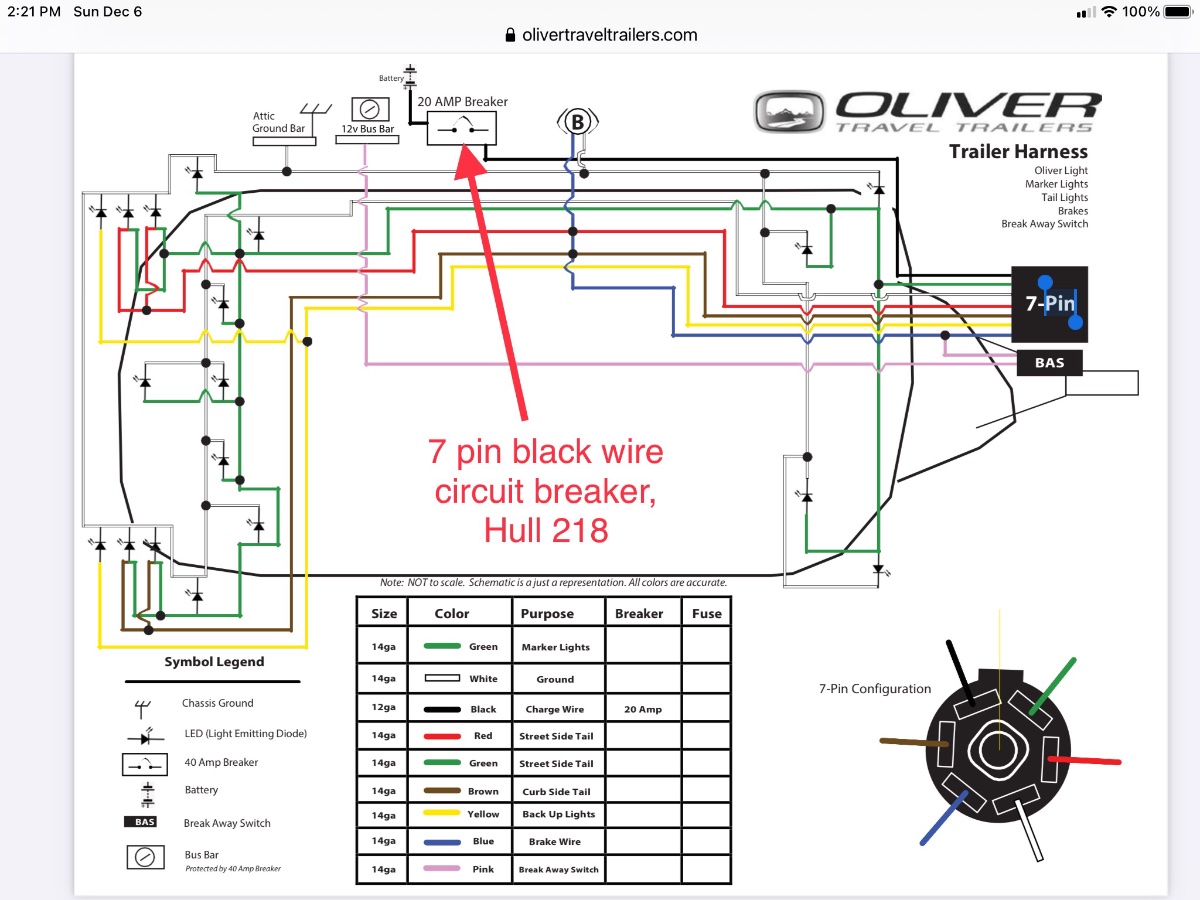
I thought I knew where the breaker was, There is a small silver (automotive type) 20 amp self resetting breaker near the bus bar and jack fuses under the street side bed. But the black wire is quite small, perhaps 16 AWG. At the very front of the trailer in the tongue harness I have a bigger 12 AWG black wire. So I guess what I was looking at is for some other circuit. There is a similar breaker close by for the rooftop solar panel wire, that is easy to spot because of the kind of wires it has. Any ideas where I will find the battery charge circuit breaker for the 7 pin connector? Does the front harness come in under the bathroom floor and tie into the trailer wiring there at a terminal strip? If so, where is it located? There is not one shown on that diagram! I would rather not file a service ticket if somebody happens to know. Surely somebody has seen these connections. I am going to install a Redarc Trailer Charger near the inverter and I need a 12 AWG or larger wire to feed it.... I would rather not be forced to run a brand new one. But if I have to I can increase it to 10 AWG. I just need to locate it! Thanks, John Davies Spokane WA
1 point
-
Hi all, We have RV’d since 2011. We purchased a new DRV 5th wheel and put over 80k miles through the Yrs. Both our kids families have RV’S so it’s been a great way to travel with them. Now we would like to downsize to a more manageable and less technical camper. From what I’ve seen and read Oliver seems to fit the bill. we are going to factory next week to see if we can function with the smaller layout. look forward to being part of this forum. Paul & Linda1 point
-
Welcome from a fellow North Texan! I’ve got a May 2021 delivery scheduled. What side of the metroplex are you on ? I’m on the Dallas side in Collin County. Good luck !1 point
-
Starshine, I don't know if you follow allelectricfamily, but they put up a YouTube today comparing drives with a Tesla X and a Ford explorer. Thought you might find it interesting. https://youtu.be/3OnEyVjo7t41 point
-
Paul and Linda, welcome! Getting a factory tour is smart, not only can you judge size but you’ll see what goes into making an Oliver. Bill’s recommendation to take lots of pictures is a good one. We have relied on pictures we took a number of times to figure something out. Mike1 point
-
I'd also highly recommend the Ford backup assist. It's just an easier way to do it in all situations.1 point
-
I'd recommend two separate disconnects, one for the solar and one for the batteries. Only because it's an idiot proof solution, and I'm often an idiot.1 point
-
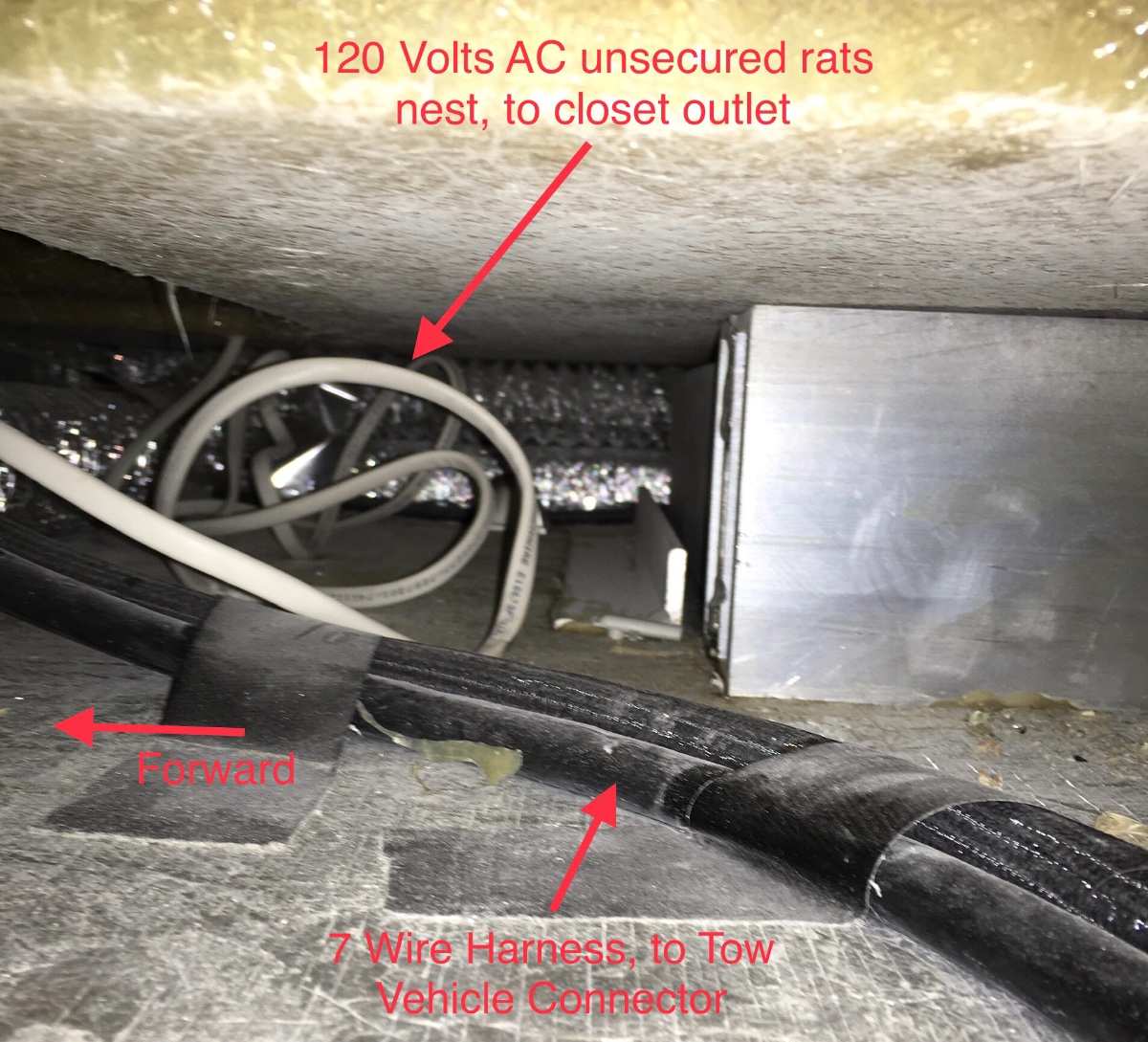
Soon maybe, but not quite yet. I still am considering running furnace air through it. I ordered a junction box to reroute all the 7 wire harnesses to, and I will have those splices located up high above the small pipe, where they can be accessed twenty years from now. I already put a similar box up on the tongue, it turned out very well. It will allow very easy troubleshooting of lighting or brake problem with a multimeter. https://www.etrailer.com/Accessories_and_Parts/etrailer/e99009.html You have to hold onto a little humor when improving mediocre trailer wiring, or it would drive you bonkers... I admit I swore for a minute when I saw the nasty mess of tangled 120 volt wires under the bathroom doorway. I will leave them “as built”.🙁 Couldn’t they just glue a piece of 1” or bigger plastic conduit to the floor and run stuff through that? Instead of using gaffer’s tape???? This could wear a hole against those aluminum parts and short out: OTH it might be possible to pull out four feet of extra wire at the other end and cut it off. Did you notice if your wires were secured under the closet? John Davies Spokane WA
1 point
-
Time to get rid of that sewer pipe. 😛1 point
-
I'm with KenB. When boondocking I use the outside shower for washing dishes if grey tank capacity is any question. And, since I use a solar shower whenever I can there can be those days when the temps are too low or the sun is not strong enough to heat the water. When this happens I simply turn on the water heater and fill the solar shower from the outside shower. Bill1 point
-
The awning was the only color my wife let me pick on our recent order.😶Now I understand why.1 point
-
My understanding is that you can choose any awning color as long as it is black.1 point
-
I use mine all the time. With two dogs, something always needs cleaning or rinsing off outside. Sometimes when the weather is nice and we’re boondocking in a private spot, I’ll take a shower or wash up outside so I don’t have to prep or wipe down the bathroom or dry the shower curtain. I found a suction cup shower head holder on-line. I stick the holder on the outside of the camper so I can have two free hands. Works great. The one improvement I’d like is to add a longer hose. The stock hose is too short. Also wish I could close the basement door once the outside shower is set up. I’ve gone to bed several nights with the basement door still open. Someone posted a how-to on adding an outside shower privacy curtain to an Oliver, so others are showering outside too. I use the outside shower often.1 point
-
I certainly agree with everything above. I would reiterate what I believe is the most important point made: the width of the OTT is narrower or near the same width as your truck. This makes towing much less stressful than most other trailers. As far as traveling down rural roads or even in traffic, I constantly remind myself that 40ft school busses use the same road and they don’t bend in the middle! For what it’s worth, I took mine through a Hardee’s drive through line the other day. I ordered, then pulled into the parking lot so I didn’t go under the canopy for the delivery window. It was an open parking lot with painted lanes so it was easy to do. But, as mentioned above, we looked on Google maps beforehand and saw there was a huge mall lot so we knew before we got there we had options!1 point
-
My 2016 Ram 1500 had a couple hundred pounds more payload than the 2020 Rebel did. They both had the same engine (5.7 Hemi), rear end (3.92) and 8 speed transmission but the 2016 towed better and had better gas mileage. I really wanted the Rebel and I’m glad I got it, but the towing experience was not as good. When this 2500 showed up at a local dealer with all the towing options, large payload capacity and Cummins it seemed like the time to move up. It looks very similar in color and styling as my Rebel and I got it at the end of the month so they were willing to deal. Mike1 point
-
Early yesterday afternoon I placed an Amazon order for several items that I had in my "cart". Then early yesterday evening I received a phone call from Amazon where a recorded message from a very professional lady told me that there were some "problems/irregular transactions" in my account and that Amazon was placing restrictions on the account. If I wanted to immediately speak to an agent I was instructed to "press 1". This call was fairly similar to emails that we have received from our bank in the past when a charge was mistakenly doubled or when we had purchased something a bit out of the ordinary. However, all of the contacts with our bank had been via email - as per our request. I didn't remember how we had told Amazon to contact us in the event of "issues" but one of those little voices in the back of my head said something just wasn't "right" with this call. Therefore, instead of immediately talking to an agent, I hung up and went to my Amazon account. There were no messages from Amazon there and all appeared exceedingly normal with the orders I had placed earlier in the day. So, I contacted Amazon and once I got past their computer's myriad of questions I actually got to talk with a real person. After explaining the reason for the call I was placed on hold and two minutes later they came back and said that there was no internal record of Amazon trying to contact me and that all appeared in order with my account. Also, I know that this phone call was not associated in any way with this Forum in that I have never given my phone number out on the Forum and it is not stored anywhere on the Forum. Given the amount of purchases that many (all) of us make on Amazon and the time of year that it is, I urge all of us to be very careful. If something just doesn't seem right or if you have that little voice in the back of your head talking to you then just pause for a moment and check things out. Bill p.s. Just for grins - I also changed the password to my Amazon account!1 point
-
We were nervous at first and I am still very cautious. We had very limited experience towing a 22ft boat. Never towed a camper. The advice already provided is terrific and accurate. Try some short local triplets and practice backing up locally in a large parking lot with some cones. Follow the advice, take your time and just plan ahead. Cold luck.1 point
-
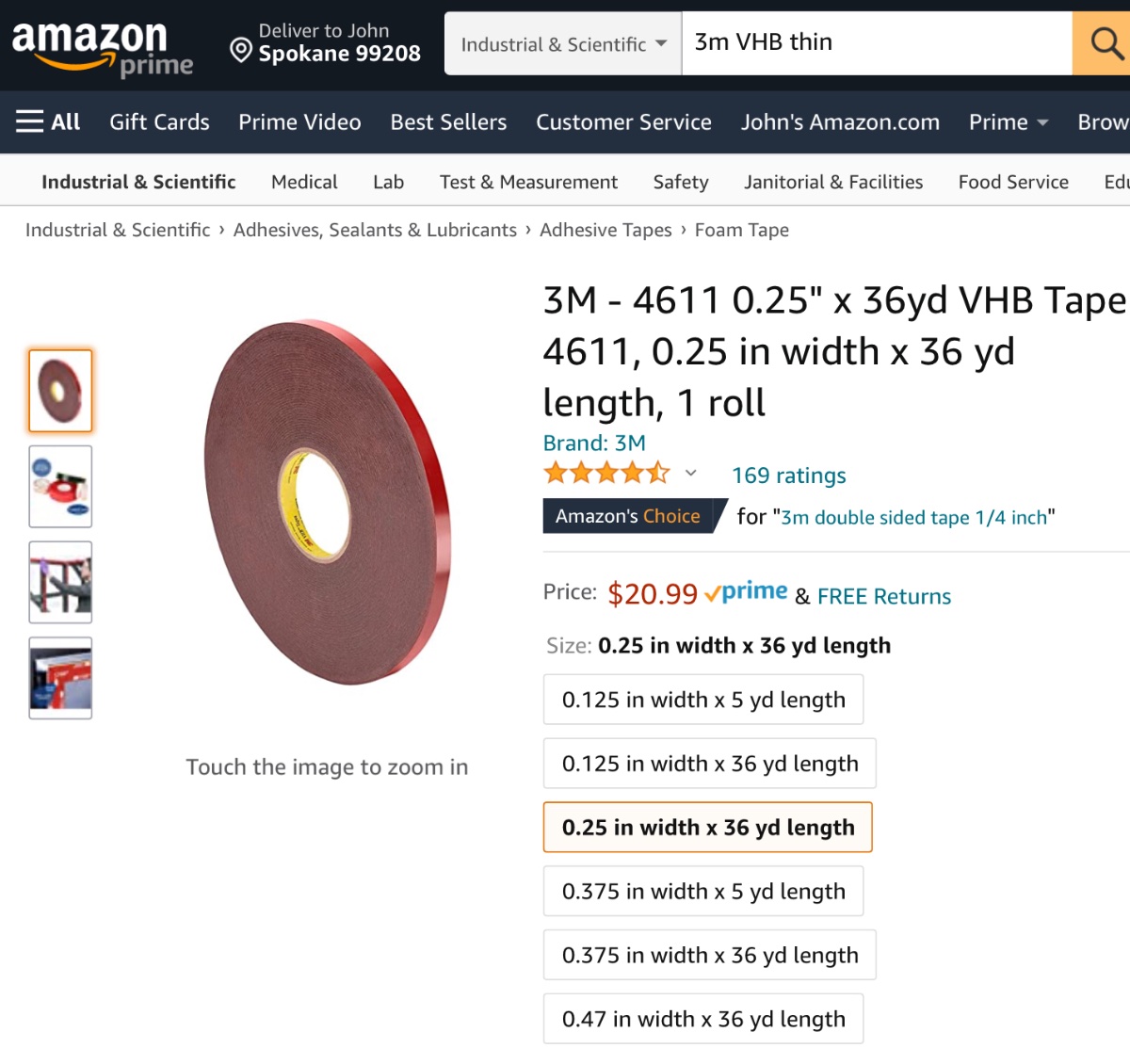
This is an unusually low price for a big roll of 1/4” wide x 36 yard VHB tape, the good stuff. Use it for sticking accessories or holders to interior walls, for securing loose foil hull insulation, for adding wire bug screens to furnace or refrigerator vents, or whatever. Interior or exterior, once cured, it can be hard to get off. You need to cut the foam with fishing line and then do some scraping and also use an adhesive remover. But it won’t leave holes like screws will..... They recommend 4 square inches per pound of weight. For a trailer maybe some extra, just to be safe. I just ordered a roll to use with insulation on the battery compartment door for when I install my new lithium batteries. Keep it in a ziplock bag, so the sides of the roll stay clean, don’t just let it bang around in a drawer, and write the purchase date on the bag. I have older tape (4 years+) that still works great. I suppose there must be shelf life, does anyone know? https://www.amazon.com/3M-4611-0-25-width-length/dp/B00N3U6BJS/ref=sr_1_4?dchild=1&keywords=3m%2BVHB%2Bthin&qid=1607281043&s=industrial&sr=1-4&th=1 Here is a 1” wide by 15 foot roll for a little less money. It can be cut lengthwise with scissors, with some difficulty and bad words. It is much easier to add many thin strips side by side than to cut down a wider piece. https://www.amazon.com/dp/B07TC16SZ7/?coliid=I1A1TAFX993KF4&colid=77ELCXYF0Y8I&psc=1&ref_=lv_ov_lig_dp_it John Davies Spokane WA
1 point
-
Just an opinion. We tow with a 2008 Tundra with the 5.7 litre and tow package. It is the entry level trim package with very few options. We have owned the truck since new and have been very happy with the reliability and the truck overall for our needs. When we decided on purchasing the Elite II last year, it was clear the truck was capable and had plenty of power. We watch the payload numbers and are probably right around the payload maximum. We have and use the Andersen hitch. The truck only has 90k miles and is comfortable to me. It performed well on our first 45 day journey. We didn't really get into any significant elevation. We hope to try some elevation this year. The truck runs fine and owes us nothing. We realize it is out dated. It is practical. I did consider getting a new truck to tow the Ollie. I test drove GMC, Ford, and Ram, HD diesel trucks. If I was starting out and didn't have a tow vehicle and was getting a truck to pull the Ollie I would get an HD truck. I would probably get a 1 ton. It is definitely over kill but the incremental price difference was only about $1500 over a 3/4 ton. The diesel gets much better gas mileage than my Tundra. No need for the Andersen hitch. Never worry about payload and the engine brake would be really nice. I think the brand of HD truck is a personal choice and the virtues of what brand is best is debatable. I thought one of the trucks, for me, was as comfortable as my Tundra. Good luck. I kept my Tundra and the $ in my pocket for now. Good luck in your decision!1 point
-
A lot of great questions. I’m sure you’ll get your answers here. To sum it up simple. ( Experience) just like when you first learned to ride your bicycle you were wobbly at first then ride no hands or on one wheel . It will take time and practice, then you won’t give it a second thought. Always scary at first.1 point
-
1- Navigation has not been an issue on public roads - campgrounds and boondocking - it can be - you just need a little foresight. If in doubt I'll go look - but honestly the Oliver is pretty easy to shoehorn in some small spaces. I got applause in Glacier once - the guy behind me was sure it wouldn't fit - nailed it first time. 2. Many apps available - you'll learn very quickly what to do. It has never been an issue. If in doubt - check it out. 3. Routine travel - just make sure you can see your exit - whether its a gas station, store, or whatever. I usually park in the out lot - take up 2 spaces. You certainly don't do drive up - but I suppose you could in some places. Gas - fuel- is usually really simple - diesel takes a little more looking at the pumps...... 4. See 3, but not an issue. I love the fact I can stop and stay almost anywhere its not illegal. 5. Never bottomed out - which I think you mean a steep entrance/exit angle. Even with the bike rack hanging way off - no. But then you should look ahead and evaluate - if in doubt... No worries you will soon become comfortable. You can always find a big lot - go practice doing stupid stuff - and your confidence will grow. Honestly - I think the biggest risks are other drivers - not paying attention (cell phones) and that is towing or not - People are too preoccupied most of the time. I love telling my SO - watch this nut.....look what he/she is doing - duhh. (A Hold my beer moment) And if you notice a vehicle or two - following you into the gas station, or the wally world - relax - they just want to look at your Oliver. It happens - a lot. RB1 point
-
Brendan - I'm sure that you are going to get a fair amount of comments/answers to your questions and many of the answers that are applicable to you depend on where and when you will want to tow. However, to get things rolling: The only places that I've encountered difficulty in navigating have been out in the boonies. There are times that forest roads simply get more and more narrow, bumpy or overgrown. Or the terrain becomes more difficult than I want to deal with. However, since the Oliver is the same width as my truck it is "normal" for me that almost anywhere I would want to take my truck - the Oliver will simply follow. Google maps in satellite view is a good tool. However, if that is not available (lack of WiFi or cell signal). As you gain experience you will develop a sense as to when you are getting in a tight spot. You learn to look for ways out or around a situation before you get into them. For instance - when pulling into a gas station it is good practice to chose a gas pump that has more than one exit just in case someone pulls in and blocks you. When exploring unfamiliar places, many people simply un-hitch in an open area and then explore to make sure the road ahead is passable and/or to find a suitable camping area without having to worry about towing the Oliver behind. This approach also makes that job faster. Only once in five years have I had to back out of a spot and that was because someone else blocked the road. Thank goodness I only had to back up a few hundred yards, but, as long as you take it slow backing up is really not that difficult. Routine travel is actually relaxing for me once I get into the rhythm of the road - learn to slow down! I put tunes or an audio book in the player, sit back and enjoy the ride in the slow lane. Since the Oliver is under 10 feet tall I've never had a problem pulling into a gas station. However, note the answer above - always look for more than one way out. Most "small towns" are no problem and I can always find a place to park - either on the street or in a lot. Again, the Oliver is the same width as the truck, therefore it is only the length I have to be concerned with. Obviously, there are places in some town that you are not allowed to tow and/or you really don't want to tow. Really narrow streets, congested traffic, etc. are to be avoided even without the Oliver AND, certainly know the height of that parking garage BEFORE you even think about entering. I have never "bottomed out" my Oliver. Particularly out West where and other places where the roads have a deep crown to the road or deep gutter it is best to approach these areas at an angle - not straight on - and take it slow. This might mean that you have to wait for traffic to clear before entering/exiting but so be it - what's the hurry? Even after RV towing now for over thirty years and boat towing for something like sixty years I still get a touch "keyed up" for the first ten miles or so. Making sure that I can see behind me, is the unit I'm towing following properly, are the brakes working as they should, is everything attached properly, etc. But after I've convinced myself that all is well the entire process is no big deal. Get a good checklist and follow it - always. If you have a friend that tows, ask them to show you the ropes. Get yourself in a large open space (parking lot) and practice turning, backing up and parking. Remember that your stopping distance and acceleration will be slowed, therefore, allow more room for everything. Slow down, relax, enjoy the world and have fun. We were all where you are at with no "special" skills and have learned to tow safely. Bill1 point
-
Well we all have opinions. I towed with a 1/2 ton, and now with my 2500 (19,000 miles towing, 43K overall), overkill is not what I'd call it, more appropriate - it performs better in every situation except tight parking lots. As has been mentioned - the most capable statistic of the larger TV is payload. I also believe the added power of the diesel is well worth the upgrade. As they say, I've been with and with out - I'll take with every time. I drove all the competition in 2018 - the Ford was much rougher ride unloaded. The GMC has decent manners unloaded and is really good loaded. I once had a 2007 HD GMC - now that was a stiff suspension!! Worlds apart from the trucks of today. If I were in the market today - I would seriously look at the Ram and the GMC - I'd want to drive the gas versions of each of the HD's - even try to talk them into letting me haul the Ollie around a bit. I'd even try the 1/2 ton ones if the payload was appropriate - I believe I saw one in the 23oo lbs. area, Not sure however. But now that I have the requisite chips, scrapes, and depreciation on the current one - I'll probably just drive it for a good while -.like forever 😉
1 point
-
We are in Section D. The clerk told me both D & E were normally reserved for the Oliver Rally.1 point
-
Greetings from North Dakota.1 point
-
We are in section E. Anything around there would be good.1 point
-
Polly and I are recently retired Health Care workers from Saint Michaels, Maryland and we've decided to try the travel trailer life. We've done some sailboat cruising and see some similarities in the lifestyle. March 31 is the delivery date for our Elite II. Our TV is a 2018 Toyota Tundra with 5.7L and tow package. I have found this forum to be a great resource for information and have read it daily for over a month. I look forward to our new adventure and hope to meet some of our fellow Ollie owners along the way. Cheers, John and Polly Lacoco1 point
-
Welcome to the Oliver forum, we are just a few miles south of you on the Chesapeake Bay. You will have no issues with your Tundra pulling an Elite II. We have been camping for 53 years and have pulled travel trailers all over this country and enjoyed every trip.1 point
-
They seemed content with the heat mat. They weren’t crazy about the humidity this summer though. Apparently New Mexico chile plants prefer dry climates. Who’d have thought?1 point
-
The current Olivers have a different electrical setup than most owners are used to. What used to be the charger and distribution panel is now just the panel, while the charging is being done by a combination charger and inverter. But I believe that the post above may have mixed up the manufacturers. As I understand, the charger/inverter either the Xantrex Freedom XC or XC Pro, depending on your battery package; and the distribution panel is the Progressive Dynamics PD-5000.1 point
-
We’ll see you there! Mike1 point
-
We made reservations last Friday. I talked to someone at the park who said as of now there are no Rally discounts available. I paid only the first night deposit and she said if they added the discount I'd just owe less at check in. We are looking forward to our first (non) Rally and meeting other Oliver owners. 89 days to our pick up date. Counting down slowly... Cindy & Charlie1 point
-
I made my reservations for your first set of dates. I'm gonna need you to help me fix that. I could not do it on line.1 point
-
I can’t help with the hole locations, but you should buy this wonderful crimping tool. https://www.homedepot.com/p/SharkBite-3-8-in-1-in-PEX-Clamp-Tool-UC961/202688118 Use the appropriate diameter stainless steel crimp rings. They are easy to install, and what is more important, they are easy to remove. A crimped copper ring requires cutting or chiseling off. The stainless rings pop off with the twist of a flat tipped screwdriver. https://www.homedepot.com/p/SharkBite-1-2-in-PEX-Barb-Stainless-Steel-Clamp-10-Pack-UC953A/202032891?MERCH=REC-_-plpsearch_multi-_-NA-_-202032891-_-N My hand strength is low and I have to have help for the 1” size, I just slip a couple of steel pipes over the tool’s handles. Once you try this system you will never go back to the stupid copper ones. You can tell your wife that you need this stuff to repair your house plumbing too.... it would also work on irrigation lines, but the parts are kind of pricey for that application. I used mine a while ago to install hot and cold water lines and valves for a bidet toilet seat, it worked great and made my wife very happy indeed! I have never had a clamp fail, but if you are repairing a joint that will be forever hidden, like inside a wall, you can double up (install two clamps instead of one) per connection, and you will not ever worry about a possible failure. John Davies Spokane WA1 point
-
Oh my...I sure hope Ford offers driver training classes on this new wonder-truck!! I does seem to be a dream truck!1 point
-
Here’s a whole romp of abbreviations for you: 4X2 or 2WD - 2 Wheel Drive 4X4 or 4WD - 4 Wheel Drive 5er or Fiver - Fifth Wheel A/C - Air Conditioning AC - Alternating Current A - Amp or Ampere Ah - Amp Hours Al - Aluminum AS - Airstream ATF - Automatic Transmission Fluid ATS - Automatic Transfer Switch AWG - American Wire Gauge BC - Brake Controller BLM - Bureau Of Land Management BTU - British Thermal Unit CCC - Cargo Carrying Capacity (payload capacity) CG - Camp Ground COE - Corp of Engineers CW - Camping World DC - Direct Current DEF - Diesel Exhaust Fluid DS - Dump Station Egg - Fiberglass Trailer FG - Fiberglass FHU - Full Hook Ups FT - Full Time FW - Fifth Wheel GAW - Gross Axle Weight GAWR - Gross Axle Weight Rating GCVW or GCW - Gross Combined Vehicle Weight GCWR - Gross Combined Weight Rating Gen - Generator GTW - Gross Trailer Weight GTWR - Gross Trailer Weight Rating GVW - Gross Vehicle Weight GVWR - Gross Vehicle Weight Rating HP - Horsepower LE - Legacy Elite LEII or LE2 - Legacy Elite II LED - Light Emitting Diode LFP or LiFePo - Lithium Iron Phosphate LP - Liquid Propane LT - Light Truck (tires) NCC - Net Carrying Capacity (payload capacity) NPS - National Park Service OTT - Oliver Travel Trailers OTTO or Otter - Oliver Travel Trailer owner OTTOR - Oliver Travel Trailer Owners Rally PU - Pop Up PSI - Pounds per Square Inch RV - Recreational Vehicle SP - State Park TPMS - Tire Pressure Monitoring System TS - Transfer Switch TT - Travel Trailer TV - Tow Vehicle TW - Tongue Weight V - Volts VA - Volt Amps (Watts) VIN - Vehicle Identification Number USFS - US Forrest Service W - Watts Wally World - WalMart Wh - Watt Hours WDH - Weight Distribution Hitch WES - Water/Electric/Sewer1 point










.jpg.6fae10da8f04d2a236a2b51a241b22bd.jpg)


.thumb.jpg.780a61c48108d06558e15f745dfe9b5e.jpg)

-
Recent Achievements
-