Leaderboard



Popular Content
Showing content with the highest reputation on 12/03/2021 in all areas
-
I think it would be 100% crazy, but a 3M vinyl wrap in your choice of colors would look fine and also be 100% reversible. Lots of folks like the bright white walls and ceiling, me included. If you painted them, you would have a REALLY hard time selling the trailer. There are a lot of color choices, and also patterns like carbon fiber. Go for it! Rvinyl 3M 2080-G12 Vinyl Car Wrap Film Sheet Roll with Air Release Technology - 5ft x 1ft with Application Card, John Davies Spokane WA3 points
-
Here's Toyota's Tundra trim, package, standard, options, and specification link for the 2022 Tundra. https://toyota-cms-media.s3.amazonaws.com/wp-content/uploads/2021/05/2022_Toyota_Tundra_Product_Information_FINAL.pdf Our SR5 that's coming in late December has the "SR5 Convenience Package" that includes the 32.2 gallon tank.3 points
-
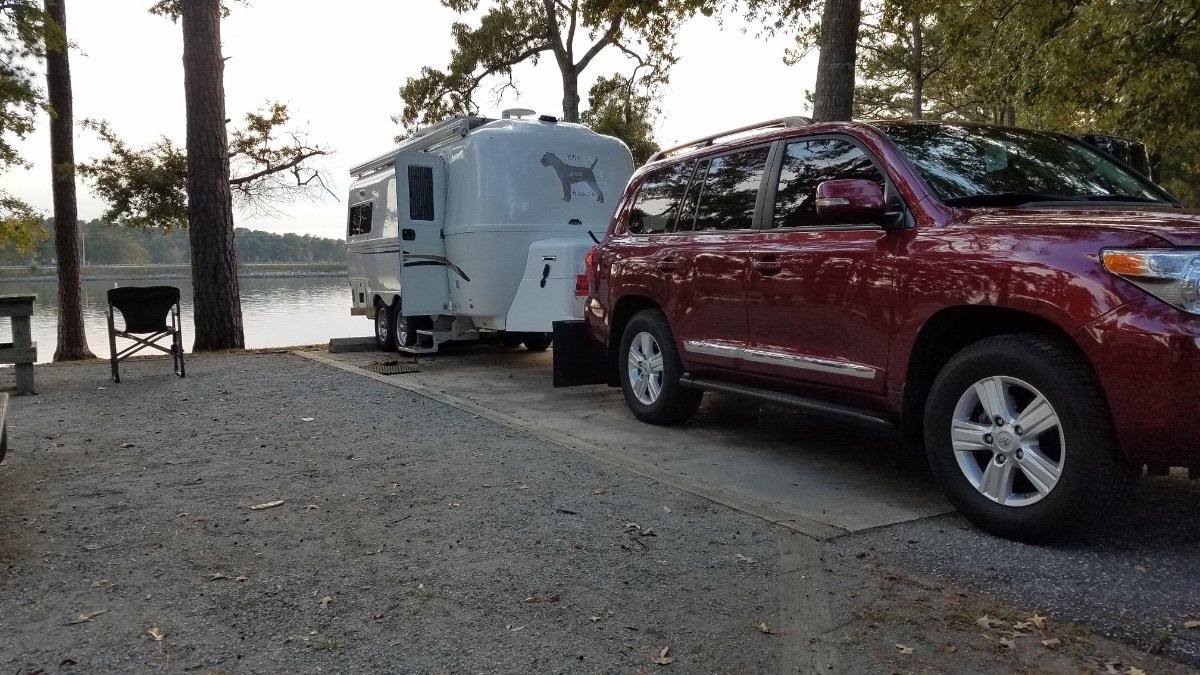
11-27 to 11-30, 2021 Eastbank COE campground near Bainbridge, GA. Very nice campground with clean facilities and grounds. And the heated shower house was a bonus as the low temps were 50, 34 and 37 our 3 mornings there. Mossey
 3 points
 -
@Boudicca908 The first step of your search should be deciding on a half ton (1500, tundra) or a 3/4 ton (250/2500). The weight difference between a diesel 3/4 and a half ton is probably more than the difference between a half ton and a Miata. They drive/ride differently and with the larger your neighbors will come over and ask where’s the 30ft horse trailer to go with it.2 points
-
Foy shipped them to Oliver and Oliver installed them during delivery. We kept the Oliver units….you just never know!2 points
-
I only know of one Elite somewhat near you, and that's in the Twin Cities, MN, and quite a hike for you, if you're in Eastern Wisconsin. Theirs is put to bed for the winter, and, it's an older one, but it's in heated storage. They'd be willing to show theirs to you, if you want to make the drive. I spoke to them this evening. Pm me if you're interested.2 points
-
Thanks all. And Bill, especially appreciate the heads-up on the changing weather. We’ve made two trips through Tennessee and on to parts north and east in the last 7 months, and it’s a long haul to Hohenwald from our house. We’re planning to drive it in one day going up, but we’ll take a more leisurely paced return trip. Frank (Hopefully my signature shows this time.)2 points
-
I don't have the experience and I don't live up North in a cold climate, but I thought about what I'd do given your circumstances... Without a doubt, I'd take them out and store them in the house / garage with a proper charge and reasonable temps. I think in Maine you might see some nights at or below 0F and I think they are pretty expensive to risk. That's my .02. 🙂2 points
-
The WeBoost cell booster will definitely improve the performance of the jetpack as a hotspot. The cell booster will mean faster speeds, and at locations with poor cell tower connectivity, the cell booster can mean the difference between a connection and no connection. The cell booster will also improve your the signal on your phones. The antenna for the booster is usually placed above the dinette table, so that is where you want to use your cell phones or place your jetpack. Reed and Karen reported problems at the back of the trailer getting signals from the cell booster. Having a JetPack should help that, with an advertised range of about 30 feet; note that obstacles, such as trailer walls, will diminish that range. In terms of which Jetpack to get from Verizon, I would recommend the 7730L, which gets the best reviews for speed. The AC791L model has longer battery life, which is important if you are keeping the hotspot in a daypack as you go about your day, but that is not an advantage if your use is in an Ollie where you can easily keep it charged. Some advice on properly using the cellular booster. After you turn on the WeBoost you should briefly put the phone in airplane mode, and then turn off airplane mode. This forces the phone to let go of the distant cell tower with the weak signal, and to now look for the closest “cell tower,” which is the WeBoost. Similarly, if you were using the JetPack in the tow vehicle, you should power it off and then back on after starting the WeBoost. If you have been out hiking all day, your phone will remain connected to the distant cell tower, and you can get it to connect to the WeBoost by cycling into and out of airplane mode. If all of your internet connections will be via cellular signal and the jetpack, then you have no need for the WiFi Ranger. If, however, you will sometimes be using WiFi (like when the crappy campground WiFi is faster than the weak cellular signal), then the WiFi Ranger has some real advantages. First, the WiFi Ranger has an antenna on the roof and connects to a WiFi source (i.e. campground or Starbucks) much better than your device, such as a phone or a laptop, could on its own. You get a stronger signal and faster speeds. There are several other advantages to the WiFi Ranger. First, it makes connecting much easier if you have multiple devices. (We travel with two iPhones, two iPads, and a laptop.) With one of your devices you connect to the WiFi Ranger, tell it to connect to Campground X WiFi, and give it the password. You do not need to put the Campground X password into the other devices, because they already know the WiFi Ranger password and immediately connect to the WiFi Ranger. Second, the WiFi Ranger generates a stronger signal than a MiFi device. This means it can transmit its signal a longer distance through obstacles like fiberglass walls than does a Jetpack. This means I can get a strong signal using my laptop at the picnic table outside of the trailer. This is true even if I am am using the Jetpack for internet, with the WiFi Ranger connected to the JetPack, since my laptop is communicating directly with the stronger WiFi Ranger. I have a Verizon Jetpack, which I keep on the dinette table near the WeBoost inside antenna. Here is part of my Campsite Arrival Checklist: • Turn on Cell Amplifier. Cycle phones into Airplane mode and back again to regular. • Turn on Verizon Jetpack. • Turn on WiFi Ranger. Connect WiFi Ranger to either Jetpack or local Wifi. Connecting to the WiFi Ranger Control Panel through a web browser is fairly easy. I have done it on each of my devices, and then bookmarked it so I can get back easily. While on a camping trip one of my browser tabs remains connected to the WiFi Ranger Control Panel. The Control Panel shows the speed of each of the possible connections, say, JetPack vs campground WiFi. If the weather is interfering with cellular signals the crappy campground WiFi may be better. Later in the evening, I can check the Control Panel again, and if the JetPack now has the better signal, I can connect the WiFi Ranger to it. Since all of my devices are connected via the WiFi Ranger, all of them have switched from campground WiFi to JetPack. Hope this helps.2 points
-
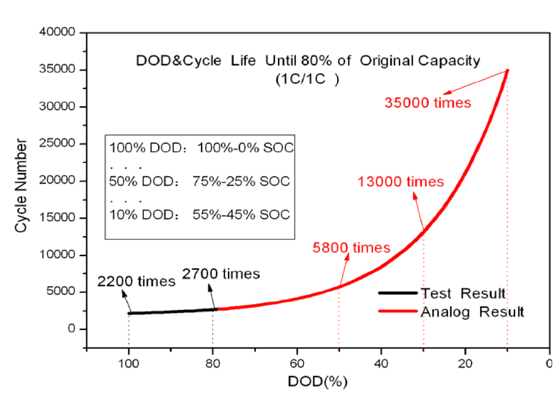
There have been numerous posts in this forum about Oliver’s lithium battery systems—about their usefulness, limitations, and value with respect to cost. Despite reasonable arguments against it, a number of us have purchased the lithium package. Reasons for purchasing the option have included the ability to run the air conditioner (A/C) for short durations (like at highway rest stops), greater usable energy (more boondocking in cloudy weather without needing a generator), faster charging, and longer battery life. This post summarizes things I’ve learned over the last 6 months about the Xantrex/Lithium/Zamp system. This post might also be titled “Things I Wish I’d Known from the Start.” This summary is a work in progress. Hopefully, with your corrections and additions, this thread will be of use to others that have purchased the Lithionics option or are considering doing so. At the time of this writing, manuals and other information for the Lithionics batteries are in the Service Center Knowledge Base — see links at the end of this post. I assume at some point Lithionics information will be compiled with all of the other trailer manuals in Oliver University. Battery State of Charge A key component of the Lithionics system is the app that lets users monitor State of Charge (SOC) and voltage (see links below). The reliability of the SOC values (which describes the amount of energy remaining in the battery) depends on (1) maintaining SOC calibration and having (2) up-to-date Lithionics firmware. The SOC should be near 100% at 13.6 volts, and about 50% (+/- about 10%) at 13.2 volts. If this is not what you’re seeing on the Zamp controller, Xantrex remote, or Lithionics battery app, then something’s wrong. By way of example, a couple times we’ve experienced the SOC readings of 60% when the batteries were dead -- not good. Note that the voltage reading on the app while there is a load on the system (e.g., electric heater) is different than when there is no load; the “resting” voltage may be higher. SOC Calibration The SOC requires periodic calibration. According to the manual for the 130 Ah batteries, the SOC can be calibrated simply by charging the batteries to 14.4 volts. The manual also states that fully charging the batteries to 14.4 volts should be done at least once every two weeks for battery life. Get the 130-Ah battery manual from Lithionics using the links below; at the time of this writing, Oliver has the incorrect manual posted in the Knowledge Base). When charging with shore power, it is not always apparent that the batteries have reached 14.4 volts, because when charging, the batteries only stay at ~14.4 volts for a short while before dropping back to about 13.6 volts. You can verify that batteries have reached 14.4 volts by monitoring battery voltage using the Lithionics app during a charging event. If you are unsure that the batteries are reaching 14.4 volts, you can at least confirm that the Xantrex charger/inverter is set to charge to at least 14.4 volts in the Xantrex app (https://support.olivertraveltrailers.com/portal/en/kb/articles/xantrex-remote-bluetooth-pair-operation) and, under Settings, check the custom absorption voltage. Ours came from the factory set at 14.6 volts, which is sufficiently high to get the batteries to 14.4 volts. Lithionics Firmware At least some of us that picked up our trailers in spring or early summer have batteries with outdated firmware. As I understand from Lithionics, more recent firmware versions have an improved SOC algorithm (our initial SOC readings were unreliable). You can check firmware version with the Lithionics app by clicking on a battery, then clicking on the settings “sprocket” in the upper right side, and then clicking on firmware. Our battery came with firmware version 1.0.05; I’ve recently updated to 1.0.07 by clicking on flash firmware. This has to be done with your phone in close proximity to the battery, and has to be done separately for each battery. Updating firmware comes with a “…this is a critical operation…” warning; you might want to check with Oliver or Lithionics if you have any questions about doing this. Has updating firmware improved our SOC readings? I’m not sure yet, but I think so. So far, the readings seem more reliable, but I’m still testing. SOC Calibration by Cycling A Lithionics rep told me that the SOC can be calibrated by “cycling” the batteries, and that this should be done every two months. Cycling consists of discharging the batteries to reserve voltage (e.g., ~12.1 volts) and then charging to 14.4 volts. However, the rep could not point to written documentation supporting this form of calibration. As the batteries support more partial cycles than full cycles (see graph below), calibrating by simply charging to 14.4 volts (assuming this effectively calibrates the SOC) seems better for battery life. Lithionics batteries will not charge from tow vehicle The standard 7-pin connection from tow vehicle to trailer cannot be used for charging the Lithionics batteries. Charging the batteries from the TV requires a DC to DC charger, which is an aftermarket installation. For more discussion on this, search for John Davies’ Redarc DC-to-DC charger installation description. Batteries Turn Off Twice now one or two of the three 130-Ah batteries have turned off when reaching low voltage (which happened because we were relying on incorrect SOC values). The SOC readings themselves looked OK, but the voltage did not correspond with SOC. The battery State in the Lithionics app reads “Off” for each battery when it is off. There is no flag on the Zamp or Xantrex control panel that alert the user to one or two batteries being off. The lesson (at least for me): monitor all three batteries, not just one, and note the Current, Power, State, and Status Code settings. If one or more batteries are off, turn the battery(ies) back on, and fully charge to 14.4 volts. Inverter Noise The Xantrex charger/inverter can be noisy charging the batteries with shore power (I’ve measured 60-64 decibels in the cabin when batteries are charging, and about 72 decibels adjacent to the inverter). The noise comes from (1) the charger/inverter fan and (2) the way in which the inverter is mounted (the fiberglass wall to which the inverter is mounted propagates noise into the cabin). The noise can be masked by turning on the A/C. Alternatively, the noise level can be reduced somewhat by lowering the charger current. In the Xantrex app, go to settings, and change the Charger Current from, for example, 100 amps to 30 amps. This will reduce fan noise. It will obviously take longer to charge the batteries with lower current. If you would like to be connected to shore power (to run an electric heater or the A/C, for example), but not charge the batteries (to avoid keeping them fully charged for long periods of time, or to reduce inverter noise) you can set the charger ignition control in the Xantrex app settings to “auto-on” (thanks to NCEagle for figuring this one out). In this mode shore power energizes the 110 outlets, the A/C, and the fridge, but does not charge the batteries. Turn the charger ignition control “off” to resume charging batteries with shore power. There are likely ways of re-mounting the inverter so that noise does not propagate into the cabin, with either a different mounting location or perhaps mounts using rubber bushings. Has anyone tried this yet? Xantrex Communication Errors Too often, I’ve gotten “Code 20” communication errors on the Xantrex remote panel. This can be resolved by pushing the red button on the 300A breaker under the streetside bed, waiting for at least 30 minutes, and then pressing in the little red flag on the breaker. Yes, this is a pain (I wish this breaker were more accessible), but it usually resolves the issue. Leaving the Xantrex inverter on battery mode for 25 hours or more will result in the Code 20 communication error. The time limit can be changed in the Xantrex app, but cannot be lengthened to more than 25 hours. As long as the inverter has not timed out, turning the inverter off and then on again at the remote panel resets the 25-hour time-limit clock. Battery Storage Lithionics provides guidance for storing the lithium batteries (see link below). Long term storage can include lowering the SOC to about 50%. Discharging to the appropriate SOC can be accomplished by turning on an electrical load (e.g., A/C or space heater) while in battery mode and monitoring frequently. Theoretically one could set the inverter cutoff voltage (in the inverter app, under settings), to something like 13.2 volts, but the highest cutoff-voltage option is 12.8 volts. Lithionics recommends keeping a log of SOC and voltage readings prior to and after storage for warranty purposes. ------------------------ Hope this helps. Again, please correct any errors that you see, and please add your observations and tips. Fritz ------------------------------------------ Relevant Links Lithionics battery app: https://support.olivertraveltrailers.com/portal/api/kbArticles/386680000012415191/locale/en/attachments/lpqvx861bbc9c842d48f7995281b07d0a193d/content?portalId=edbsnfe5dceb1ade7571879ff200cb63e14a94b62f48e3338c31a6401acd00130b0bc&inline=true). Lithionics battery manual: At the time of this writing, the Oliver Knowledge Base has links to Lithionics manuals for 125 Ah and 320 Ah batteries. However, our LE2 has three 130 Ah batteries as part of the 390-Ah package, and the manuals for the 125-AH batteries and the 130-Ah batteries are not the same. A manual for the 130 Ah battery can be found on the Lithionics website: https://lithionicsbattery.com/wp-content/uploads/2018/12/12V130-G31LRBM8-Battery-User-Guide-R1.pdf. Lithionics Storage Procedure https://support.olivertraveltrailers.com/portal/api/kbArticles/386680000012415191/locale/en/attachments/lrotz3ebee5a7020f42a58eb0d4db18a41356/content?portalId=edbsnfe5dceb1ade7571879ff200cb63e14a94b62f48e3338c31a6401acd00130b0bc&inline=true Lithionics FAQs https://support.olivertraveltrailers.com/portal/api/kbArticles/386680000012415191/locale/en/attachments/lrotz0edc34bc92ef4dce941bbb7f3f2d89db/content?portalId=edbsnfe5dceb1ade7571879ff200cb63e14a94b62f48e3338c31a6401acd00130b0bc&inline=true Xantrex Remote Bluetooth Pairing and Operation https://support.olivertraveltrailers.com/portal/en/kb/articles/xantrex-remote-bluetooth-pair-operation
1 point
-
Val and I are excited about our trip to Hoenwald next week to pick up our LE2 on Dec 8th! I’ve appreciated all the advice/information from owners via the forum. I had planned to send our first post with pics of the new Ollie, but I’m not sure whether I’ve set up my account correctly, so thought I’d send this introductory post first. Frank TV-2020 F250 Power Stroke: LE2 #9641 point
-
Last month, we had four people camping with us on our mountain property. I was the only one with a working Verizon phone. Att and tmobile got consistent "no Signal" messages, unless we drove a mile and a half down the road.. As an experiment, we picked up a wilson weboost. The guy at bestbuy told me it would only work if there was at least a small signal, but we could return it in 15 days if it didnt work. Well, long story short, with the booster, i showed 4 bars on the tmobile phone and tablet, but got an error signal of no network. The booster picked up a tower, but not one that my tmobile devices could share, apparently. (Because we experience this issue a lot as we travel, paul and I have one each tmobile and verizon phones and tablets... ) I found this field test info on the wilson site. It explains how to check for towers and strength. What i discovered was what I've known for ten years, at our mountain proprrty. The verizon tower near us has great signal. US Cellular comes in also. Tmobile and att cant sign onto these towers. Back to square one, and the booster goes back... My tmobile devices listed all towers and strength. My verizon devices greyed out the capability to see other towers than verizon, interestingly. All devices were recent android. Heres the link to the field test. Maybe it will help you. Its very easy with android. A little typing with apple... Field test Sherry1 point
-
Mark and I were thrilled to finally welcome 953 into the family. We spent 2 great days in Hohenwald getting to know Ollie. Super experience at the factory - only very minor issues that were fixed immediately on-site. What a great company!
1 point
-
@Spike, the unit you referenced is 15k btu, over a foot tall. I don't think any of us have installed this unit,, which I think is 1st generation, not 2nd gen lower profile like Minnesotaoli, katanapilot, and others. My amateur understanding would be that 15k is way over the top, probably contributing to short cycling, for an le2, but who knows? The Houghton we installed will not accommodate a thermostat, of any kind. I "think" this is true of all their models remote only. Also, condensate runs down the roof. Btw, I've found prices to be better on the recpro site, rather than Amazon.1 point
-
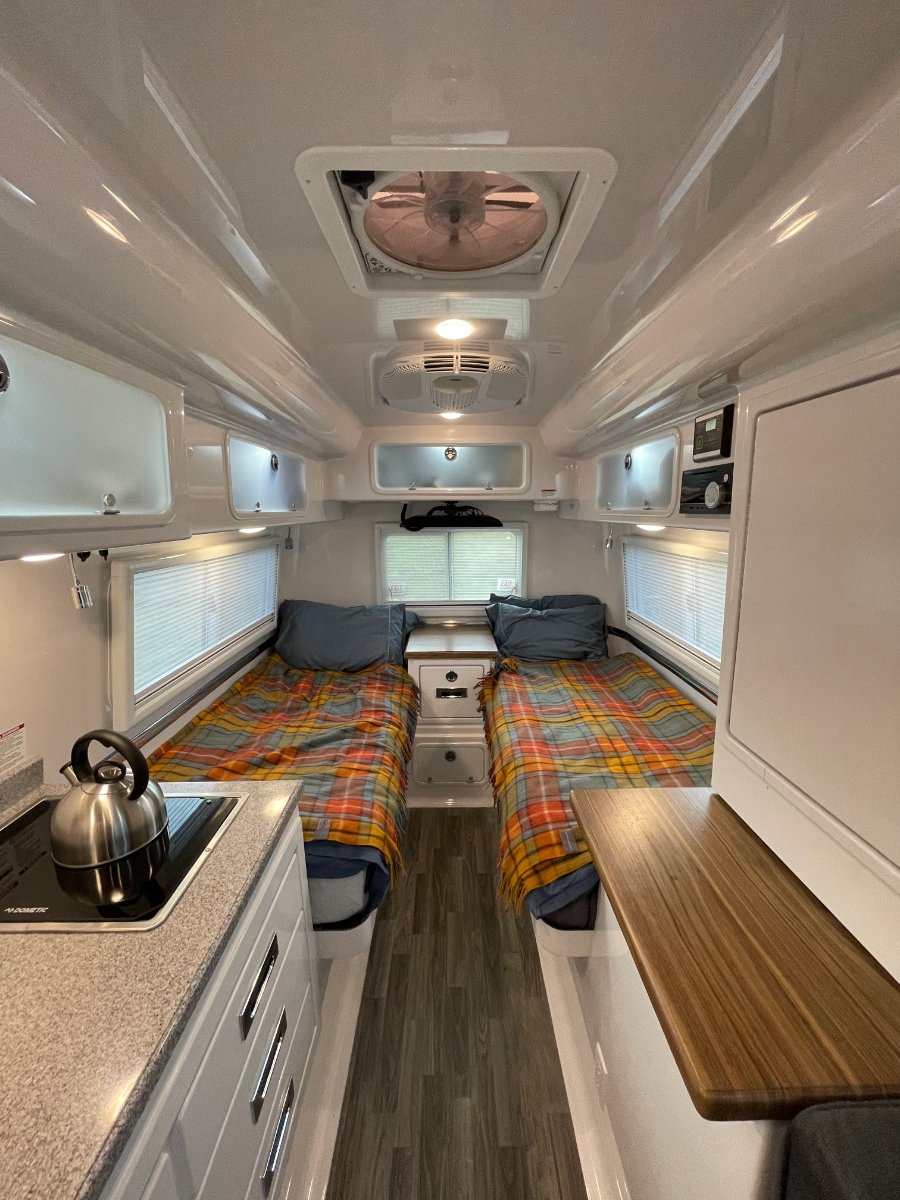
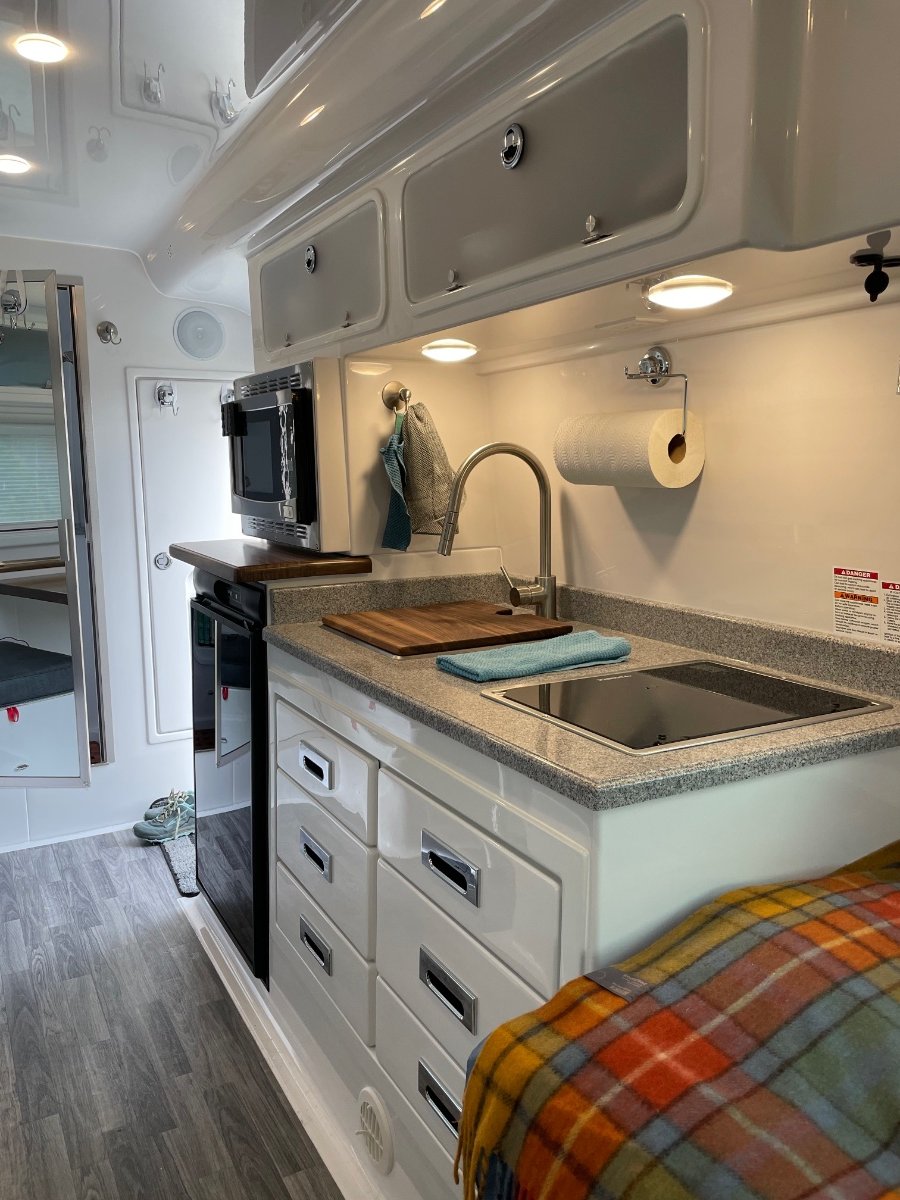
Painting gel coat is best left to professionals, imo, and expensive. Special paints, protective gear, etc . I actually love the clean white interior. So easy to clean, bright and a nice backdrop to the fabrics on the bed and dinette. Some people have installed backsplashes. Really nice. Others warm up the interior with wood tops from Foy Sperring, really, really nice. A few have added non adhesive graphics. I love mine the way it is. Though someday, I might like a walnut top from Foy.1 point
-
They started out as a way to provide a hot spot for cell service to those overseas. With Covid 19 limiting foreign travel, they turned to seducing USA users. I've had one of the two we purchased for USA use for more than two years. They are 3G/4G and when it works, it works well. They have had a number of software updates that have improved their hot spot. However, I've have had difficulty with connections in the past. It sometimes reported "no partners" are available in the area when I see others using their cell phones. Lake Powell in AZ was one place and the Navajo Reservation in northern NM was another. In summary, I think it may be a good choice as a backup service as their cell phone plans have become more inexpensive and convenient to use, but it doesn't seem to work where there are only 3rd party providers for the major cell phone providers.1 point
-
First I’ve heard of it, but it’s interesting.1 point
-
When everyone Is thinking about how the furnace is getting it's intake air, keep this in mind. There are built in drains in the outer hull. If you block off the furnace cold air return in any way I am sure some that some air will come In those holes. And in some circumstances that air could be quite 'chilly'. Don't think I have ever counted them, but they are visible from underneath hidden by SS caps. At one time the thought had crossed my mind that the whole space around the inner hull could be pressurized by conditioned air, but the emergency drains would be compromised. Then thoughts about elimination of the present AC, and maybe a heat pump came to mind. However, for the present, we are more than pleased how the system now seems more balanced with the high wall vent. It functions very well, and we can keep that door closed...1 point
-
I received the following private message, and am posting it here in case anyone else has the same question (or to give others a chance to correct my response): "Are there switches/breakers inside the trailer that I need to switch off before I remove my batteries? I would assume so - like a "main" switch similar to on a house panel that would just power everything off." I have not yet removed the batteries for the season (I'm still trying to get an inverter issue resolved). That said, I think the only thing that is necessary is to stop all major loads (e.g., unplug from shore power, turn off major uses (e.g., microwave), and perhaps turn off the solar controller (the red dial-switch located in the upper cabinet above the streetside bed). Record the SOC and voltage for warranty purposes (I take screenshots of these readings for each battery). Take a photo of the wiring array before you begin disconnecting terminals to help with reconnection in the spring. Then turn off each of the Lithionics batteries (the light-blue lit button in the far right corner of each battery). Disconnect the batteries beginning with the primary negative terminal (this is the right-front terminal with multiple, heavy-gauge wires), then disconnect all of the other wires being careful not to accidentally bridge terminals with a wrench. As a heads-up for reconnecting in the spring, I think I recall seeing a torque specification in the manual for tightening nuts on the terminals (to avoid damaging the batteries by over tightening terminal nuts).1 point
-
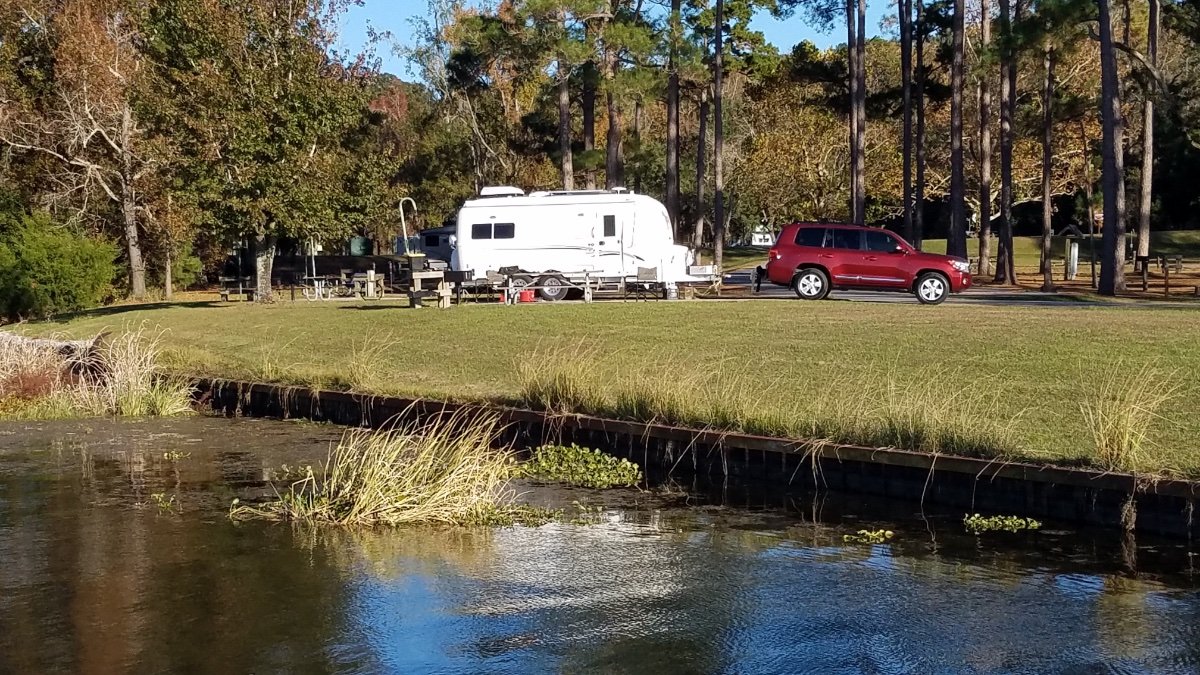
11-10-2021 Overnight stop while traveling. White Oak Creek COE campground near Eufaula, AL. Very typical for COE campgrounds. It is clean, waterfront and cheap for old people. And they even had the heat on in the shower building. Sweet. Mossey
1 point
-
Thanks for posting this Mike and Carol. We are taking a similar route in January we will leave New Orleans and head directly for Austin. After that we are going to Waco and Fort Worth. From there we are heading to Roswell NM. We appreciate the referrals. We will take I 10 from New Orleans but will look to go north of Houston if possible on our way to Austin. Thanks for all the great advice you offer on this Forum.1 point
-
I would suggest you call Oliver Service, give them your hull number and ask your questions. They are good in helping. Even better open a service ticket and ask your questions that way. Usually get a faster responce this way.1 point
-
I agree about the bathroom. . . . . my husband is 6'2" and the Elite II is ok for showering, but barely. Elite would not pass muster for him. I guess you can always shower while sitting on the toilet.1 point
-
Be safe on the road both coming and going. After a spell of warm, dry weather it looks like it will be a bit damp and more seasonal for temps next week. However, I don't believe that there is anything "bad" (such as snow or heavy rain ) forecast at this point. Bill1 point
-
Great news! Let us know how your pick up goes. Pics are always welcome…. Mike1 point
-
I'm wondering if the addition of a vent through the bathroom wall would negate the potential of this problem. It would allow air to flow more easily through to the bathroom (which had been a dead end), which would, in turn rebalance the air flowing into and out of the furnace. As I pondered above, repositioning the hose and exhaust that is closest to the cold-air return to a round vent under the rear dinette seat. Should help with keeping the balance as well, with the added benefit of sharing some heat with some vulnerable spots such as the battery compartment and exterior shower. I took a quick look and it seems like running the vent hose, under the floor to the street side, under the inverter, past the battery box and into the compartment under the seat would be fairly easy.1 point
-
Congratulations as your big day arrives !! Please post plenty of pictures. Safe travels !!!1 point
-
I was considering trying to cap the closest vent (to the heater intake) altogether and, in it's place, running a line under the floor to the street side and, if possible, as far forward as the rear dinette seat. Adding a round vent there. This would bring heat past the outside shower, and under the battery compartment, both areas that can use a little love. Venting the bathroom wall and perhaps doing as John suggested with allowing some flow through the closet all seems like it should help minimize the most vulnerable area. Thoughts?1 point
-
Hey Maniac, As the area you vented is double walled, where did you get the vent? Is it finished on the inside of the bathroom as well?1 point
-
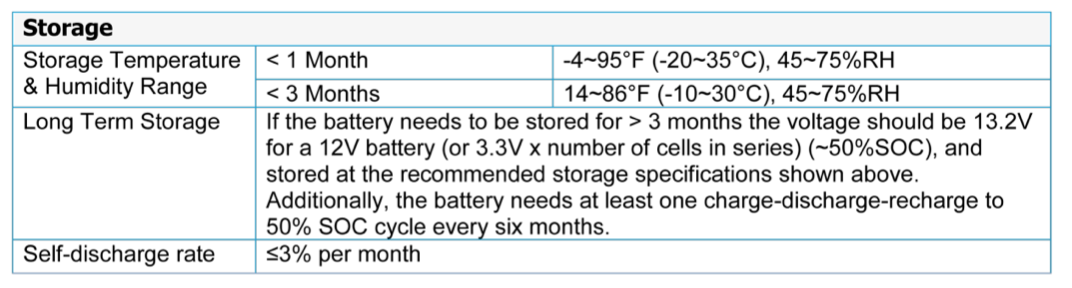
To me, the Lithionics storage requirements are a bit ambiguous, in that the duration of extreme temperatures isn't addressed. For example, the batteries have a 130°F maximum operating range; does this mean that temperatures during storage cannot exceed ~95°F at all, or for most of the time, or? Similarly, short-term low temperature limit is -4°F, but longer term short-term limit is 14°F. So for how long can short-term storage can batteries be less than, say, 14°F -- a month, or? Here in southern Idaho temperatures can be lower than 0°F for a few days (or nights), but not generally very long. But nighttime temperatures can be less than 14°F for several weeks at a time, with daytime temps above 14°F. To be safe, I'll be removing the batteries for the winter, storing them at about 50% SOC. I haven't done so yet, because daytime temperatures here are still in the mid 50s -- and it's December! There are also relative humidity (RH) criteria for storage. I have no idea how to address these here in a relatively dry climate, especially indoors in the winter (the batteries will be stored in a heated shop/garage). Recognize that the SOC values under load (or while charging) can be substantially different than those when the batteries are at rest, at least in my experience. So, I plan on discharging for a while, stop the load, look at the resting SOC, repeat as necessary. Next, for those that haven't seen earlier Lithionics-related posts, the SOC is unreliable if the battery firmware has not been upgraded to the current version. See: Finally, note that the manual suggests that you record SOCs and voltages when storing the batteries for warranty purposes. See https://lithionicsbattery.com/wp-content/uploads/2018/12/12V130-G31LRBM8-Battery-User-Guide-R1.pdf.
1 point
-
Congratulations! Let the travel adventures begin!1 point
-
Last night I tried using the back cushion from the dinette as a back support for sitting upright in bed. Worked brilliantly, and as with most things Ollie related, I saw this trick on the forums!1 point
-
Kevin: In addition to input from this forum, I would call the battery manufacture and ask them your questions, as they carry your battery warranty. (Don't put your batteries directly on a concrete floor, use wood in between.)1 point
-
I've owned two of the 3.5 liter Ford engines and have been basically very happy with both. Unbelievable power, speed and decent gas mileage (as long as you are able to control those urges in your right foot) when not towing and acceptable gas mileage when towing. No issues what so ever in towing on the flats or in the mountains - plenty of power for both. For what I think are obvious reasons, any relatively smaller turbo'd engine is somewhat more complicated than a comparable non-turbo'd V8 engine. There are numerous YouTube videos out there where pundits champion one versus the other. I tend to not keep vehicles any longer than 5 or 6 years. Unless I'm on the road my vehicles are always stored in a garage, all maintenance is completed at or ahead of schedule and I consider myself a conservative driver - if I have a "need for speed" I hop on a motorcycle where the sensation of speed is generally amplified. Perhaps these are the reasons I've not had any troubles with either of the Ford trucks I've owned - or - perhaps, it is because I'm lucky 😉. If you tend to keep your vehicles a lot longer than I do, you might want to pay more attention to the "simpler is better" argument. If you plan to use this new truck as your daily driver and put a bunch of miles on it then, again, perhaps simpler is better. If you embrace newer tech (even though turbos have been around for quite a number of years), want better gas mileage, don't mind the "sound" of the turbo'd engines versus the "growl" of a V8 then you've got your answer. Good luck! Bill1 point
-
I went to look at the window sticker from my Chevy 1500 3.0L Duramax and the axle ratio is 3.23. I'm not an engineer or a mechanic but I believe that is to favor fuel economy which is a main selling point of the the 3.0L deisel powertrain. I'm sure a 6.6L 2500 truck has more power and stability in towing but I'm just saying that my 1500 has performed well for me in towing my LE2. I've been more than satisfied with the low-end torque/power and it feels comfortable to me in handling the task of towing. I do use the Anderson weight distributing hitch which I believe you would not really need on a 2500.1 point
-
The 6.6 Duramax is the easy button. No numbers to crunch or compromise needed until you more than double the weight of an elite II. I drive a ‘21 duramax and a older 6L gas with the same trailers down the same roads. I have to rail on the gas engine while the diesel doesn’t even move above 2k rpm. If I drop the hammer with a 10k lb trailer I need to make sure the load is VERY secure.1 point
-
Islandgrl, 2019 Elite II twin with solar, (2) 100 amp/hour Battle Born batteries, 20 lbs. propane tanks and no front basket or rear bike rack. With full propane and all our gear, food and clothes for a two week trip, our tongue weight is 400 lbs. With full water it is 500 lbs. These weights are from a CAT scale. Hope this helps. Andrew1 point
-
490 is for a “no option” trailer with no fluids or cargo. Whether you have the tongue tray and/ or the bike rack will have the most effect on tongue weight, by as much as about 200 pounds. Equipment mounted close to the axles really doesn’t matter, it adds to the empty weight, reducing the available payload, and the TW will go up a little, but it isn’t that big of an effect. Solar panels and the batteries are centered over the axles. The latter especially is an excellent (and very uncommon) design feature. I do not know the TW for a fully loaded (7000 pounds) LE2 without a tray or bike rack, but on my trailer, I shifted the factory tray from front to back, onto a custom mount. With the same 120 pound load (2 full jerry gas cans and other stuff and including the weight of supports and the tray itself) the TW dropped from 720 to 480! This is with a trailer towing weight of “about” 6000. I haven’t had it on a truck scale, but I do use a TW scale. This was with four AGMs, solar and full 30 pound bottles; since then I reduced the empty weight by 200 pounds by going to lithiums…. Picking a number from what I have read here, IMHO you should use 650 as a baseline. The amount of stuff you carry including water and waste is a factor, but be very aware that hanging a heavy generator on the tongue or a couple of ebikes off the back could skew this number dramatically! At least one member is really into Power Wagons, please post a pic😀 Are you planning to use the Andersen hitch? I suspect that it could be helpful since the PW has such (wonderfully) soft suspension, and a very small payload for a 2500. Does yours have the Ram Boxes? The Andersen would add 50 pounds to the TW but it would shift a little weight onto the front axle (if you tension the chains very hard - I do not). Or alternatively add rear airbags, for leveling. If it were mine, that would be my choice… along with an off-road coupler, hitch, and an Extreme offroad tongue jack, as overland has done to his LE2 and Ford Raptor. That setup just won’t work on my short LC200😤 I suggest that you try towing with a $40 dead weight ball and drop mount and later buy the Andersen if you felt it was needed to control jounce on choppy highways. And IMHO do NOT buy the tongue tray, instead put your generator in the front of the truck bed to reduce the TW. A location six feet in front of the ball is way better than two feet behind it. I forget where you will be living - East Coast? If so, you won’t use a generator that much anyway, until you get out West. John Davies Spokane WA1 point
-
There are those on the Forum that claim much higher tongue weights than others. Some of these differences can be attributed to "caution" or conservative guessing. But, I would guess that most of the differences can be attributed to what is loaded or how it is loaded in any particular Ollie. Each Oliver is weighed at the end of production and has its specific weight noted in that Oliver. In my case - a twin bed with solar, 20 pound propane tanks, nothing in any tank and ready for a trip, the tongue weight varies from 600 pounds to 640 pounds. Again, the standard configuration and the twin bed configuration will each have their own individual weight depending on the specific trailer. Having said this, I don't believe that there is very much difference between the two with regards to total and/or tongue weight. Bill1 point
-
WiFi boost would be if you intend to spend most of your time in campgrounds. Cell phone is the way you want to go. Depending upon how you plan to use trailer, if you boondock on the close fringes of society then it will work great as installed. If you are too far out of a boondocker then it will be slightly limited by the mounted elevation in the trailer, at which point a self install on a telescoping pole (which stores away when not used) and is positionable would work better and save some cash from the initial purchase. I have the WiFi and have never used it, use the cell booster all the time.1 point
-
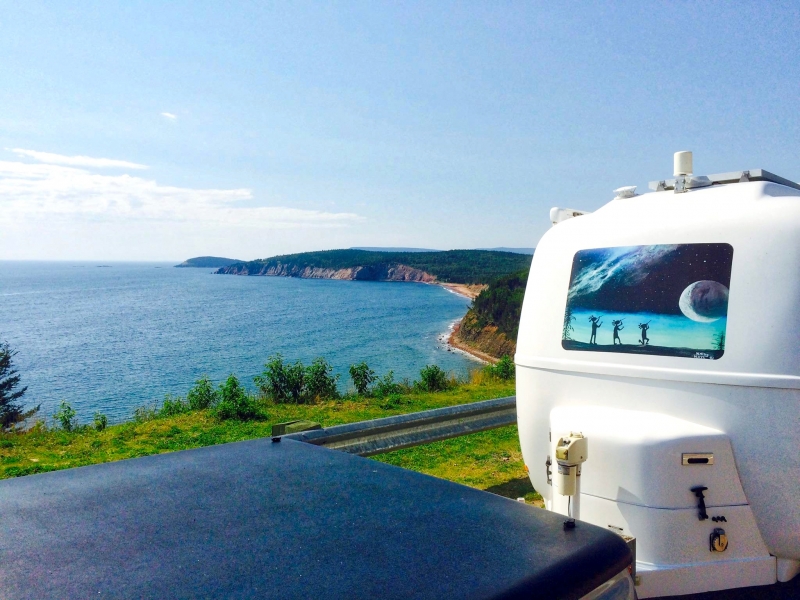
Following the Cabot Trail, Cape Breton Island, Nova Scotia - Summer 2015. Stunning scenery, friendly people . . .
1 point
-
Looks like we have the first test of towing something like an Ollie with an electric truck - a Rivian towing a 6500 lb trailer across country. Unfortunately, I think the best you can say is that it’s possible. With the trailer, the truck’s range was about 100 miles, meaning they had to make 26 stops to charge, each one adding about an hour to their trip. I’d go insane.0 points























-
Recent Achievements
-