Leaderboard



Popular Content
Showing content with the highest reputation on 08/27/2023 in all areas
-
As some of you know, we had an Oliver LE2 for about two years. We put on about 20,000 miles and went to the Oliver Rally twice with it from Nevada. John Davies sent me a picture of the suspension system on an Australian style Caravan, a Black Series. I started looking into that style trailer and ended up buying a Black Series HQ19. We had it for a couple of years too and I did a lot of work on it. A very capable trailer, but with quality issues and a lot heavier than the Oliver. Next Iwent to an Xplore X22 which was a nice compromise between the earlier two. About the same weight as the Oliver, very comfortable and durable. An interesting design with an aluminum skeleton and V nose, with thick fiberglass panels for the exterior. It also had a large lithium battery bank and I installed 660 watts of solar on the roof. This trailer was very practical with a three burner stove, oven, a 12 volt, 10 cu ft compressor fridge, a dry bath with tankless water heater and a full sized bed. It towed easily. It also had hydraulic suspension that raised and lowered about 8" with a remote control, large off-road tires, 12" brakes and independent torsion suspension. I did 50 modifications to it and RVs of America did a video about the whole project and posted it on Youtube. We also went to the OliverRally in 2021. Well now, we've done it again and switched to a Roamer1 from RVs of America (ROA). This is an Explore X195 with some upgrades to make it into an R1. It has Cruisemater independent air suspension from Australia. Raises and lowers or tilts side to side for leveling. No external piping, heavily insulated walls, ceiling and floor made from fiberglass insulation panels glued into large aluminum extrusions. Large aluminum storage boxes front and rear, Isotherm compressor fridge/freezer, Truma combi heat and hot water system, 1080 amp hours of Expion 360 lithium batteries in a heated area under the bed, 1200 watts of glass solar panels on the roof, an electric induction cookstove, 60 gallons of fresh water, waterless toilet with no black tank, north/south walkaround full bed, 12 volt air conditioner that runs fine from the batteries and solar system and a McHitch articulating hitch for any off-road conditions and super easy hookup. All in just under 7' width and overall length, hitch to bumper of about 25.5'. This is a true, all season trailer rated to withstand -40 degrees. Under normal conditions it may never need to be plugged in. We've been out camping, but not as much as previously. I've been in a cancer treatment program for over a year and am now cancer free. So we are heading out in a couple of weeks for an extended trip to Utah, Colorado and possibly Pennsylvania and Maine, depending on how the first leg goes. Hoping to cross paths with some of you. Leavitt lake.mp4
 6 points
 -
We could do that with our Ollie. Once. And not go back out. Ever. Except in pieces. 😁 Glad to hear you're through your treatment regime successfully! That's huge. Every time you see the words "no evidence of disease" is a gift to treasure. Such a cool trailer. Have a blast with it. We just left the Maine coast. Check out Burnett's Campground in York if you're in the area and like seafood and ice cream.4 points
-
Two other major, respected fiberglass manufacturers have relationships with a limited dealer network of their selection-- Bigfoot and Northern Lite. I don't think their resales have been affected, either. I can certainly see the benefit of being able to order and pick up somewhat locally, and especially to get qualified service closer to home than Hohenwald. (It's a 12 to 13 hour drive for us, from Florida. ) Not everyone is able to do all the service and upgrades themselves. And, as Oliver has always tried to be on the leading edge of tech, these trailers, when fully optioned, can be a bit of a learning curve for the "ordinary" rv tech. This is, indeed, a big leap for Oliver. Let's see how it shakes out. I wish them, and future owners, all the best, as I have for the last 15 years.3 points
-
I believe that as long as OTT maintains its high quality of manufacturing Ollies, without cutting any workmanship corners, being able to partner with well vetted, quality dealers who value excellence in service and customer satisfaction, this new chapter of Oliver Travel Trailers lifecycle will benefit both the Oliver company and future owners. Having new trailers on site at different locations throughout the country will expose the Ollie to campers who may otherwise not have had a chance to see one in person. Best of luck to OTT in this new chapter of their business!3 points
-
15A AC power, with a 15A to 30A adapter of course, is more than adequate to keep even 630Ah of Lithionics LiFePO4 batteries warmed by the internal battery heaters, even down to 0 F. Our 390Ah Lithionics pro package fully recharges from reserve cutoff levels with a 15A connection in a few hours. The battery warmers don't draw even close to enough DC power to offset that AC infusion, even at only 15A. Every 3 months you leave your Elite II plugged in to shore power full time, Lihionics recommends running a full discharge/recharge cycle down to the reserve power level, then restoring shore power. For our winter in the Idaho mountains last year, with our Elite II stored in our 30' x 30' shed with 30A receptacle beginning in mid-November, I did one full discharge/recharge cycle in February. By April, we were using the Oliver again, so only one discharge/recharge cycle was necessary. I presume you are planning to install a 30A receptacle in your new 30' x 36' garage?3 points
-
Although it probably seems strange to us, there are still thousands and thousands of potential RV customers out there that have never ever heard of an Oliver. If you don’t know about a product, you are very unlikely to ever purchase it. Having a network of dealers across the US would expose a lot more folks to an example of an Oliver, which, in turn, hopefully would lead to an increase in sales. I’ll admit that I did not like the idea at first, but after thinking it over, it does make good business sense to adopt this model.2 points
-
Good info and thank you! Yes, one 30A on the outside for guests and one on the inside as well since I'll have a big enough service line to do so.2 points
-
One of the things I love about Oliver’s is they are a independent company and you could only buy one (new) direct from the factory. It’s part of what makes the Oliver so special. I understand this move from Oliver’s perspective. They are a business looking to grow. I hope this works out well for Oliver, I wish them all the best and much success as I’m sure it was a difficult decision to expand outside of their home base.2 points
-
The only solution I’m aware of is what Steve describes above. I’ve tried bending the clips to create more resistance with some success. I don’t want them permanently mounted because I remove them when I do a deep clean on the window tracks. Mike2 points
-
We also have the Platinum package with the built in battery heaters. Because I only had one shared 15A outlet outside I throttled the Xantrex back to only 5A (setting 28) and it did just fine sitting outside here in CT all winter. The heaters don't draw much.2 points
-
303 Black Streak Remover. Used 303 products for ten years and they do the job.2 points
-
@Steph and Dud B: Congrats on your new build project, guarantee that you'll love your new Ollie-dedicated garage! We have a 30'x30'-er as well and it serves as our workshop and general "Man-cave". Gone are those days of winterizing! Consider an exterior 30AMP plug, soft water, and septic access for that occasional visitor... Please keep us posted regarding your build project progress... Cheers!
2 points
-
My few experiences with RV dealer-based service centers have not been good. Dealers have a hard time finding and retaining techs, and the techs they have are usually poorly-informed about the details of the various product lines they sell. Just read through any of the forums for SOB trailers and you'll see these types of comments over and over. "I asked the service tech what the red switch does, and he didn't know," "My trailer's been in the shop for 6 weeks now," "I finally got my trailer back and the problem still isn't fixed," etc. In our case, the dealer simply wouldn't return our calls and we ended up taking the trailer back to the factory in Indiana for repairs. Now we only deal with a local/mobile service facility that does NOT sell RVs. If OTT wanted to partner up with RV service centers, fine, but I'd be very wary of any dealership-based service they offered. As for sales, I think a dealer network will effectively cheapen the product, one way or another. To keep the price point the same while still allowing dealer profit would require lowering the manufacturing costs/cutting corners. We've already seen a bit of that to cover the COVID sales crunch: no more customization, no swoosh decals. Two of our previous trailers were from independent manufacturers not based in Elkhart. Slightly better quality than the Indiana trailers and slightly more expensive. Both those companies went under because they couldn't compete side by side with cheaper units on dealer lots. So, service centers? Maybe good. Dealer sales? I don't think so. But,OTT apparently needs to do something different. I hope it works out.2 points
-
The touch activated LED puck over our sink is pulsing pretty badly. Uneven blinking as if there is a short but does not seem to react to rocking the trailer. Currently still works but feels like it may fail sometime. Has anyone had this issue and, if so, how did you fix? It is pop riveted into the underside of the cabinet so I'd assume that switching the unit out is going to require some drilling?!?1 point
-
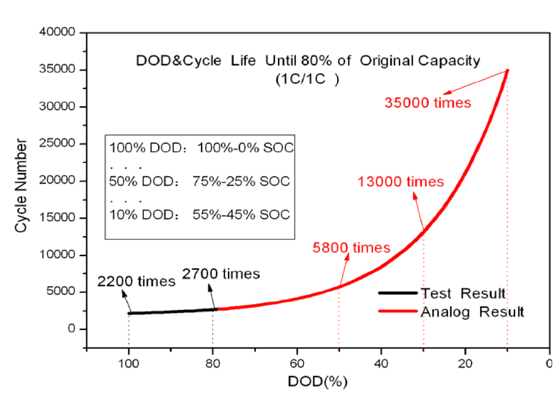
There have been numerous posts in this forum about Oliver’s lithium battery systems—about their usefulness, limitations, and value with respect to cost. Despite reasonable arguments against it, a number of us have purchased the lithium package. Reasons for purchasing the option have included the ability to run the air conditioner (A/C) for short durations (like at highway rest stops), greater usable energy (more boondocking in cloudy weather without needing a generator), faster charging, and longer battery life. This post summarizes things I’ve learned over the last 6 months about the Xantrex/Lithium/Zamp system. This post might also be titled “Things I Wish I’d Known from the Start.” This summary is a work in progress. Hopefully, with your corrections and additions, this thread will be of use to others that have purchased the Lithionics option or are considering doing so. At the time of this writing, manuals and other information for the Lithionics batteries are in the Service Center Knowledge Base — see links at the end of this post. I assume at some point Lithionics information will be compiled with all of the other trailer manuals in Oliver University. Battery State of Charge A key component of the Lithionics system is the app that lets users monitor State of Charge (SOC) and voltage (see links below). The reliability of the SOC values (which describes the amount of energy remaining in the battery) depends on (1) maintaining SOC calibration and having (2) up-to-date Lithionics firmware. The SOC should be near 100% at 13.6 volts, and about 50% (+/- about 10%) at 13.2 volts. If this is not what you’re seeing on the Zamp controller, Xantrex remote, or Lithionics battery app, then something’s wrong. By way of example, a couple times we’ve experienced the SOC readings of 60% when the batteries were dead -- not good. Note that the voltage reading on the app while there is a load on the system (e.g., electric heater) is different than when there is no load; the “resting” voltage may be higher. SOC Calibration The SOC requires periodic calibration. According to the manual for the 130 Ah batteries, the SOC can be calibrated simply by charging the batteries to 14.4 volts. The manual also states that fully charging the batteries to 14.4 volts should be done at least once every two weeks for battery life. Get the 130-Ah battery manual from Lithionics using the links below; at the time of this writing, Oliver has the incorrect manual posted in the Knowledge Base). When charging with shore power, it is not always apparent that the batteries have reached 14.4 volts, because when charging, the batteries only stay at ~14.4 volts for a short while before dropping back to about 13.6 volts. You can verify that batteries have reached 14.4 volts by monitoring battery voltage using the Lithionics app during a charging event. If you are unsure that the batteries are reaching 14.4 volts, you can at least confirm that the Xantrex charger/inverter is set to charge to at least 14.4 volts in the Xantrex app (https://support.olivertraveltrailers.com/portal/en/kb/articles/xantrex-remote-bluetooth-pair-operation) and, under Settings, check the custom absorption voltage. Ours came from the factory set at 14.6 volts, which is sufficiently high to get the batteries to 14.4 volts. Lithionics Firmware At least some of us that picked up our trailers in spring or early summer have batteries with outdated firmware. As I understand from Lithionics, more recent firmware versions have an improved SOC algorithm (our initial SOC readings were unreliable). You can check firmware version with the Lithionics app by clicking on a battery, then clicking on the settings “sprocket” in the upper right side, and then clicking on firmware. Our battery came with firmware version 1.0.05; I’ve recently updated to 1.0.07 by clicking on flash firmware. This has to be done with your phone in close proximity to the battery, and has to be done separately for each battery. Updating firmware comes with a “…this is a critical operation…” warning; you might want to check with Oliver or Lithionics if you have any questions about doing this. Has updating firmware improved our SOC readings? I’m not sure yet, but I think so. So far, the readings seem more reliable, but I’m still testing. SOC Calibration by Cycling A Lithionics rep told me that the SOC can be calibrated by “cycling” the batteries, and that this should be done every two months. Cycling consists of discharging the batteries to reserve voltage (e.g., ~12.1 volts) and then charging to 14.4 volts. However, the rep could not point to written documentation supporting this form of calibration. As the batteries support more partial cycles than full cycles (see graph below), calibrating by simply charging to 14.4 volts (assuming this effectively calibrates the SOC) seems better for battery life. Lithionics batteries will not charge from tow vehicle The standard 7-pin connection from tow vehicle to trailer cannot be used for charging the Lithionics batteries. Charging the batteries from the TV requires a DC to DC charger, which is an aftermarket installation. For more discussion on this, search for John Davies’ Redarc DC-to-DC charger installation description. Batteries Turn Off Twice now one or two of the three 130-Ah batteries have turned off when reaching low voltage (which happened because we were relying on incorrect SOC values). The SOC readings themselves looked OK, but the voltage did not correspond with SOC. The battery State in the Lithionics app reads “Off” for each battery when it is off. There is no flag on the Zamp or Xantrex control panel that alert the user to one or two batteries being off. The lesson (at least for me): monitor all three batteries, not just one, and note the Current, Power, State, and Status Code settings. If one or more batteries are off, turn the battery(ies) back on, and fully charge to 14.4 volts. Inverter Noise The Xantrex charger/inverter can be noisy charging the batteries with shore power (I’ve measured 60-64 decibels in the cabin when batteries are charging, and about 72 decibels adjacent to the inverter). The noise comes from (1) the charger/inverter fan and (2) the way in which the inverter is mounted (the fiberglass wall to which the inverter is mounted propagates noise into the cabin). The noise can be masked by turning on the A/C. Alternatively, the noise level can be reduced somewhat by lowering the charger current. In the Xantrex app, go to settings, and change the Charger Current from, for example, 100 amps to 30 amps. This will reduce fan noise. It will obviously take longer to charge the batteries with lower current. If you would like to be connected to shore power (to run an electric heater or the A/C, for example), but not charge the batteries (to avoid keeping them fully charged for long periods of time, or to reduce inverter noise) you can set the charger ignition control in the Xantrex app settings to “auto-on” (thanks to NCEagle for figuring this one out). In this mode shore power energizes the 110 outlets, the A/C, and the fridge, but does not charge the batteries. Turn the charger ignition control “off” to resume charging batteries with shore power. There are likely ways of re-mounting the inverter so that noise does not propagate into the cabin, with either a different mounting location or perhaps mounts using rubber bushings. Has anyone tried this yet? Xantrex Communication Errors Too often, I’ve gotten “Code 20” communication errors on the Xantrex remote panel. This can be resolved by pushing the red button on the 300A breaker under the streetside bed, waiting for at least 30 minutes, and then pressing in the little red flag on the breaker. Yes, this is a pain (I wish this breaker were more accessible), but it usually resolves the issue. Leaving the Xantrex inverter on battery mode for 25 hours or more will result in the Code 20 communication error. The time limit can be changed in the Xantrex app, but cannot be lengthened to more than 25 hours. As long as the inverter has not timed out, turning the inverter off and then on again at the remote panel resets the 25-hour time-limit clock. Battery Storage Lithionics provides guidance for storing the lithium batteries (see link below). Long term storage can include lowering the SOC to about 50%. Discharging to the appropriate SOC can be accomplished by turning on an electrical load (e.g., A/C or space heater) while in battery mode and monitoring frequently. Theoretically one could set the inverter cutoff voltage (in the inverter app, under settings), to something like 13.2 volts, but the highest cutoff-voltage option is 12.8 volts. Lithionics recommends keeping a log of SOC and voltage readings prior to and after storage for warranty purposes. ------------------------ Hope this helps. Again, please correct any errors that you see, and please add your observations and tips. Fritz ------------------------------------------ Relevant Links Lithionics battery app: https://support.olivertraveltrailers.com/portal/api/kbArticles/386680000012415191/locale/en/attachments/lpqvx861bbc9c842d48f7995281b07d0a193d/content?portalId=edbsnfe5dceb1ade7571879ff200cb63e14a94b62f48e3338c31a6401acd00130b0bc&inline=true). Lithionics battery manual: At the time of this writing, the Oliver Knowledge Base has links to Lithionics manuals for 125 Ah and 320 Ah batteries. However, our LE2 has three 130 Ah batteries as part of the 390-Ah package, and the manuals for the 125-AH batteries and the 130-Ah batteries are not the same. A manual for the 130 Ah battery can be found on the Lithionics website: https://lithionicsbattery.com/wp-content/uploads/2018/12/12V130-G31LRBM8-Battery-User-Guide-R1.pdf. Lithionics Storage Procedure https://support.olivertraveltrailers.com/portal/api/kbArticles/386680000012415191/locale/en/attachments/lrotz3ebee5a7020f42a58eb0d4db18a41356/content?portalId=edbsnfe5dceb1ade7571879ff200cb63e14a94b62f48e3338c31a6401acd00130b0bc&inline=true Lithionics FAQs https://support.olivertraveltrailers.com/portal/api/kbArticles/386680000012415191/locale/en/attachments/lrotz0edc34bc92ef4dce941bbb7f3f2d89db/content?portalId=edbsnfe5dceb1ade7571879ff200cb63e14a94b62f48e3338c31a6401acd00130b0bc&inline=true Xantrex Remote Bluetooth Pairing and Operation https://support.olivertraveltrailers.com/portal/en/kb/articles/xantrex-remote-bluetooth-pair-operation
1 point
-
I'd be totally surprised if the original business model "went away", completely. I'd suspect (though I don't know) that the limited, vetted dealer network would simply amplify the great network we have today.1 point
-
Mark your calendars, the day this network becomes official indicates the death of an un-matchable independent brand. I hope there are very firm stipulations to prevent price manipulations by the clueless dealer sales droids. If dealers can set prices, it will destroy the stellar resale value of existing Hulls. I have some personal experience with a local “premium” dealer, RnR RV Superstore, I sure hope they are not in the new network ;( They do indeed have a fine glitzy indoor super showroom, they took over a defunct Fred Meyer box store. I guess that would be good for showing an Ollie… Sad times ahead! IMHO of course. John Davies Spokane WA1 point
-
As most everyone knows, the blinds hang on two tabs at the top and snap onto two brackets on the bottom. To take them down, pull out sharply at the bottom and then lift the whole frame off the two top hangers. (Later Edit...some have the same snap in brackets top and bottom, but you still just pull them off, If you don't know which you have, pull the bottom off first to allow you to check) If you’re traveling on a bumpy enough road the bottom will eventually pop loose from the bottom brackets and then it’s only a matter of time before the top will jump off the hangers. The best way I’ve found to prevent this is to take the blinds down, squirt some adhesive caulk on the two surfaces of each bottom bracket and re-install the blind. Once the caulk sets up, they’re unlikely to come loose accidentally. But, they can still be removed as described above albeit a little more difficult at the bottom.1 point
-
John, good to hear from you! Glad to hear your health is now on track. I watched all the videos you made with Shane and your Black Series. Enjoy that Explore! Here we are at Quartzsite years ago - Mike
1 point
-
The Oliver can be a very good off-road, rough-road or boondocking trailer. But there are different kinds of rough roads. Steep rocky trails are fine if traveled very slowly because the Oliver has good clearance, is narrow and is not too heavy. I towed mine as far back in as my Ram 3500 would pull it, with all four wheels clawing for traction. Never a problem. But on higher speed dirt, with washboard, the suspension struggles and the interior suffers. I had my window coverings fall off, cabinets open and the microwave try to escape from its alcove, repeatedly. Lowering tire pressure to about 25 lbs seems to really help, but the vibration should be avoided. Hard suspension hits at speed are also a no-no. With only about 2" of suspension travel, metal to metal stops, and minimal shocks, the pounding can be brutal. Just take it slow, pick your path and don't be afraid to venture off the highway. The best camp spots are out there beyond where trailers usually go.1 point
-
I use 3M light polish with wax to remove the black streaks. Doesn't do as good a job protecting as their straight wax does but protects good enough to get me to the next whole Ollie waxing. I will try the scrubbing bubbles on the window weather stripping, though.. The only way I've been able to remove mold from them so far is to soak overnight in a bleach/water solution.1 point
-
I use Meguires One Step Marine compound. Works great on those black streaks.1 point
-
I’m glad I already have most of the stuff listed, it gives me a chance to avoid the crowds! And hopefully we only get some rain.🙏 Mossey1 point
-
When younger and working, "estimated time" needed for a potential project always seemed to creep into the equation. But now, my "time factor" is different, I don't really care/stress how long it takes for a project, especially an Ollie one - just want it done right the first time. That's the goal at least. The peace of mind achieved by a correctly executed DIY OTT project is worth so much more than having to pay someone else do it for us, IMO. This is the case for major systems maintenance and upgrades efforts, such as running gear, AC/DC electrical, solar, plumbing systems, etc., as well as for the smaller upgrades. Having this peace of mind gives us a higher level of confidence in our trailer when out on the open road or boondocking in an isolated US FS camping area, knowing exactly the status of these key systems, because we did the work. More to the point of the thread, maintaining the proper condition of wheel bearings and Dexter EZ flex suspension components at the recommended service intervals is part of the Oliver owner experience for us... Yeah, it takes longer for us to complete the servicing of these important parts than taking the rig to Les Schwab's, but we also get to fix and clean-up a lot of ancillary items that LS will not consider attending to. Pride of ownership, perhaps. ...we just like doing the projects!1 point
-
That's the quickest and easiest way to do it.1 point
-
Another tool that saves lots of time when greasing multiple zerks is this Lock N Lube grease gun coupler: https://www.amazon.com/LockNLube-fittings-best-selling-Long-lasting-rebuildable/dp/B00H7LPKKU/ref=sr_1_5_pp?hvadid=177565028286&hvdev=c&hvlocphy=9029558&hvnetw=g&hvqmt=e&hvrand=17231719377028863953&hvtargid=kwd-117864911294&hydadcr=7540_9880937&keywords=lock+n+lube+grease+gun+coupler&qid=1692803808&sr=8-5 Expensive, but well worth the cost to me. I have one of these couplers on each of the 3 grease guns I own. They clip onto the zerk with a spring-loaded clamp, so you don't have to thread a standard coupler onto each zerk, then unthread each time. That process gets tedious when greasing 16 zerks.1 point
-
OTT uses Mystik grease, so that is what I bought to lube our Elite II. Link on Amazon below: https://www.amazon.com/Mystik-665005002901-Hi-Temp-Multi-Purpose-Grease/dp/B0B85SSQQ9/ref=asc_df_B0B85SSQQ9/?tag=hyprod-20&linkCode=df0&hvadid=647244483985&hvpos=&hvnetw=g&hvrand=15993320974279103773&hvpone=&hvptwo=&hvqmt=&hvdev=c&hvdvcmdl=&hvlocint=&hvlocphy=9029558&hvtargid=pla-2021192446527&gclid=Cj0KCQjw3JanBhCPARIsAJpXTx59ct93dWx1KWfsWLBv0kzc9PndE_zIIDuTevC6mlJE4YoOtfyZ1f4aAvUnEALw_wcB&th=1 Using the same grease Oliver uses, I run no risk of incompatibility. Amazon sells it in 2-packs, so you will have enough should one tube not quite be enough. I have a dedicated grease gun filled with Mystik grease just for use on the Oliver. I use a separate grease gun, with different grease, for my tractor.1 point
-
I think this is a wise move by Oliver. Thinking forward and into the future about potential new customers and more exposure of the Oliver brand and having approved dealerships that can work on existing Oliver owners trailers. If you are in Southern California or Washington State or Maine and you need service on your Oliver it’s a long trek to Hohenwald. I think if Oliver can partner up with a strong dealership sales network and get techs trained up on servicing Olivers it has the potential for a very successful venture. It appears from Anita’s email nothing will prevent owners from still having service done at the Hohenwald Service Center. Onward! Patriot🇺🇸1 point
-
I recently opened a ticket for two (2) lights I was having issues with. OTT replaced both. BL1 point
-
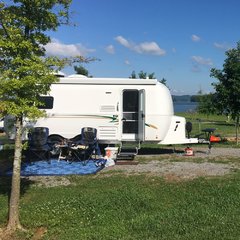
BTW, our Olivers look way better than the silver-looking stuff in the first photo.1 point
-
Note that lithium batteries are not all the same as their internal battery management systems ultimately dictate how they respond to being energized. Charlie.1 point
-
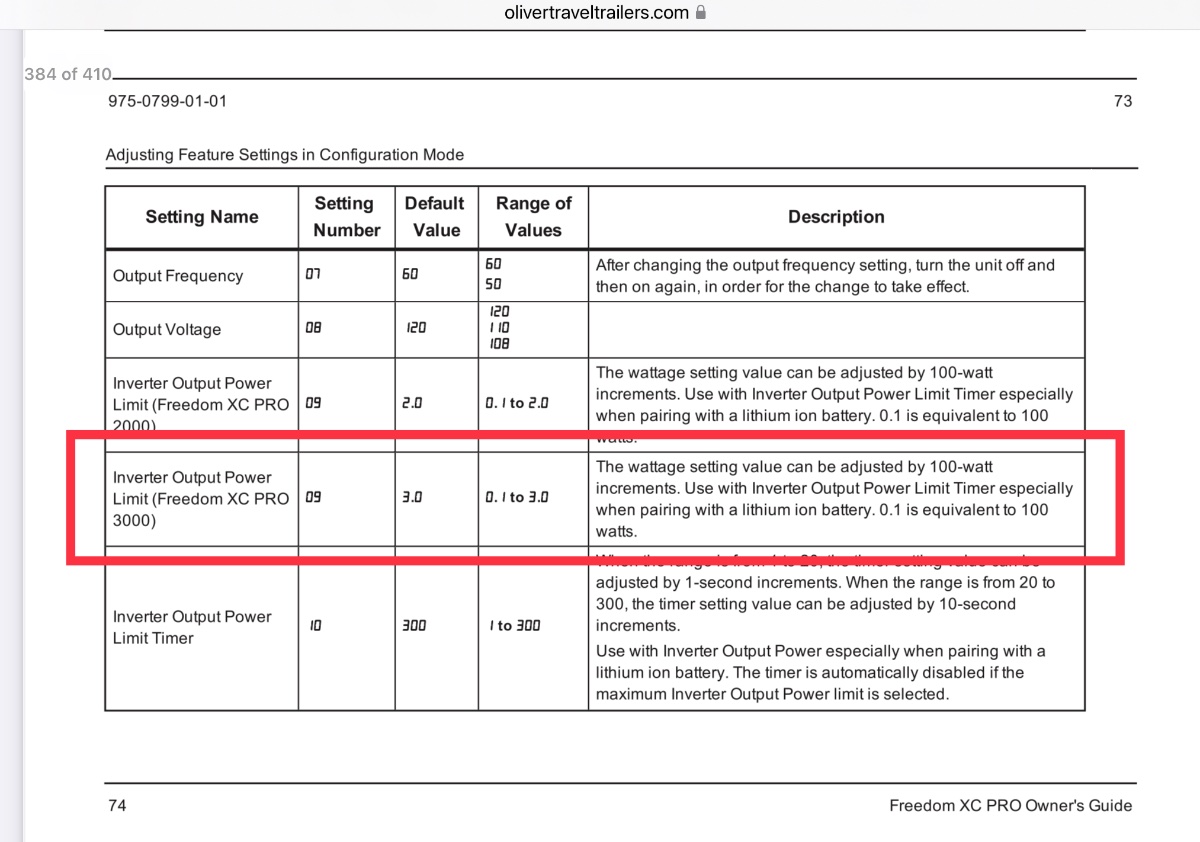
It's Setting #28 on our Xantrex. Set it to the highest amps your source will allow (15 if it's a standard household outlet with nothing else on the circuit). I actually have ours set for 5 when we're at home because our house is old and that outside outlet shares its circuit with several other loads. With everything in the trailer turned off and the solar panels on, 5 amps has been adequate to keep the batteries charged so far, even with the batteries' internal heaters running at night. (If that changes in colder weather, we'll have a dedicated outlet installed.) (And, yes, a bulk charge for lithiums can overload a 15 amp circuit if the Xantrex is left at the factory setting of 25 amps.)1 point
-
I've been charging mine (hull #709, with Xantrex Freedom Pro 3000 inverter/charger/converter unit) by adjusting the inverter setting so that it won't draw more than 14 amps (I have a few light bulbs on the same circuit so want to leave headroom for them). I think it's a different setting than John circled above - as the units are in amps, but if you check the settings on your inverter you should be able to sort out which to adjust for this purpose. Before I did this, I tripped the circuit if I plugged in with SOC low enough that the charger was in "bulk charge" mode, but it's been fine with this setting. It's easy to switch the setting from the Xantrex phone app, e.g. in the rare event I'm plugged in to a 30 amp outlet at a campground as I was back in June.1 point
-
John, I have winterized and just have the refrigerator on auto with no gas on. The only two draws on the lithium batteries are the refrigerator and the battery heater. I am in Denver where it was 25 and sunny. The batteries are at 100% on the lithium pro package. Yesterday I was just hooked up to an extension cord and a 30>15 amp plug and the only thing it was charging was the battery. As I understand it you're spot on. The 30 amp service lets you have more things on, but you can plug into just a regular outlet and use the 30>15 amp plug. As soon as the snow stops and the roads are good, I will continue on to Oregon.1 point
-
Not always the case if only charging the batteries. I have the 4 x 12v lead acid wet cell battery setup and I keep it charged quite easily at home connected to a standard 15 amp household outlet using an adapter on the 30 amp Oliver connection. It never draws above 7 amps when I’m just recharging the batteries.1 point
-
This is very incorrect. As long as you manage the AC loads correctly, you can certainly run off a 20 amp or 15 amp circuit. The 30 amp power is needed for running all the loads at once. When hooked up to a smaller supply, just turn off the hot water heater and fridge circuit breakers (run them on propane). Do not operate the microwave. Do not expect to run the air conditioner while charging lithium batteries. Do the latter early in the morning, until they are topped up, then turn off the charger and run the aircon in the afternoon…. I rarely hook up to shore power, and when I do it is hardly ever 30 amp. You can access the xantrex charge control settings and turn down the output current if needed, this has been discussed in several other threads. John Davies Spokane WA
1 point
-
That would seem reasonable. If there is only one possible shore connection and it's rated at 30 amps and that's what's required to operate the battery charger, we are pretty much constrained by the onboard system. This may have always been the case, after all the LE2 has always had a 30A shore requirement so you wouldn't want to connect that to a source that isn't rated for 30 amps regardless of the type of battery system.1 point
-
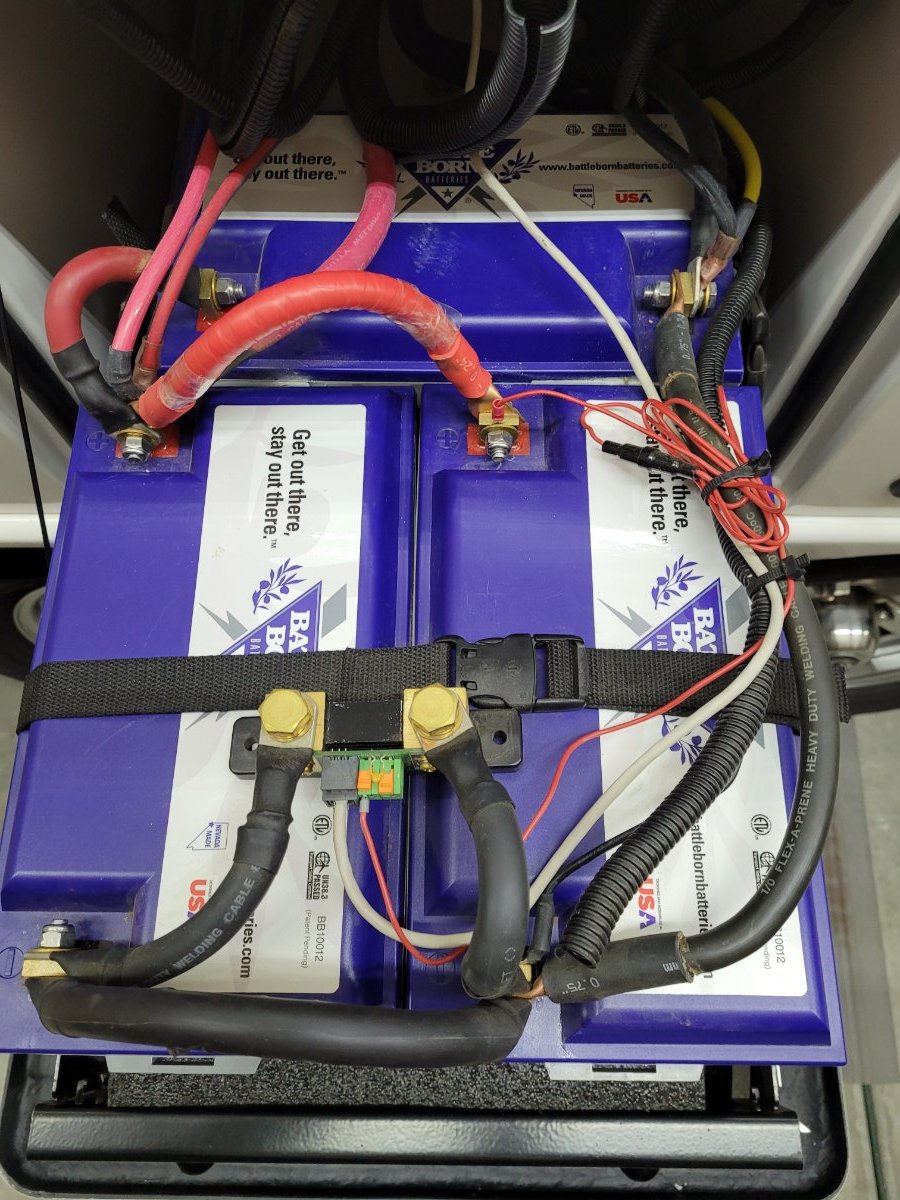
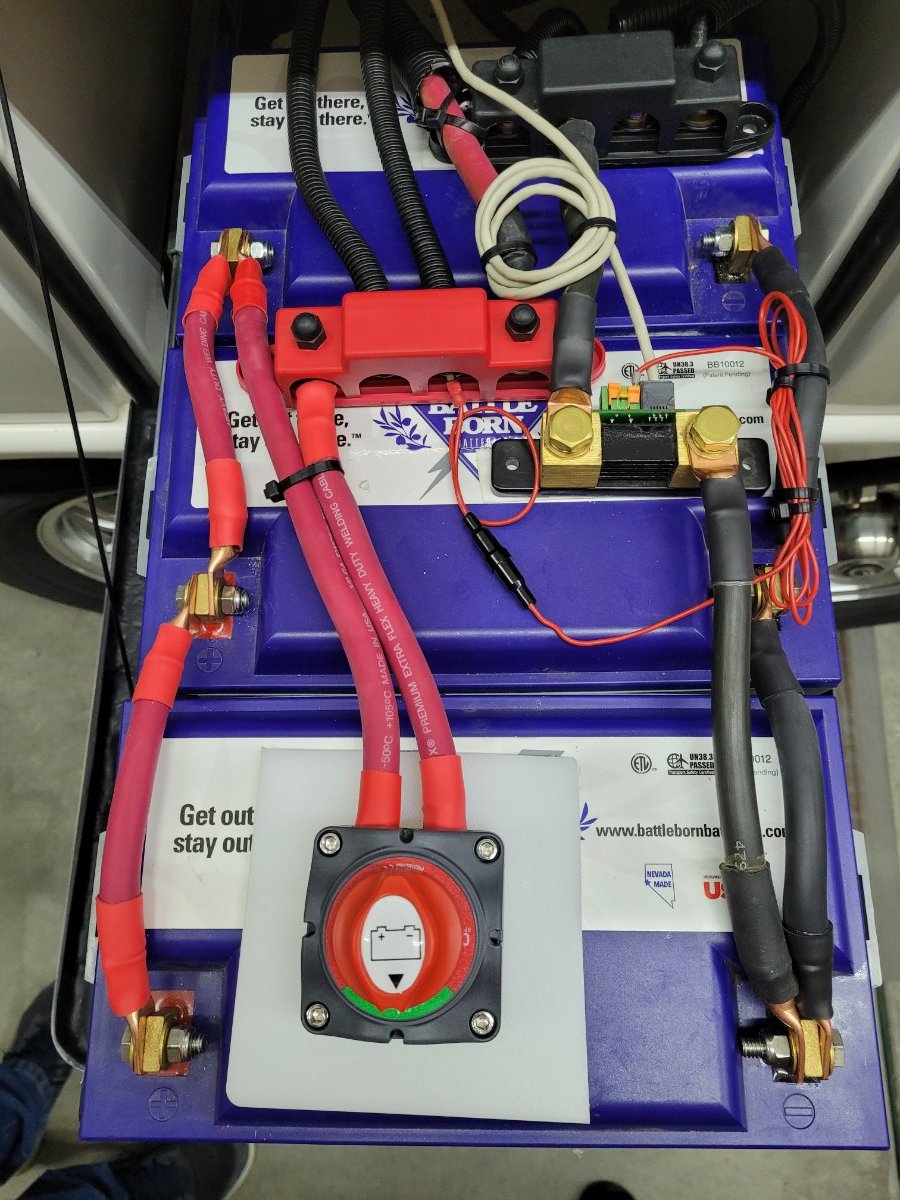
Hi, we're coming from experience with Battleborn batteries and Victron equipment in an Airstream Interstate motorhome. Having recently purchased a 2020 Oliver E2, we're now selling our Airstream. I wanted to note that our experiences with Battleborn as a company over the past several years has been exceptional. With 4 BBGC100s, 350 watts of solar, a Victron 100/30 MPPT, a Victron 712 shunt, a Victron 2000 Multiplex and a PC lithium battery isolator for alternator charging - we frequently went a week boondocking without using the on-board generator. In fact, the black tank was the frequent limiter to longer boondocking. Our "new to us" 2020 Oliver E2 came with three Battleborn batteries hooked up as one would connect a "dumb" lead battery. I spend Saturday building new cables so we could make the three lithium batteries compatible with each other - I'm specifically referring to their BIMs. Now the number one battery is the system's positive and the number three battery is the system's negative. I was amazed the 2020 Oliver E2 has no readily available "master switch" to isolate batteries. So now, we have the main positive running to a battery switch before going to other positive connections via a buss. We also corrected the Victron 712 shunt connection. It had one terminal connected to one battery negative and the other terminal connected to a different battery negative. Clearly it could not report total usage in and out as was intended. So, we took the main negative lead to one side of the shunt and the other to the load side via a negative buss. Now that it's connected correct, I need to manually go through the settings to check if everything else is OK and that the unit isn't "locked." If it is locked, any settings made via the Victron app will not be saved! I learned this the hard way by going from 200ah to 400ah and finding the reported SOCs were never correct. I think I remember scrolling to somewhere near the mid-sixties in the manual menu settings to unlock the 712 and then used the Bluetooth app to make changes. BTW, I started this response to agree that SOCs are frequently reported differently by different instruments and to point out just one example - I had a Victron 712 which had the wrong inline fuse installed by the factory in some units. That simple fuse caused the units to report the SOCs incorrectly. Our next task for the 2020 Oliver will to place a master switch into the line before the solar controller to isolate the solar panels - I'm trying to decide whether to just bite the bullet and install a Victron 100/30 at the same time.
1 point
-
I received this question as a private message (PM), but am posting it here as others may benefit from the discussion, or wish to weigh in... "Does the inverter automatically shut off when the batteries reach their full charge state? If so how would I know this? Is there any setting that would tell me this? Since our fan keeps running I am thinking in my head that the inverter is still trying to charge the batteries... I am thinking that the inverter is still drawing some power from our batteries when we are disconnected from shore power if that is at all possible. Maybe that is why our batteries are draining so fast with nothing on in the RV?" My understanding (which is very far from complete, and may in fact be flat-out wrong) is that the Xantrex unit really has two components: (1) a charging function and (2) an inverting function. When connected to shore power, the Xantrex unit is on, but its sole function is charging the batteries. The Xantrex unit is not inverting (changing 12V current to 110 volts) because it doesn't need to; the 110V outlets (and A/C, microwave, etc) are powered with shore power. The uppermost "esc" light on the remote panel is lit when the trailer is plugged into shore power and the Xantrex unit is set up to charge. The only way that I know to really "turn off" the Xantrex entirely is to trip the 300A breaker under the streetside bed. When in charge mode (i.e., plugged in to shore power) the Xantrex fan is running while charging. When the batteries are full the fan kicks on for about a minute every 15 minutes or so. When the batteries are full (or as full as you want them to be), you can set the charger ignition control in the Xantrex app to "auto-on" (again, thanks to NCEagle for this tip). In this mode the 110 outlets, the A/C, and the fridge get electricity from shore power, but the Xantrex unit is not charging the batteries. The inverter portion of the Xantrex unit is (or should be) active only when the trailer is not connected to shore power and the inverter is turned on (i.e., the button on the remote inverter panel is pressed in). The "bat" light on the remote panel is lit when the inverter is on. The Xantrex fan may run briefly when the inverter is first turned on (I suppose the fan could also run if the inverter is inverting to meet a large load). If the batteries are draining overnight there is likely another problem. Here are some ideas for troubleshooting the problem: Update the battery firmware to version 1.0.07 if you have not yet done so. In my experience, the SOC is completely unreliable if this is not done. Unreliable SOC might lead you to think there is a drain when there really is not. If updating the firmware, be sure to fully charge the batteries to 14.4 volts afterward to calibrate the SOC. When disconnected from shore power, turn off the solar (by turning off the the knob at the front of the streetside bed upper cabinet), turn off all lights, fans (including the toilet fan), etc., and check to see if there is a load on the batteries by checking the Lithionics app (2 upper right boxes below the SOC). The current and power should both be zero. Then... With updated firmware (and solar off, and no obvious load on the batteries), record the SOC and battery voltage on the Lithionics app. Let the trailer sit overnight and check again. The batteries should have a SOC and voltage very close to where you left it. If not, then... Turn off the inverter by tripping the 300 amp breaker under the streetside bed and letting the trailer sit overnight again. The SOC and battery voltage after a day or so should be the same as when you started the test. If this is the case, then there may be something in the inverter. If this is not the case, then there may be some other phantom load that is drawing down the batteries. (smoke, propane, etc detectors will draw down the batteries some, but it should not be very much over 24 hours). Record the SOC and battery voltage. Turn off each of the 3 batteries (button on top of the battery) and let them sit for a day or so. The SOC and battery voltages should be the same as when you started the test. This should confirm that the problem is not in the batteries. Next, .... Call Oliver. Any suggestions of mine are those of a well-meaning amateur, not to be confused with those of a real professional. They really should be able to help with this stuff; hopefully the results from some of the above-described steps will help them. Good luck!1 point
-
I appreciate the effort that you put into this post. My soc percentage on the app and battery voltages never seemed to correlate. After reading your post I have flashed firmware. Hopefully the new firmware will do a better job. Thank you.1 point
-
Thank you, John. You and others have set a very high standard!1 point
-
I would agree with SeaDawg, I have recently completed a up grade to roof mounted panels and have had talked to Zamp about recommendations for charge controller for the rated watts of my solar array. They are very helpful and easy to talk to and for my size of system they recommend a mppt charge controller, they said they currently do not have one to offer to me but that in the future they will have one. It was in the process of being developed, I did purchase there panels for my project, I do think they make a quality product and I like the made in USA.1 point
-
I don't think that's a "cheap out." I think it's more an easier option for most owners. Zamp is in no way "cheap" equipment. It's solid, well tested, well received, usa based, and an integral part of the Oliver solar package for a long time. Is it appropriate or best for lifepo4 batteries? No, imo, not really. I suspect that will change, in the future. In the meantime, if I were buying a lithium option, I'd ask for an mppt controller, and if turned down, I'd swap it out. The more people who ask, the greater likelihood of change. Heck, maybe zamp will even come out with an mppt someday soon. A solid industry tested mppt controller would be a great addition to the system, imo . We have victron on the boat, blue sky in our trailer, and lithium in neither (yet.) Both solar controllers are capable of working with lithium. We may, or may not, change up to lifepo4 in the future. I'm personally not sold, yet, on the expense or necessity, for our needs. But, truth is, most relatively small pv systems (like what fits on the Oliie rooftop) could not fully recharge the big lithium batteries being sold today, on a regular basis, if drawn down to zero. The math doesn't support it. So, reliable, proven easy to use Zamp is not such a bad choice, either.1 point
-
Thanks for the information. We have the lithium but not fully understanding how it all works yet. We have used it to run the AC a few times and other electrical stuff while dry camping.1 point
-
Re the black streaks, I tried a black streak remover but found using a "cleaner wax" (I used Collinate #920) required much less elbow grease. Even though the cleaner wax made Ollie look good, I followed up with a good paste wax (#885) to really boost her shine & protection.1 point
-
At the end of the season, I'll use a "Clay bar" with a lubricant (Maguires makes a great kit), then wax with "Rejex". The "clay bar" will remove a lot of grime you don't notice, but you feel; slide your fingers over the fiberglass. Using the "clay bar" produces a smooth surface to be waxed over. I highly recommend this procedure for the roof section. The roof takes the biggest beating and accumulates the most road/camping dirt. At least up there you're working horizontally. Take your time, it doesn't take that long. When you're finished you really get that "warm fuzzy feeling" knowing you're done! Sure makes a significant difference with the gelcoat over time. Try the "clay bar". It truly does not take that much extra effort and produces a superior surface to cover with wax. Best, E1 point
-
You can also use Duragloss black streak remover (or several other brands). Oliver Service now stocks and sells Duragloss products and are big fans of this black streak remover. They even use it for cleaning up that big shiny floor in the new Sales area. Bill1 point
-
Pretty neat the way your drill holds up the trailer.1 point
-
As I am a member of Escapees Club, when I'm traveling, I boondock wherever I can to save $, so I travel with 1/4-1/2full tanks to save gas. If I know I'm gonna' want hookups, I''ll do the shower then. So I'll usually boondock/drycamp 2 nites and full hookup the 3rd. That's traveling! When camping, I'll fill water tank before arriving if I'm dry camping and not if I've got hookups but I never let water get below 1/4 full. I carry 2, one gallon jugs in bath for flushing and usually 2 three gallon jugs or a case of drinking water for the dogs and I. Usually do not use fresh water for drinking but add bleach to keep it purified. Traveling= getting from point A to point B rapidly with no fun stops Camping= the fun stops Chuck1 point











.thumb.jpg.e34bf01ef7f7d5e99ad31856d45afbeb.jpg)






.thumb.JPG.dd838cdb3df463dab6a16861fa23a319.JPG)










-
Recent Achievements
-